Offered by RM Sotheby’s | Hershey, Pennsylvania | October 10-11, 2019
Photo Courtesy of RM Sotheby’s
Frederic Chandler worked for Lozier before he jumped ship in 1913 with a few of his fellow employees to form his own company. The Chandler was a hit and lasted through 1929, when it was acquired by Hupmobile and quickly phased out.
There were a lot of cars “in the middle” of the American market in the 1910s and 20s. Chandler was one of the better ones in that class. This 1917 model is powered by a 27 horsepower 4.4-liter inline-six. Five body styles were offered, and the seven-passenger touring sold new for $1,395. This time around it should bring between $20,000-$30,000. Click here for more info.
Offered by RM Sotheby’s | Hershey, Pennsylvania | October 10-11, 2019
Photo Courtesy of RM Sotheby’s
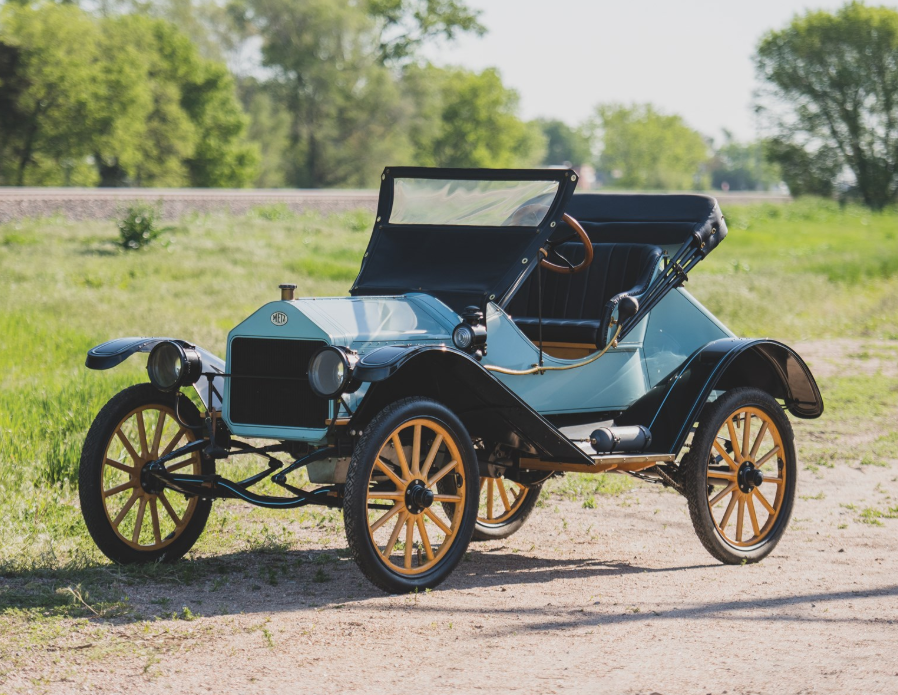
Charles Metz originally founded the Waltham Manufacturing Company, producer of the Orient Buckboard. He left it in 1901 and returned in 1908 when it was financially destroyed. Essentially what was left was a huge pile of debt and a huge pile of parts. So he started selling the parts for $25 a pack. Fourteen “packs” later and you’d have an entire car, unbuilt, at your home.
But if you spaced it out right, the next pack would arrive just as the prior one was put together. It was like buying a car on an installment plan. But you had to build it yourself. It was one of the first kit cars. Mail-order at that.
After the “Metz Plan” paid off Waltham’s debts, Metz reorganized as the Metz Company in 1909 and upped the price a bit. It was a popular car and lasted through 1921.
The Model 22 was the only model offered in 1914 and could be had as a Roadster, Speedster, or Torpedo. This Roadster cost $475 and is powered by a 22 horsepower inline-four. It features a friction transmission and chain drive.
It’s kind of weird to think someone assembled this car in their garage. Over 100 years ago. And yet here it is, ready to go. It should sell for between $20,000-$30,000. Click here for more info and here for more from this sale.
Offered by RM Sotheby’s | Hershey, Pennsylvania | October 10, 2019
Photo Courtesy of RM Sotheby’s
Autocar remains the oldest surviving vehicle brand in the United States, but they haven’t built a passenger car in over 100 years. It’s been heavy trucks for most of that time. Well, since 1907 to be exact.
This stake-bed truck is powered by a two-cylinder engine and has solid 35″ rubber tires, no weather protection, and a giant ship-like headlight. It’s basic. But that’s exactly what trucks were in 1910. They served a purpose – and it’s amazing that this one is still around. Look for a price between $20,000-$25,000 next week. Click here for more info.
Update: Sold $33,000.
1912 International Model AW Auto Wagon
Offered by RM Sotheby’s | Hershey, Pennsylvania | October 10, 2019
Photo Courtesy of RM Sotheby’s
It’s hard to really draw a line in the sand as to when International switched from cars to trucks, as all of their high-wheeled cars were sort of truck-like from the start. In a way, 1911 was the last official year for passenger cars, as their 1912 announcement centered on delivery wagons (though you could get car-like appointments by request on their smallest commercial chassis for years afterward).
These “Auto Wagons” were available in two models for a few years: the AW and the MW. They evolved through 1915, but in 1916 IHC moved to a more modern style and things just kept going from there. With the rear bench seats, I like to think of this as an early SUV, a territory that IHC would dabble in all the way through the early 1980s.
The difference between the AW and MW was their cooling systems. This is where it gets weird. The AW was the air-cooled car, and the MW was water-cooled. The red car above is listed as an AW in RM’s catalog and is clearly water-cooled. The blue car below is listed as a 1913 Model MW. But it is air-cooled. Something is wrong here, or these cars got their running gear swapped at some point.
Both engines were 3.2-liter flat-twins, but the air-cooled version was good for 18 horsepower, three more than its water-cooled sibling.
Regardless, both cars are expected to fetch between $20,000-$30,000 each. So pick one and then rename it. More info on the red car is available here, and you can see the blue one here. Check out more from this sale here.
Photo Courtesy of RM Sotheby’s
Update: Sold (red one): $33,000. (Blue one): $28,600.
Offered by RM Sotheby’s | Hershey, Pennsylvania | October 10-11, 2019
Photo Courtesy of RM Sotheby’s
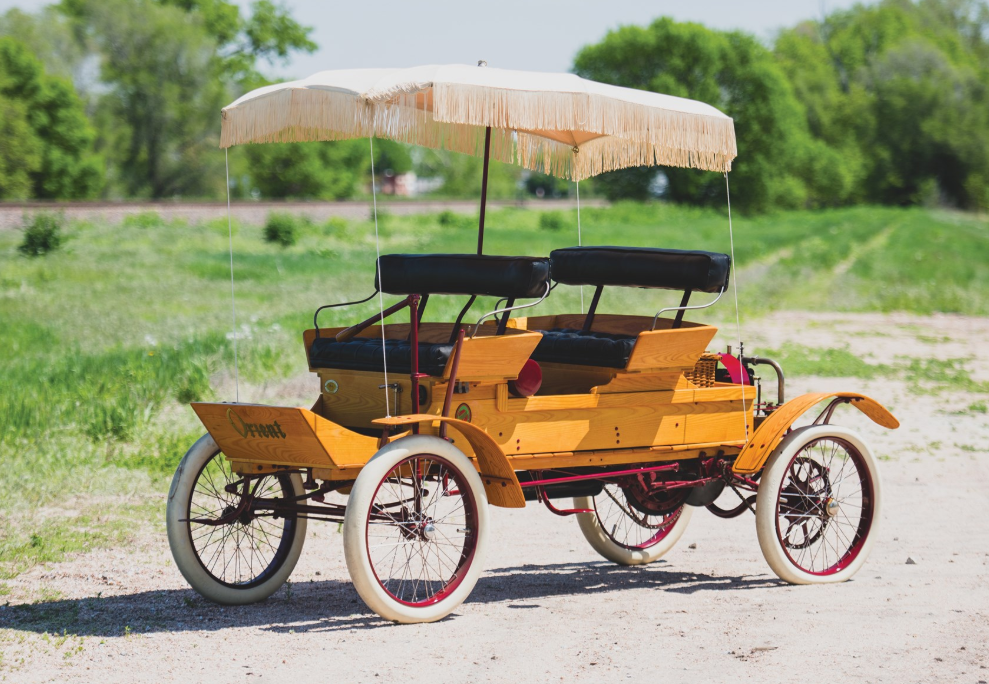
Charles Metz’s Waltham Manufacturing Company of Waltham, Massachusetts began producing bicycles in 1893. Their first automobile was built in 1899 and it was electric. Different cars followed for 1900-1902, and their most famous product, the Buckboard, debuted in 1903. They used “Orient” as a brand name through 1905 when it shifted to Waltham-Orient or just Waltham.
This 1907 model was from the final year of Orient Buckboard production and is quite different from most of their products. Called the Surrey, it features two-rows of bench seating and a surrey top that made it look downright luxurious compared to other two-passenger buckboard cars. Power is from a four horsepower two-stroke single-cylinder engine.
Only 1,020 examples were built. This one should bring between $10,000-$15,000. Click here for more info and here for more from this sale.
Update: Sold $27,500.
1919 Briggs & Stratton Flyer
Offered by RM Sotheby’s | Hershey, Pennsylvania | October 10-11, 2019
Photo Courtesy of RM Sotheby’s
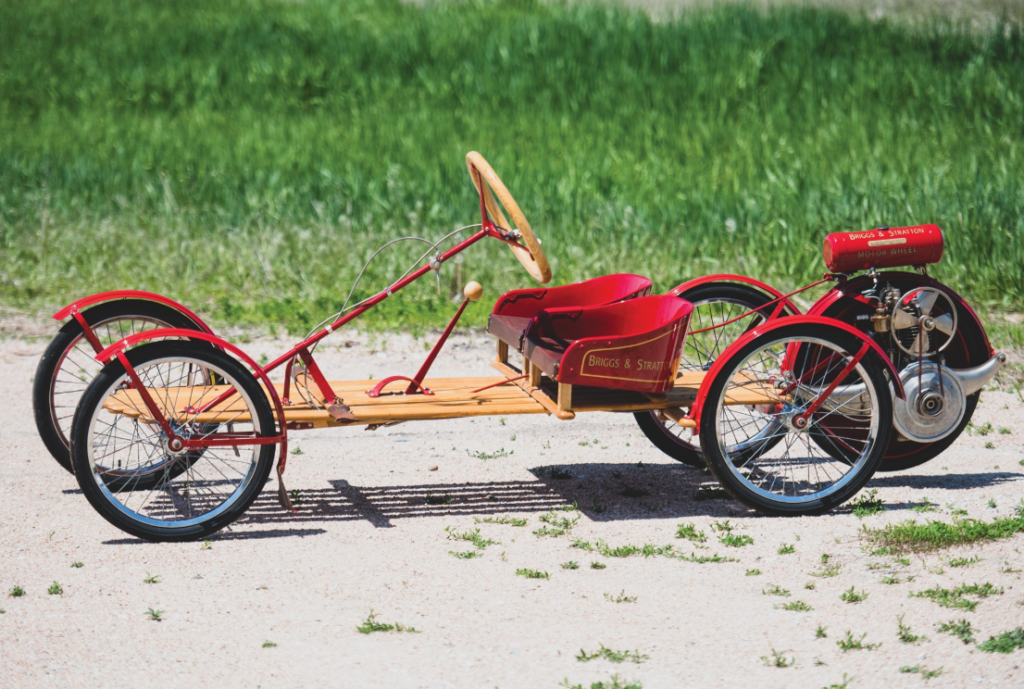
When A.O. Smith stopped producing his “Smith Flyer,” he sold the rights to Briggs & Stratton, they of more recent lawn mower-engine fame. The company has been around since 1908 building small engines. When they acquired the rights to the Flyer in 1919, they improved upon it a little and continued production with their motors through 1923.
After that, the design was sold to a different company that produced it as the Red Bug. This five-wheeled car has a top speed of 25 mph and a single-cylinder engine. It should sell for between $10,000-$15,000. Click here for more info and here for more from this sale.
Offered by RM Sotheby’s | Hershey, Pennsylvania | October 10-11, 2019
Photo Courtesy of RM Sotheby’s
The Kearns Motor Buggy Company was founded by Maxwell Kearns in Beavertown, Pennsylvania in 1909 after he purchased the former Eureka plant. High-wheelers were still in fashion so that’s what they started building. It was also almost the same car Eureka had been building.
Kearns advertised the cars as different than your standard high-wheeler, which they were with their more conventional setup. They eventually moved into four-cylinder cars and cyclecars. Ultimately, the company stopped passenger car production in 1916 to focus on commercial vehicles, which lasted through 1928.
The Model G as one of six models offered in 1910 and one of two powered by a 20 horsepower, three-cylinder two-stroke engine. It has dual-chain drive, a right-hand steering wheel, and other features not found on many of its contemporaries. This former Henry Austin Clark Jr. car is one of about 100 examples of the Model G produced, and it should sell for between $20,000-$30,000. Click here for more info and here for more from this sale.
Offered by RM Sotheby’s | Hershey, Pennsylvania | October 10-11, 2019
Photo Courtesy of RM Sotheby’s
The Jeffrey was kind of an important marque. It was founded by Thomas B. Jeffrey and his son Charles. They started by building the Rambler, but after Thomas died, Charles changed the name to Jeffrey. In 1917, the company was sold to Charles Nash (after Charles survived the Lusitania sinking), and the name changed again. Nash eventually merged into AMC, which is now part of Chrysler… which is now part of Fiat. So this is just like an old Fiat.
Jeffrey cars were only sold between 1914 and 1917. Three models were offered in 1914 and the Six was the largest. It is powered by a 48 horsepower inline-six. Over 10,000 Jeffreys were sold in 1914, and this one should bring between $30,000-$50,000. Click here for more info and here for more from this sale.
Update: Sold $52,250.
1909 Enger Model B High-Wheel Runabout
Offered by RM Sotheby’s | Hershey, Pennsylvania | October 10-11, 2019
Photo Courtesy of RM Sotheby’s
Frank J. Enger set up shop in Cincinnati in 1909 to build high-wheelers. More traditional touring cars followed in 1910, but the company folded in 1917 after Frank’s suicide in his office. This high-wheeler is from the first year of production.
The Enger high-wheeler was actually a normal car but with big wheels. It’s pretty much the original donk. Three models were offered that year, and the Model B was the least expensive at $1,600. It’s powered by a 14 horsepower flat-twin. This one should bring between $15,000-$25,000. Click here for more info and here for more from this sale. Also, I really want this car.
Offered by RM Sotheby’s | Hershey, Pennsylvania | October 10-11, 2019
Photo Courtesy of RM Sotheby’s
The Grout was built in Orange, Massachusetts between 1899 and 1912. The company was founded by brothers C.B., Fred, and Carl Grout, along with their father William who happened to own a sewing machine business. The company history was full of family drama, and the brothers left town after trying to force their dad out (and failing).
Steam cars came first, and gasoline vehicles followed. The Model H was likely built in 1903 and was the cheapest car they offered that year at $775. This steam-powered runabout is London-to-Brighton eligible and has spent quite a few years in museums.
It should sell for between $30,000-$50,000. Click here for more info and here for more from this sale.