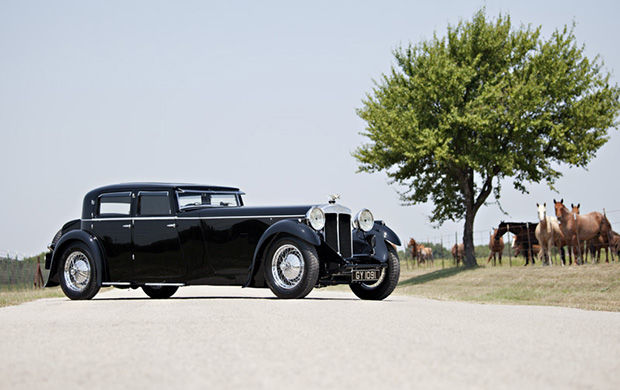
The Final Ferrari 340 MM

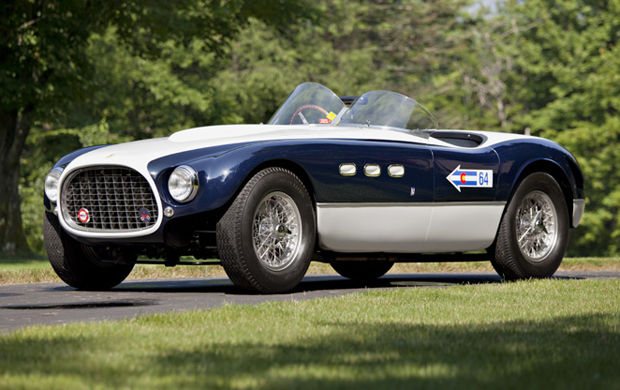
1953 Ferrari 340 MM Spider

Offered by Gooding & Company | Monterey, California | August 18, 2012

There are a few variants of the Ferrari 340 – the 340 America, the 340 Mexico, and the final version, the king-of-the-hill 340 MM. It had a 300 horsepower 4.1-liter V12. Only 10 were made and five of them were bodied by Vignale. This car was the last one made and it cost its American buyer an eye-watering $18,000 in 1953.

The car was bought new by Californian Sterling Edwards, who was, at about the same time he purchased this car, building cars under his own name. He picked this car up in Italy on his honeymoon, before shipping it home to San Francisco. He campaigned the car in SCCA events on the west coast, winning races and beating drivers like Masten Gregory in the process. Edwards sold the car in 1955 for $8,000.

The car passed through many hands and at one point someone repainted it red. Thankfully it has been restored to its original condition and color. This car competed in the Mille Miglia a number of times in the late 1980s and early 1990s. The current owner has owned the car for nearly 30 years and is being sold along with a number of his other significant Ferraris.

Ferrari 340 MMs are very rare – only 10 were made – so you don’t see them for sale too often. Expect this one to command a price between $4,500,000-$6,500,000. For more information, click here. And for the rest of Gooding’s Monterey lineup, click here.

Update: Sold $4,730,000.

Bugatti Type 55

1932 Bugatti Type 55 Cabriolet

Offered by Gooding & Company | Monterey, California | August, 19, 2012

Bugatti’s Grand Prix car for 1931 was the Bugatti Type 54, which was a development of the Type 51. The Type 55 you see here is the road-going variant of the Type 54. It features a 2.3-liter straight-8 that has been supercharged, giving it 135 horsepower.

Only 38 Type 55s were built. According to the lot description provided by Gooding & Co., 14 of the cars were bodied by the factory as roadsters. Seven were factory coupes. And there was one factory cabriolet. That accounts for 22 of them. It goes on to say that 11 received bodies from Gangloff or Vanvooren. And the “other three” all had one-off coachwork. You are correct, discerning reader, that 22+11+3=36. So keep an eye out, you may find one of the mysterious unaccounted-for Bugatti Type 55s.

These were very expensive cars at the time – the Type 51 and 54 weren’t winning races like their predecessors, so presumably racing income was way down and maybe Bugatti was making up for it on the road car end. Then again, they were always expensive cars. In any case, this car was purchased as a chassis by a wealthy surgeon who ordered a new Bugatti every year. He sent it to Lyon to receive this fantastic coachwork from Billeter & Cartier. This is the only such car constructed by them.

Somebody had the brilliant idea to finish this in black and green – an amazing color combination. Every owner of the car is known and it underwent a restoration over a number of yeas and under the direction of multiple owners. It has never been shown at the big Concours’ and it is one seriously good-looking Bugatti. Of course, this comes at a price, with an estimate between $5,000,000-$6,500,000. For more information, click here and for more from Gooding in Monterey, click here.

Update: Not sold.

Bentley EXP Speed 8

2001 Bentley EXP Speed 8

Offered by RM Auctions | Monterey, California | August 18, 2012

Volkswagen acquired Bentley in 1998, the same year Audi (a VW subsidiary since 1969) announced its intention to compete in the 1999 24 Hours of Le Mans. Audi was brand new to prototype racing and its closed-roof R8C (as well as the open-top R8R) both raced at the 24 Hours in 1999. An R8R finished on the podium in 3rd and one came home 4th, but they didn’t win. So, for 2000, both cars were replaced by the legendary Audi R8, which won the race five times.

Bentley had, up until 2000, also won the 24 Hours of Le Mans five times, the latest of which came in 1930. A Bentley hadn’t even appeared at the track since 1933. So Ferdinand Piech, head of the VW Group (and grandson of Ferdinand Porsche), declared Bentley would return to the track. And when Dr. Piech declares something, it happens: like the Bugatti Veyron. I imagine the green-light meeting for the Veyron going down as follows:

  • Accountant: “But, Dr. Piech, we stand to lose millions from this project.”
  • Piech: “Ja, but ve vill be zee fastest!”

The plan was for Bentley to show up at the 2001 24 Hours of Le Mans. But instead of just straight copying the Audi R8, the crew at Racing Technology Norfolk (who were responsible for developing the car) based their design on the closed-coupe Audi R8C that was no longer competing. And they managed to turn that odd duck race car into this beautiful monster.

The car used the same engine from the Audi, the 670 horsepower 3.6-liter twin-turbocharged V8. Two cars were prepared for the 2001 race, including this one. Only one competed in 2002. In neither year was Bentley triumphant – but Audi was, both times. So in 2003, the Audi factory team (Audi Sport Team Joest) “took the year off” – and all of the normal factory Audi drivers drove Bentleys and came home 1-2. Piech was satisfied and the program ended then and there. It’s really an incredible thing when you think about it: an eccentric German auto executive buys an automobile company with a historic racing pedigree then decrees they will return to their former glory. And all in a few years time. And then they do it. Then they walk away immediately after having proven their point.

The Bentleys were never even entered at any race but Le Mans. Which, too, is awesome as it shows they weren’t concerned with championships or anything but winning the race that Bentley was known for winning. The brief competition history of this car is:

  • 2001 24 Hours of Le Mans – 3rd (with Andy Wallace, Eric van de Poele and Butch Leitzinger)

That’s it. Nine cars were built – four of them EXP Speed 8s (2001 and 2002) and five Speed 8s (2003). The difference between them is a slight bodywork change around the nose as well as an expansion to 4.0-liters for the later cars. Not all of them raced due to the program being cut after the win in 2003. There were also two test mules built.

They never even had sponsorship – the car just said “Bentley” – showing it wasn’t about money but pride. The car is listed as in race-ready condition and will undoubtedly be welcome at just about any event anywhere. The pre-sale estimate is $1,900,000-$2,500,000. For the complete lot description, click here. And for more from RM in Monterey, click here.

Update: Sold $2,530,000.
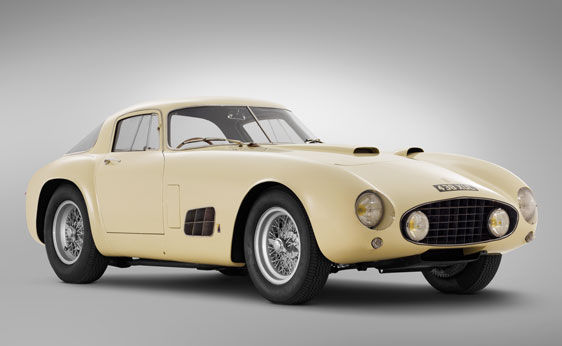
Ferrari 410 S

1955 Ferrari 410 S Berlinetta by Scaglietti

Offered by RM Auctions | Monterey, California | August 17, 2012

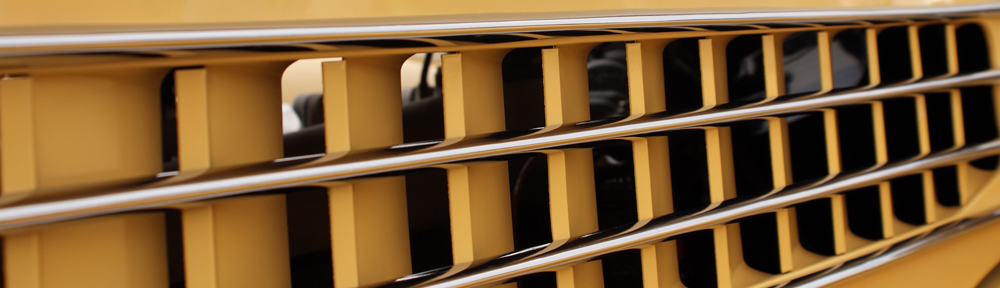
The Ferrari 410 Superamerica was biggest, baddest Ferrari you could buy between 1955 and 1959. It featured a 5.0-liter V12 making 340 horsepower. The car was an evolution of the America line, that included its predecessor 375 America and the 340 before it. The 400 Superamerica actually came after the 410.

This car has one-of-a-kind coachwork by Scaglietti and its really quite racy looking with dual, off-set hood scoops and a rear that just sort of rounds off after the rear window. The 410 was designed to compete in the Carrera Panamericana road race, but never actually did. Of the 35 410 Superamericas built, only two were factory prepped race cars. This is not one of those, although it did partake in some hillclimbing in the 1960s and the 2002 Mille Miglia.

Ownership history is known from new and the car was restored within the past 10 years. This car will be a hot ticket to discriminating shows and should fetch quite a sum, although RM is being coy about what that sum might be. For the complete lot description, click here. And for more from RM in Monterey, click here.

Update: Sold $8,250,000.

The Only S.P.O. in Existence

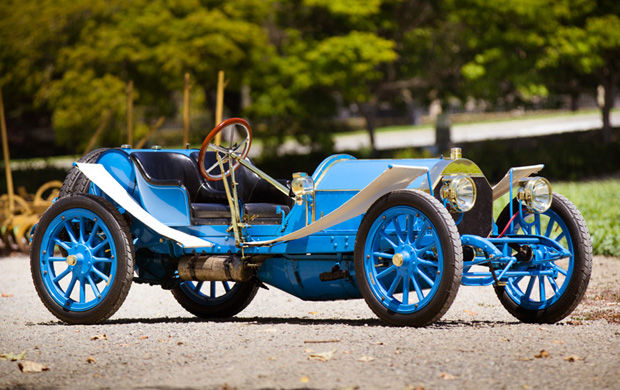
1911 S.P.O. Raceabout

Offered by Gooding & Company | Monterey, California | August 19, 2012

S.P.O. was a French manufacturer that began selling cars in 1898. They jumped into the American market as soon as they could. The manager of their American operations was also a racing driver and S.P.O.s were seen on the beaches in the early days of speed trials. They also competed for the Vanderbilt Cup. And they inspired some American competition – namely Mercer, who were able undercut S.P.O. on price. By 1911, it was all over for the French firm.

This car, a Raceabout (the first time this was used to describe a car), has a 4.2-liter inline-4 rated at 24 horsepower. Ownership history is known from new and it is believed that this car actually competed in beach races in Maine in 1911 as well as sat on the stand at the 1911 Importer’s Exhibition at the Astor Hotel in New York. It was also part of the Harrah Collection (shocking!) until it was broken up and parted out in the 1980s (the collection, not the car).

This is the only S.P.O. in existence. So the buyer not only has a new toy, but also a responsibility to maintain and preserve something of which there will never be another. The car is gorgeous – a fine example of early sporting cars. I think the cloth “fenders” are fantastic. You won’t get another chance to purchase an S.P.O. Jump at it for $500,000-$650,000. For more information, click here. And for more from Gooding during the Pebble Beach festivities, click here.

Update: Not sold.

Porsche RS60

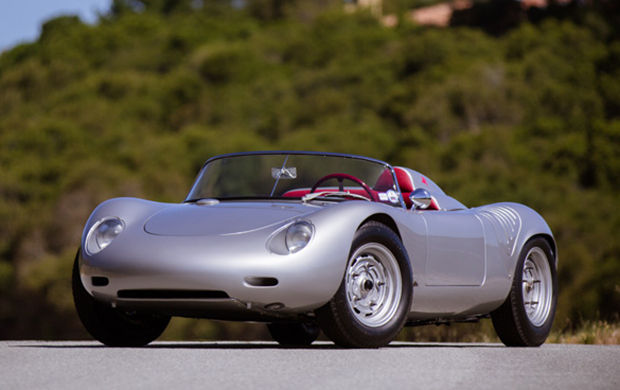
1960 Porsche RS60

Offered by Gooding & Company | Monterey, California | August, 18, 2012

The Porsche 718 (or RSK) was introduced in 1957 as a further developed racing version of the 550 Spyder. In 1960, due to FIA rule changes, Porsche had to refine the 718 and the RS60 was born. The RS60 was a one-year only racing model, as it was lightly changed for 1961 to become the RS61.

Changes over the 718 included a larger cockpit area and windshield, as mandated by the FIA. The engine in this car is a 1.5-liter flat-4 making 150 horsepower. It cost $9,000 in 1960 and is one of 14 non-works RS60s built.

This car ran in sports car races across the U.S. during its day, never suffering an accident and passed through the hands of a few owners/collectors until it was “sympathetically” restored (I guess that could mean anything, but I take it to mean “as needed”) sometime after 1999. It has seen track time during the Monterey Historics and the Rennsport Reunion.

The pre-sale estimate is $2,250,000-$3,000,000 – which is a lot of money for a car that begs the question: “Is it going forward or backward?” For the complete lot description, click here. And for more from Gooding & Co in Monterey, click here.

Update: Sold $3,465,000.

Ferrari 857

1955 Ferrari 857 Sport

Offered by Gooding & Company | Monterey, California | August 19, 2012

The Ferrari 857 was born out of a need for an improved Ferrari road-racing car – that is, something to do battle with the new Mercedes 300 SLRs. The 750 Monza and 500 Testa Rossa had done their jobs, but in the House of the Prancing Horse, “doing one’s job” probably lies somewhere well below “total domination” on il Commendatore’s list of cherished qualities.

So, for 1955, Ferrari took a 750 Monza chassis and stuffed under the hood a new, larger, version of the Lampedri straight-four, now displacing 3.5-ish liters, a 421cc improvement. Power jumped from about 260 to 290, which looked great on paper – unfortunately, the car was not the power-house it was intended to be. Over the next two years, however, the Monza line would produce some stellar, race-winning cars.

This particular car, chassis 588M, was the last of the four 857s built. It is the only car with this particular Scaglietti-designed body that includes a fin behind the driver. The car was entered by the Scuderia in a single race, where it was rolled in practice by Olivier Gendenbien. After that, it was repaired and sent to America where, in the hands of privateers, it competed in various road races across the country with drivers such as Carroll Shelby, Masten Gregory and Richie Ginther.

Once its racing life had concluded, the car was purchased by Andy Warhol and driven around New York by his agent. It changed hands several times after that, being restored in 2011. With a pre-sale estimate of $5-$7 million, this might be the cheapest way to get  your hands on something that you can connect to Andy Warhol. For the complete lot description, click here. For more from Gooding in California, click here.

Update: Sold $6,270,000.

Bugatti Brescia

1920 Bugatti Type 13

Offered by Gooding & Company | Monterey, California | August 19, 2012

Photo – Gooding & Company

Look at this little snub-nosed dart. It reminds me of one of those little short, stubby guns – completely innocuous looking, but it’ll still pack a punch. A pocket pistol – it’s the Derringer of Bugattis.

The Bugatti Type 13 was the car that really launched Bugatti as a manufacturer. The first cars were built around 1910, but World War One interrupted things and production – and racing – resumed in 1920. In 1921, Bugatti Type 13s swept the top four spots at the Brescia Grand Prix, earning the car the nickname “Brescia” thereafter.

This car left the factory in 1920 as a Type 22, which was a larger, road-going version of the Type 13. It still had the same 50 horsepower 1.5-liter inline four. The car was brought to America after the Second World War, where it was acquired by a collector who had the chassis shortened and bodywork adjusted to Type 13 specification. In the 1980s it was purchased by a Japanese collector and the car underwent a restoration while in his possession.

In 1998 it was purchased by its current owner, who has raced it on occasion. I remember seeing this on track during the Monterey Historics a few years ago. It was a field of Bugattis, mostly Grand Prix cars, like the Type 37 and Type 35. Those big powerful cars took off immediately, leaving this little guy as well as a large road-going convertible to fight it out amongst each other way at the back. Neither car was quick, but you could tell that each driver was having a complete blast. And that’s why you own a Bugatti.

This is an early Bugatti and while it may not have elegant coachwork or a very sporting Grand Prix body (the only real bodywork is a small box behind the engine with a cushion on it… sort of primitive in a way) no one will mistake it for anything else. The pre-sale estimate is $250,000-$350,000. For more information, click here. And for more from Gooding in California, click here.

Update: Sold $379,500.

Update II: Sold, Artcurial Paris 2016, $400,683.

S/N #981.

World’s First 4-cylinder Car

1895 Buffum Four-Cylinder Stanhope

Offered by Bonhams | Carmel, California | August 17, 2012

You’re looking at the oldest American car ever offered for auction and the oldest American gasoline-powered car in private ownership. It was also the first four-cylinder car ever built – anywhere in the world. And you’ve likely never heard of it.

Herbert H. Buffum built his first car in 1895 (actually he started it in 1894). Anyway, this is it. While other early automotive manufacturers where attaching single and twin-cylinder engines, Buffum had an idea for something a little more useful but just as compact. A designer and builder of machines for the shoe industry, Buffum had the technical know-how to accomplish what he wanted. And what he accomplished was building the world’s first four-cylinder gasoline engine for an automobile. It was a inline-four.

A chassis was needed to house this technical marvel – and for that Buffum turned to a local carriage builder named George Pierce, a name that would go on to be synonymous with high-quality automobiles in the next decade. Buffum was secretive with his new car, keeping it locked away in a shed when not using it, but eventually he hand-built six others for customers prior to 1900, when he entered production as an official manufacturer. The cars he produced until 1906 were front-engined cars, unlike most of their American competitors.

Other Buffum firsts included America’s first eight-cylinder car (of 80 horsepower) in 1904. In 1905 saw the world’s first V8. Buffum died in 1933 and his widow sold this car the following year from the secretive shed where he kept it stashed. It has changed hands numerous times and has appeared in a number of museums. It is operational and presents an extremely rare opportunity to acquire a pre-1898 American car (as almost all of the others reside in museums).

The pre-sale estimate is $200,000-$280,000. For more details, click here. And for the rest of the lineup from Bonhams in Carmel, click here.

Update: Not sold.

Update II: Sold, $182,000 at Bonhams Veteran Motor Car sale, 2012.

Awe-Inspiring Daimler Double Six

1932 Daimler 40/50 Double Six Sport Saloon

Offered by Gooding & Company | Monterey, California | August 19, 2012

This is one of my favorite cars in the world – ever. When I set up my calendar of cars to feature from the various Monterey sales (yes, I have a calendar of cars to feature – I have to, this year is completely overwhelming with the number of unbelievable cars on offer), this car wasn’t among them. It didn’t show up in Gooding’s “Auction Preview.” But when their full catalog came online, I stopped everything when I saw this was in the auction. I recognized it immediately as the 1999 Best in Show winner at Pebble Beach (perhaps, if you recognize it, it is from this as well).

The Double Six was first introduced by Daimler in 1926. They were over-engineered masterpieces and quickly became the car of choice for the British royal family. It is also one of only two models of cars that have used a sleeve-valve V12 (the other was a Voisin). This car has the 6.5-liter V12 making 150 horsepower. It could also do more than 80 mph.

This car has the longest wheelbase of any of the Double Sixes, coming in just a few inches shorter than a Bugatti Royale, which it somewhat resembles. The body was built by Martin Walker Ltd. and The styling is just amazing – the long hood, low roof and four suicide doors all add up to a somewhat menacing – and totally breathtaking – look.

Only 26 Double Sixes were built, but this car is truly one-of-a-kind. I’ve loved it since the first time I saw it after the ’99 Concours d’Elegance. You won’t find a better-looking four-door anywhere. The pre-sale estimate is $3,000,000-$4,000,000. For the complete description, click here. And for more from Gooding & Company in Monterey, click here.

Update: Sold $2,970,000.