1912 Oldsmobile Limited

1912 Oldsmobile Limited Five-Passenger Touring

Offered by RM Auctions, Boca Raton, Florida, February 25, 2012
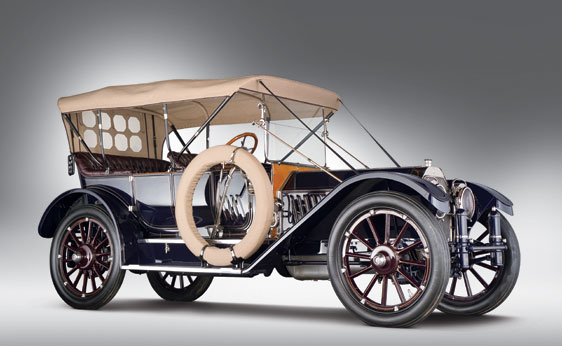
Cars do not come much more grand than this. Built for only three model years (1910, 1911, and 1912), the Oldsmobile Limited might very well be the greatest car Oldsmobile ever built. They were available in a number of bodystyles – and an unrestored barn-find 7-Passenger Touring model sold for $1.6 million at an RM Auction in 2007.

This is one of only 140 Limiteds built in 1912 (only 725 were built in total) and the only 1912 known to exist. The first owner was Canadian and it has passed through the collection of Otis Chandler on its way to the Milhous Collection in Florida. These cars are immense – they should really put something in the photo (like Shaquille O’Neal) so you can compare it to the largest wheels ever fitted to a production car – 42 inches (take that, rap stars). It’s seven feet tall and over 17 feet long. In other words, giant.

The 11.5 liter (!) T-head six-cylinder engine produces 60 horsepower and was enough for a capable top speed. There is a famous painting of an Olds Limited outrunning the 20th Century Limited (a train).

A new Limited in 1910 would run you $4,600. By 1912, the limousine model would require at least $7,000. So even the base model cost more than a three-bedroom house at the time. Well, that’s still true today. With a pre-sale estimate of $1,400,000-$1,600,000 you could trade a very nice house for this car. Pre-WWI cars do not come much better than this. For the complete catalog description, click here. To see the rest of the Milhous Collection, click here.

Update: Sold $3,300,000.

995cc “Squariel”

1938 Ariel 995cc Model 4G “Square Four”

Offered by Bonhams, Shepton Mallet, U.K., February 18, 2012

The Ariel Square Four was a four-cylinder motorcycle introduced in 1930 as a 500cc motorcycle. In 1937 the model was updated to the “4G” with a 955cc OHV engine. It’s a powerful 1930s motorcycle with similar displacement to a 1960s-era Mini (which weighed a lot more). This isn’t a Vincent and doesn’t pretend to be but, on the plus side, it’s way more affordable.

Ariel was absorbed by BSA in 1944 and continued production until 1970. But their heyday was the 1930s when models like the Square Four and Red Hunter were serious bikes.

This particular bike was acquired in 1947 by the most recent owner (who is deceased). It also comes with a sidecar, but from the pictures it would appear that the sidecar needs some serious work. This one hasn’t been ridden in 40 years and hasn’t been started in 10. It is in original condition – and it doesn’t look too bad. It’s a restoration project and for the estimate of $11,000-$16,000, it’s a lot cheaper than some of the other restoration projects that we’ve seen at auction recently. Then again, it’s priced higher than many of the running bikes in this sale, which makes me feel better about talking this up as a desirable model.

For the complete catalog description, click here.

Update: Sold $19,000.

1913 Alco Touring Car

1913 Alco Six Model H Five-Passenger Touring

Offered by RM Auctions, Boca Raton, Florida, February 24-25, 2012

The American Locomotive Company was formed in 1901 as the result of a merger between eight smaller locomotive manufacturers. This made Alco the second-largest steam locomotive producer in the United States.

In 1906 the company began producing Berliet automobiles under license (as American Berliet). This license agreement was trashed in 1908 in favor building their own cars. Alco cars won the Vanderbilt Cup in 1909 and 1910 and competed in the inaugural Indianapolis 500 in 1911. Alco was also the first automobile company at which man named Walter P. Chrysler worked before he left in 1911 to join Buick.

In 1913 Alco shifted their focus back to locomotives (they had lost an average of over $450 on every car sold since 1906), producing their last steam locomotive in 1948 and final diesel locomotive in 1969.

The car seen here is a six-cylinder Model H from the final year of production. It is believed that this car was featured on the Alco stand at the 1913 New York Auto Show. It has 60 horsepower and after the completion of restoration in the mid-1990s, the car was “mechanically updated” in order to take place in brass-era tours. So it’s a driver.

Only six of these cars are known to exist and this one is a glorious example. There is something undeniably stately and imposing about large brass-era touring cars. The estimate on this car is $400,000-$600,000 and is offered from the Milhous Collection. For the complete catalog description, click here and to see all of the other interesting things available at this sale, click here.

Update: Sold $506,000.

Duesenberg J-487

1930 Duesenberg Model J LWB Dual Cowl Phaeton by LeBaron

Sold by RM Auctions | Phoenix, Arizona | January 19, 2012

Photo – RM Auctions

We somehow missed featuring this Duesenberg during the hype and excitement leading up to the auctions in Arizona in January. And since one of my goals here is to feature every Model J that comes up for sale, here it is.

This is actually my favorite bodystyle – the LeBaron Dual Cowl Phaeton. It is also the coachwork most commonly associated with the Model J. And this is the only long-wheelbase Dual Cowl Phaeton built by LeBaron and it is the original body.

The engine, however, is not. When this car was delivered to a Mr. J. Clarke Dean of Chicago, Illinois in 1930, it had engine J-320 under the hood. The second owner discovered, in 1948, that the engine had been replaced with J-487 – an engine with no known previous history in another car. As always, the straight-8 makes 265 horsepower.

The sweep panel two-tone paint scheme is also my favorite. Black and red is the most common I’ve seen although most combinations are attractive (green and black is how I will have mine, please). LeGrande also built sweep panel Dual Cowl Phaetons that looked more or less the same. The way to tell the difference is that, on a LeGrande, the sweep of color extends farther down, halfway through the door.

This car was estimated between $900,000-$1,200,000. With this desirable, original coachwork, known history and coming from the John O’Quinn collection, it is definitely worth that. It sold for $880,000. Well bought. To read the complete catalog description, click here.

Update: RM Auctions, Amelia Island 2015:

Photo - RM Auctions

Photo – RM Auctions

Sold $1,155,000.

Update: RM Sotheby’s, Amelia Island 2019:

Photo Courtesy of RM Sotheby’s

Sold $1,650,000.

Horch 853

1938 Horch 853 Cabriolet

Offered by Artcurial | Paris, France | February 3, 2012

In 1909, August Horch was forced out of the company that bore his name. Instead of pouting about it, he moved across town & set up Audi. In 1932, Horch became part of Auto Union, with DKW, Wanderer, and Audi. Shortly thereafter, Horch introduced a new series available on three different sized wheelbases.

There was the 850, 851 and this, the largest, the 853. These were solid cars that rivaled the grand Mercedes-Benz 500K and 540K models. Horch 853s were driven by the top echelon of German citizenry – politicians, industrialists, etc.

This car features a 5.0 liter straight 8 engine making 105 horsepower. Performance was acceptable – capable of 80+ mph. But, apparently, this car was carved out of a block of lead – it weighs nearly three tons!

While the 853 A is more desirable (120 HP), this 853 is still quite rare and valuable. The coachwork is beautiful and these cars just look unflappably solid. Artcurial is set to auction this at Retromobile in Paris and they estimate it between $410,000-$490,000. Horchs don’t come up for sale very often so here’s your chance to own a brilliant automobile. Find out more about the car here and more about the Retromobile sale here.

Update: Sold $520,732.

1913 Delaunay-Belleville

1913 Delaunay-Belleville Type O6 8L

Offered by Artcurial, Salon Rétromobile, Paris, February 3, 2012

Photo – Artcurial

The Type O6 was the most powerful car produced by Delaunay-Belleville prior to the First World War. It featured an 8-liter straight-six engine producing 100 horsepower at an insanely low, count-the-revs 1500 rpm. The car is capable of just over 70 mph.

These cars were sold as bare chassis with coachwork to be added later. This particular car retains its original coachwork from J. Rothschild & Sons. Over time, the hood had weakened and was replaced. The car was also repainted and mechanically refreshed – but not restored – in the 1980s.

This car was purchased new by Edward Daubree – part of the family that founded a little known company called “Michelin.” After World War I the car was given to his nephew and at the onset of the Second World War the wheels were removed from the car and walled up in a house, while the rest of the car was stashed in a different residence. The car was re-discovered in 1986 and brought back to life. It remains in the Michelin family as it has its entire existence. The car is being sold to raise funds for medical research.

Delaunay-Belleville cars are extremely rare and valuable as they were once near the height of French automobile production – being owned by royalty from France to Russia. They were out of production by the end of the 1920s and they rarely come up for sale. Here is a chance to own one with known ownership (the same family) from new. It’s a massive, amazing car with a fascinating history. Buy it.

The pre-sale estimate is a wide $525,000-$785,000. It is being sold for a charitable cause, but that shouldn’t have a huge impact on its selling price because it is worth a ton of money as it is. For a complete run down of this car, click here. To see the rest of Artcurial’s lineup, click here.

Update: Sold $600,834.

Update II: Sold, Bonhams Monterey 2016 $450,000.

1928 Amilcar C6

1928 Amilcar C6 Voiturette

Offered by Bonhams | Paris, France | February 2, 2012

“Voiturette” is basically French for “small car” or “light car” (no, that’s not a direct translation). The term was used widely and applied to many pre-war automobiles coming from France. Amilcar started producing cyclecars in 1921 and before long that had sturdier equipment tearing it up on racetracks in Europe.

The C6 was introduced at the Paris Auto Salon in October of 1926. It featured a twin-cam straight six with a Roots-type supercharger that made over 60 horsepower. Because Amilcar was not a giant operation like some of their competitors (like Salmson), their cars were somewhat more expensive (economies of scale, anyone?).

This led to a price for the C6 of about 40,000 francs – which is about what you could’ve bought a Bugatti Type 37 for back in the day. The Amilcar shares the pre-war open-wheel race car look (and the striking blue paint) with Bugatti and, while the Bugatti might win the sexiness competition, one could argue that an Amilcar is more interesting (and rarer).

This car did not sell at a previous Bonhams auction within the past 12 months. It is being offered again with an pre-sale estimate of about $580,000-$680,000. For a more thorough history on this particular care, click here and for more on Bonhams in Paris, click here.

Update: Not Sold.

DeSoto Adventurer II Concept Car

1954 DeSoto Adventurer II Coupe

Offered by Barrett-Jackson, Scottsdale, Arizona, January 15-22, 2012

The DeSoto Adventurer was a regular production model sold from 1956 through 1960. During it’s run, it was the best DeSoto you could buy. However, a few years prior to its introduction, Chrysler commissioned a series of beautiful concept cars, The DeSotos bore the Adventurer name (the Dodges were called Firearrows).

This is the Adventurer II – and it’s the only one. It has a sleek, jet-age body designed and built by Ghia in Italy. This car is an extension of the Ghia Supersonic cars that they built around the Fiat 8V – and the 1955 Ghia Gilda borrows a lot from the Adventurer II. It featured the Hemi engine of the day and was originally owned by King Mohammed V or Morocco.

This is another car coming from The Blackhawk Collection so you know it’s in fantastic shape and has been lovingly cared for. A few years ago Barrett-Jackson sold a Dodge Firearrow concept car for about $1 million. This car is far better looking and worth every penny of the Dodge, if not more. Fore more info, click here and more on the Barrett-Jackson auction here.

Update: Sold $1,430,000.

Duesenberg J-381

1930 Duesenberg Model J LWB Town Car by Murphy

Offered by Barrett-Jackson | Scottsdale, Arizona | January 15-22, 2012

Photo – Barrett-Jackson

Well I said in a previous post that we’d try and feature every Model J Duesenberg that comes up for auction and this is the third of the Arizona Duesenbergs for this season. And it just so happens that all three of them were bodied by Murhpy – the most prolific of all Duesenberg body-builders (now I’m picturing some hulk of a man lifting a Duesenberg with each arm like a barbell).

This car was delivered to its first owner on Halloween of 1930 (cue the sounds of ghosts and ghouls). This is that actual engine (J-381) that was fitted to this long-wheelbase chassis. There are a fair number of Model Js that have swapped engines over the years. And some that have swapped bodies – Freaky Friday-style (hmm, the Halloween theme returns).

This is an attractive Town Car from the Walter M. Murphy Company and it’s a car that would very much appear to be designed for some extravagantly wealthy person to be driven in. I’ve always wondered why “the help” were relegated to riding in the elements, but I guess that’s one of the perks of being wealthy. I’m sure the chauffeur’s union would object to this treatment if this car didn’t have a 265 horsepower straight-eight engine.

Barrett-Jackson doesn’t publish estimates for the cars they’re offering but I’m guessing it should come in right at about $1 million. There are bodystyles that are much more valuable and $1 million is a nice round number and a good starting point for valuating a Duesenberg. Also, this car has been sitting (for sale) at the Blackhawk Collection for quite some time.

There were 481 Model Js built and only 4 Murphy Town Cars. Find out more here and more about Barrett-Jackson in Scottsdale, here.

Update: Sold $1,045,000.

Update II: Sold, Bonhams Monterey 2016, $1,254,000.

Bugatti Type 38A

1927 Bugatti Type 38A Tourer by J. Figoni

Offered by Gooding & Company | Scottsdale, Arizona | January 20-21, 2012

Photo – Gooding & Company

The Type 38 Bugatti was the second iteration of the eight-cylinder Bugatti. The first, the Type 30, was introduced in 1922. It wasn’t until 1926 that the Type 38 came about (the Type 40 was introduced that same year). There were 385 Type 38 Bugatti’s built with only 54 being the supercharged Type 38A, which featured the supercharger from the Type 37A race car.

The rather anemic supercharged 2.0 liter straight-8 engine made 60 horsepower. Only a few years later supercharged Duesenbergs would be putting out 320 horsepower – then again that was almost 7.0 liters. There’s no replacement for displacement.

This Bugatti features rather exceptional bodywork by Joseph (Giuseppe) Figoni of Figoni & Falaschi fame, although that partnership would not come to fruition for another eight years.  One thing I like about this car is that, even though it’s a 4-6 passenger (depending on size) touring car, it still has that awesome “Bugatti camber” that shows that this car means business:

Photo – Gooding & Company

These cars are rare but they aren’t quite as desirable as any Bugatti with, say, racing provenance or more sporting intentions (read: “more than 60 HP”). Gooding estimates this car at $500,000-$650,000. For more info, check out the car’s page on the auction website and more on the auction here.

Update: Sold $495,000.