Delahaye 135 MS by Figoni et Falaschi

1938 Delahaye 135 MS Coupe by Figoni et Falaschi

Offered by RM Auctions | Phoenix, Arizona | January 18, 2013

1938 Delahaye 135 MS Coupe by Figoni et Falaschi

Guess what my favorite feature of this car is. It isn’t the beautiful Figoni & Falaschi-styled body. It’s that French flag on the grille. How cool. I almost didn’t feature this car, but that colorful grille alone sold me on it – that and I’ve yet to feature a Delahaye 135 MS – however I have done a 135 M.

So what’s the difference? More horsepower, of course. While the M lumbered around with up to 115 horsepower, the 3.6-liter straight six in the MS offered 160 horsepower. The “Teardrop” bodystyle is the most famous style from French coachbuilders Figoni & Falaschi. It’s also the one that it usually shown as the “typical” French coachbuilt body of the period. It is certainly nice.

This car was on the Figoni et Falaschi stand at the 1938 Paris Salon and disappeared shortly thereafter, being rediscovered in 1964. It was restored in the late 1980s and was acquired by John O’Quinn in 2006, who had it restored again. It is being offered with an invitation to the 2013 Amelia Island Concours d’Elegance, which it could win. It should sell for between $1,000,000-$1,400,000. Click here for more info and here for the rest of RM’s Arizona lineup.

Update: Sold $1,540,000.

A [Mostly] Original 540K Cabriolet A

1938 Mercedes-Benz 540K Cabriolet A

Offered by Bonhams | Scottsdale, Arizona | January 17, 2013

1938 Mercedes-Benz 540K Cabriolet A

Hmm, three maroon cars in a row. I didn’t plan that. We’ll need something more colorful for tomorrow. But color isn’t a big issue here because this is a Mercedes-Benz 540K. One of the most desirable cars on earth.

The 540K was, essentially, an updated 500K with a bigger engine. Introduced in 1936, the 540K used a supercharged 5.4-liter straight eight making 180 horsepower with the supercharger engaged. How it worked was, the engine made 115 horsepower as is, but when you floored the accelerator, the compressor kicked in and bumped the power up considerably – allowing the car to attain speeds up to 110 mph.

But what really catches everyone’s attention is that body by Sindelfingen, Mercedes’ in-house coachbuilder. Their cars are gorgeous, this Cabriolet A-style body being no exception. The 540K lasted until 1940, with a total of 83 Cabriolet As built. This car was originally delivered to Paris, but was brought home with a U.S. soldier after the war (what a war prize!). He kept it until 1970 when it was purchased by famed car rescuer Paul Karassik, who painted it the burgundy color you see, replaced the top, and refurbished the leather on the seats. Other than that, this car is original.

Mercedes 540K Cabriolet A’s have an average sale price over the past few years of about $2.5 million. The fact that this car is pretty much original is a wild card – but look for it to bring in the neighborhood of that amount, as Bonhams declined to publish an estimate. You can read more here and check out more from this sale here.

Update: Sold $1,312,500.

SS100 Roadster

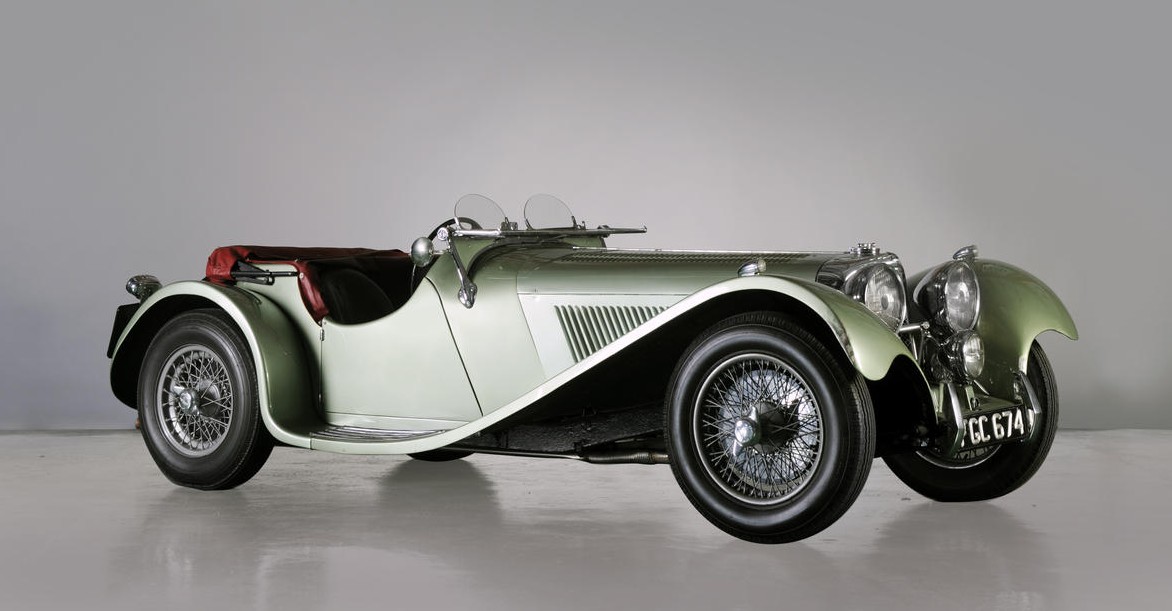
1938 SS 100 3.5-Litre Roadster

Offered by Bonhams | Brooklands, U.K. | December 3, 2012

Swallow Sidecar Company was founded in 1922 by William Walmsley and William Lyons – and they built, well, sidecars. 1926 brought coachbuilding into the business. In 1932, they introduced their own car, the SS I and in 1934 Lyons founded SS Cars Ltd to continue the line of sports cars.

The SS 100 was introduced in 1936 and was nicknamed “Jaguar” by Lyons. The 100 referred the car’s capability to hit or exceed 100 mph. The engine was originally a 2.5-liter unit, but in 1938 a new 3.5-liter straight-six was introduced, making 125 horsepower. These cars were sporting: racking up victories around the U.K. and continental Europe. It’s one of the fastest, best-handling cars of the era.

The styling is superb and this one, in light green metallic, looks stunning. Only 116 3.5-liter cars were made and they command a price premium, with an estimate on this car for between $320,000-$400,000. The model lasted through 1940 and in 1945, the company changed its name to Jaguar, mostly because the initials “SS” had a much more sinister connotation thanks to the Second World War. For more information on this car, click here. And for the rest of Bonhams lineup at Mercedes-Benz World Brooklands, click here.

Update: Sold $402,800.

Pebble Beach-Winning Horch

1938 Horch 853A Special Roadster by Erdmann & Rossi

Offered by RM Auctions | Monterey, California | August 17, 2012

This is one of the stars of the auction weekend in Monterey. If it looks familiar, that might because you’ve seen it featured as winning Best in Show at a number of high-class Concours d’ Elegance all over the country, namely Pebble Beach in 2004. Over the past eight years, this car hit the show circuit hard. I saw it in person in 2009 and I can attest that it is truly a magnificent car.

Horch was founded in Ehrenfeld, Cologne, Germany in 1899 by August Horch. The company moved to Reichenbach im Vogtland in 1902 and in 1904 relocated again, this time to Zwickau. August Horch was forced out of the company in 1910 and he went across the street and set up Audi. The company that bore his name would continue on without him, being merged into Auto Union in 1932 (coincidentally, Audi was also part of that group and is the sole surviving marque).

The Horch 853 (and 853A, as you see here) were introduced alongside other models of varying sizes/configurations in 1937 – but all used the same 120 horsepower 5.0-liter straight-eight engine. The main competition for these cars came from Mercedes-Benz and their lineup up elegant roadsters, namely the 540K. The Mercedes had a variant called the “Special Roadster” and they all look pretty much the same – about 25 were built.

Only eight Horch 853A Special Roadsters were built. The first one was bodied by Horch, the next six by Erdmann & Rossi, and the final one by Glaser. They are all different. The first three cars were referred to as “Series One” cars, while the final five are “Series Two.” This is one of three surviving Series Two cars.

One note about these cars when new: Horch wouldn’t sell you one until they concluded that you resided in an acceptable realm of society. They picked you to buy one of their cars instead of the other way around (well, you had to want one, I guess. But they almost certainly refused to sell them to certain individuals, although somehow Hermann Göring slipped through their screening process. I guess personality and likability weren’t among their requirements). In any case, this cost “significantly more” than its 540K counterpart.

Ownership history is known from the end of the war and the car was restored by RM, being completed sometime prior to being shown in August of 2004. This is one of the nicest pre-war cars around – and one of the most famous. But you better crack open your piggy bank(s) if you want to own it, as the estimate is between $6,000,000-$8,000,000. For  the complete lot description, click here. And for more from RM in Monterey, click here.

Update: Sold $5,170,000.
Re-bodied Bugatti 57C

1938 Bugatti Type 57C ‘Cäsar Schaffner Special Roadster’

Offered by Bonhams | Monaco | May 11, 2012

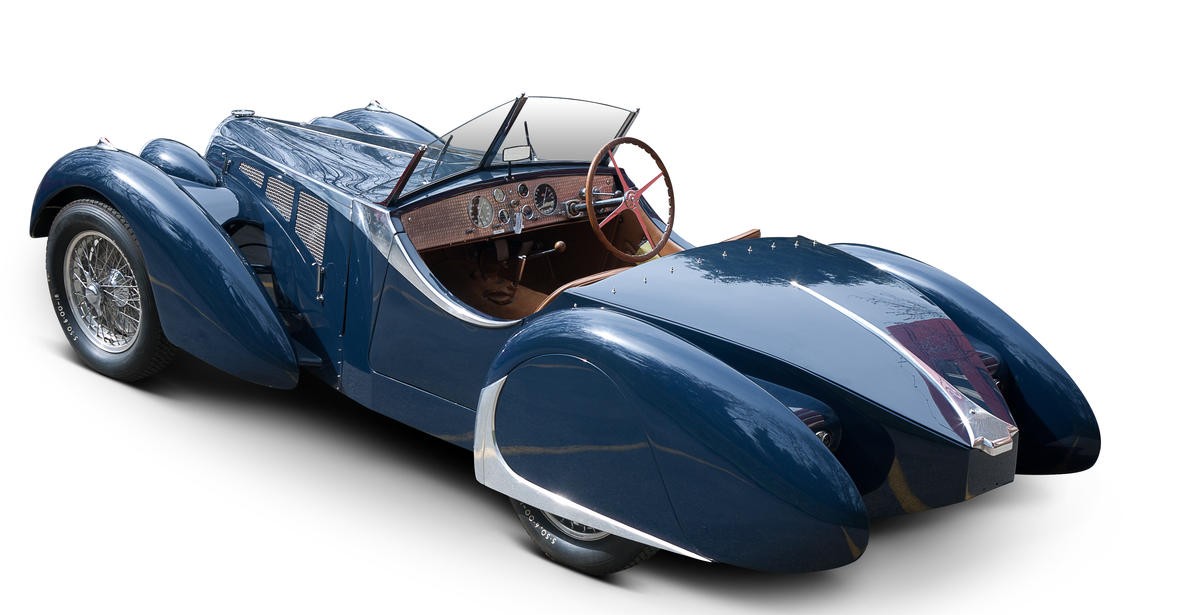
The Bugatti Type 57 was the most popular Bugatti model that the company ever made. It was produced from 1934 until 1940 and there were some very limited editions that are very desirable today – such as the 57SC Atlantic. The 57C, as seen here, featured the 3.3-liter straight-eight – but with a Roots-type supercharged added on, for a total output of 160 horsepower.

This car, chassis 57.577, was originally a Gangloff-bodied Stelvio cabriolet. In the 1960s, it was acquired by Cäsar Schaffner who restored it and, in the process, decided to restore it to the specifications of a different chassis number. So, while 57.577 retains its original chassis (although it was shortened) and engine – it does not retain its original body. The new body was in the style of a Type 57S by Corsica. It looks nice, but you have to question, today, what would be more valuable? A Bugatti with its original body, or a Bugatti with a sort of replica body?

In any case, this car has been freshened over time and is quite nice and it’s eligible for all of the historic events it would have been had the Gangloff cabriolet body remained. It is priced confidently with an estimate between $420,000-$580,000. And if you’re still not quite sold on it, check out the back of this thing:

Pretty nice. For the complete catalog description, click here. And for more on Bonhams in Monaco, click here.

Update: Not sold.

995cc “Squariel”

1938 Ariel 995cc Model 4G “Square Four”

Offered by Bonhams, Shepton Mallet, U.K., February 18, 2012

The Ariel Square Four was a four-cylinder motorcycle introduced in 1930 as a 500cc motorcycle. In 1937 the model was updated to the “4G” with a 955cc OHV engine. It’s a powerful 1930s motorcycle with similar displacement to a 1960s-era Mini (which weighed a lot more). This isn’t a Vincent and doesn’t pretend to be but, on the plus side, it’s way more affordable.

Ariel was absorbed by BSA in 1944 and continued production until 1970. But their heyday was the 1930s when models like the Square Four and Red Hunter were serious bikes.

This particular bike was acquired in 1947 by the most recent owner (who is deceased). It also comes with a sidecar, but from the pictures it would appear that the sidecar needs some serious work. This one hasn’t been ridden in 40 years and hasn’t been started in 10. It is in original condition – and it doesn’t look too bad. It’s a restoration project and for the estimate of $11,000-$16,000, it’s a lot cheaper than some of the other restoration projects that we’ve seen at auction recently. Then again, it’s priced higher than many of the running bikes in this sale, which makes me feel better about talking this up as a desirable model.

For the complete catalog description, click here.

Update: Sold $19,000.

Horch 853

1938 Horch 853 Cabriolet

Offered by Artcurial | Paris, France | February 3, 2012

In 1909, August Horch was forced out of the company that bore his name. Instead of pouting about it, he moved across town & set up Audi. In 1932, Horch became part of Auto Union, with DKW, Wanderer, and Audi. Shortly thereafter, Horch introduced a new series available on three different sized wheelbases.

There was the 850, 851 and this, the largest, the 853. These were solid cars that rivaled the grand Mercedes-Benz 500K and 540K models. Horch 853s were driven by the top echelon of German citizenry – politicians, industrialists, etc.

This car features a 5.0 liter straight 8 engine making 105 horsepower. Performance was acceptable – capable of 80+ mph. But, apparently, this car was carved out of a block of lead – it weighs nearly three tons!

While the 853 A is more desirable (120 HP), this 853 is still quite rare and valuable. The coachwork is beautiful and these cars just look unflappably solid. Artcurial is set to auction this at Retromobile in Paris and they estimate it between $410,000-$490,000. Horchs don’t come up for sale very often so here’s your chance to own a brilliant automobile. Find out more about the car here and more about the Retromobile sale here.

Update: Sold $520,732.