Bugatti Superprofile

1930 Bugatti Type 46 Superprofile Coupe

Offered by RM Auctions | Lake Como, Italy | May 25, 2013

1930 Bugatti Type 46 Superprofile Coupe

Photo – RM Auctions

I’ll start this off by saying that this is not an original Bugatti Superprofile Coupe. It is an original Bugatti Type 46, but the body has been redone in the style of Jean Bugatti’s famous Superprofile car.

The Type 46 uses a 5.4-liter straight-eight making 140 horsepower. The car originally had a four-door sedan body on it and sometime in the past 15 years, this stunning new body was constructed by Mr. Ken Haywood in Australia. The Coupe Profilée (as Jean’s original drawings were officially referred to) bodystyle was never applied by the factory to a Type 46. One acquired an original Profilée body in the 1960s and that car is in the Schlumpf Collection, never to see the light of day again. The first factory Profilée was on a 1935 Type 50, which was once owned by Bill Harrah. It is valued at about $2 million.

This car sold in March of 2012 for $1,017,500, which was perhaps a little high, considering that, while beautiful and probably better done than any original Bugatti body, it will never be a contender at places like Pebble Beach because it isn’t a period body. And owning a Bugatti like this is all about garnering awards and patting yourself on the back for being able to afford something beautiful that somebody else made.

In all, 450 Type 46s were built between 1929 through 1933. One has a real Profilée body on it from back in the day. This one has a new Profilée body. It’s definitely more valuable than some other Type 46s, but I kind of doubt it will bring the same kind of money it brought last year. But who knows. Click here for more and here for more from what’s shaping up to be a monster sale from RM in Italy.

Update: Sold $873,600.

Maserati Tipo 26 Four-Seater

1930-31 Maserati Tipo 26 Sport

Offered by Bonhams | Goodwood, England | September 15, 2012

If you can believe it, there are actually two 1930 Maserati Tipo 26s up for auction at this sale. One is a two-seater, and the one seen here is a four-seater – you know, the more useful of the two when hauling the kids to soccer practice. Both cars come out of the same collection and having similar histories, as they were both imported into the U.K. for racing purposes in 1930. We’ll focus on the four-seater from here on.

The car is powered by a supercharged 2.5-liter straight-8, taking direct aim at Alfa Romeo’s 8C competition cars. This car competed against Alfa 8Cs, driven by the likes of Henry “Tim” Birkin, in the 1931 Eireann Cup in Dublin, Ireland. This car finished second to Birkin in an 8C. It was driven by Giuseppe Campari, who mid-race, was temporarily blinded when mud and debris from another car came off the track and shattered his goggles, sending glass into one of his eyes. Giulio Ramponi, a sometimes riding mechanic who was working in the pits, took over the car while Campari had his eye tended to. Before long, Campari ran back onto the track, flagged Ramponi down, and resumed his race.

The car was entered at Brooklands earlier that year, but only one of the two cars offered here actually competed (chassis unknown, based on price, I’d say likely this one). This car did compete at Brooklands in 1933 and a few other races over the next few years. It passed through numerous hands – and numerous drivetrain configurations – before being acquired by its current owner in 1952. All of its original pieces were located and reinstalled, making this a highly original example of an already extremely rare car.

It is very impressive, in both history, rarity and condition. It is an exquisite alternative to the comparatively common Alfa Romeo 8C. The pre-sale estimate is $2,900,000-$3,500,000. For the complete lot description, click here. And from more from Bonhams at Goodwood, click here.

Update: Sold $2,727,000.

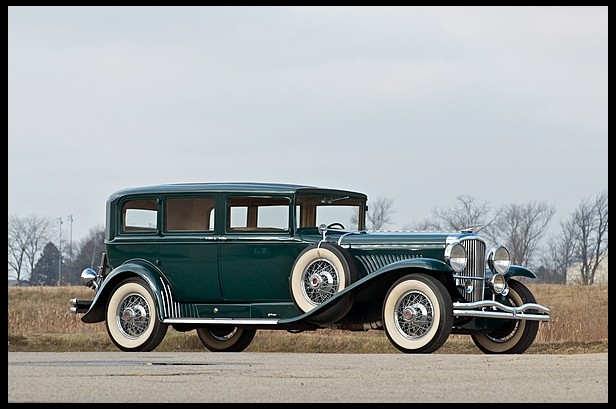
Duesenberg J-306

1930 Duesenberg Model J Limousine by Willoughby

Offered by Mecum Auctions | Monterey, California | August 18, 2012

Duesenberg Fridays continue. This one is being sold at Mecum’s Monterey sale and it looks great. This is a rare numbers-matching Duesenberg that doesn’t have its original engine. Many of these cars swapped engines (and bodies) over the years, and the factory records of what chassis was fitted with which engine and who coachbuilt what for it, never seems to match reality. But this car has a slightly different story.

It was born with J-383, which was considered “defective” and replaced by Duesenberg with J-306. The 7-passenger limousine body was added by the Willoughby Company of Utica, New York – and this is the original body. Willoughby was founded in 1893 as a carriage manufacturer. After a fire in their Rome, New York, factory, they relocated to Utica and it was here that they received the first order for automobile bodies in 1899 from Columbia Electric.

In addition to Columbia Electric, Willoughby built bodies (both one-off/custom and large orders placed by automobile manufacturers) for the likes of Studebaker, Cadillac, Marmon, Packard, Franklin, and the American arm of Rolls-Royce. Though, there are, perhaps, few more regal than this large, enclosed Duesenberg in stunning dark green. Willoughby bodied its last cars, mostly Lincolns, in 1938 before shutting down for good in 1939.

Mecum doesn’t publish estimates, but look for the price to head north from $500,000. For more information, click here. And for more from Mecum in Monterey, click here.

Update: Not sold (after reaching a high bid of $350,000).

Update: Sold, $370,000 (at Mecum Auctions in Anaheim, California, 2012).

Update: Not sold, RM Sotheby’s, Hershey 2022.

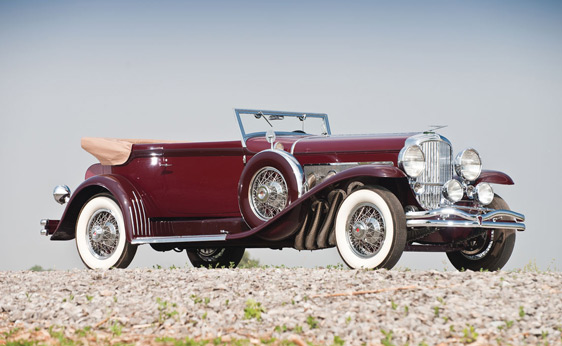
Duesenberg J-272

1930 Duesenberg Model SJ Convertible Victoria by Rollston

Offered by RM Auctions | Plymouth, Michigan | July 28, 2012

I’ve always imagined the 1920s to have been just one big party. The “war to end all wars” was over and things would continue to improve until the end of time. The Jazz Age, in full swing for some time, was reaching its zenith when the Model J Duesenberg was introduced. Unfortunately it would end almost immediately thereafter.

If there is any single thing in my mind that defines the Jazz Age, it is George Gershwin’s “Rhapsody in Blue” – a near-perfect combination of classical music and jazz. Many people consider it one or the other but I happen to think it is the greatest example of both. This absolutely amazing piece of music was commissioned in 1924 by Paul Whiteman, a bandleader referred to in the media as “The King of Jazz.” His arrangement of “Rhapsody in Blue” for full orchestra is the definitive version this song. A shellac 78 record of Whiteman’s version is spinning across the room as I write this.

So what does any of this have to do with this car? Well, this car was purchased new by Paul Whiteman with the original body being a LeBaron Sport Phaeton. Whiteman sold the car in 1932 and the new owner replaced the original body with the Convertible Victoria style by Rollston you see here, making it one of 16 Rollston Convertible Victorias built and one of 57 Rollston-bodied Duesenbergs in total. The new owner also had a supercharger installed, bumping horsepower from 265 to 320. This move also elevated this car into a whole new realm of collectability.

When it comes to American cars, the SJ Duesenberg is exceeded in price by few and in desirability by even fewer. For me, this SJ (engine no. J272) would be the one to have because of its direct connection to the Jazz Age – an era like no other. If I had the means, this car would soon be in my garage – and while it’s no yellow Rolls-Royce, I would drive this thing around town like I was Jay Gatsby himself.

The pre-sale estimate is $850,000-$1,200,000 – putting it just out of my reach. To read more about this car, click here. And to see more from RM at St. John’s, click here.

Update: Sold $957,000.

Update: Sold, Mecum Indianapolis 2021, $2,970,000.

Dennis Fire Engine

1930 Dennis Fire Engine

Offered by Coys | Ascot Racecourse, U.K. | April 21, 2012

John & Raymond Dennis set up shop as Dennis Brothers Ltd in 1895 in Guildford. Originally, the sold bicycles before building their first motor-powered tricycle in 1899. Four-wheeled cars followed in 1901 and commercial vehicles – beginning with a bus – in 1903. The first Dennis fire engine was built in 1908 and the company had found their groove. Passenger cars disappeared by 1915.

Buses and fire engines were their specialty and this 1930 fire engine features a 2.7-liter four-cylinder engine and it is in the livery of what is believed to be the original department, County Hospital Prestwich. There is a lot of attractive brass and many period fire-fighting items, including antique extinguishers, ladder and a trailer pump.

The Dennis company has gone through a serious of corporate mergers since 1972. At one point, it was split into three separate companies, with Dennis Bus and Dennis Fire being merged back into one another and re-branded as Alexander Dennis in 2001, the form in which they currently exist.

Fire engines are great collectibles – they usually don’t cost all that much and there are a ton of them out there. Dennis is a recognized brand name among fire equipment collectors and this one shows well and would be great for parades – the most common duty retired fire trucks serve. Coys estimates that this will sell for between $15,000 – $24,000. For the complete description, click here. And for the rest of Coys’ Ascot lineup, click here.

Willys-Knight “Plaid-Side” Roadster

1930 Willys-Knight Great Six Plaid-Side Roadster

Offered by Gooding & Company | Amelia Island, Florida | March 9, 2012

Photo – Gooding & Company

Willys-Knight was a line of automobiles produced between 1914 and 1933 by the more commonly known Willys-Overland Company. There were a number of “Knight” branded cars in production around this time because they all used Knight Sleeve-Valve engines (there were no less than eight).

The Knight Sleeve Valve engine wasn’t exactly a novelty – there were all kinds of pioneering ideas in the early days of motoring as to how an automobile should be powered. That said, they did have a few issues and they were expensive to produce, even if the straight-six in this car did make 82 horsepower.

But the car pictured here is about the looks. That combination of light green and black is very attractive – especially the painted grille. It’s a “Plaid-Side” Roadster with the doors appearing to be plaid. It isn’t something you see everyday. The body was designed by the Griswold Motor Body Company in Chicago.

The pre-sale estimate is $140,000-$180,000, with uniqueness being a selling point here. To read the complete description and for more pictures, click here. To see the complete Amelia Island lineup from Gooding & Co, click here.

Photo – Gooding & Company

Update: Sold $220,000.

Here’s video of a similar car:

Duesenberg J-208

1930 Duesenberg Model J Convertible Sedan by Murphy

Offered by RM Auctions, Boca Raton, Florida, February 25, 2012

I’m trying to figure out if everyone is selling their Murphy-bodied Model Js this year or if the law of averages is in effect, as Murphy bodied the most Model Js. Either way, here’s another great looking Convertible Sedan by Murphy for the taking.

This is the original body wearing a very nice two-tone red paint job. The car was used as a factory demonstrator by the New York Duesenberg branch. Do you think they slashed the price on it and had big sticky letters on the windshield identifying it as a “Demo?” I doubt it. The car was sold to someone in Los Angeles who quickly turned around and sold it again – to the husband of actress Dolores Del Rio – another Duesenberg with a 1930s Hollywood connection.

The car was restored in the late 80s and retained it’s original 265 horsepower straight-8 engine (J208). It presents very nice and is expected to fetch somewhere between $900,000-$1,200,000 – and it’s selling without reserve. For the complete catalog description, click here and to see the rest of the lineup, here.

Update: Sold $990,000.

Update: Sold, Broad Arrow Auctions 2023, $1,380,000.

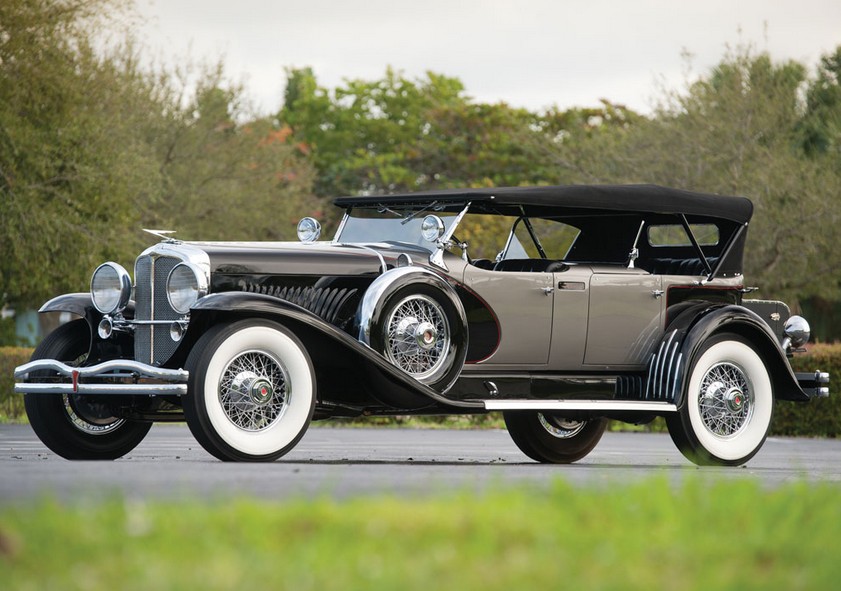
Duesenberg J-487

1930 Duesenberg Model J LWB Dual Cowl Phaeton by LeBaron

Sold by RM Auctions | Phoenix, Arizona | January 19, 2012

Photo – RM Auctions

We somehow missed featuring this Duesenberg during the hype and excitement leading up to the auctions in Arizona in January. And since one of my goals here is to feature every Model J that comes up for sale, here it is.

This is actually my favorite bodystyle – the LeBaron Dual Cowl Phaeton. It is also the coachwork most commonly associated with the Model J. And this is the only long-wheelbase Dual Cowl Phaeton built by LeBaron and it is the original body.

The engine, however, is not. When this car was delivered to a Mr. J. Clarke Dean of Chicago, Illinois in 1930, it had engine J-320 under the hood. The second owner discovered, in 1948, that the engine had been replaced with J-487 – an engine with no known previous history in another car. As always, the straight-8 makes 265 horsepower.

The sweep panel two-tone paint scheme is also my favorite. Black and red is the most common I’ve seen although most combinations are attractive (green and black is how I will have mine, please). LeGrande also built sweep panel Dual Cowl Phaetons that looked more or less the same. The way to tell the difference is that, on a LeGrande, the sweep of color extends farther down, halfway through the door.

This car was estimated between $900,000-$1,200,000. With this desirable, original coachwork, known history and coming from the John O’Quinn collection, it is definitely worth that. It sold for $880,000. Well bought. To read the complete catalog description, click here.

Update: RM Auctions, Amelia Island 2015:

Photo - RM Auctions

Photo – RM Auctions

Sold $1,155,000.

Update: RM Sotheby’s, Amelia Island 2019:

Photo Courtesy of RM Sotheby’s

Sold $1,650,000.

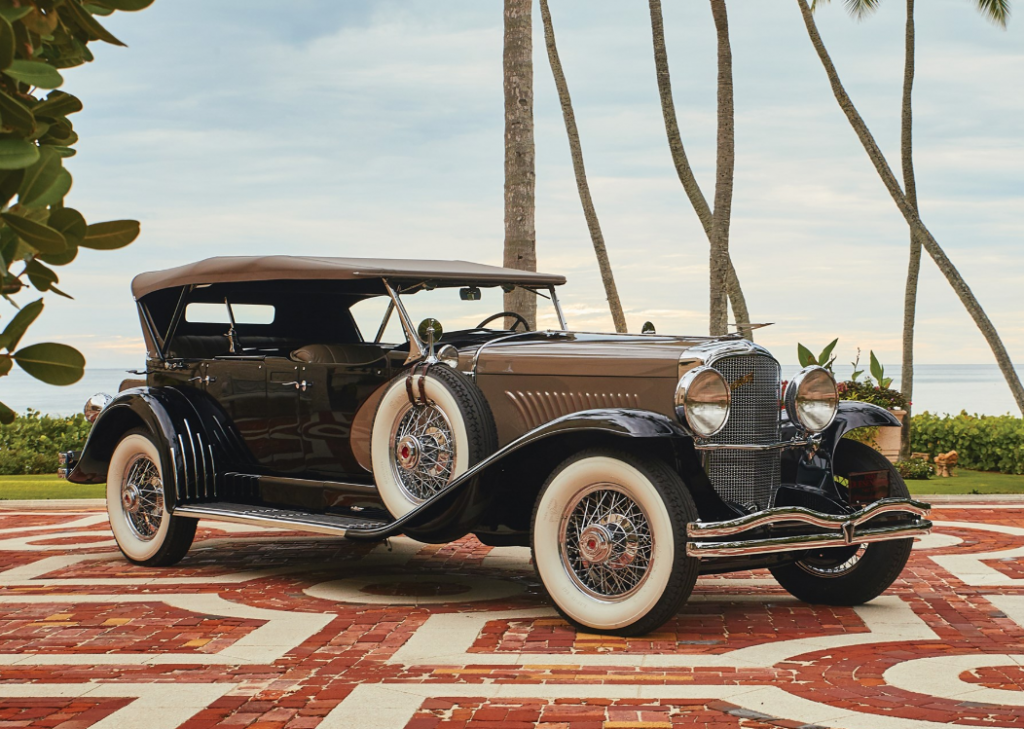
Duesenberg J-381

1930 Duesenberg Model J LWB Town Car by Murphy

Offered by Barrett-Jackson | Scottsdale, Arizona | January 15-22, 2012

Photo – Barrett-Jackson

Well I said in a previous post that we’d try and feature every Model J Duesenberg that comes up for auction and this is the third of the Arizona Duesenbergs for this season. And it just so happens that all three of them were bodied by Murhpy – the most prolific of all Duesenberg body-builders (now I’m picturing some hulk of a man lifting a Duesenberg with each arm like a barbell).

This car was delivered to its first owner on Halloween of 1930 (cue the sounds of ghosts and ghouls). This is that actual engine (J-381) that was fitted to this long-wheelbase chassis. There are a fair number of Model Js that have swapped engines over the years. And some that have swapped bodies – Freaky Friday-style (hmm, the Halloween theme returns).

This is an attractive Town Car from the Walter M. Murphy Company and it’s a car that would very much appear to be designed for some extravagantly wealthy person to be driven in. I’ve always wondered why “the help” were relegated to riding in the elements, but I guess that’s one of the perks of being wealthy. I’m sure the chauffeur’s union would object to this treatment if this car didn’t have a 265 horsepower straight-eight engine.

Barrett-Jackson doesn’t publish estimates for the cars they’re offering but I’m guessing it should come in right at about $1 million. There are bodystyles that are much more valuable and $1 million is a nice round number and a good starting point for valuating a Duesenberg. Also, this car has been sitting (for sale) at the Blackhawk Collection for quite some time.

There were 481 Model Js built and only 4 Murphy Town Cars. Find out more here and more about Barrett-Jackson in Scottsdale, here.

Update: Sold $1,045,000.

Update II: Sold, Bonhams Monterey 2016, $1,254,000.

Duesenberg J-284

1930 Duesenberg Model J Disappearing-Top Convertible Coupe by Murphy

Offered by Gooding & Company | Scottsdale, Arizona | January 20-21, 2012

Photo – Gooding & Company

Hooray! Gooding & Co. has finally put up their catalog so we can all “ooh” and “aah” at some of the best cars money can buy. The first car we are going to feature from their 2012 Scottsdale lineup is this 1930 Duesenberg Disappearing Top Convertible.

This car is titled as a 1932 because it is titled by its engine number. J-284 was installed at some point and a supercharger was added. The Duesenberg SJ was the factory supercharged version but this is an aftermarket conversion. I’m picturing 1930s high-schoolers souping up their dad’s Duesenberg. Let’s be thankful there isn’t a giant wing on the back.

The supercharger (which actually was a transplant from an actual SJ engine owned the this car’s owner during the 1960s) ups horsepower from 265 to 320. So it moves. Ownership history is known from new.

The Disappearing Convertible Coupe bodywork is by Walter M. Murphy Co. of Pasadena. This body style is one of the most sought after and definitely commands a price premium over a four-door sedan variant of the Model J. There is something quite elegant – and sporty – about a car that appears to have no top. This would have been quite the car to be seen driving (or riding) in 1930.

Gooding & Co. estimates a $1,600,000-$2,200,000 selling price. For more info about the car, click here. To see the entire lot list from Gooding & Co., click here.

Update: Sold $2,640,000.