Purple Pierce-Arrow

1919 Pierce-Arrow Model 66 A-4 Tourer

Offered by Barrett-Jackson | Scottsdale, Arizona | January 19, 2013
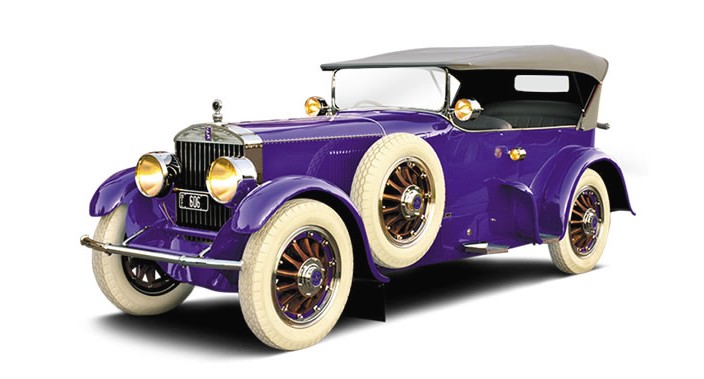
If I had to describe this car in one word it would be “opulent.” Pierce-Arrows were known as high-quality, high-cost automobiles for most of their existence and it’s cars like this that gave them that well-deserved reputation. It was one of the best cars you could buy in 1919.

And so, legendary film comedian Roscoe “Fatty” Arbuckle purchased this car as a bare chassis in 1919 and had it shipped to Don Lea Coach & Bodyworks in Los Angeles to have this custom body fitted. At the time, the designer working for the Don Lea coachbuilding company was a young Harley Earl. The color is described as “purple-blue” and whatever you want to call it, it is certainly striking. Especially when accented with those impossible-to-keep-clean all-white tires.

The Model 66 was introduced in 1910 and by 1918 it was a pretty old design. This 1919 model was one of the last built. In total, 1,250 were built and only about 14 survive today (only seven are the A-4 type). The engine is a monstrous 13.5-liter straight six making around 60 horsepower.

Tom Barrett (of Barrett-Jackson) acquired the car in 1976 and a light cosmetic restoration was performed before it was acquired by the Blackhawk Collection in 1982 where it remained until 2006. It was restored completely by its current owner, winning first-in-class at Pebble Beach in 2007. This is an exceptional automobile with a storied history and a one-of-a-kind look. For more information, click here.

Update: Not sold.

Stately Soviet Sedan

1978 GAZ Chaika M13

For sale at Hyman Ltd | St. Louis, Missouri

Russian cars are so weird. But in a really interesting way. The “marque” is usually associated with a particular factory, in this case it is GAZ – which roughly translates to “Gorky Automobile Plant.” It is located in Nizhny Novgorod, which, coincidentally, will be the name of my first-born child.

The Chaika (which kind of translates to “seagull”) was a car used by Soviet government officials – but not the really important ones (they got ZIL limousines). This was for your run-of-the-mill bureaucrats and field officers. You might be thinking “How is this a 1978? It looks like something from the mid-1950s.” Well you’d be right. After WWII, the U.S. government prodded Packard into licensing (or selling) their old body dies to the Soviet Union, presumably to appease them into not nuking us.

Well Packard did just that but Packard also went out of business in the 1950s. So the Chaika (Mark I or “M13”), which was produced from 1959 through 1981 was almost a direct copy of the 1955-1956 Packard Patrician, at least from the outside. The engine was a 195 horsepower 5.5-liter V8. It also used Russia’s first three-speed push-button automatic transmission (which was essentially copied from Chrysler). In 1977, the Chaika M14 was introduced and it was more of an original (and contemporary) design, at least for the time.

Chaikas are really rare – anywhere in the world, especially in the U.S. They were not mass produced by American standards – or anybody’s standards, really. And their limited market ensured not many would be built. It’s really interesting and a piece of Cold War history. This one is in really good shape and can be yours for $69,500. For more information, click here.

White M16 Half-Track

1944 White M16

Offered by Auctions America | Auburn, Indiana | December 8, 2012

Here’s another good-lookin’ White half-track, this one an M16. The M16 was essentially an M3 (like the Autocar above) but it has a powered, armored turret with up to four .50 caliber machine guns. As with all of the items offered in this sale, the guns have been demilitarized – meaning, they no longer work as guns. But this is what makes something like this legal to own… and drive down the street. Engine-wise, this is powered by a 148 horsepower 6.3-liter straight-six. More here.

Update: Sold $95,000.

Update II: Sold, Auctions America Auburn Spring 2017, $82,500.

Hanomag Half-Track

1940 Hanomag S.P.W. Ausf. C Sd.Kfz. 251/1

All offered by Auctions America | Auburn, Indiana | December 8, 2012

Photo – Auctions America

This massive Hanomag is technically a 3/4-track. Whatever. I don’t like fractions. The Sd.KFz. 251 was one of the more popular German vehicles with 15,252 built by various manufacturers, with Hanomag being the most prolific. It uses a 100 horsepower 4.2-liter Maybach straight-six. This is a Model C (they made them in A through D configuration) so it had many improvements over earlier models, such as better engine ventilation. More here.

Update: Sold $160,000.

Metz Model 25

1915 Metz Model 25 Tourer

Offered by Bonhams | Harrogate, U.K. | November 14, 2012

This is the third Metz I can recall coming up for auction in the past two months. I really wanted to feature one of the other two but it never fit on the schedule. So when I saw this one third from the end of Bonhams’ lot list for their Harrogate sale (here), I had to feature it.

Charles Herman Metz founded the car company that bore his name in 1909 in Waltham, Massachusetts. He bought out the Waltham Manufacturing Company – a company he co-founded and was subsequently booted from. They were producing Waltham and Orient Buckboard cars when he bought them out. Metz produced cars in their factory but they also offered them on the “Metz Plan” where consumers would pay a weekly fee and have parts shipped to their homes, where they would assemble it themselves. It was a mail-order car – in parts. Which is interesting, but not great if you needed a car, say… anytime in the next 4-to-6 months. Metz folded in 1922.

No word on if this four-cylinder Metz was a home-build or a factory car, but it was involved in an accident in 1915 before it had even covered 600 miles. It was then promptly garaged for the next (gets his calculator out)… the next 55 years! That’s right, this thing sat in storage somewhere until 1970 when it was dragged out and had its engine rebuilt with only 564 miles on the odometer. It has since been completely restored and can be yours for $19,000-$24,000. Fore more information, click here.

Update: Sold $13,600.

Panther J72

1975 Panther J72 Roadster

Offered by Bonhams | Harrogate, U.K. | November 14, 2012

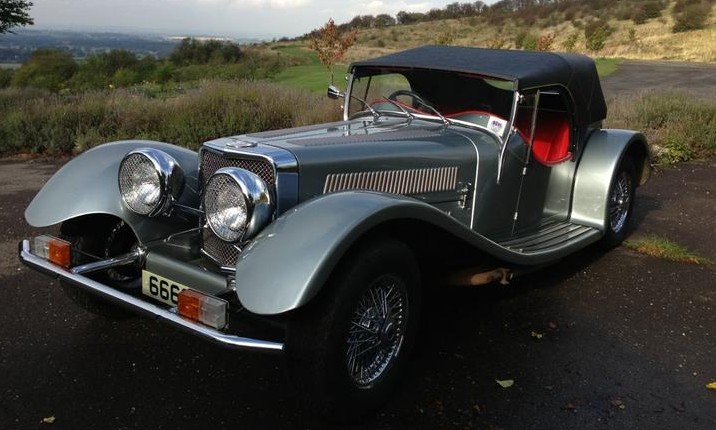
Panther Westwinds was founded in 1972 by Robert Jankel to build low-volume sports and luxury cars in Surrey. The J72 was the first car from the company and it combined a little of both luxury and sports car. It was not a kit car, but rather a full production car with styling reminiscent of the Jaguar SS100. It was not a replica either and it preceded the wave of “nostalgia cars” (aka neo-classics) by a solid five years.

It did, however, use Jaguar engines. You could get a 5.3-liter V12 or your choice of two Jaguar straight-sixes. This one has the 4.2-liter I6 (a 3.8 was also available) that makes somewhere around 240 horsepower.

The J72 was produced from 1972 until 1981. In total, 368 were built and this one has been owned by its current owner since new. It’s a 7,000 mile car that has seen extremely light use in the past 10 years. This is a rare, unusual and cool car for only $29,000-$35,000. For more information, click here. For more from Bonhams at the Great Yorkshire Showground, click here.

Update: Sold $35,500.

Vespa 400

1960 Vespa 400

For Sale at Hyman Ltd | St. Louis, Missouri

Vespa is the world famous scooter manufacturer that produces the classic design that has been popular among so many different groups of people since it went on sale in the late 1940s. They have been featured in many films over the years, but perhaps most famously in Roman Holiday with Gregory Peck and Audrey Hepburn. Sales took off after that and when I think “Vespa” I think someone roaring around the streets on a scooter outside the Colosseum in Rome.

Vespa is owned (and has been since its inception) by Piaggio, the Italian motorcycle conglomerate. In the late 1950s, Piaggio designed a small car and licensed the design to ACMA in France, who built the car as the Vespa 400. ACMA was independent of Piaggio, yet they were still badged as Vespas, which was a Piaggio trademark. While Vespa scooters are Italian, this Vespa car is French. Weird. In any case, ACMA put the car into production in 1957 but they closed up in 1962, a year after Vespa 400 production wrapped.

About 34,000 of these cars were built and this is as nice of one as you’re likely to find. It’s tiny but two people can fit inside. It has a folding fabric top and is powered by a 393cc straight-twin making 20 horsepower. It’s a two-stroke engine mounted in the rear, driving the rear wheels. See that weird looking thing on the front where the grille would normally be? That’s a sliding tray containing the battery.

This is a U.S. market car (it has a 3-speed transmission, other markets got 4-speeds). It will do 50 mph and can be yours for $31,500. For more information, click here.

Update: Sold, Mecum, Kansas City, December 2012, $22,500.

Ruxton Sedan

1931 Ruxton Model C Sedan

Offered by Barrett-Jackson | Scottsdale, Arizona | January 19, 2013

The idea for the Ruxton came from Archie Andrews, who was on the board of Hupmobile. He named the car after William Ruxton, an investor he was hoping to attract to the car. Ruxton said no and sued for the use of his name. It didn’t matter – Ruxton was founded in 1929 and was out of business by early 1931.

The car was designed and backed by New Era Motors Inc of New York City. While the design was original, the company lacked the capital to undertake production themselves. The cars ended up being built in one of two locations: either at the Moon plant in St. Louis or by Kissel in Hartford, Wisconsin. It was a front-wheel-drive car – aimed directly at Cord – that used a 100 horsepower 4.4-liter Continental straight-eight engine.

The design was sleek and sporty looking – it lacked running boards and its rakish design made it look quick while their paint schemes were intended to make them look longer. The headlights are some of the coolest on any car ever (called Woodlight headlights) – although they don’t provide much light – make sure you’re home by dusk!

Moon went bankrupt before production really got going and Ruxton tried a hostile takeover of Kissel and the Kissel family shut their business down to prevent it – forcing Ruxton out of business after production had been underway for only four months. Only 300 to 500 cars were built. Two were Phaetons, one was a Town Car and the rest were split between Sedans and Roadsters. Only 19 total are known to still exist, only eight of those being sedans. This is a very rare car and it’s one of the best Depression-era cars and one of the greatest American cars ever built. You can read more here and see more from Barrett-Jackson in Scottsdale, here.

Update: Sold $275,000.

1963 Chrysler 300

1963 Chrysler 300 Sport Series Convertible Coupe

Offered by RM Auctions | North Palm Beach, Florida | December 1, 2012

Photo – RM Auctions

Well this the last 300 offered from the Staluppi Collection and it is not a Letter Series car – although the Letter Series continued in 1963 with the “J”, 1964’s “K”, 1965’s “L”, the 1970 Hurst 300 and the 1979 300. The 1963 300J was not available in convertible form. But the 1963 Sport Series was. It was also available as a 4-door hardtop, sedan and 2-door hardtop. The Sport Series convertible still used a 6.8-liter V8 but it only put out 305 horsepower. Production was much higher – 1,535 300 Sport Series Convertibles were built  in 1963 while only 400 300Js were built in total. Needless to say, if you want to pick up most of the run of 300 Letter Series cars, then this is the sale for you. Estimate: $60,000-$75,000. You can read more here and check out more from RM’s sale of the Cars of Dreams Museum here.

Update: Sold $71,500.

300H Convertible

1962 Chrysler 300H Convertible Coupe

Offered by RM Auctions | North Palm Beach, Florida | December 1, 2012

Photo – RM Auctions

The front-end styling remained almost the same, but the fins disappeared for 1962. This was also the first year for the non-letter series Chrysler 300 (that is just “300” without a letter and referred to as the “Sport Series”, which was available with two or four doors). Styling differences between the two separate 300 models were non-existent. It was under hood where the difference lay. Power on the 6.8-liter V8 was back up to 380 and there were a few cars sold with a high-output 405 horsepower option. Production dropped significantly now that there was a cheaper alternative that looked the same. Only 570 were built, 435 coupes and 135 convertibles. Estimate: $60,000-$80,000. More info can be had here.

Update: Sold $74,250.