Duesenberg J-299

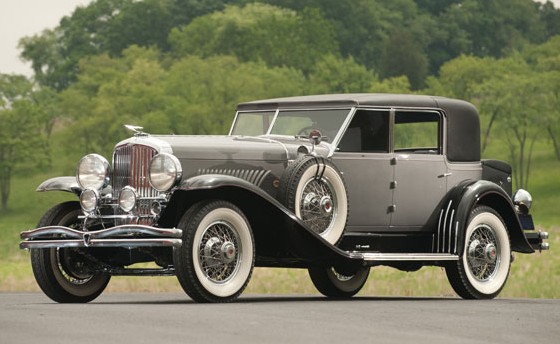
1931 Duesenberg Model J Dual Windshield Barrelside Phaeton by LeBaron

Offered by RM Aucitons | Hershey, Pennsylvania | October 11-12, 2012

This Duesenberg has two things – okay three things – going for it. First, it’s a Duesenberg. So score a point over just about all competition. Second, it carries a rare and desirable bodystyle. And third, it has a story.

The body is by LeBaron and it’s a rare “barrelside” dual-windshield phaeton – one of only seven built. “Barrelside” just means that the body has a bit of a curve to it – it’s not extremely noticeable in the pictures.

But the story is the interesting part here. This car was delivered new to Phil Berg, a wealthy Hollywood agent. He and his wife, actress Leila Hyams, were at Al Jolson’s house when Zeppo and Chico Marx roared up in their Mercedes S-Type (I feel like Regis Philbin telling one of his heavy-on-the-name-dropping Hollywood tales). The gathering shifted focus to the two cars parked outside and eventually Chico Marx bet Berg that his Mercedes could beat the Duesenberg in a race from Al Jolson’s house to Santa Monica beach.

Instead of a Depression-era The Fast and the Furious-style race through Hollywood, they decided to move the race to Muroc Dry Lake in the Mojave Desert. Two engineers/racers were grabbed to drive the cars and the friendly wager ballooned to $25 grand – a princely sum in the 1930s. They stripped the cars down to nothing – the Duesenberg looking very awkward without fenders or any unnecessary body panels (pictures available at RM’s site).

There were a few hundred invited celebrity guests in attendance and this Duesenberg was victorious. The car passed through numerous owners before being restored in 1985. It’s an exceptional car with an exceptional history. For more information, click here. And for more from RM in Hershey, click here.

Update: Sold $1,292,500.

Hemi Superbird

1970 Plymouth Hemi Superbird

Offered by Barrett-Jackson | Las Vegas, Nevada | September 20-22, 2012

The Plymouth Superbird is the most outlandish of all muscle cars. Nothing competes with that wing. It’s original purpose was a homologation model for the road so Chrysler could go beat up Ford and General Motors in NASCAR.

Basically, they took a Plymouth Road Runner (the sister car, the Dodge Charger Daytona was based on, well, a Dodge Charger). From there, a streamlined nosecone was added to the front and there were cutouts above the front wheels, covered by rear-facing scoops. Then there was that wing. Why is it so tall? Well, so they could still open the trunk. There were also some cool decals here and there.

Engine choices were limited to the base 440 Super Commando V8 making 375 horsepower. A step up from there was to the six barrel carb setup for 390 horsepower. Or you could go all out and get the 426 Hemi making 425 horsepower.

The car was pretty successful in NASCAR, enough so to get itself banned for 1971. Chrysler only needed to produce 500 road cars to satisfy NASCAR, but, in total, 1,290 Superbirds were built – but only 135 had that oh-so-wonderful and sought-after Hemi engine. This is a matching-numbers Hemi car in Lemon Twist Yellow with 20,000 original miles. It has been restored and looks great. My best guess for price would be around $275,000. For more info, click here. And from more from Barrett-Jackson in Vegas, click here.

Update: Sold $297,000.

Invicta Bluebird

1931 Invicta 4½-Litre S-Type Low-Chassis Tourer

Offered by Bonhams | Goodwood, England | September 15, 2012

Invictas – especially the low-chassis models – are some of the sportiest cars of the era. They are aggressive looking with a low center of gravity, meaning handling and road holding were areas were Invicta cars excelled over their competitors – which included Bentley and Lagonda, among others. The cars were expensive and only about 1,000 Invicta cars of all models were built.

This is a 4.5-liter S-Type meaning the engine is a 4.5-liter straight-six that has been supercharged to produce speeds capable of 100 mph. All Invictas used Meadows engines built by Henry Meadows (except the first three prototypes). The supercharged Meadows six was a torquey monster – you can drive this car in top gear down to 6 mph!

Invictas never saw the racing success of Bentley. They went after a different niche – cars that could be throttled by their owners – just wrung out. High speeds for extensive distances with no wear or tear. The cars were so solidly built that 68 of the 77 S-Types built still survive.

This car, nicknamed “Bluebird,” has known ownership history since the 1960s and a three-year restoration was completed in 2011. It’s kind of weird, but pre-war cars were available in many different guises: big tourers, racing cars, etc. But this is a sports car. It’s made to go fast – but it’s not a competition car. There aren’t a lot of pre-war cars that are worthy of this designation. And this is among the best of them. The pre-sale estimate is $870,000-$1,100,000. For more information, click here. And for more from Bonhams at Goodwood, click here.

Update: Not Sold.

Maserati Tipo 26 Four-Seater

1930-31 Maserati Tipo 26 Sport

Offered by Bonhams | Goodwood, England | September 15, 2012

If you can believe it, there are actually two 1930 Maserati Tipo 26s up for auction at this sale. One is a two-seater, and the one seen here is a four-seater – you know, the more useful of the two when hauling the kids to soccer practice. Both cars come out of the same collection and having similar histories, as they were both imported into the U.K. for racing purposes in 1930. We’ll focus on the four-seater from here on.

The car is powered by a supercharged 2.5-liter straight-8, taking direct aim at Alfa Romeo’s 8C competition cars. This car competed against Alfa 8Cs, driven by the likes of Henry “Tim” Birkin, in the 1931 Eireann Cup in Dublin, Ireland. This car finished second to Birkin in an 8C. It was driven by Giuseppe Campari, who mid-race, was temporarily blinded when mud and debris from another car came off the track and shattered his goggles, sending glass into one of his eyes. Giulio Ramponi, a sometimes riding mechanic who was working in the pits, took over the car while Campari had his eye tended to. Before long, Campari ran back onto the track, flagged Ramponi down, and resumed his race.

The car was entered at Brooklands earlier that year, but only one of the two cars offered here actually competed (chassis unknown, based on price, I’d say likely this one). This car did compete at Brooklands in 1933 and a few other races over the next few years. It passed through numerous hands – and numerous drivetrain configurations – before being acquired by its current owner in 1952. All of its original pieces were located and reinstalled, making this a highly original example of an already extremely rare car.

It is very impressive, in both history, rarity and condition. It is an exquisite alternative to the comparatively common Alfa Romeo 8C. The pre-sale estimate is $2,900,000-$3,500,000. For the complete lot description, click here. And from more from Bonhams at Goodwood, click here.

Update: Sold $2,727,000.

Duesenberg J-139

1929 Duesenberg Model J Sport Sedan by Murphy

Offered by RM Auctions | Hershey, Pennsylvania | October 11-12, 2012

Photo – RM Auctions

Yay, another Murphy-bodied Model J Sport Sedan. I’m going to be honest, I’m running out of things to say about this bodystyle of car from this specific coachbuilder. So instead, I’ll leave you to look at the car and marvel in awe of how the performance and glamour of this thing must have felt in 1929. Incredible, I’m assuming.

RM hasn’t published a lot description yet (which can be read here), but unless this car has some fantastic ownership history or some really cool story, I would expect it to sell for between $400,000-$700,000. You can see more from RM in Hershey here.

Update: Sold $792,000.

Update: Sold, Auctions America Auburn Fall 2013, $962,500.

All-Original Mercedes-Benz S-Type

1928 Mercedes-Benz 680 S-Type Four-Seat Open Tourer

Offered by Bonhams | Goodwood, England | September 15, 2012

Well check this out. This 1928 Mercedes-Benz S-Type Tourer has been in the same family for the last 84 years. That’s single-family ownership from new. And it has never been restored and has covered only 8,375 miles. This is an incredible car and an example of one of those cars that proves there is always something out there that will surprise you when it surfaces.

Mercedes-Benz introduced the S-Type in 1927. It featured a 6.8-liter straight-six with supercharger that was designed by Ferdinand Porsche. Power was around 180 and the top speed was in excess of 100 mph. The big brothers of this car, the SS, SSK and SSKL are legendary for their performance.

This car was ordered by an Army Captain in early 1928. It was delivered to England as a bare chassis and bodied by Cadogan Motors Ltd. of London with this lightweight, four-seat, fabric open tourer-style body. It was road-registered up through 1937 and by the 1950s it was set on blocks in the custom-made garage built specifically for this car.

The original owner’s grandson acquired the car in 2012 and brought it back to life. It runs and drives and has been inspected by a Daimler-Benz Classic engineer. This was the first great car produced by Mercedes-Benz and everything is just as it was in 1928 (well, the tires are new and the transmission was replaced by the owner in the 1930s). You won’t find a car this rare and interesting that hasn’t been seen in 60 years anytime soon. Then again, who knows what else will drive out of the woodwork tomorrow.

The pre-sale estimate is $2,400,000-$3,200,000. For the complete lot description, click here. And for more from Bonhams at Goodwood, click here.

Update: Sold $4,544,000.

1917 Abbott-Detroit

1917 Abbott-Detroit 6-44 Four-Passenger Roadster

For Sale at Hyman Ltd. | St. Louis, Missouri

The Abbott-Detroit Motor Car Company was founded in Detroit in 1909. Cars could be had with either four or six-cylinder Continental engines. This car uses a 3.7-liter straight-six making an estimated 44 horsepower. The body looks like a two-door, two-passenger roadster, but there are actually two seats directly behind the driver – a layout common in modern coupes, but not something you see too often in cars from the 1910s. Also, this car is listed as “bigger than it looks in the pictures,” which sounds about right when you see some of the detail shots.

Abbott-Detroit relocated to Cleveland in 1916 and was renamed the Consolidated Car Company. They badged their cars as “Abbott”s, although the 1917 model you see here is badged as an Abbott-Detroit. The company went bankrupt in 1918 and was liquidated the following year.

Abbott-Detroit cars were guaranteed for life, but unfortunately, the company had long since closed before this car was discovered and restored. It comes with a large amount of documentation including documents from the factory such as stock certificates and correspondence, which is pretty cool.. The asking price is $73,500. For more information, click here.

Update: Sold, Mecum Kansas City, 2014 for $35,000.

Duesenberg J-356

1932 Duesenberg Model J Tourster in the style of Derham

For sale at St. Louis Car Museum & Sales | St. Louis, Missouri

Ordinarily I wouldn’t feature a car on a Saturday, the day I normally reserve for auction results or, well, my day off. But this is a makeup post because two weeks ago I featured J-355, a car which had already been featured. I knew this car was for sale, and it was going to be skipped so I could feature that other car. So I felt dumb, and here we are.

This is a Model J that was constructed from pieces of other Duesenbergs. In total, three cars combined to make this one. A Willoughby Sedan originally sat atop this chassis and the engine came from a Murphy Convertible Sedan. Other parts came from a car that was once a Rollston Cabriolet. But it does have an actual Duesenberg engine, no. J-356.

The body is not original. It is one of a few built by a man named Ted Billings to an exacting standard in the style of a Derham Tourster. This type of Model J isn’t the most desirable, but it will get you in the ever-exclusive “I-own-a-real-Duesenberg” club. The cost of entry? $799,900. For more information, click here.

Update: Failed to sell at Motostalgia, Houston 2014.

Update II: Failed to sell at Bonhams, Greenwich 2015.

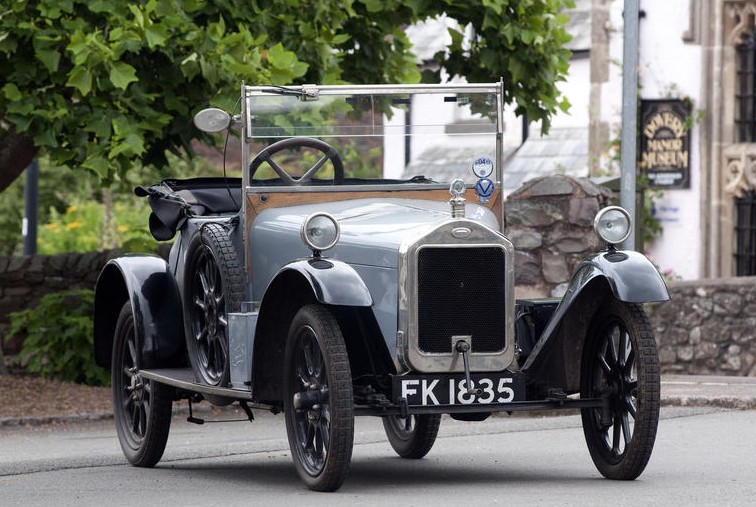
Wolseley Seven

1922 Wolseley Seven Tourer

Offered by Bonhams | Beaulieu, U.K. | September 8, 2012

Here’s another small British convertible. The name Wolseley is probably familiar to you, as they produced cars in Birmingham from 1901 until 1975. The Seven name might also be familiar to you, as the Austin Seven (or 7, as it is usually seen) was one of the most popular British cars during the years of its production of 1922 through 1939. I kind of think of the Austin 7 as the British Ford Model T. Sure, the Model T came first and the British had them too, but the Austin 7 had the same kind of effect on the British automotive market as the Model T did in the U.S.

Wolseley and Austin were independent manufacturers in the 1920s, although Austin tried to buy Wolseley in 1927, but were outbid by Morris. But Austin and Morris merged in 1952 anyway as British automotive firms began to consolidate time and again. For a while  thereafter, Austin and Wolseley produced badge-engineered versions of the same cars.

But this was not the case in 1922 when the Wolseley Seven was introduced. The car was high in quality but it was at the bottom end of the market with its flat-twin engine of 986cc making just 8.5 horsepower. The Austin 7, introduced the same year, used a 747cc straight-four making 10.5 horsepower. And, to make matters worse, the Wolseley was considerably more expensive. This led to only about 1,000 being made before production halted at the end of 1923.

Only about 10 of these very rare cars survive today – and this one is in drop-top form. It’s a former museum car in good shape. The pre-sale estimate is between $13,000-$19,000. For more information, click here. And for the rest of Bonhams’ lineup for this sale, click here.

Update: Sold $18,773.

1913 Humberette

1913 Humber Humberette 8HP Two-Seater

Offered by Bonhams | Beaulieu, U.K. | September 8, 2012

Like many automotive manufacturers, Humber began as a bicycle company. Founded as such in 1868 by Thomas Humber, their first car didn’t appear until 1898, a three-wheeler. Four-wheelers appeared in 1901. “Humberette” was applied to light (single-cylinder) Humbers in 1903 and 1904 and then it went missing until after 1910.

The cyclecar fad was sweeping the U.K. in the early teens and Humber eagerly opted in, bringing the Humberette name back from the great beyond for their v-twin powered cyclecars, like the one you see here. This has a 996cc V-Twin making eight horsepower. Unlike most of its competition, this cyclecar has shaft drive, as Humber was not a fan of the much more common chain drive.

Humberette was not technically its own marque but the cars are often referred to as if they were. The Humberette name disappeared again at the start of WWI. The Humber name lasted until 1976, being killed during the Chrysler Europe fiasco. This car was restored at some point and has seen little use over the last quarter century in the hands of its current owner. The pre-sale estimate is $17,000-$22,000. For the complete description, click here and for more from Bonhams at the National Motor Museum, click here.

Update: Sold $36,809.