Duesenberg J-357

1930 Duesenberg Model J Disappearing Top Convertible by Murphy

Offered by RM Auctions | Phoenix, Arizona | January 17, 2014
1930 Duesenberg Model J-357 Disappearing Top Convertible by Murphy

Photo – RM Auctions

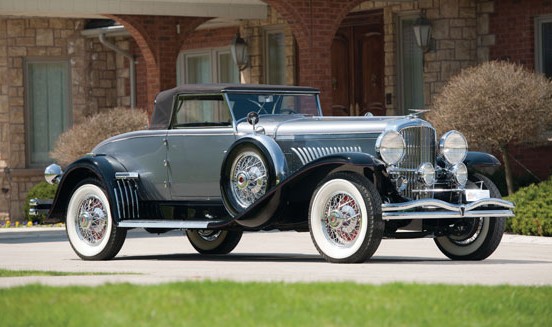
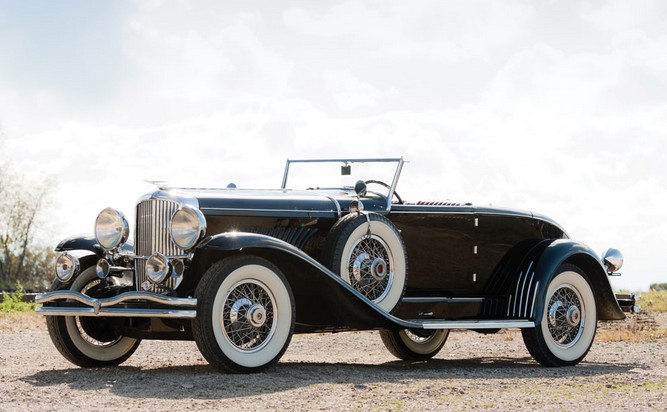
Well this is a beautiful car. What is strange though is that this was the cheapest Model J by Murphy you could buy in 1930. It cost a wealthy lumber baron in West Virginia $13,500 that year. It’s a short-wheelbase chassis and uses Duesenberg’s signature Lycoming 6.9-liter straight-eight engine making 265 horsepower.

The original owner sold it in 1946 to a man named Melvin Clemans who regularly drove the car from West Virginia to Auburn, Indiana, for the annual ACD gathering. A friend of Clemans worked on the car for him and became the cars’ third owner in 1998.

Luckily, he never restored it. He rebuilt the mechanicals (and so did RM Restorations, more recently) but the body, paint, wood, interior, and chrome are all-original. This is a 30,000 mile car that has been driven a lot by every owner it’s ever had. It’s really nice to see a car like this still being driven hard and on the road to local car shows and not across putting greens at big, fancy concours.

This is 1 of about 25 “Disappearing Top Convertibles” built by the prolific Walter M. Murphy Company. It is arguably among the coolest as it remains as it did the day it left the showroom floor in Huntington, West Virginia, back in 1930. This car should bring between $2,000,000-$2,400,000. You can read more here and see more from RM here.

Update: Sold $2,200,000.

Update: Sold, Gooding & Company Amelia Island 2016, $2,640,000.
A Brough Superior Road Car

1935 Brough Superior 4-Litre Drophead Coupe by Atcherely

Offered by H&H Auctions | Buxton, U.K. | October 30, 2013

1935 Brough Superior 4-Litre

George Brough built, perhaps, the greatest motorcycles of all time. Brough Superior motorcycles are the most sought-after collector bikes out there and with good reason: they were the result of fantastic engineering and incredible build-quality. They were the most expensive motorcycles you could buy and were the equivalent of a two-wheeled Rolls-Royce.

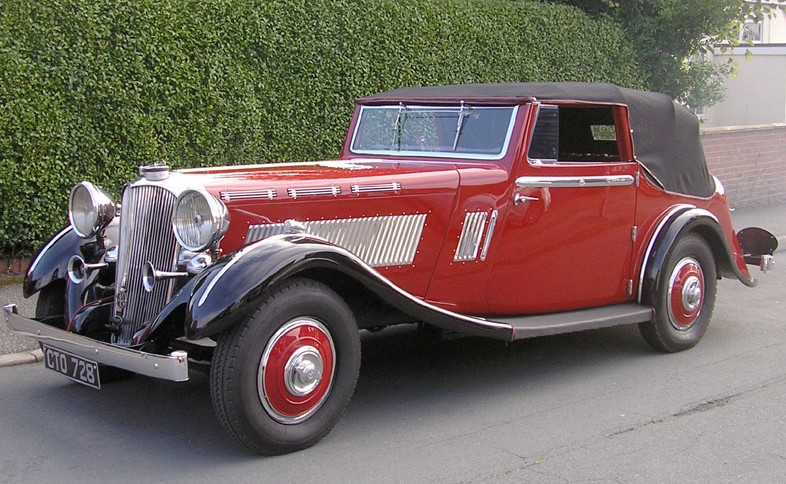
Motorcycle production started in 1919 and continued to 1940. In 1935, George Brough decided to produce a few cars as well. The first model used a Hudson-sourced 4-litre straight-eight engine making 125 horsepower. They offered quick acceleration and a 90 mph top speed. The 4-Litre lasted only through 1936 before it was replaced by a six-cylinder model. Most had this bodywork from Atcherley.

Only about 20 4-Litre cars were built and only eight are known to survive (Brough Superior only built about 85 cars total). This car is “described as ‘restored.'” What’s interesting to me is that Brough Superior motorcycles, while very rare, outnumber cars by a lot to a few and bring prices very similar to the $110,000-$130,000 that this car is supposed to bring. I’ve just always assumed cars would be more expensive than motorcycles. I guess that’s not always the case, but it sure makes this car seem like a bargain. Click here for more info and here for more from H&H.

Update: Sold $107,800.

Duesenberg J-331

1930 Duesenberg Model J Convertible Coupe by Murphy

Offered by Auctions America | Auburn, Indiana | August 29-September 1, 2013

1930 Duesenberg Model J-331 Convertible Coupe by Murphy

The Convertible Coupe bodystyle by the Walter M. Murphy Company of Pasadena, California, is one of the most-popular bodystyles on Duesenberg Model Js. It’s on the shorter of the two Model J wheelbases, so the proportions are fantastic.

All Model Js had their bodies outsourced to coachbuilders, but there was a factory catalog for customers who purchased the bare chassis and wanted some idea as to where to go for a body. This was the cheapest body in the catalog – at $13,500. About 60 of them were built.

This car was originally built for a member of the du Pont family and delivered new to New York City. It passed through quite a number of owners over the years, having spent a good deal of time recently in a Chicago collection – until now. The restoration is nice but older and it could a “minor freshening.” Look for a price around $900,000. Click here for more info and here for more from Auctions America’s fall Auburn sale.

Update: Sold $1,540,000.

Renault Nervastella Grand Sport

1935 Renault Nervastella Grand Sport Convertible

Offered by Artcurial | Paris, France | June 10, 2013

1935 Renault Nervastella Grand Sport Convertible

The first things that struck me about this car were 1. the lack of a windshield and 2. the wheel covers in the rear. Then I looked at other photos and realized that the windshield actually folds forward onto the hood of the car. Still, it’s kinda striking.

The Renault Nervastella was Renault’s eight-cylinder model that took the place of the Reinastella in 1930 (the Reinastella remained in production alongside for a few years). Production continued through 1936 when it was replaced by the Suprastella. 1934 was the year in which Renault adopted new super aerodynamic styling, which this car definitely sports. The engine is a 5.5-liter straight-eight.

The Grand Sport (series AMB3) was produced only between March and September of 1935 and only 118 were built. This is the only one left. I think it’s pretty cool – maybe because so many French cars of the 1930s from Renault, Peugeot, Citroen and Panhard rarely cross the Atlantic. Anyway, this one should sell for between $78,000-$130,000. Click here for more info and here for more from this sale.

Update: Sold $324,844

Hudson Commodore 8 Convertible

1950 Hudson Commodore 8 Convertible Brougham

Offered by Auctions America | Auburn, Indiana | May 9-11, 2013

1950 Hudson Commodore 8 Convertible Brougham

There is a fabulous collection of Hudsons at this year’s Auburn Spring Sale from Auctions America. There are two 1950 Commodore 8 Convertibles, and while the other one is in nicer, brand-new condition, I think the color combo on this one is more attractive. Plus the photos are better.

The third generation of the Hudson Commodore was introduced for the 1948 model year. This generation is one of my favorite American car designs of all time. Their final year was 1952. Engine options were a straight-six or a straight-eight, as found in this car. It is 4.2-liters and makes 128 horsepower.

The convertible was a nice style – as all two-door Commodores are super-sporty looking, sharing styling cues from the Hornet, which had been honing its skills on the NASCAR circuit. This is an all-original car with 71,000 miles and three-on-the-tree. The fender skirts are what sets it apart – to me at least. And the wire wheels are off a Chrysler (and I’m not sure why). This is a $30,000-$45,000 car. Click here for more info and here for more from this sale.

Update: Sold $51,700.

3000GT Convertible

1992 Mitsubishi 3000GT VR-4 Convertible Conversion

Offered by Mecum | Kansas City, Missouri | April 26, 2013

1992 Mitsubishi 3000 GT VR-4 Convertible Conversion

The 3000GT was the coolest car Mitsubishi ever built – and yes, that includes the Evos. They were built from 1990 through 2001 and the competitive set through those years included the Toyota Supra, Nissan 300ZX and Mazda RX-7.

But there was never a factory convertible offered on the 3000GT. There were, however, conversions available from convertible masters ASC (American Sunroof Corporation), whose name was a little misleading as they tended to chop the entire roof off instead of just making sunroofs. Anyway, the ASC convertibles were only available for the 1995 and 1996 model years. And they were retractable hardtops.

So what gives here with this rag top car? Well let’s start with the fact that it is a VR-4 – the king hell version of the 3000GT. What the VR-4 model got you was 4-wheel-drive with a 296 horsepower 3.0-liter twin turbo V-6. Pretty desirable among these cars. But someone (Mecum’s description says “Californian R. Strahan” but I have no idea what that refers to) lopped the roof off and installed a soft top. And it looks well done. It looks so good, that I’m pretty bummed Mitsubishi never offered the option from the factory.

This is a 23,000 mile original car. 3000GTs have not held their price as well as Supras and RX-7s. They, with the 300ZX, have fallen off a bit, but the nice ones can still command a premium. And this is a nice one. $15,000 or slightly more doesn’t sound unreasonable at all. Click here for more info and here for more from this sale.

Update: Sold $14,500.

F-Code T-Bird

1957 Ford Thunderbird F-Code Convertible

Offered by RM Auctions | Fort Worth, Texas | April 27, 2013

1957 Ford Thunderbird F-Code Convertible

The Ford Thunderbird was the supposed answer to the Chevrolet Corvette (I say “supposed” because the Thunderbird diluted its image every possible chance it got after 1957 while the Corvette got more and more intense). The first two years of Corvette production saw the car saddled with a straight-six. Chevy upped the ante for 1955 with a V-8. Ford introduced the Thunderbird as an all-new model for 1955 and a V-8 as the only power choice.

Both cars were absolute stunners in the looks department. Thunderbirds were offered in a sea of colors – pastels and the like. If you wanted to collect the entire rainbow, you probably could. This one is black with black wheels – and it looks rather menacing.

And it should. This is an “F-Code” car – which means it has the 5.1-liter V-8 that has been supercharged to make 300 horsepower. The most powerful Corvette you could buy in 1957 only made 283 ponies. And this wasn’t even the king of the Thunderbirds. There was one more step up – but only 12 of those were made.

As I’ve been writing these posts for cars from this sale prior to the release of the lot description from RM, I had to do a little research to find out how many F-Code Thunderbirds were actually built. On Barrett-Jackson’s website, I did a search for them and every result had a different total for the number built. An older RM post has the number at 205, which is what I’ll go with.

Thunderbirds are thought as cruisers today but this one will get your attention off the line. It’s a really awesome car and the fact that it looks the part is even better. It should bring a massive $150,000-$200,000. Click here for more info and here for more from this sale.

Update: Sold for $198,000.

Tri-Power Catalina Convertible

1959 Pontiac Catalina Tri-Power Convertible

Offered by Mecum | Boynton Beach, Florida | February 23, 2013

1959 Pontiac Catalina Convertible

For 1959, Pontiac dropped the Chieftain name and started using “Catalina” instead, which sounds 1. more politically correct (in today’s insane terms) and 2. way cooler – especially for a convertible as the word “Catalina” has a two semi-exotic connotations in my mind (a flying boat and an island). Although, if your first thought when you hear “Catalina” is salad dressing, you have my deepest sympathy (and absolute understanding).

This bodystyle for the first generation of the Catalina was available for 1959 and 1960 only. This particular car is gorgeous. I’ve never looked at late-1950s Pontiacs in the same light as I do Chryslers (300 Letter Series) and Cadillacs. But I do now. Part of it is the whitewalls and chrome wire wheels. The engine is a 6.4-liter V8 (the only option available, although varying compression ratios and carburetor setups allowed for different power outputs). This is a Tri-Power car, using three Rochester 2-barrel carbs making 318 horsepower.

You don’t see many of these – especially in this condition with “all the goodies.” It comes from Fran & Ron Green’s Verde Classics Museum in Boynton Beach, Florida. The whole museum is going under the hammer. I don’t see why this isn’t a $100,000 car. Click here for more info and here for the rest of the collection on offer.

Update: Sold $58,000.

Minerva Convertible Sedan

1931 Minerva Model AL “Windswept” Convertible Sedan by Rollston

Offered by Bonhams | Scottsdale, Arizona | January 17, 2013

1931 Minerva Model AL Windswept Convertible Sedan by Rollston

Minerva is one of the great makes of the 1930s. They built big, powerful, imposing cars for the rich elite. The cars came adorned in the fanciest coachwork from the most respected of coachbuilders. This particular Minerva meets all of the above criteria.

Dutchman Sylvain de Jong started manufacturing bicycles under the name Minerva in Antwerp, Belgium in 1897 before moving onto automobiles. In 1930, the Model AL was introduced. It uses a 6.6-liter sleeve-valve straight-eight making between 120-130 horsepower. The wheelbase of 152 inches was one of the longest you could get, giving the folks at Rollston a lot of room to work with when crafting this exquisite “windswept” convertible sedan. The “windswept” referring to the distinct “in-motion” look the car has when sitting still – the sharp angle of the doors, A & B pillars and roofline.

Rollston provided some of the most expensive coachwork you could buy in the 1930s and the Minerva AL chassis was also near the top of its own list. In fact, it was so expensive, only about 50 were ever built and you had to have deep pockets to get one. This car was purchased new by the son-in-law of R.J. Reynolds (of tobacco fame). Over the years, it has maintained its exclusive price, with a pre-sale estimate of $900,000-$1,100,000. Click here for more info and here for more from Bonhams in Scottsdale.

Update: Did not sell.

Update II: Sold, RM Auctions, New York, 2013: $660,000.

Sunbeam Tiger

1966 Sunbeam Tiger Mark II

Offered by Mecum Auctions | Kansas City, Missouri | December 8, 2012

The Shelby Cobra was more than just a badass sports car – it was an inspiration and a new way of thinking in the automotive world. A completely redesigned Sunbeam Alpine appeared in 1959. It was supposed to be a sports car. But by 1963, the most powerful engine available was an 80 horsepower straight four. Meanwhile, Carroll Shelby had transformed the 120-horsepower AC Ace into his famous fire-breathing 271 horsepower monster – and that was just the start, as later cars would have 425 horsepower. The Alpine didn’t compete with the Ace in terms of performance, much less the Cobra.

Ian Garrad, West Coast Sales Manager for the American arm of the Rootes Group and a few other employees realized the Alpine’s potential and figured out that Ford’s Windsor V8 would fit in the car. They sent an Alpine to Shelby and had him wedge one of the engines in. Then they shipped it to England to have the Sunbeam folks evaluate the car.

Sunbeam approved and tasked sports car maker Jensen with the production of the Tiger. Series I cars used the 164 horsepower 4.3-liter V8. Series II cars had a 200 horsepower 289 Ford V8 (4.7-liters). This is a Series II car and they are very rare – only 536 of the 7,085 Sunbeam Tigers built were 200 horsepower Series II cars. While it doesn’t compete with the Cobra in terms of power or performance, this is still a fast, powerful British sports car from the 1960s. And there is that always-desirably Shelby connection.

This being a Series II car ups its value to a fair degree. To read more and for more pictures, click here. And for more from Mecum in Kansas City, click here.

Update: Not sold.