Autovia Roadster

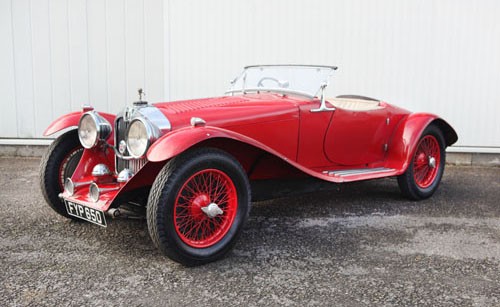
1939 Autovia 3-Litre

Offered by Coys | Graz, Austria | October 12-13, 2013

1939 Autovia 3-Litre

There are sporty cars from the U.K. from the 1930s that everyone knows about, like the SS100 and Invictas. Then there are the lesser known ones like Arabs and this beautiful Autovia.

Like Arab, Autovia was a very short-lived marque. Founded in Coventry in 1937 as a subsidiary of well-known Riley. The cars were expensive, luxurious and sporty. It was a market that was already full of more prominent manufacturers. Two different sedan bodstyles were offered, as well as a limousine. In total, only 38 four-door cars were built. There were also six bare chassis sold – this is one of those cars. The Autovia proved an expensive experiment that ultimately bankrupted Riley, which was acquired by the Nuffield Organization in 1938. Autovia disappeared forever after that.

This car is the only Autovia to receive two-door aluminium roadster bodywork. What sets this roadster apart from many other British sports cars of the day is the engine. It’s a 3.0-liter V-8 making 125 horsepower. That’s a lot more than most of its competition – it’s Bugatti territory. This is a very quick car.

And very desirable too. Only eight Autovias are thought to survive, with this one having the most desirable coachwork (by far). This is definitely one of the stars of this auction. You can read more here and find out what other cars will be crossing the block here.

Update: Sold for about $110,000.

Microcar Mondays Part IV

The Bruce Weiner Microcar Collection

Offered by RM Auctions | Madison, Georgia | February 15-16, 2013

____________________________________________________________

1951 Reyonnah

1951 Reyonnah

Reyonnah (which comes from the name of company founder Robert Hannoyer spelled backwards), was a short-lived automaker from Paris. It was only around from 1951 through 1954 and this was the car that they built.

A single-cylinder engine was used, either of the 125cc or 175cc variety. The 175cc put out 8.5 horsepower. It will do 63 mph and can seat two people – the passenger directly behind the driver. You’ll probably notice the weird angle this thing is parked at – that’s because the front had a very wide track compared to the rear – but, when parked, the front wheels could be brought in closer – to make it easier to park. When this happens, it raises the front of the car up into the air. Weird. This should sell for between $75,000-$100,000. Click here for more info.

Update: Sold $184,000.


____________________________________________________________

1985 Sinclair C5

1985 Sinclair C5

Most of the cars from this sale are from the 1940s through the 1960s. Not this one. Designed by Sir Clive Sinclair and built by the Hoover vacuum people, the C5 was built for 1985 only. It had pedals (like a sit-down bicycle) but was also powered by an electric motor making capable of 15 mph. But a street-legal 15 mph tricycle – that could be driven without a driver’s license – was dangerous. And the fact that it was built and marketed primarily in England and had no top, made it unsuitable for the general climate. It was a massive flop, even though 17,000 were sold in 1985. It should sell for between $3,000-$5,000. Click here for more info.

Update: Sold $4,600.


____________________________________________________________

1968 Authi Mini 1275C
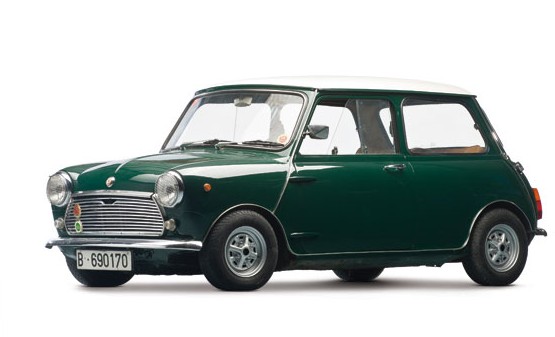
1968 Authi Mini 1275C

Wait, just a plain ol’ Mini Cooper after all these weird cars? Well, kind of. It isn’t a Morris or Austin or even a Mini-badged Cooper. It’s not even British-built. Authi – of Pamplona, Spain, – built the Mini under license from 1968 through 1975. This is from their first year of production and it has the 1275cc Mini engine (1.3 liters) making about 54 horsepower. Authi was an automotive production plant, primarily, and built cars for BMC under the Austin brand. But the Mini they branded themselves. The Authi plant became part of SEAT in 1976. They built about 140,000 Minis with their name on it, but you hardly ever see them. This one should sell for between $20,000-$30,000. Click here for more info.

Update: Sold $28,750


____________________________________________________________

1956 VELAM Isetta

1956 VELAM Isetta

Another Isetta from another brand. In this case, this Isetta was built by VELAM – a French company that built them under license between 1955 and 1958. There were slight variations – the body was more rounded and there is a big, bold “VELAM” script across the front door. It uses a 236cc split-single-cylinder engine making about 9.5 horsepower. It could do 50 mph and only about 5,000 were built. It should bring between $30,000-$40,000. Click here for more info.

Update: Sold $37,375.


____________________________________________________________

1959 Bond Minicar Mk F
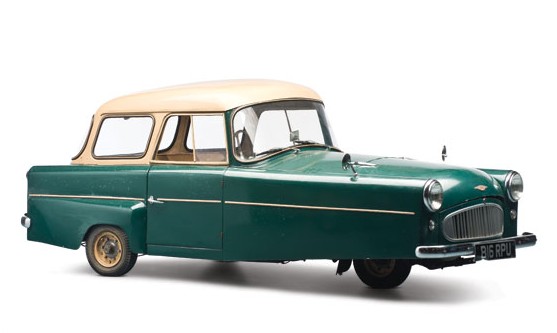
1959 Bond Minicar Mk F

The Mark F iteration of the Bond Minicar was the second-to-last version offered for sale. Built from 1958-1963, the Mk F is differentiated from its immediate predecessor by its  larger engine – a 247cc single-cylinder making 12 horsepower. There were different body styles offered – this is a hardtop. It was capable of 55 mph and there was a four-seat version available (I honestly can’t tell if this has four seats or two). Only 6,493 were made in total. This one, with some of the tiniest looking wheels in comparison to overall car size I’ve ever seen, should sell for somewhere in the range of $15,000-$20,000. Click here for more info.

Update: Sold $11,500.


____________________________________________________________

1959 Frisky Family Three
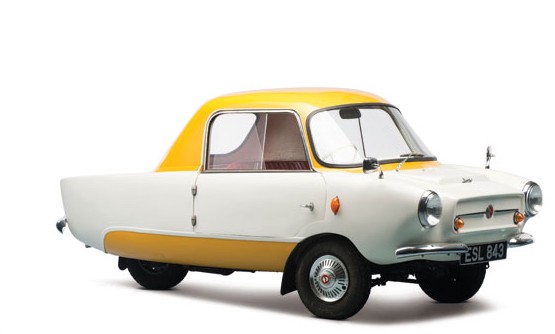
1959 Frisky Family Three

The Frisky was one of those cars that was produced by multiple companies – all of whom couldn’t help but go bankrupt at some point. The second company to use the Frisky trademark was Frisky Cars Ltd and they introduced the Family Three in late 1958. It was essentially a three-wheeled version of the Frisky Coupe that could be driven with a motorcycle license. The company was reorganized the following year (1959) and the model names were changed. This car uses a rear/mid-mounted 197cc single-cylinder making 9.5 horsepower. It could do 50 mph and should sell for between $15,000-$20,000. Click here for more info.

Update: Sold $57,500.


____________________________________________________________

1959 PTV 250

1959 PTV 250

PTV sold their Spanish-built microcars from 1956-1961. Two models were offered, the 250 and the 400. Both were tiny two-door convertibles that differed only in engine size. The 250 used a rear-mounted 247cc single-cylinder making 11 horsepower. Top speed was around 45 mph. Most of the cars were sold in Spain, although same made it to Portugal. Between the two models, a total of around 11,000 were sold. This one will sell again for between $40,000-$50,000. Click here for more info.

Update: Sold $46,000.


____________________________________________________________

1939 New-Map Baby

1939 New-Map Baby

This unrestored pre-war microcar from French motorcycle manufacturer New-Map is very rare. New-Map was founded in 1920 in Lyon and it built its first itty-bitty car in 1938. It was called the Baby and it used a 100cc single-cylinder Sachs engine – the same one from their motorcycles. Only about 1,000 were built. In 1946 they re-introduced the car with a 125cc engine but it only lasted one year. This one should bring between $15,000-$20,000. Click here for more info.

Update: Sold $21,850.


____________________________________________________________

1957 Victoria 250
1957 Victoria 250

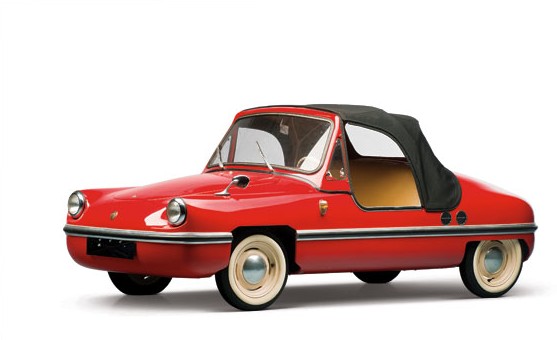
This little German fiberglass convertible was originally marketed as the Brütsch Spatz. Victoria was a motorcycle manufacturer in Nuremberg and they entered a joint venture with another company to form BAG (Bayerische Autowerke GmbH), to produce these cars under license as the BAG Spatz. But first, they re-engineered the car to make it stronger and safer – and added a fourth wheel from the original three-wheeled design – this got them out of paying licensing fees. Lastly, they pumped the displacement up to 250cc from 200cc. The single-cylinder made 14 horsepower. While BAG produced the Spatz, Victoria produced the car concurrently, from 1956 through 1958 as the Victoria 250. Only 729 of the Victoria-badged cars were sold. This one should sell for between $35,000-$45,000. Click here for more info.

Update: Sold $37,375.


____________________________________________________________

1958 Goggomobil Dart
1958 Goggomobil Dart

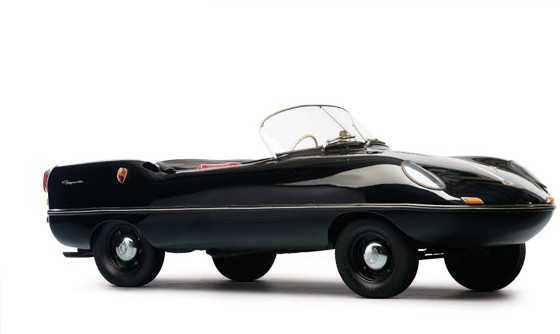
Goggomobil was a German microcar company, but in 1959, Buckle Motors of Sydney, Australia designed a two-door roadster based on the small Goggomobil Coupe. Somehow, they were able to market the cars under the Goggomobil name and they called it the Dart. It used the same 293cc straight-two making 14 horsepower (with an optional upgrade to 392cc and 18 horsepower). The body was fiberglass and it was produced through 1961. Only about 700 were built. It’s an Australian car with a German name and it could be yours for $35,000-$45,000. Click here for more info.

Update: Sold $54,050.
New-Map Baby

1939 New-Map Baby

Offered by RM Auctions | Madison, Georgia | February 15-16, 2013

1939 New-Map Baby

Photo – RM Auctions

This unrestored pre-war microcar from French motorcycle manufacturer New-Map is very rare. New-Map was founded in 1920 in Lyon and it built its first itty-bitty car in 1938. It was called the Baby and it used a 100cc single-cylinder Sachs engine – the same one from their motorcycles. Only about 1,000 were built. In 1946 they re-introduced the car with a 125cc engine but it only lasted one year. This one should bring between $15,000-$20,000. Click here for more info.

Update: Sold $21,850.

Five Cool WWII Trucks

Vehicles from The National Military History Center

All offered by Auctions America | Auburn, Indiana | December 8, 2012


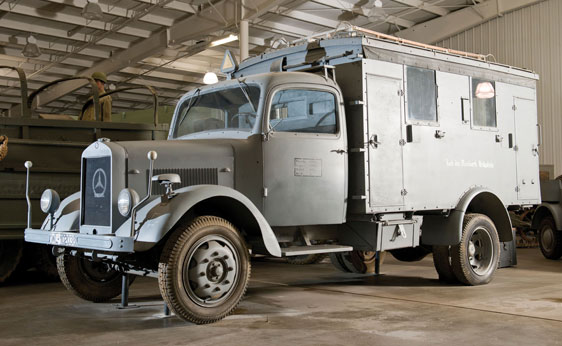
1942 Mercedes-Benz L3000S

Okay, I’ll be honest. I want this truck – or, rather “Box-Van Truck” – for one reason and one reason only (besides it being a valuable piece of history) and that is: to reenact my very own Raiders of the Lost Ark chase sequence. This truck has a 75 horsepower 4.8-liter four-cylinder diesel and a 6.75-ton load capacity. The box-van body is made of wood and pressed cardboard – for cost reasons, so it’s a miracle it has survived this long. About 7,400 of these were built. Estimate: $30,000-$40,000. More info can be had here.

Update: Sold $32,000.


_________________________________________________________________________

1940 Breda 40 4×4 Artillery Tractor

This relatively uninteresting-looking vehicle is an artillery tractor. It is pure function. Built in Italy, this little brute could pull 7.75-tons of artillery over all kinds of terrain, using huge tires and high ground clearance in place of tracks. It uses a 110 horsepower 9.4-liter six-cylinder diesel but it will only do a blistering 11 mph on the road. Talk about low gearing! It can be yours for $25,000-$35,000. More info here.

Update: Sold $37,000.


_________________________________________________________________________

1942 GMC DUKW-353

Ah, the good ol’ Duck. Wanna start a tour company near a body of water? Then this is the vehicle for you. Easily one of the most popular and recognizable vehicles from WWII, these things are still in use all over the country – a testament to how good of an amphibious vehicle they really were. About 21,000 were made from 1942 through 1945 and they were shipped all over the world. Designed to hold 25 troops or 2.5-tons of cargo. It will do 45 mph on the road or 6.3 mph (yes that’s a decimal) on the water – conditions permitting – thanks to its 94 horsepower 4.4-liter straight-six. It’s super, super cool. Estimate: $50,000-$75,000. More info here.

Update: Sold $97,000.

Update II: Sold, Auctions America Auburn Spring 2017, $49,500.

_________________________________________________________________________

1940 Humber Hexonaut GS 6×6 Amphibious Prototype

Here’s another amphibious vehicle – although it’s much smaller than the Duck above. And it’s much rarer, being the only one in existence as the vehicle never entered production as it was “not fit for duty.” It could hold eight men or 1-ton of supplies and has two engines (of 14 horsepower each) and transmissions – one for each side/set of three wheels. This is also how it turned (operating them at different speeds), as you can see how close the wheels are to the body. Unpopular in 1940, this style would become more popular decades down the road on some ATVs. The estimate is $30,000-$50,000. More info here.

Update: Sold $47,500.


_________________________________________________________________________

1939 Latil M2TL6 4×4 Tractor

Latil was a French manufacturer of heavy-duty trucks and tractors. Yes, this is another artillery tractor and you might be wondering why – but hey, when’s the next time I’ll get to feature a vehicle built by Latil? This one is faster on road than the Breda above – it will do 45 mph and has a 68 horsepower 4.1-liter straight-four. Estimate: $20,000-$30,000. More info here. And for the rest of the Auctions America lineup for this fantastically interesting sale, click here.

Update: Sold $10,000.

Unic Half-Track

1939 Unic Kegresse P107/U304(f)

All offered by Auctions America | Auburn, Indiana | December 8, 2012

Photo – Auctions America

Unic, the French automobile manufacturer that turned to trucks in 1938 – which was highly convenient when war broke out the following year. Military vehicles are usually an extension of the heavy-truck business. Unic was bought by Fiat in 1966 and was merged into Iveco in 1975.

This Kegresse tracked tractor uses a 60 horsepower 3.4-liter straight-four. Kegresse means that the tracks are made out of rubber or canvas and not metal like most tanks and other half-tracks. I guess it’s gentler on the roads… or enemy soldiers. Strangely, all of these vehicles were built before the Germans took over France – but Germany used them anyway. More here.

Update: Sold $20,000.

Half-Track Mania!

Half-Tracked Vehicles from The National Military History Center

All offered by Auctions America | Auburn, Indiana | December 8, 2012


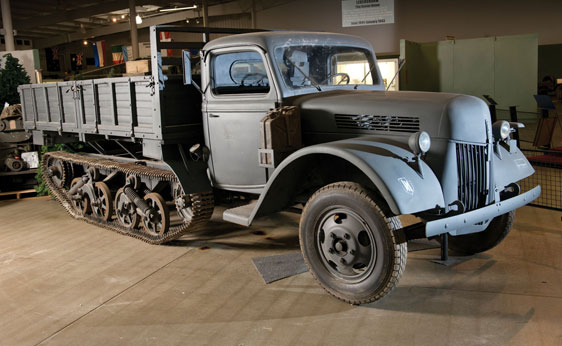
1943 Ford Maultier

This Ford “Maultier” (or “Mule”) is one of quite a few half-tracks going under the hammer from the National Military History Center in Auburn, Indiana. I’m not sure of the story behind this sale. The collection is quite astounding and it’s a shame that it’s being broken up and sold off, especially considering they are all available for the public to see. Half-tracks are some of my favorite WWII vehicles because… well they’re just so awesome. I’m unaware of the condition of these vehicles. The paint looks fresh but they are museum pieces so they might not be in the best shape mechanically (some even lack engines). But who cares – they are all rare and all really, really cool.

This one was built by Ford of Germany (this collection includes an impressive number of rare “Axis” vehicles). It’s powered by a 3.9-liter V8 making 95 horsepower. It will do 25 mph with those big tracks on the back. More here.

Update: Sold $42,500.


1945 Daimler-Benz DB10 Sd.Kfz. 8

Daimler-Benz was the name of the company that owned Mercedes-Benz in the 1930s. Instead of badging their Sd.Kfz.8s as “Mercedes-Benz,” they went ahead and just called them “Daimler-Benz”es – as were most of their heavy machinery during the war. The front is adorned with the three-pointed Mercedes-Benz star, but lacks the ring around it.

These were in production from 1937 until 1945 and used a Maybach 8.5-liter V12 making 185 horsepower, although this particular truck is engine-less. It has a 12-ton payload capacity – in other words, it’s a monster. About 4,000 were built in total by various manufacturers making this one of the most desirable half-tracks you can get. More here.

Update: Sold $200,000.


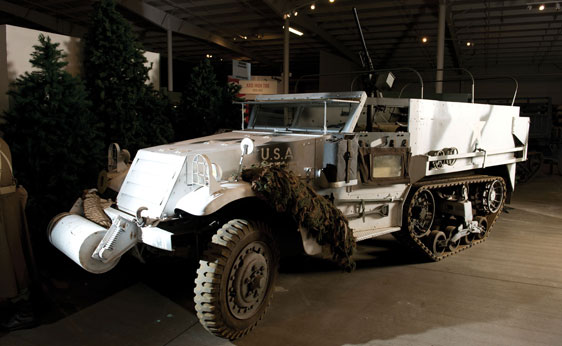
1941 Autocar M3

This is, by far, one of my favorites of this sale. It has that classic look – as did most of the vehicles produced by White, Autocar and Diamond T. That slanted front where a radiator would usually be. And whatever that thing is hanging off the front. Classic.

About 12,000 of these were built for the U.S. war effort (about 41,000 half-tracks were built in total of all kinds for the U.S.). This one has a 148 horsepower 6.3-liter straight-six. It’s quick too, capable of 40 mph. More here.

Update: Sold $38,000.


1940 Hanomag S.P.W. Ausf. C Sd.Kfz. 251/1

This massive Hanomag is technically a 3/4-track. Whatever. I don’t like fractions. The Sd.KFz. 251 was one of the more popular German vehicles with 15,252 built by various manufacturers, with Hanomag being the most prolific. It uses a 100 horsepower 4.2-liter Maybach straight-six. This is a Model C (they made them in A through D configuration) so it had many improvements over earlier models, such as better engine ventilation. More here.

Update: Sold $160,000.


1944 Auto Union HL kl 6p

This Auto Union model was the final evolution of the 3-ton half-track. They were made for a short time in 1944 only and, due to material shortages in Germany at the time, the cabs were mostly finished with wood and/or cardboard. Classy. It’s powered by a 100 horsepower 4.2-liter Maybach straight-six. More here.

Update: Sold $75,000.


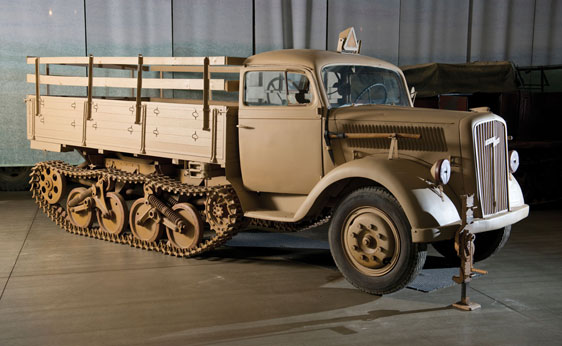
1943 Opel Maultier

This 2-ton Opel Maultier is one of about 4,000 built. It has a 75 horsepower 3.6-liter straight-eight. Opel was a curious case during the war. They  have been a General Motors subsidy since 1929. When the war broke out, Opel’s automobile production ceased so they could help with the war effort. Meanwhile, back in Detroit, GM was building airplanes that could have possibly flown missions in Europe, essentially bombing their own factories. More here.

Update: Sold $65,000.


1939 Unic Kegresse P107/U304(f)

Unic, the French automobile manufacturer that turned to trucks in 1938 – which was highly convenient when war broke out the following year. Military vehicles are usually an extension of the heavy-truck business. Unic was bought by Fiat in 1966 and was merged into Iveco in 1975.

This Kegresse tracked tractor uses a 60 horsepower 3.4-liter straight-four. Kegresse means that the tracks are made out of rubber or canvas and not metal like most tanks and other half-tracks. I guess it’s gentler on the roads… or enemy soldiers. Strangely, all of these vehicles were built before the Germans took over France – but Germany used them anyway. More here.

Update: Sold $20,000.


1942 Borgward H kl 6

Carl Borgward’s little (okay, it wasn’t that little) automobile company was drafted into producing vehicles for the Reich. This truck has a 3-ton payload capacity and entered production in 1937. This particular vehicle does not have an engine – it’s more of a static display piece – but back during the war it likely had a 100 horsepower 4.2-liter Maybach straight-six. More here.

Update: Sold $145,000.


1944 White M16

Here’s another good-lookin’ White half-track, this one an M16. The M16 was essentially an M3 (like the Autocar above) but it has a powered, armored turret with up to four .50 caliber machine guns. As with all of the items offered in this sale, the guns have been demilitarized – meaning, they no longer work as guns. But this is what makes something like this legal to own… and drive down the street. Engine-wise, this is powered by a 148 horsepower 6.3-liter straight-six. More here.

Update: Sold $95,000.


1943 Opel Maultier Panzer-Werfer 42 Rocket Launcher

This Opel Panzer-Werfer is a tracked rocket launcher. It’s pretty mean looking, isn’t it? It has one 10-barreled rocket launcher mounted in the back – of course it no longer works, so you won’t be able to blast traffic jams out of your way. This piggish brute is powered by a 75 horsepower 3.6-liter eight-cylinder engine. It weighs about 7-tons, so that is probably no where near enough horsepower. Only 300 of these were built. More here and the rest of the auction lineup here.

Update: Sold $60,000.