An Unrestored WWI Truck

1916 Nash Quad

Offered by Artcurial | Paris, France | June 10, 2013

1916 Nash Quad

Okay, yes, I know. This thing is in rough shape. But let’s step back from condition issues and think about something: when was the last time you saw a World War One vehicle? What about one for sale? What about one for sale in original condition? Wartime vehicles generally don’t even survive the war, yet alone the one hundred years that follow.

World War Two trucks can be found with relative ease. But there’s something so inaccessible about the “War to End All Wars.” Maybe because so many vehicles from that era were scrapped to build things to fight the Nazis. Maybe it’s because no one from that era is still alive (but were as of recently). This truck just blows my mind.

The Quad was designed by Thomas B. Jeffrey and was built as the Jeffrey Quad beginning in 1913. The thing is amazing for the time: it has a 5.2-liter straight-four engine making 29 horsepower and driving all four wheels with solid tires. Top speed is about 15 mph. It also has four-wheel brakes (an absolute rarity in 1913) and four-wheel steering. Four-wheel drive vehicles existed prior to this, but none were this solid or well built. They started out as delivery trucks popular (especially in rural areas) in the U.S. In 1914, war broke out and production picked up (thousands – 11,000+ – were built in total, exact figures unknown). In 1916, Nash Motors acquired Jeffrey and continued production of the Quad as the Nash Quad. So this thing is from the first year of Nash production.

This was undoubtedly a wartime truck. Other Quads exist – some in pristine, restored condition. But you won’t find one “straight out of the war,” so to speak. The engine turns over but it doesn’t run and it could be restored. It’s one of only three in France (if that means anything to you). It was discovered as-is in the 1980s – but think of the life it lived – the people it may have carried into battle – and now none of them are still alive today. It’s a piece of history from another time and so, so cool. It should sell for between $10,000-$20,000. Click here for more info and photos and here for more from Artcurial.

Update: Sold $21,456

Renault Nervastella Grand Sport

1935 Renault Nervastella Grand Sport Convertible

Offered by Artcurial | Paris, France | June 10, 2013

1935 Renault Nervastella Grand Sport Convertible

The first things that struck me about this car were 1. the lack of a windshield and 2. the wheel covers in the rear. Then I looked at other photos and realized that the windshield actually folds forward onto the hood of the car. Still, it’s kinda striking.

The Renault Nervastella was Renault’s eight-cylinder model that took the place of the Reinastella in 1930 (the Reinastella remained in production alongside for a few years). Production continued through 1936 when it was replaced by the Suprastella. 1934 was the year in which Renault adopted new super aerodynamic styling, which this car definitely sports. The engine is a 5.5-liter straight-eight.

The Grand Sport (series AMB3) was produced only between March and September of 1935 and only 118 were built. This is the only one left. I think it’s pretty cool – maybe because so many French cars of the 1930s from Renault, Peugeot, Citroen and Panhard rarely cross the Atlantic. Anyway, this one should sell for between $78,000-$130,000. Click here for more info and here for more from this sale.

Update: Sold $324,844

ASA RB 613

1966 ASA RB 613

Offered by Artcurial | Paris, France | June 10, 2013

1966 ASA RB 613

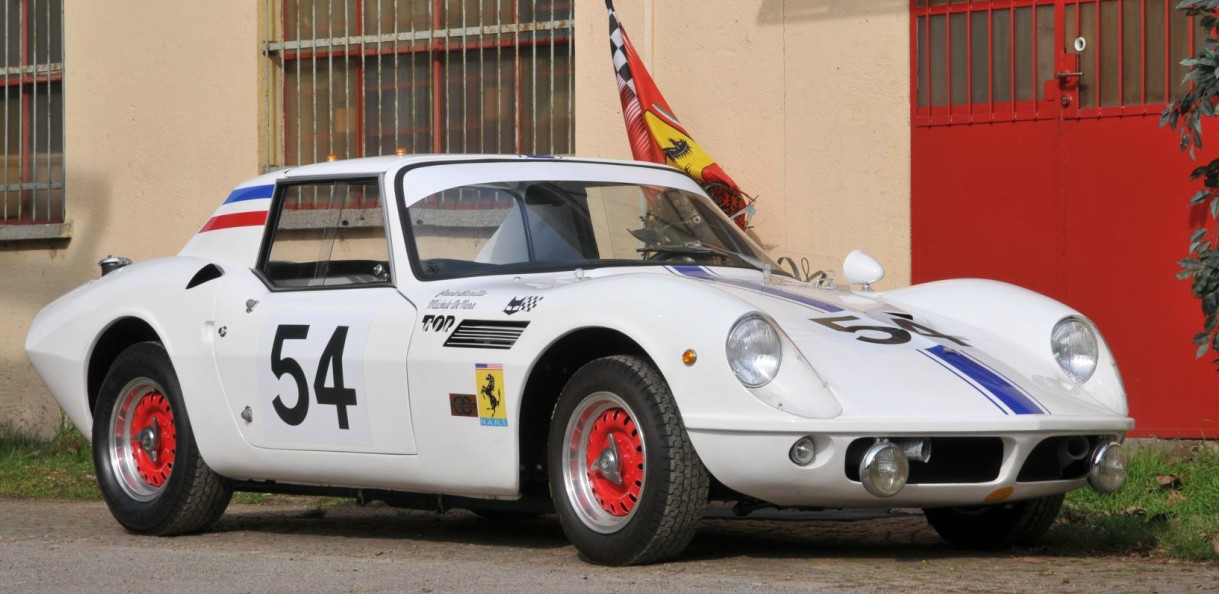
The ASA 1000 GT was a small Italian coupe built through the mid and late 1960s. It used a small 1.0-liter engine that was developed by Ferrari engineers. It was like a mini-Ferrari.

But what’s a small Italian sports car without any racing pedigree? ASA decided to go racing in 1966 and they went to Carrozzera Corbetta for a more aerodynamic and racy body. They integrated a roll bar into the rear bodywork – hence the model name, “RB.” They also upped the engine: this car has a 1.3-liter straight-six making 124 horsepower. (The “613” in the model name ostensibly standing for “6” cylinders “1.3” liters).

Only three of these cars were built and the model was never intended for public sale. They were factory-built race cars. Two of them competed at Le Mans. This one did not. But it does have a historic FIA certificate and is prepped and eligible for some historic racing events. It is expected to sell for between $360,000-$440,000. Click here for more info and here for more from Artcurial in Paris.

Update: Sold $291,184

1909 Mitchell

1909 Mitchell Three Seater

Offered by Bonhams | Greenwich, Connecticut | June 2, 2013

1909 Mitchell Three Seater

Mitchell was a short-lived but not extremely rare automobile produced for 20 years from 1903 in Racine, Wisconsin. Sure, it’s not a marque you hear about often – but they are out there and you do see them from time to time.

This is an earlier car and, at the time, the four-cylinder was the largest engine offered (sixes and eights would come later). It’s a 3.3-liter straight-four and power output is not known (but feel free to buy this thing, strap it to a dyno and report back!).

This car was part of the Harrah collection (shocking, I know) and was restored while a part of said collection. It ventured back into the collector car world in the 1980s. Small cars of this vintage don’t necessarily all have highly original coachwork – this is your standard fare, but it’s attractive and would be fun to motor around a small town in. And it has one of the most horrifying early car fads: the so-called “mother-in-law” seat – a single seat behind the rear bench that is just kind of there by itself. It you fell out (seemingly likely) the driver would be none the wiser, because you’re tucked behind the stowed convertible top. Nice.

The pre-sale estimate is $35,000-$45,000. Not bad for something over 100 years old. Click here for more info and here for the rest of Bonhams’ lineup in Connecticut.

Update: Sold $39,600.

Supercharged Bugatti Type 43

1930 Bugatti Type 43 Sports 2/4-Seater

Offered by Bonhams | Greenwich, Connecticut | June 2, 2013

1930 Bugatti Type 43 Sports

The Bugatti Type 43 was part of the line of cars that spawned off the Type 30. Introduced in 1927, the Type 43 stood apart from earlier models in that it, while it used a similar chassis, it added a supercharger – making it quick and one of the world’s first 100 mph production cars with a top speed of 112 mph.

The engine is a 2.3-liter supercharged straight-eight making 120 horsepower. It was a transplant from Bugatti’s current grand prix car of the day. The history on this car goes back to 1928, when the engine was built. It’s titled as a 1930 because it wasn’t sold until then.

This car spent most of its early life on the French Riviera – which is only about the coolest place you could own and drive an old Bugatti. It came to the U.S. in 1950. The current coachwork on the car was already on the car by 1950 – although it is not original, nor is it certain where the body originated. The car has been restored within the last 10 years and finished 3rd in its class at Pebble Beach.

This is basically a road-going Bugatti grand prix car (running gear, short wheelbase, etc.) and it can be yours for between $1,000,000-$1,200,000. Click here to read more and here for more from Bonhams in Greenwich.

Update: Sold $875,000.

A Car for the Gatsby Generation

1922 Mercer Series 5 Sporting

Offered by Bonhams | Greenwich, Connecticut | June 2, 2013

1922 Mercer Series 5 Sporting

I recently watched Baz Luhrmann’s take on The Great Gatsby and one thing I noticed was that nearly all of the cars were from the 1930s. The book (and the movie) both take place in 1922 – and are pretty explicit about it. But I guess pre-1923 cars are a lot harder to come by than using things that came later. Plus, to the casual viewer, the cars would pass as period-correct The car you see here wouldn’t have been driven by Gatsby himself, but it’s the type of car that some of his party-goers would have driven.

Mercer invented the sports car in 1911 with the Raceabout. In the mid-1910s, Mercer changed ownership and in 1921, it reverted back to the family of its founders. Along with their sporty raceabouts, Mercer built sporty touring convertibles like this. It uses a 4.9-liter straight-four making 70 horsepower at a rumbling 2,800 rpm. The engine was introduced in 1915 on the second generation Raceabout.

This 1922 Sporting model (“Sporting” referring to the touring car body) has Model 22-70 Raceabout underpinnings and it’s an original survivor (although it has been repainted at some point). This is the first time in the car’s known history that it is being offered for public sale. It should bring between $110,000-$130,000. Click here for more info and here for more from this sale.

Update: Sold $121,000.

American Austin Pickup

1933 American Austin Pickup

Offered by Bonhams | Greenwich, Connecticut | June 2, 2013

1933 American Austin Pickup

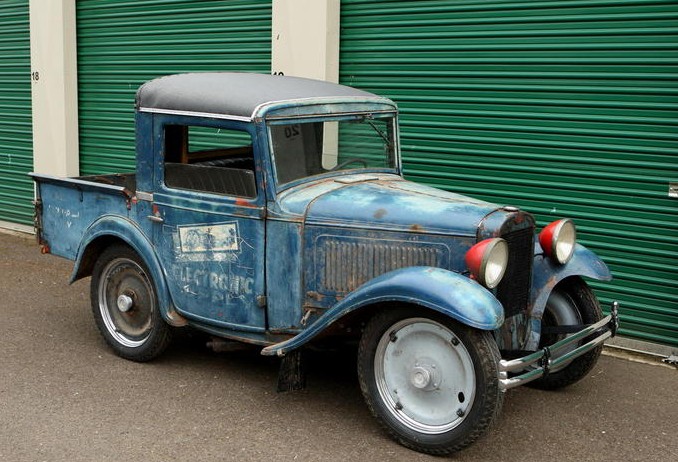
Maybe I’m slow, but it wasn’t until I really looked at this little pickup that it dawned on me that American Austins really were just Austin Sevens (don’t judge me). Most of the convertibles that you see have two-tone “Sweep Panel” faux-Duesenberg paint job. It makes them look way fancier than the “British Model T” that the Austin Seven really is.

Anyway, this pickup is probably my favorite American Austin/Bantam that I’ve ever seen. Part of that is the weathered paint (okay, a lot of it is the weathered paint) – but there’s just something about the proportions of this truck that really appeals to me. The pickup variant was made in very small numbers and only a few survive today. It uses the same 747cc straight-four that all American Austins were blessed with. It made almost 14 horsepower. It is being sold “as is, no reserve” with an estimate between $15,000-$20,000. Click here for more info.

Update: Sold $9,350.

American Austin Panel Truck

1935 American Austin Panel Truck

Offered by Bonhams | Greenwich, Connecticut | June 2, 2013

1935 American Austin Panel Truck

Photo – Bonhams

The Great Depression put a lot of American automobile manufacturers out of business – but they weren’t all glamorous marques like Auburn and Pierce-Arrow. American Austin went into the red big time in 1935 and the company had to be re-organized, this time as American Bantam (production would cease in 1941). This car was produced shortly before the company became American Bantam.

Much like the pickup featured above, this Panel Truck (with “truck” being used very loosely) is a very rare variant of the American Austin. It uses the same 747cc straight-four. The lot description lists it as “rated” at 15 horsepower. The life of this car is known since 1959 and it had a full restoration in the 1970s. It’s one of only a handful of panel van American Austins that survive. It should sell for between $20,000-$25,000. Click here for more info and here for more from this sale.

Update: Sold $9,350.

A Pair of American Austins

1933 American Austin Pickup

Offered by Bonhams | Greenwich, Connecticut | June 2, 2013

1933 American Austin Pickup

Maybe I’m slow, but it wasn’t until I really looked at this little pickup that it dawned on me that American Austins really were just Austin Sevens (don’t judge me). Most of the convertibles that you see have two-tone “Sweep Panel” faux-Duesenberg paint job. It makes them look way fancier than the “British Model T” that the Austin Seven really is.

Anyway, this pickup is probably my favorite American Austin/Bantam that I’ve ever seen. Part of that is the weathered paint (okay, a lot of it is the weathered paint) – but there’s just something about the proportions of this truck that really appeals to me. The pickup variant was made in very small numbers and only a few survive today. It uses the same 747cc straight-four that all American Austins were blessed with. It made almost 14 horsepower. It is being sold “as is, no reserve” with an estimate between $15,000-$20,000. Click here for more info.

Update: Sold $9,350.

_________________________________________________________________________

1935 American Austin Panel Truck

Offered by Bonhams | Greenwich, Connecticut | June 2, 2013

1935 American Austin Panel Truck

The Great Depression put a lot of American automobile manufacturers out of business – but they weren’t all glamorous marques like Auburn and Pierce-Arrow. American Austin went into the red big time in 1935 and the company had to be re-organized, this time as American Bantam (production would cease in 1941). This car was produced shortly before the company became American Bantam.

Much like the pickup featured above, this Panel Truck (with “truck” being used very loosely) is a very rare variant of the American Austin. It uses the same 747cc straight-four. The lot description lists it as “rated” at 15 horsepower. The life of this car is known since 1959 and it had a full restoration in the 1970s. It’s one of only a handful of panel van American Austins that survive. It should sell for between $20,000-$25,000. Click here for more info and here for more from this sale.

Update: Sold $9,350.

Pierce “Great Arrow”

1905 Pierce 28/32 Five-Passenger Roi-des-Belges

Offered by Bonhams | Greenwich, Connecticut | June 2, 2013

1905 Pierce 2832 Five-Passenger Roi-des-Belges Great Arrow

George N. Pierce’s automobile company began building internal-combustion automobiles in 1901. In 1903, a two-cylinder model was introduced and it was known as the Arrow. In 1904, Pierce shifted focus to larger, more luxurious cars – these were referred to as Great Arrows and, initially, they used four-cylinder engines. In 1908, Pierce became Pierce-Arrow.

This Great Arrow uses a 24/28hp straight-four of 3.8-liters. Six-cylinder engines would be used from 1907. This is an early Great Arrow with cast aluminium bodywork that was at least five years ahead of its time.

This particular car was discovered during World War II and restored – or “recommissioned” – under the ownership of Henry Austin Clark. In the 1990s, he sold it to another owner via the Imperial Palace Collection. This is the first time this car has ever come up for public sale. The car is in its 1950s restoration state. The seats are original, the paint 60+ years old. The engine was overhauled in the last 15 years.

The Great Arrow is the car that set Pierce on the path to becoming one of the most legendary luxury car manufacturers of all time. It is expected to sell for between $170,000-$220,000. Click here for more info and here for more from Bonhams in Connecticut.

Update: Sold $243,100.