Victor Electric Highwheeler

1907 Victor Electric Runabout

Offered by Coys | London, U.K. | December 3, 2013
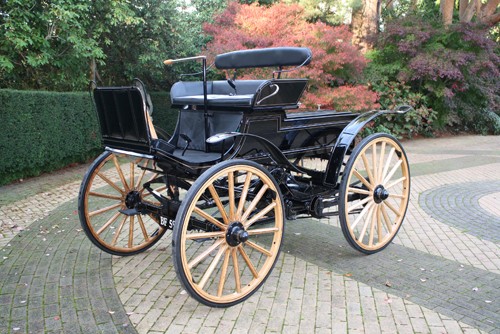
1907 Victor High Wheel Electric Runabout

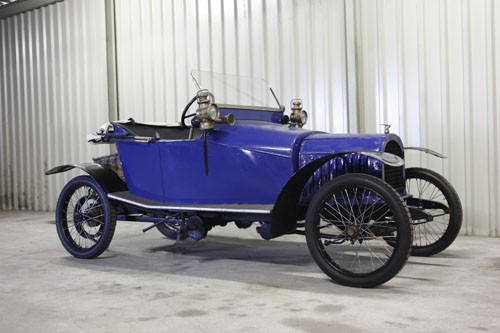
There is some confusion as to the origin of this car, but one thing is certain: it is called Victor. It has electric power and it is also a highwheeler of American origin. There was a company in St. Louis which operated from 1907 to 1911 called the Victor Automobile Manufacturing Company and they specialized in highwheelers for the first two years of their existence.

Coys mentions that this is the only Victor ever produced (there is even a tacky homemade plaque on the side of the car proclaiming this “fact”). They mention that the car could’ve been a one-off built in Nebraska, but that there isn’t any proof.

I offer a third possibility: Victor of St. Louis built highwheelers in 1907 that used a two-stroke engine. Perhaps they experimented with an electric drivetrain on one? Who knows. At any rate, the electric system has been completely redone lately and this thing will do about 70 miles on a charge and tops out around 30 mph.

It’s in the U.K. now, but it is available for purchase. It should sell for between $61,000-$88,500. Click here for more info and here for more from Coys in London.

Update: Not sold.

Update II: Sold, Historics at Brooklands, June 2016, $54,145.
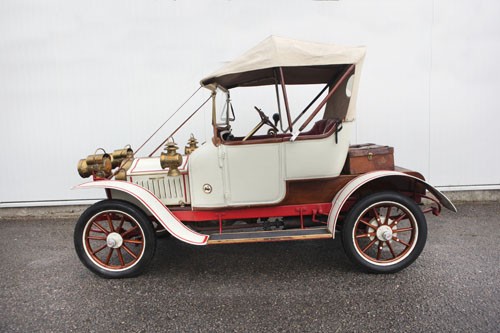
1912 Stimula

1912 Stimula Roadster

Offered by Coys | Graz, Austria | October 12-13, 2013

1912 Stimula Roadster

Stimula was founded by two brothers – Guy and Carl de la Chappelle – in the Gier Valley in France in 1907. They started with motorcycles and three-wheelers for a few years before the car business really got going.

At the beginning, Stimula, unlike many contemporary French manufacturers who used engines from De Dion-Bouton, designed and built their own engines. But by the second decade of the 20th century, they went scrambling for De Dion engines as well, as this car uses a 1.7-liter De Dion straight-four. The cars were light and handy in competitive events like hillclimbs.

Stimula built over 1,000 cars before WWI shut the business down in 1914. Xavier de la Chappelle, a great-nephew of Carl and Guy, resurrected the Stimula name in the 1970s to build the de la Chappelle Bugatti replica. You can read more about this recently restored car here and check out the rest of this auctions lineup here.

Update: Sold for about $25,800.

Warne Cyclecar

1913 Warne 8

Offered by Coys | Graz, Austria | October 12-13, 2013

1913 Warne 8hp Cyclecar

I love it when fine examples of short-lived automobile manufacturers survive for 100 years. This Warne 8 cyclecar is 100 years old. The company, Pearsall-Warne Ltd, was founded in Letchworth in 1913. It only lasted through 1915.

Light cars were all the rage in that day. A lot of companies popped up and built cars of varying quality with varying success. Warne may not have had a lot of success, but they had quality down. The engine is an eight horsepower 1.0-liter V-twin from J.A.P. and the price was a crazy-low-sounding £99!

The car is simple, yes, but it does have a convertible top, lights and it is belt-driven (for weight reasons). I don’t know how many were made in total, but it is said the company built six of them a week. This is car #57. You can read more here and check out more from Coys here.

Update: Sold for about $10,800.

Autovia Roadster

1939 Autovia 3-Litre

Offered by Coys | Graz, Austria | October 12-13, 2013

1939 Autovia 3-Litre

There are sporty cars from the U.K. from the 1930s that everyone knows about, like the SS100 and Invictas. Then there are the lesser known ones like Arabs and this beautiful Autovia.

Like Arab, Autovia was a very short-lived marque. Founded in Coventry in 1937 as a subsidiary of well-known Riley. The cars were expensive, luxurious and sporty. It was a market that was already full of more prominent manufacturers. Two different sedan bodstyles were offered, as well as a limousine. In total, only 38 four-door cars were built. There were also six bare chassis sold – this is one of those cars. The Autovia proved an expensive experiment that ultimately bankrupted Riley, which was acquired by the Nuffield Organization in 1938. Autovia disappeared forever after that.

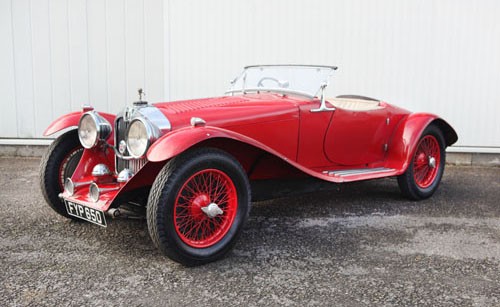
This car is the only Autovia to receive two-door aluminium roadster bodywork. What sets this roadster apart from many other British sports cars of the day is the engine. It’s a 3.0-liter V-8 making 125 horsepower. That’s a lot more than most of its competition – it’s Bugatti territory. This is a very quick car.

And very desirable too. Only eight Autovias are thought to survive, with this one having the most desirable coachwork (by far). This is definitely one of the stars of this auction. You can read more here and find out what other cars will be crossing the block here.

Update: Sold for about $110,000.

Philos Double Phaeton

1913 Philos Ballot Double Phaeton

Offered by Coys | Graz, Austria | October 12-13, 2013

1913 Philos Ballot Double Phaeton

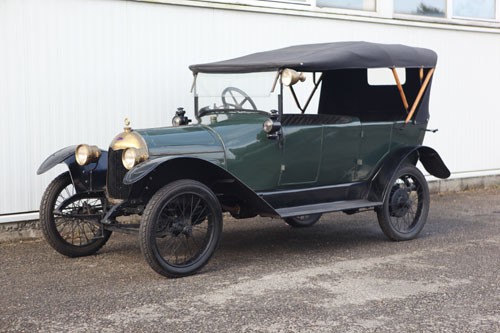
SA Nouvelle des Automobiles Philos was founded in Lyon, France, in 1912. In 1923 they were acquired by Jean Gras – another French automobile manufacturer. While Jean Gras soldiered on until 1930, 1923 was the end of the line for Philos. Early Philos cars used engines from Ballot.

This car, being from the second year of manufacture, uses an aforementioned Ballot engine: it’s a 1.1-liter straight-four. Later cars used engines of varying size from a variety of manufacturers. The design feature that set the Philos apart was its curved V-shaped radiator.

This car is offered in preserved, all-original condition. It is a very fine example of early French motoring. You can read more here and check out more from Coys here.

Update: Sold for about $16,100.

One of the World’s First Microcars

1921 Moll-Mobil III Chemnitz Roadster

Offered by Coys | Graz, Austria | October 12-13, 2013

1921 Moll-Mobil III Chemnitz Roadster

The Moll was introduced during the cyclecar craze of the early 1920s. Many cyclecars of the era were small – but this was was downright tiny. It was one of the first true microcars ever built.

Introduced in the early 1920s, the Chemnitz Roadster was constructed by Moll-Werke AG of Chemnitz, Germany. It used a 125cc single-cylinder engine that is mounted between the driver’s legs (this car features tandem seating – the passenger sits directly behind the driver).

This car is listed as a 1921, likely because they have no idea when it was built. My records show the company in existence from 1922 through 1925 and this Mobil III model having been built from ’24-’25 with a more standard light car preceding it. In any case, this is one of two or three of these to survive and it is in excellent restored condition. Read more about it here and see more from this awesome sale here.

Update: Sold for about $14,500.

Genestin Double Phaeton

1928 Genestin GS8 Double Phaeton by J. Pessel-Annonay

Offered by Coys | Graz, Austria | October 12-13, 2013

1928 Genestin DS8 Double Phaeton by J. Pessel-Annonay

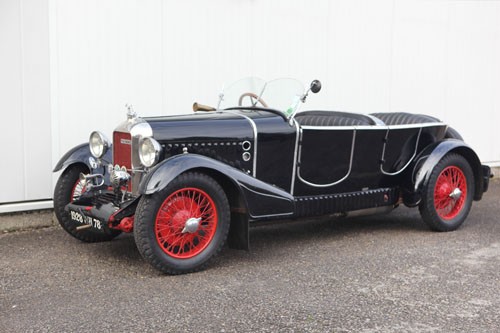
Paul Genestin started building his own cars in 1925 in Fourmies in the north of France. He got his start at the end of World War One rebuilding cars that were left behind by the Germans. I’ve honestly never seen one of these cars but this thing looks super sporty and I really like it.

The engine is a 1.8-liter straight-eight made by Vermerel and the torpedo body is by a little known French coachbuilder. Genestins are said to be sporty and a shorter wheelbase was offered for even better handling.

This is one of only a few Genestins still in existence and has spent a long time in museums. It would be an awesome addition to any collection and a welcome sight at car shows all over the globe. No pre-sale estimate is available but you can find out more here and more from the sale of the Karl Ritter Collection here.

Update: Sold for about $71,100.

A Cool-Looking Moretti

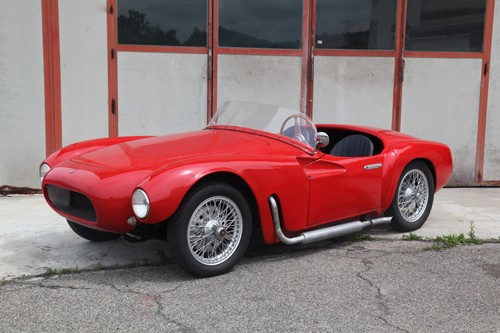
1954 Moretti 750 Spider Bialbero

Offered by Coys | Nurburgring, Germany | August 10, 2013

1954 Moretti 750 Spider Bialbero

Moretti built a number of small sports cars using a 750cc engine. This is one of them – but it seems like everyone I come across has a different body on it. The body here was evidently designed by Giovanni Michelotti. I’m not sure who built it. It kind of resembles a Ferrari 250 Testa Rossa – or at least that’s what I can see inspiring it. “Bialbero” refers to the engine being a “twin cam.”

1953 was Moretti’s first go at racing. Since the 750 was the larger of the two engines they used in their cars, it was a natural fit for the race tracks. This car was owned by the French importer for Moretti who raced it a little bit in Venezuela (where he was from), but  he preferred Ferraris and saved them for the big events, like Le Mans.

He sold it to one of his countrymen, who raced it until 1960. The car returned to Europe in the 1980s when it was restored and it was restored again a few years ago. Morettis are rare, but this is probably the only one bodied like this (just guessing). It should sell for between $315,000-$370,000. Click here for more info and here for the rest of Coys nice auction lineup.

Speedwell GT

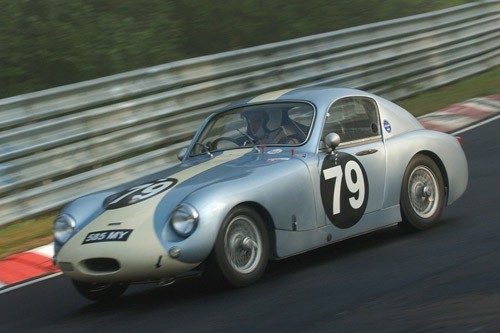
1960 Austin-Healey Speedwell GT

Offered by Coys | Woodstock, Oxfordshire, U.K. | June 29, 2013

1960 Austin-Healey Speedwell GT

The Speedwell GT was a version of the Austin-Healey Sprite that was intended for racing. It was developed by Speedwell – an outside tuning company – and there were some noticeable differences between the Sprite and the GT.

First of all, the Sprites are commonly referred to as “Bugeye” (or Frogeye) Sprites because of their inset headlights that gave them a unique – if not dorky – look. This car has the lights in a more traditional place and it’s a fixed-top coupe.

Speedwell was founded by John Sprinzel, Len Adams and George Holbert in the late-1950s. The GT was designed by Frank Costin, brother of Cosworth co-founder Mike Costin. This is one of very few factory-built Speedwell GTs and it is based around a 1961 Sprite Mk I. The engine is a 948cc straight-four making 43 horsepower. Many of the new body panels were aluminium to save weight. It’s a quick car for its class.

The car was campaigned in the 1960s. It’s racing history includes:

  • 1966 500 Miles of Brands Hatch – 17th (with Keith Grant and Grahame White)
  • 1966 1000km Nürburgring – 32nd, 2nd in class (with Grant and White)
  • 1966 GP Mugello – Not Classified, 2 laps down (with Grand and White)

In the 1970s, it was raced and then parked and forgotten until it was rediscovered in the late-1980s and restored. It has appeared at the Goodwood Revival three times since and is in race-ready condition. It should sell for between $75,000-$95,000. Click here for more info and here for the rest of Coys’ Blenheim Palace sale.

Phantom I Ascot Phaeton

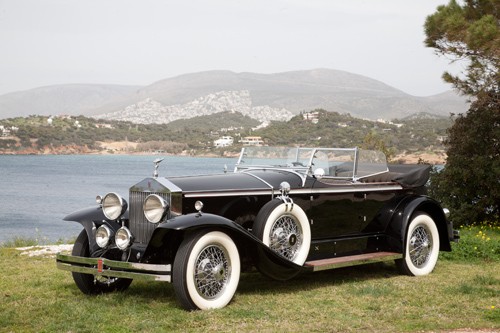
1929 Rolls-Royce Phantom I Ascot Phaeton

Offered by Coys | Athens, Greece | June 15, 2013

1929 Rolls-Royce Phantom I Ascot Tourer

Rolls-Royce of Derby, England, set up a manufacturing arm in America which was referred to, surprisingly, as Rolls-Royce of America. They opened shop in 1921, constructing the already-old Silver Ghost. In 1925, Rolls introduced the follow-up model to the Silver Ghost – the Phantom. In 1929, the Phantom II was introduced and the Phantom’s name was changed to “Phantom I” and it stayed in production through 1931.

The car you see here was built by Rolls-Royce of America and they are often referred to as a “Springfield” (which refers to Springfield, Massachusetts – where the cars were built). As it is a Phantom I, it uses a 7.7-liter straight-six that made about 120 horsepower.

What is great about this car is the bodywork. As far as early Rolls’ go this is one of my favorite designs. The body is by Brewster – the Long Island coachbuilder contracted by RR of America to build many of their bodies. It is called an “Ascot Phaeton” to give the buyer an aura of Britishness. It’s a five-seater with sporty looks and I like it.

The car has known ownership history from new. It was restored first in 1970 in New Jersey and is being sold by a European collector who had more work done recently. The car comes without an estimate but is being sold at no reserve. It is one of 28 Springfield Ascot Phaetons built on the Phantom I chassis. RR of America built 1,240 Phantom Is total (of 3,512 built worldwide). I estimate this car at about $300,000. Click here for more info and here for the rest of Coys’ Greek lineup.

Update: Not sold.