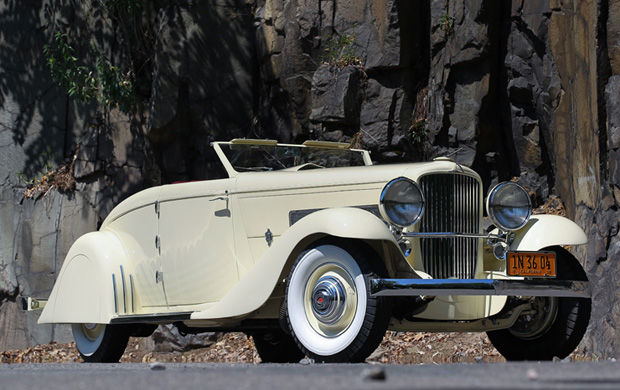
Duesenberg J-355

1929 Duesenberg Model J Convertible Sedan by Murphy

Offered by Gooding & Company | Monterey, California | August 19, 2012

You thought Duesenberg week would have ended last week, you know… when the week ended, didn’t you? Well, I don’t know how to read a calendar. This is the final Model J that were featuring that was on offer at Pebble Beach this year.

It’s a Murphy-bodied car, the most prolific coachbuilder of Model Js. This one originally had J-204 under the hood, but was swapped for J-355 at some point. This car spent quite a while in a European automotive museum until 2011. It’s been freshened recently and is ready to cruise.

Purchasing this car would have been a great way to get your hands on a Duesenberg, relatively inexpensively, that has been out of the public eye for quite some time. The estimate was $500,000-$700,000. The catalog description is here.

Update: Sold $522,500

Mecum Monterey 2012 Highlights

Mecum’s multi-day sale at this year’s Pebble Beach weekend featured a number of high-dollar Porsches, including this year’s top sale, our featured 1972 Porsche 917/10 that brought an impressive $5,500,000. The second-highest selling car was our featured 1908 Simplex that was also impressive at $1,900,000. Our featured Duesenberg from this sale was bid to $350,000 but didn’t meet the reserve and thus failed to sell. The only other million dollar car was this $1,050,000 1972 Ferrari 365 GTB/4 Daytona Spider.

1972 Ferrari 365 GTB/4 Daytona Spyder

I mentioned all the cool Porsches and one that really struck me as awesome is this 1974 911 RSR that was driven in the IROC series by Emerson Fittipaldi. There were only 15 of these built by Penske for the 1974 season. Fittipaldi drove this in the season’s first race and it was a reserve car the rest of the year. It sold for $875,000.

1974 Porsche 911 RSR IROC - Emerson Fittipaldi

Another race car, or sort of race car – a car that was designed with racing in mind but could probably be easily driven on the street, was this 1955 Devin Monza. It sold for $105,000.

1955 Devin Monza

Some other cool cars from the 1950s included this one-off 1952 Astra Coupe. This car was for sale last year in at Fantasy Junction in California for $125,000. It sold here for $43,000.

1952 Astra Coupe

Perhaps one of the most beautiful cars of the sale was this 1953 Muntz Jet. Designed and originally built by Kurtis, production was taken over by Earl “Madman” Muntz for a little while. They’re rare and they’re pretty. This one cost $75,000

1953 Muntz Jet

From large-ish American convertibles to tiny European microcars – this 1958 Goggomobil TS400 brought a small-ish $26,000.

1958 Goggomobil TS400

Another teeny-tiny European car was this 1970 Autobianchi Bianchina Panoramica. I’ve seen a number of Bianchina Transformables (the convertible) but I’ve never seen the wagon variant. It sold for $17,500.

1970 Autobianchi Bianchina Panoramica

This 1977 International Scout SSII (yes, I’m out of transitions) is a very rare find – especially in this condition. It sold for $23,000.

1977 International Scout SSII

Continuing with the theme of utility, I thought this 1956 Hudson Rambler Station Wagon was pretty cool. I’ve actually seen one of these up close and they are kind of bizarre looking – in a very good way. It sold for $19,500.

1956 Hudson Rambler Wagon

And finally, we always seem to be able to find some oddball Corvette at Mecum auctions (and Auctions America’s sales too, I guess). This sale was no different. Witness: the 2009 Corvette SV 9 Competizione. Only four of these were built (aftermarket). They have an all-carbon fiber body, so don’t ding it – or chip it. It sold for $44,000.

2009 Chevrolet Corvette SV 9 Competizione

For complete results, click here.

Duesenberg J-270

1929 Duesenberg Model J Dual Cowl Phaeton by LeBaron

Offered by Gooding & Company | Monterey, California | August 18, 2012

This Model J has the LeBaron Dual Cowl body on it – my favorite bodystyle. This body was originally attached to a different chassis and engine than it is now. When it was first bought, it was wrecked and the chassis was junk. So Duesenberg removed the body, repaired it, and fitted it to a new chassis and engine, the one it currently has, including engine J-270.

One reason this car doesn’t really look like all the other LeBaron Dual Cowl Phaetons is because in 1937, the then-owner took the car to Derham and had them streamline it a little. There are aspects of this car that scream “1930s Art Deco” instead of “Big 1920s Touring Car.” The skirted fenders and bullet headlights are an awesome additions.

This car has been with the current owner for almost 60 years. It has been used regularly and never restored, just mechanically maintained. The two tone blue paint on the Sweep-Panel body (which is hard to see in the photo above) has helped create the nickname “Blue J” for this car.

For being unrestored, this is a truly impressive automobile. The pre-sale estimate was $2,000,000-$2,750,000. The complete catalog description is here.

Update: Sold $1,980,000.

Duesenberg J-108

1929 Duesenberg Model J Disappearing Top Convertible Coupe by Murphy

Offered by RM Auctions | Monterey, California | August 18, 2012

This early Model J was the first one ordered from Duesenberg as a chassis-only. It was purchased by the wife of a department store owner in Los Angeles who also owned a handful of Model A Duesenbergs. The chassis was shipped to California where it was delivered to the Walter M. Murphy Company in Pasadena to be bodied.

Murphy built the Disappearing Top Convertible Coupe to the owner’s specifications, including the white paint that covers both the body and the chassis (a somewhat angelic touch, I guess). A couple of owners later, the car was restored by Fran Roxas in 2010, having covered a mere 73 miles since.

Although the fact that we’re featuring a boatload of these cars, it should be remembered that some Model Js may never come up for sale. They have become museum pieces. Especially if they hold a certain distinction. This is a chance to own a very early Model J. A chance that doesn’t happen all too often. The price was estimated between $1,800,000-$2,400,000. The complete description is here.

Update: Sold $1,897,500.

Update: Sold, Gooding & Co., Monterey 2013, $2,365,000.

Duesenberg J-430

1931 Duesenberg Model J LWB Limousine by Willoughby

Offered by Gooding & Company | Monterey, California | August 18, 2012

Photo – Gooding & Company

A few weeks ago we featured a car very similar to this. J-306 is also a Willoughby Limousine, but it is green and was offered by Mecum during the Pebble Beach weekend as well. The write up for J-306 included a history of Willoughby, so we’ll keep this one short.

The other thing that differs between these cars is that this one is original. It has been repainted – in the late 1950s. It is in amazing condition for a car this old. Then again, this car was owned by people who loved Duesenbergs for most of its life. The owners appreciated the car and maintained it. It has also spent time in museums.

A decent number of Duesenbergs have been rebodied over the years. Many more have been restored (or over-restored). This one is all original – a 1930s time warp car. It is way cool. The pre-sale estimate was also in the affordable-for-a-Duesenberg range of $400,000-$500,000. The complete lot description can/could be found here.

Update: Sold $330,000.

Update: Sold, RM Sotheby’s Hershey 2019, $451,000.

Duesenberg JN-560

1935 Duesenberg Model JN Convertible Coupe by Rollston (and Bohman & Schwartz)

Offered by Gooding & Company | Monterey, California | August 19, 2012

You might be saying, “Hey, the Pebble Beach sales have already concluded, why are you still featuring cars from them?” Well, that’s because there were so many great cars that I just went ahead and skipped all of the Duesenbergs (except for the one from Mecum). I figured we could feature them post-auction as there is a short lull before any other big sale. Turns out, that lull isn’t long enough because there were no less than seven of these beautiful Dueseys for sale in Monterey. So saddle up, because for the next week or so it’s nothing but Model Js.

This might be the most desirable Duesenberg of all during the Monterey weekend. The Model J was introduced in 1929 (and it was expensive) and almost immediately, the selection of people who could afford such a car dwindled rapidly. The SJ was introduced in 1932 with some more power. By 1935, Duesenberg was struggling mightily. They updated the Model J to JN specification, which was more modern looking. All had Rollston bodies and only 10 were built.

The engine remained the same 265 horsepower 6.9-liter straight-8 of the cars before it. Some things did change, like the wheels – they were smaller. The cars had sleeker bodies with skirted fenders and new taillight designs. The designs – especially this one – embraced the Art Deco look better than their predecessors.

This car was purchased new by Clark Gable. The full lot description includes the great story of him and this car, it’s worth a read but I won’t just copy it here. Originally a Rollston Convertible Coupe, Gable took the car to Bohman & Schwartz who updated it to the much more dramatic car you see here, the design being done with Gable’s input. In the late 1940s, after the death of Carole Lombard, Gable’s wife, he sold the car.

It changed hands numerous times, spending about 10 years in the Blackhawk Collection until 2006, when the current owner bought it and restored it to how you see it now – that is, how it was when Clark Gable and Carole Lombard cruised the streets of Beverly Hills with it in the 1930s. It originally had engine J-560 in it, but in the 1950s engine J-521 was installed. It currently has the 560 number on it, but could probably best be described as having bits of both.

The is one hell of a car with one hell of a history. The fact that Gooding lists the estimate as “available upon request” when they feel quite comfortable quoting prices up to $10 million for other cars, means this car is going to bring a ton of money. For the complete description (including the very narrative-like story of Gable and Lombard’s courtship), click here.

Update: Not sold.

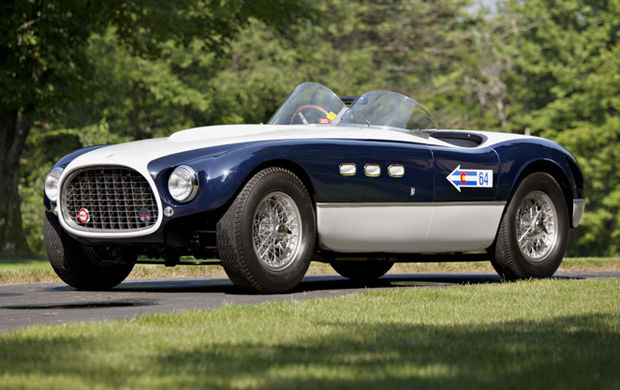
The Final Ferrari 340 MM

1953 Ferrari 340 MM Spider

Offered by Gooding & Company | Monterey, California | August 18, 2012

There are a few variants of the Ferrari 340 – the 340 America, the 340 Mexico, and the final version, the king-of-the-hill 340 MM. It had a 300 horsepower 4.1-liter V12. Only 10 were made and five of them were bodied by Vignale. This car was the last one made and it cost its American buyer an eye-watering $18,000 in 1953.

The car was bought new by Californian Sterling Edwards, who was, at about the same time he purchased this car, building cars under his own name. He picked this car up in Italy on his honeymoon, before shipping it home to San Francisco. He campaigned the car in SCCA events on the west coast, winning races and beating drivers like Masten Gregory in the process. Edwards sold the car in 1955 for $8,000.

The car passed through many hands and at one point someone repainted it red. Thankfully it has been restored to its original condition and color. This car competed in the Mille Miglia a number of times in the late 1980s and early 1990s. The current owner has owned the car for nearly 30 years and is being sold along with a number of his other significant Ferraris.

Ferrari 340 MMs are very rare – only 10 were made – so you don’t see them for sale too often. Expect this one to command a price between $4,500,000-$6,500,000. For more information, click here. And for the rest of Gooding’s Monterey lineup, click here.

Update: Sold $4,730,000.

Bugatti Type 55

1932 Bugatti Type 55 Cabriolet

Offered by Gooding & Company | Monterey, California | August, 19, 2012

Bugatti’s Grand Prix car for 1931 was the Bugatti Type 54, which was a development of the Type 51. The Type 55 you see here is the road-going variant of the Type 54. It features a 2.3-liter straight-8 that has been supercharged, giving it 135 horsepower.

Only 38 Type 55s were built. According to the lot description provided by Gooding & Co., 14 of the cars were bodied by the factory as roadsters. Seven were factory coupes. And there was one factory cabriolet. That accounts for 22 of them. It goes on to say that 11 received bodies from Gangloff or Vanvooren. And the “other three” all had one-off coachwork. You are correct, discerning reader, that 22+11+3=36. So keep an eye out, you may find one of the mysterious unaccounted-for Bugatti Type 55s.

These were very expensive cars at the time – the Type 51 and 54 weren’t winning races like their predecessors, so presumably racing income was way down and maybe Bugatti was making up for it on the road car end. Then again, they were always expensive cars. In any case, this car was purchased as a chassis by a wealthy surgeon who ordered a new Bugatti every year. He sent it to Lyon to receive this fantastic coachwork from Billeter & Cartier. This is the only such car constructed by them.

Somebody had the brilliant idea to finish this in black and green – an amazing color combination. Every owner of the car is known and it underwent a restoration over a number of yeas and under the direction of multiple owners. It has never been shown at the big Concours’ and it is one seriously good-looking Bugatti. Of course, this comes at a price, with an estimate between $5,000,000-$6,500,000. For more information, click here and for more from Gooding in Monterey, click here.

Update: Not sold.

Bentley EXP Speed 8

2001 Bentley EXP Speed 8

Offered by RM Auctions | Monterey, California | August 18, 2012

Volkswagen acquired Bentley in 1998, the same year Audi (a VW subsidiary since 1969) announced its intention to compete in the 1999 24 Hours of Le Mans. Audi was brand new to prototype racing and its closed-roof R8C (as well as the open-top R8R) both raced at the 24 Hours in 1999. An R8R finished on the podium in 3rd and one came home 4th, but they didn’t win. So, for 2000, both cars were replaced by the legendary Audi R8, which won the race five times.

Bentley had, up until 2000, also won the 24 Hours of Le Mans five times, the latest of which came in 1930. A Bentley hadn’t even appeared at the track since 1933. So Ferdinand Piech, head of the VW Group (and grandson of Ferdinand Porsche), declared Bentley would return to the track. And when Dr. Piech declares something, it happens: like the Bugatti Veyron. I imagine the green-light meeting for the Veyron going down as follows:

  • Accountant: “But, Dr. Piech, we stand to lose millions from this project.”
  • Piech: “Ja, but ve vill be zee fastest!”

The plan was for Bentley to show up at the 2001 24 Hours of Le Mans. But instead of just straight copying the Audi R8, the crew at Racing Technology Norfolk (who were responsible for developing the car) based their design on the closed-coupe Audi R8C that was no longer competing. And they managed to turn that odd duck race car into this beautiful monster.

The car used the same engine from the Audi, the 670 horsepower 3.6-liter twin-turbocharged V8. Two cars were prepared for the 2001 race, including this one. Only one competed in 2002. In neither year was Bentley triumphant – but Audi was, both times. So in 2003, the Audi factory team (Audi Sport Team Joest) “took the year off” – and all of the normal factory Audi drivers drove Bentleys and came home 1-2. Piech was satisfied and the program ended then and there. It’s really an incredible thing when you think about it: an eccentric German auto executive buys an automobile company with a historic racing pedigree then decrees they will return to their former glory. And all in a few years time. And then they do it. Then they walk away immediately after having proven their point.

The Bentleys were never even entered at any race but Le Mans. Which, too, is awesome as it shows they weren’t concerned with championships or anything but winning the race that Bentley was known for winning. The brief competition history of this car is:

  • 2001 24 Hours of Le Mans – 3rd (with Andy Wallace, Eric van de Poele and Butch Leitzinger)

That’s it. Nine cars were built – four of them EXP Speed 8s (2001 and 2002) and five Speed 8s (2003). The difference between them is a slight bodywork change around the nose as well as an expansion to 4.0-liters for the later cars. Not all of them raced due to the program being cut after the win in 2003. There were also two test mules built.

They never even had sponsorship – the car just said “Bentley” – showing it wasn’t about money but pride. The car is listed as in race-ready condition and will undoubtedly be welcome at just about any event anywhere. The pre-sale estimate is $1,900,000-$2,500,000. For the complete lot description, click here. And for more from RM in Monterey, click here.

Update: Sold $2,530,000.

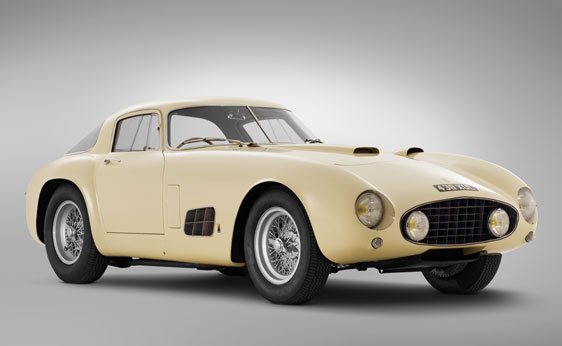
Ferrari 410 S

1955 Ferrari 410 S Berlinetta by Scaglietti

Offered by RM Auctions | Monterey, California | August 17, 2012

The Ferrari 410 Superamerica was biggest, baddest Ferrari you could buy between 1955 and 1959. It featured a 5.0-liter V12 making 340 horsepower. The car was an evolution of the America line, that included its predecessor 375 America and the 340 before it. The 400 Superamerica actually came after the 410.

This car has one-of-a-kind coachwork by Scaglietti and its really quite racy looking with dual, off-set hood scoops and a rear that just sort of rounds off after the rear window. The 410 was designed to compete in the Carrera Panamericana road race, but never actually did. Of the 35 410 Superamericas built, only two were factory prepped race cars. This is not one of those, although it did partake in some hillclimbing in the 1960s and the 2002 Mille Miglia.

Ownership history is known from new and the car was restored within the past 10 years. This car will be a hot ticket to discriminating shows and should fetch quite a sum, although RM is being coy about what that sum might be. For the complete lot description, click here. And for more from RM in Monterey, click here.

Update: Sold $8,250,000.