Ogle SX1000

1963 Ogle SX1000 GT

Offered by RM Auctions | London, England | October 31, 2012

David Ogle formed Ogle Design in 1954, coming in contact with the automotive industry in 1959, where they designed cars like the Reliant Scimitar GTE, the Reliant Robin, and and the Bond Bug as well as a few motorcycles for BSA/Triumph. Of course, these things happened later in the company’s life. In the late 1950s, David Ogle decided to build a few cars himself, the most popular was this, the SX1000 GT.

Based on Mini mechanicals, the SX1000 GT used the Mini Van chassis and the 997cc four  – although this particular car (as did others) uses the 1275cc straight-four from the Mini Cooper S. Top speed is supposedly around 110 mph. Only 66 of these fiberglass cars were built before David Ogle was killed in a car crash in one of the cars in 1962. Production wound down until they ran out of parts to make more. This is car #63 of 66 and was personally registered to Ogle himself.

Restored eight years ago, this is thought to be the best of the 26 surviving SX1000s. Ogle Design still exists as Ogle Noor and these cars have a small but loyal following. It’s very rare and very cool. You can expect for it to sell for between $29,000-$35,000. For more information, click here. And for more from RM in London, click here.

Update: Sold $23,400.

1904 Richard-Brasier

1904 Richard-Brasier Four-Cylinder 16HP Side-Entrance Tonneau

Offered by Bonhams | London, England | November 2, 2012

No, the guy who started this company was not that full of himself that he thought his first and last names needed to be on the company letterhead. Richard Brasier was not a person – in fact, Richard-Brasier (that hyphen is important!) was actually founded by two people: Henri Brasier and Georges Richard. (Ironically, Georges Richard sold cars under the name “Georges Richard” before Brasier joined him, so yeah, maybe he was a little full of himself).

Henri Brasier left Mors in 1901 and cars were offered as Richard-Brasiers beginning in 1902. It was short-lived, however, as Georges Richard left the company in 1905 to found Unic. Beginning in 1905 the cars were known simply as “Brasier.” And here is an rare example of this very fleeting marque.

This model, from the last year of production before switching names, uses a 2.3-liter straight-four making 16 horsepower (rated by the factory at the time it was built). It’s a large car for such a small power rating, as the company offered models up to 40 horsepower as well. The history of this car is known from 1975, when it entered display at a Dutch museum. It is definitely a driver, having run London-to-Brighton every year since 2000 (with one exception).

This is a truly glorious automobile from the pioneering days of motoring and it would be worth any serious collector’s time to think carefully about acquiring it. It is expected to sell for between $350,000-$480,000. For more information, click here. And for more from Bonhams’ Veteran car sale, click here.

Update: Sold $358,000.

Update: Sold, Bonhams London-to-Brighton 2023, $424,222.

Ferrari 250 Tour de France

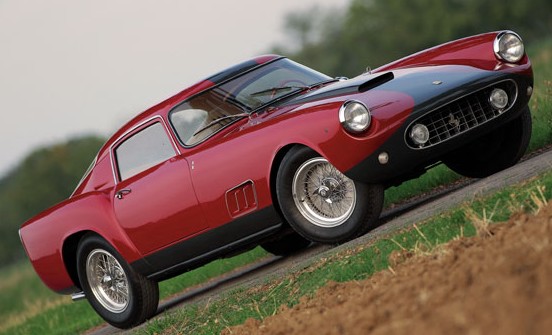
1959 Ferrari 250 GT LWB Berlinetta ‘Tour de France’ by Scaglietti

Offered by RM Auctions | London, England | October 31, 2012

There are perhaps few cars that have had more variations of them built than the Ferrari 250. The backbone of the series is the Colombo V12 displacing 3.0 liters. Power output was model-specific, and this car puts out 247 horsepower, which is about mid-range for a Tour de France model (they ranged from 237-256 between the different series).

The 250 GT Tour de France came about after a special Pinin Farina-designed and Scaglietti-built special won the 1956 Tour de France road race that was held all over France. The designation was never official but was used to describe the cars by the factory. The design was put into production and a total of 79 were built between 1956 and 1959. They were built in four distinct series. This is a Series IV car, the 30th of the 36 built (Series IV are the most numerous). What sets it apart is the fact that it has but one vent behind each of the side windows as well as uncovered headlights (although some export models had the headlight covers fitted, making this even rarer).

Right from the get-go, this car was used for competition. It competed in hill climbs all over Italy in the hands of its first owner, reaching the podium in its class multiple times and winning a few as well. After only three years on the circuit, the car exchanged hands for the first time, and then hopped from here to there, spending years in some of the world’s great collections.

It has competed in the historic Mille Miglia and was restored by its current owner, who acquired it in 2002. While the ‘Tour de France’ 250 GT may not be a 250 GTO, their prices have risen steadily over the years and they remain one of the most collectible (and by that I mean “expensive”) variants of the 250 GT. Only serious Ferrari collectors need apply, as the pre-sale estimate is listed at $2,900,000-$3,850,000. For more information, click here. And for more from RM in London, click here.

Update: Sold $3,160,000.

Alloy 300SL Gullwing

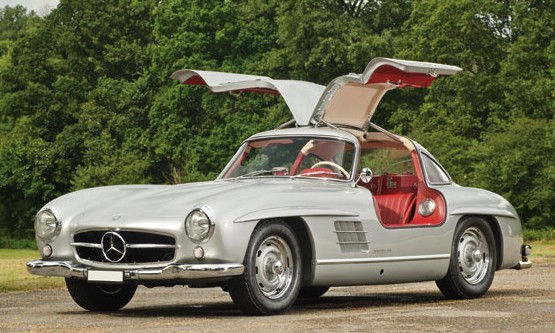
1955 Mercedes-Benz 300SL Alloy Gullwing

Offered by RM Auctions | London, England | October 31, 2012

I’m beginning to think I’ve missed the heyday of custom ordering automobiles. No longer can you go to your local dealer and tick boxes for absurd options that included special engines or go-fast bits from race cars – or, insanely, the type of metal your car is made out of.

Most of Mercedes-Benz’s legendary 300SLs were steel-bodied cars, save for the aluminium hood, doors and trunk lid. Only 29 of them were “Alloy” bodied cars, that is, aluminium all the way around. The cost for this special option was very high and the weight savings around 175 lbs.

These cars were intended for privateer racing teams and were available beginning in 1955, the same year Mercedes-Benz withdrew from competitive motorsport. Other sporting changes made to the Alloy cars included suspension upgrades and those awesome Rudge knock-off wheels. There was also a “special” engine available (to all Gullwings, according to Mercedes) that used a competition camshaft, adding 15 horsepower. This car has that as well, so it’s 3.0-liter straight six makes 215 horsepower.

This is car #21 of the 29 built and its ownership history is known from new. An Alloy 300SL is the most desirable version of an already must-have classic (not counting any of the earlier racing versions). This one has no stories and would be a joy to own – and maybe even flog a little on the backroads. I just hope that the new owner is into that sort of thing, and not into storing this in a bunker somewhere, waiting for prices to rise so they can turn around and cash in. Gooding & Company sold one of these earlier this year for over $4 million. This should do likewise. You can read more here and check out more from RM in London here.

Update: Not sold.

Koenigsegg CCX

2008 Koenigsegg CCX

Offered by RM Auctions | London, England | October 31, 2012

Boom. The top speed of the car we featured yesterday was 15 mph. This car will do 245 mph. Yeah, that’s a McLaren F1 difference in top speed (they topped out at 231 with the rev limiter). This is one of the finest and fastest legitimate modern supercars in existence.

Christian von Koenigsegg’s first hand built road car was delivered to its new owner in 2002. The CCX model you see here was introduced for 2006 with an eye toward entering the American market (with emissions compliance, etc.). It uses a Koenigsegg-designed twin-supercharged 4.7-liter V8 making 806 horsepower with 62 mph coming in a scant 3.2 seconds.

The top on this car is removable and can be stowed in the trunk at the front of the car – it fits in there just perfectly and is a really neat design feature. Even neater are the doors: they are not gullwing doors nor are they “Lambo” scissor doors. They are what Koenigsegg refers to as “dihedral synchro-helix” doors. In other words, instead of just flipping forward, they go out, then rotate forward for a truly alien look. Coolest. Doors. Ever.

It’s a quick car – and that small spoiler on the back helps keep it planted. It exists thanks to Top Gear, which tested the first CCX (and it had an “off” into some tires when their test driver, The Stig, lost it at high speed). The wing was introduced and the car topped their lap chart, although the time was, jokingly, credited to “KoenigseggisseggggnignigsegigisegggnigseggniggseggCCX with Top Gear wing.”

It’s also pretty rare. Only 27 were built and this is one of only eight that are in right-hand drive configuration. It is expected to sell for between $380,000-$460,000, the high-end of that being only about $100,000 less than the price as new. Then again, it only has 1,700 miles on it, so it’s almost new. You can read more here and check out more from RM in London, here.

Update: Sold $397,000.

Walker Electric Delivery Van

1909 Walker Model 15 Van

For Sale at Hyman Ltd | St. Louis, Missouri

Talk about aerodynamics having come a long way. You can tell this electric delivery van was designed for utility and not comfort because of the solid state tires and big square, featureless body. The entry door is located in a very Isetta-like front-of-the-vehicle position (there’s one at the rear too). How cool.

The Walker Vehicle Company of Chicago, Illinois began producing electric trucks such as this in 1907. They were convenient because they were quiet, easy to operate, and didn’t smoke up the already crowded and polluted streets of cities like New York, where this van was in the service of Hearn’s Department Store.

The van has a 3/4-ton load capacity and with a full set of charged batteries, it can hit speeds up to 15 mph with a range nearing 40 miles from the 3.5 horsepower rear-mounted motor. I’m sure 15 mph in this thing is plenty fast. The interior is immaculate for a 100+ year-old commercial vehicle with varnished wood and a fresh seat. As rare as early commercial vehicles are, early electric commercial vehicles are even rarer. And, strangely, there is at least one other 1909 Walker electric out there.

This one will set you back a hefty $99,500. For more information, click here.

1953 Monterey Woodie Wagon

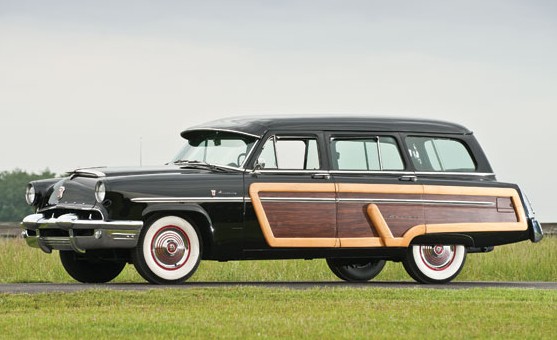
1953 Mercury Monterey Station Wagon

Offered by RM Auctions | Grapevine, Texas | October 20, 2012

I think this woodie wagon is way cool. 1953 was the second year for the Mercury Monterey as a stand-alone model (it started as a trim line on the 1950 Mercury Eight). 1953 was the first year for the four-door wagon bodystyle.

Under the hood is a 125 horsepower 4.2-liter flathead V8. I really dig the styling – woodwork on a 1950s wagon is just a solid look. This car was utilitarian by design and by fate. What I mean is that it’s a four-door wagon – fit for a family. Two-door wagons (although this was not offered as such) have a high-survival rate do to their unique style and desirability. Only five Mercury Monterey (four-door) wagons are known to exist (it was the 14th built).

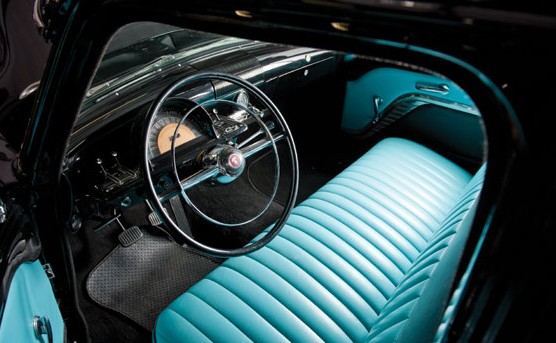
The interior of this car is amazing. It is black and turquoise. Well, instead of talking about it, here’s a picture, tell me this is a color combo that doesn’t blow you away:

Love it. This car is coming from the fairly large Charlie Thomas Collection – you can see the rest of the offerings here – and is expected to sell for between $70,000-$90,000. For more information, click here.

Update: Sold $44,000.

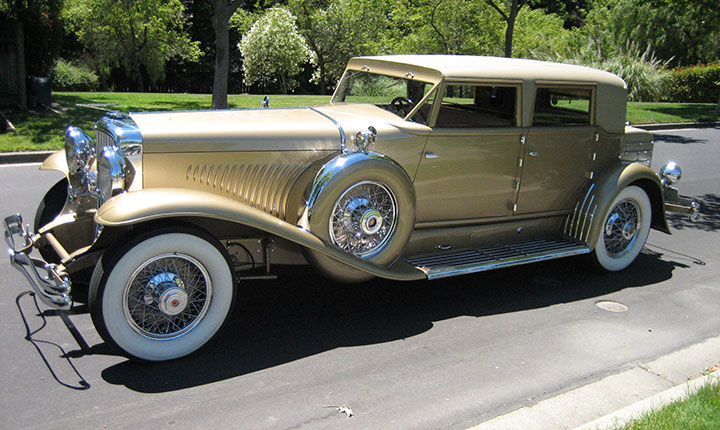
Duesenberg J-468

1934 Duesenberg Model J LWB Custom Beverly Sedan by Murphy

Offered by Barrett-Jackson | Scottsdale, Arizona | January 19, 2012

This long-wheelbase Model J has a “Beverly Sedan” body from Murphy. I really don’t know what “Beverly” refers to, but it was used on a few Model Js and a number of Cords. If anyone knows, please share.

In any case, this car (engine no. 468), painted in an ostentatious (and, in my opinion, pretty ugly) shade of gold, is one of 12 Murphy Beverly Sedans built. Of course, it is claimed that this is the “finest in existence,” but then again, who would claim that they car they are trying to sell is “meh, maybe the fourth or fifth finest in existence?”

It is being offered as part of Barrett-Jackson’s second-annual “Salon Collection” (it even has its own website) at their Scottsdale auction in January. The car is coming from the Imperial Palace Collection where it has been on display for some time. Barrett-Jackson doesn’t publish pre-sale estimates and it’s hard to guess, as their prices are all over the place. I expect this car to either A. not meet its reserve or B. go for more than it should after the crowd is prodded by being told it’s “way under the money.” Watch and see. You can read more here.

Update: Sold $1,430,000.

Autech Zagato Stelvio

1991 Autech Zagato Stelvio AZ1

Offered by Coys | Ascot, U.K. | October 13, 2012

I would hate to call a car that has been designed by one of the world’s foremost automotive design houses “bizarre” so I won’t. I’ll call it “Japanese,” as they are known for their love of quirky, boxy cars. Milanese design house Zagato created the aluminium body – which even has the signature Zagato “double bubble” roof, if only so slightly – while Autech, a Nissan-owned performance tuning subsidiary, was behind the rest of the car.

The car is based on a Nissan Leopard (a car America received as the Infiniti M30) and has an Autech-tuned 3.0-liter turbocharged V6 under hood making 320 horsepower. They also tuned the suspension and the frame. The entire car was built by hand and a production run of 200 was scheduled, although only 104 made it out the door.

They were very expensive when first released in 1989, but the price has subsided a little bit, with Coys expecting this to fetch between $38,000-$48,000. This is a very rare car – tell me if you’ve ever seen one let alone even heard of it. You can read more about it here, and check out the rest of Coys auction lineup here.

1958 Coronet

1958 Coronet Convertible

Offered by Coys | Ascot, U.K. | October 13, 2012

Coronet Cars Ltd. produced the three-wheeled Coronet Convertible from 1957 through 1960. The British have had a thing for three-wheeled cars since, well, pretty much ever. Each has excelled in different areas, these three-wheelers, but few are attractive (okay, the original Morgans are pretty attractive). This one kind of is – especially when compared to things like the Reliant Robin.

It’s powered by a 328cc straight-twin located behind the seat. It’s rear-engined and rear-wheel drive. Somewhere between 250 and 500 were built – but only seven still exist. It is very rare and highly sought after – especially by microcar collectors.

No estimate is available because there really isn’t much of a precedent, as these don’t come up for sale all that often. $20,000-$40,000 would be a decent estimate, I guess. For more information, click here. And to check out more from Coys, click here.