Offered by Bonhams | Cheserex, Switzerland | June 18, 2023
Photo – Bonhams
The 202 was a small car produced by Peugeot from 1938 through 1942 and again after the war from 1945 through 1949. Styling cues included headlights set nearly next to each other behind the sloping front grille.
Various body styles were offered including a sedan, cabriolet, and pickup. Power is from a 1.1-liter inline-four that made about 29 horsepower. Top speed was about 62 mph. This one is a “UH” model, meaning it was a commercial vehicle with hydraulic brakes.
This truck was discovered in the ’70s as a project. It was relocated to Switzerland in the 1980s and has remained there since. Peugeot built 104,126 examples of the 202, and this one has a pre-sale estimate of $16,000-$22,000. Click here for more info.
Offered by Bonhams | Greenwich, Connecticut | June 4, 2023
Photo – Bonhams
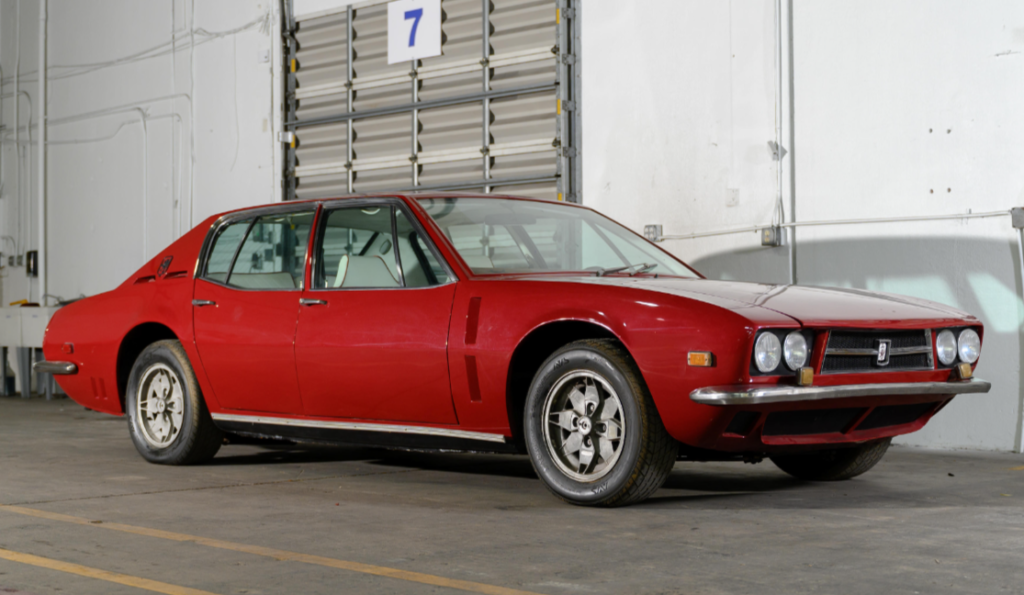
Here is a rare 1960s European four-door sedan in the vein of the Monteverdi 375/4, Maserati Quattroporte, and Aston Martin Lagonda. Iso was no Maserati or Aston Martin (even in the ’60s). It was more on par with Monteverdi as a small-batch car manufacturer.
The Fidia sedan was sold between 1967 and 1975, and in that time, just 192 were produced. Each one had styled by Giorgetto Giugiaro at Ghia and was powered by an American V8. In this case, it’s a 5.8-liter Ford V8 rated at 330 horsepower. A GM unit was also available on earlier cars. Only 35 had the 351 Cleveland.
This car has been on static display for the last 10 years and will require work before it is roadworthy. But I feel like saying that a 50-year-old exotic Italian sedan from a cottage industry manufacturer “requires work” is somewhat a given. The pre-sale estimate here is $25,000-$40,000. Click here for more info.
Offered by Bonhams | Brussels, Belgium | May 13, 2023
Photo – Bonhams
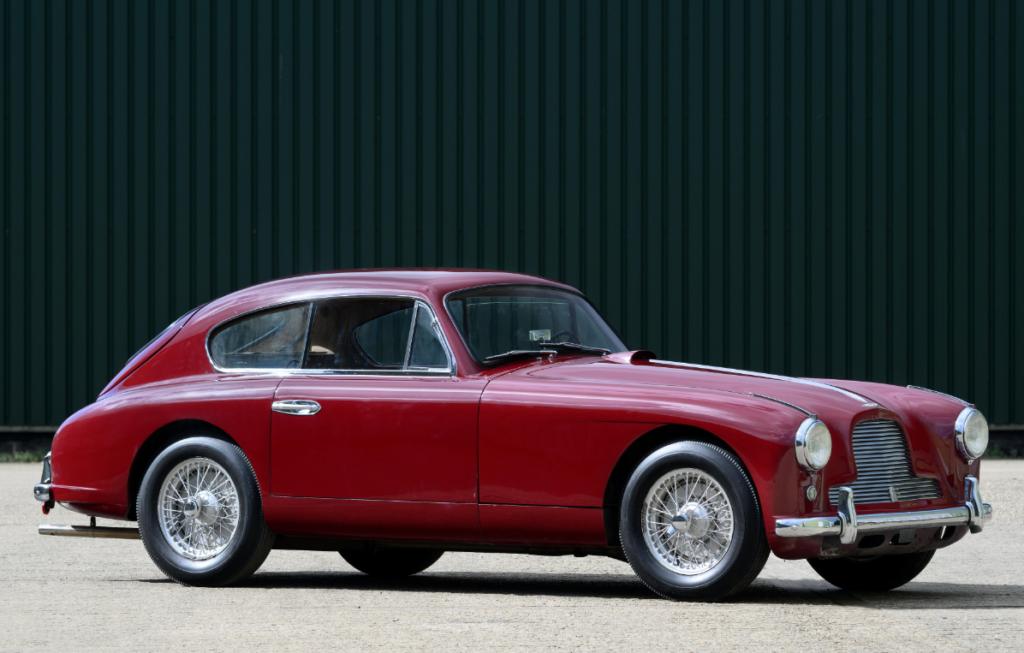
The DB2 was the first post-war Aston produced in significant numbers. A two-seater, it was replaced in 1953 by a 2+2 coupe. Called the DB2/4, the new car would be on sale through 1957 and would also be offered as a two-seat drophead coupe and a two-seat fixed-head coupe.
Power is provided by 2.6-liter inline-six that was rated at 125 horsepower. Later, a 2.9-liter unit would be available. Just 764 examples of the DB2/4 would be built, 565 of which were Mark I examples like this. The Mark II went on sale in 1955 with more power.
This car was sold new in Switzerland and was restored about 25 years ago. Still, it is said to require further work before being declared roadworthy. It carries a pre-sale estimate of $90,000-$155,000. Click here for more info.
Offered by Bonhams | Brussels, Belgium | May 13, 2023
Photo – Bonhams
Jean Rondeau raced at Le Mans a few times before he decided he could do better designing, building, and competing in his own cars. The first Rondeau cars arrived at Le Sarthe in 1976, although they were branded as Inalteras due to their sponsorship with the wallpaper company.
The Rondeau M378 was the first Rondeau-branded car at the race, and the last would be this: the 1983 M482. It had power in-period from a 3.9-liter Cosworth V8. There is currently no engine installed, but a Cosworth DFV V8 accompanies the car. The competition history for this chassis, #003, includes:
1983 24 Hours of Le Mans – 48th, DNF (with Jean-Pierre Jaussaud and Philippe Streiff)
1985 24 Hours of Le Mans – 46th, DNF (with Christian Bussi, Jack Griffin, and Marion L. Speer)
Only three M482s were built. And they did not do well at Le Mans in 1983. So bad, in fact, that Rondeau has to file for bankruptcy, which is how this car ended up in the hands of a privateer in 1985. Successful or not, the car carries a pre-sale estimate of $275,000-$390,000. Click here for more info.
Update: Sold, though Bonhams is being LAME and not telling anyone how much.
Offered by Bonhams | Brussels, Belgium | May 13, 2023
Photo – Bonhams
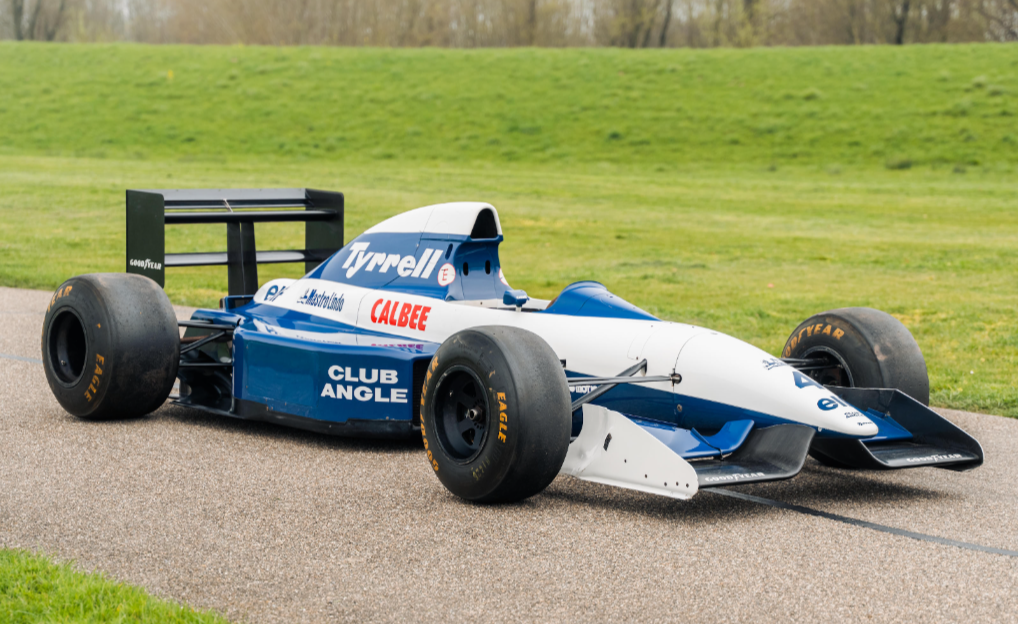
Ken Tyrrell’s Formula One racing team had been around since the 1960s and entered the 1990s already struggling. The 1971 constructor’s champion was a far cry from the peak. Their 020 chassis was designed by Harvey Postlethwaite and George Ryton and debuted for the 1991 season.
For that year, the car had a Honda V10 powerplant. For 1992, they upgraded the 020 (including this chassis, 020-6), to 020B spec, which meant that it now used 3.5-liter Ilmor V10 that made 680 horsepower. The competition history for this car includes:
1991 Canadian Grand Prix – 10th (with Satoru Nakajima)
1991 Mexican Grand Prix – 12th (with Nakajima)
1991 French Grand Prix – 22nd, DNF (with Nakajima)
1991 British Grand Prix – 8th (with Nakajima)
1991 German Grand Prix – 18th, DNF (with Nakajima)
1991 Hungarian Grand Prix – 15th (with Nakajima)
1991 Belgian Grand Prix – 23rd, DNF (with Nakajima)
1991 Italian Grand Prix – 19th, DNF (with Stefano Modena)
1991 Portuguese Grand Prix – 18th, DNF (with Modena)
1991 Spanish Grand Prix – 16th (with Modena)
1991 Japanese Grand Prix – 16th, DNF (with Nakajima)
1991 Australian Grand Prix – 26th, DNF (with Nakajima)
For 1992, it was used as a spare car for seven races. It later entered private ownership – sans V10 – and is offered as a roller out its current collection, where it’s been since 2003. The estimate is $55,000-$77,000. Click here for more info.
Offered by Bonhams | Brussels, Belgium | May 13, 2023
Photo – Bonhams
Not a Volkswagen. But not all that different. Mercedes-Benz introduced the W23 130H in 1934. It was their smallest car to date. The related W28 170H debuted in 1936 and was produced as the rear-engined alternative to the front-engined 170 V.
The 170 models shared an engine: a 1.7-liter inline-four that was rated at about 37 horsepower. The 170H was produced until 1939, with just 1,507 built – only 250 of which were made in 1938. Low demand was due mostly to the fact that it cost more than the 170 V but had less room and was altogether a worse car.
The restoration on this convertible version was completed in 2020. These rear-engined Mercs are a rare sight, and this one is about as good as they come. The estimate is $66,000-$100,000. Click here for more info.
Offered by Bonhams | Brussels, Belgium | May 13, 2023
Photo – Bonhams
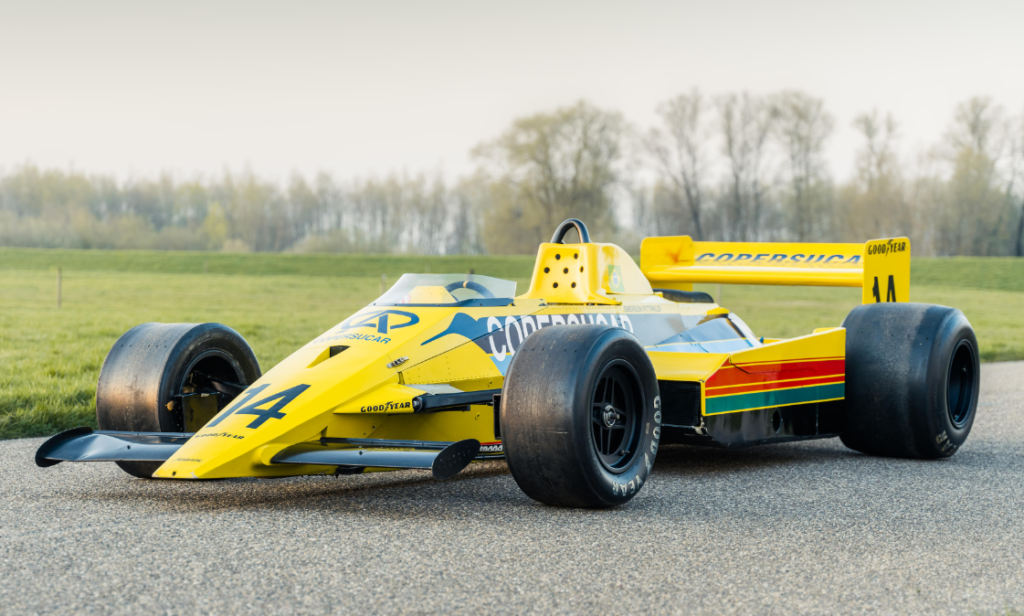
Imagine Max Verstappen, or Sebastian Vettel, or Michael Schumacher, three years out from an F1 world championship arriving on the grid with a team of their own. It would be insane. But it’s exactly what Emerson (and brother Wilson) Fittipaldi did in 1975.
Emerson Fittipaldi won the F1 driver’s championship for Lotus in 1972, and Wilson drove for Brabham for ’72 and ’73. They started working on Fittipaldi Automotive in 1974. The team appeared on the grid in 1975 with Wilson driving the only car (and Arturo Merzario running in one race). Emerson would be the team’s main driver from 1976-1980, and the team’s final season was 1982.
The F6 was used for the latter part of the 1979 season (and, strangely, one race toward the beginning of the year). Two chassis were built, with Emerson driving one of them in seven races and Alex Ribeiro failing to qualify for three races in the other. The engine at the time was a Ford-Cosworth DFV 3.0-liter V8.
This chassis is lacking all running gear and is set up as a static show car. Apparently it doesn’t even really roll, and the suspension is listed as “not correct.” Still, it’s an interesting part of F1’s small history of “owner/drivers.” It has an estimate of $55,000-$75,000. Click here for more info.
Offered by Bonhams | Goodwood, U.K. | April 16, 2023
Photo – Bonhams
Spyker F1 bought out the Midland F1 team late in the 2006 Formula One season. This was a big leap for what was already a struggling boutique road car manufacturer. 2007 would be the team’s only full year running under the Spyker name.
Late in the 2007 season, Vijay Mallya stepped in to buy the financially doomed team, and it would be renamed Force India for 2008. Spyker raced their Ferrari-powered F8-VII (and VIIB) for the season with drivers Adrian Sutil (who scored Spyker’s only championship point) and Christijan Albers. Albers was let go halfway through the year and was replaced by Markus Winkelhock (for one race) and Sakon Yamamoto for the rest.
Force India’s first F1 entry was the VJM01, which was just an updated version of the previous year’s Spyker chassis. So they literally just updated the existing cars and reused them for the season. This particular chassis, VJM01-04, was a Spyker in 2007 and a Force India in 2008. It’s competition history includes:
2007 French Grand Prix – 17th (with Adrian Sutil)
2007 British Grand Prix – 15th (with Christijan Albers)
2007 European Grand Prix – 17th, DNF (with Markus Winkelhock)
2007 Hungarian Grand Prix – 22nd, DNF (with Sakon Yamamoto)
2007 Italian Grand Prix – 20th (with Yamamoto)
2007 Belgian Grand Prix – 17th (with Yamamoto)
2007 Japanese Grand Prix – 12th (with Yamamoto)
2007 Chinese Grand Prix – 17th (with Yamamoto)
2007 Brazilian Grand Prix – 21st, DNF (with Yamamoto)
2008 Monaco Grand Prix – 18th, DNF (with Giancarlo Fisichella)
2008 Canadian Grand Prix – 14th, DNF (with Fisichella)
The highlight there is the 2007 European Grand Prix, one that featured a monsoon that saw a large number of the field end up in the gravel right after the start. Winkelhock pitted for wet tires at the end of the formation lap, a move that led to him leading the race when all hell broke loose. Then it was red-flagged and he lost his advantage, eventually retiring with electrical issues, probably because of the rain. It was Winkelhock’s only F1 start.
In period, this car would’ve had a 2.4-liter Ferrari V8 making about 750 horsepower (for both seasons). Now it’s just a roller with a $100,000-$125,000 estimate. Click here for more info.
Offered by Bonhams | Goodwood, U.K. | April 16, 2023
Photo – Bonhams
This may look like a kit car from the 1980s that was trying to approximate a post-war sports special. But it actually is a post-war sports special. Jim Boothby was an RAF pilot during the war and established Jim Boothby Motors (JBM) in 1946.
The JBM Sports used surplus Ford V8 engines and refurbished pre-war Ford V8 chassis. Body work was done in the cycle-fendered style of the day. This car has a 3.9-liter Ford V8 that was built in Canada in 1949. It’s estimated to make 110 horsepower.
Only about eight examples of the JBM sports car were built through 1950. The company even had plans of entering Formula One, but they never came to fruition. This is the only survivor. It has an estimate of $25,000-$35,000. Click here for more info.
1911 Palmer-Singer Model 4-50 Seven-Passenger Touring
Offered by Bonhams | Middletown, Rhode Island | April 29, 2023
Photo – Bonhams
Yes, that Singer. Charles Singer was part of the Singer sewing machine family, and he joined with barrel maker Henry Palmer to start a Simplex, Matheson, and Isotta Fraschini dealership in Manhattan. The next year, 1908, they started building their own cars in Long Island City.
The company’s 1911 model range constituted four cars, with the 4-50 positioned as the second most powerful. It’s powered by a 50-horsepower, 8.2-liter inline-four. It has a four-speed manual transmission and rear drum brakes. Six body styles were offered, and the seven-passenger touring retailed for a hefty $3,900.
This car has had three owners since new and has been in the same family since 1956. It was restored from ’56 through 1960 and is the only four-cylinder Palmer-Singer left (and the only 4-50). The estimate is $400,000-$500,000. Click here for more info.