Alfa 6C Sport Berlina GT

1952 Alfa Romeo 6C 2500 Sport Berlina GT

Offered by Oldtimer Galerie Toffen | Toffen, Switzerland | March 27, 2021

Photo – Oldtimer Galerie Toffen

We’ve featured a number of variants of Alfa’s 6C over the years. The model was a mainstay of Alfa’s lineup from the late 1920s through the mid-1950s. The 6C 2500 was built between 1938 and 1952, and quite a few different sub-models were offered across a range of power ratings.

The auction catalog notes that this is one of 188 6C 2500 Sport models produced with a 105-horsepower 2.4-liter inline-six from the Super Sport. It features a two-door Berlina GT body that was styled in-house by Alfa Romeo.

Somehow, the car was delivered new to a fire department in Milan. It was restored in the 1990s and came to Switzerland in 2015. It was later refreshed and is now offered with a pre-sale estimate of $210,000-$230,000. Click here for more info and here for more from this sale.

TVR 290S

1992 TVR S3 290S

Offered by Brightwells | Leominster, U.K. | March 27-April 1, 2021

Photo – Brightwells

TVR produced an “S” series of cars between 1986 and 1994. They were the transition between the wedge-shaped TVRs of the 1980s and the insanity of the 1990s. There were four “S” cars powered by V6s, and there was the V8S.

The S2, S3, and S4 all shared the same 168-horsepower, 2.9-liter Ford V6. The changes between the series were mostly cosmetic (or emissions-related), and the S3 was launched in 1990. It got a stiffer chassis than earlier cars as well as longer doors and an interior redesign.

Only 887 examples of the S3 were built through 1992, making it the most common of the S cars. But, uh, they are still not common at all. This is a cheap way into TVR ownership (though there is nothing saying that TVR ownership will remain cheap). The pre-sale estimate is just $8,700-$10,000. Click here for more info and here for more from this sale.
Update: Sold $8,524.

Jaguar XJS Celebration

1995 Jaguar XJS Celebration Convertible

Offered by Historics Auctioneers | Ascot Racecourse, U.K. | April 17, 2021

Photo – Historics Auctioneers

The XJS was Jaguar’s follow-up to the E-Type. Introduced in 1975, variants of the car would remain in production through 1996. The final generation of the XJS launched in 1991, and two different engines were available: a 4.0-liter inline-six or a 5.3-liter V12.

This car, sadly, has the six, which was rated at 237 horsepower when new. I’ve always felt like if you’re going to buy one of these, you might as well get the overly-complicated and still-not-that-much-more-powerful V12. Bragging rights. So why are we featuring this car? Because it’s a wonderful shade of teal. That’s why.

The Celebration edition, I think, was to celebrate that Jaguar had saved on development costs by not completely redesigning this car after 20 years. They built 115,413 XJS cars in 21 years, which is pretty impressive. This one has about 10,000 original miles and should sell for between $34,800-$41,700. Click here for more info and here for more from this sale.

Update: Sold $62,605.

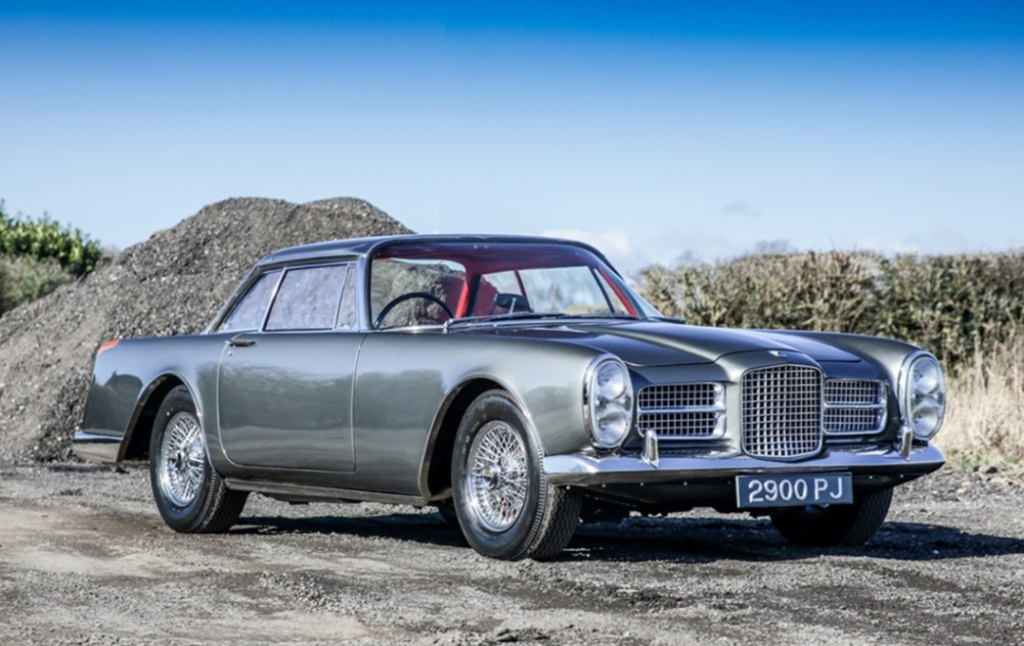
Facel Vega Facel II

1963 Facel Vega Facel II

Offered by Historics Auctioneers | Ascot Racecourse, U.K. | April 17, 2021

Photo – Historics Auctioneers

Facel SA was a French company that started as a component manufacturer that turned toward coachbuilding and eventually automobile production. Their first cars went on sale in 1954, and the company ended up bankrupt in 1964. The Facel II was their last gasp.

It’s a two-door, four-seat grand tourer that went on sale in 1962. It’s powered by a 6.3-liter (383) Chrysler V8 good for 355 horsepower. Top speed was 135 mph when equipped with an automatic transmission like this one. The cars were quick in their day – faster than a Gullwing, a DB4, and a 250 GT.

Only about 180 were produced through the end of the road in 1964. This one was on the London Motor Show stand and spent 25 years in storage before being restored in 2017. It is now expected to sell for between $360,000-$430,000. Click here for more info and here for more from this sale.
Update: Not sold.

Austin Seven

1927 Austin Seven Chummy

Offered by H&H Auctioneers | Duxford, U.K. | April 14, 2021

Photo – H&H Auctioneers

The Austin Seven (or 7) was a landmark British car. It was like the British Model T – it was extremely popular, cheap, and reliable. It helped put the UK on wheels. It was introduced in 1923, and variants of it remained in production until 1939. The car was licensed all over the world, including by Rosengart in France, BMW in Germany, and American Austin in the US. Its legendary status was cemented when the original Mini was launched in 1959 as the “Austin Seven.”

The 747cc inline-four made approximately seven horsepower, hence the name. It had a three-speed manual gearbox and what we now think of as “conventional” controls. Quite a few body syles were offered, including this four-seat “Chummy” tourer.

This particular car has been in dry storage for some time and could probably do for some reconditioning. It is selling at no reserve alongside a few other Seven variants. Click here for more info and here for more from this sale.

Update: Sold $15,929.

Zedel Type P Torpedo

1923 Zedel Type P 15HP Torpedo

Offered by Aguttes | Neuilly, France | March 21, 2021

Photo – Aguttes

Ernest Zurcher and Herman Luthi founded Zedel in Switzerland in 1896. In 1903, they set up a second manufacturing location in France, and it was successful enough that the Swiss location eventually closed, making Zedel a predominantly French marque thereafter. It was taken over by Donnet in 1919, and the marque was changed to Donnet-Zedel in 1924.

The Type P is said to feature a “large displacement” inline-four that was rated at 15 taxable horsepower when new. The body is the story here, though. It looks long and low. It is long, but I think the shadows are making the roof look much more “chopped” than it really is. It makes it look menacing.

The pre-sale estimate on this car is $12,000-$18,000. You can read more about it here and see more from this sale here.

Update: Sold $21,429.

Lagonda 2.6 Drophead

1952 Lagonda 2.6-Litre Drophead Coupe

Offered by Bonhams | Bicester, U.K. | March 20, 2021

Photo – Bonhams

Lagonda has an interesting history of being a marque, then a model, then a marque again. The 2.6-Litre was the first model produced by Lagonda after the company was acquired by David Brown, who paired it with his other baby, Aston Martin.

The 2.6 was produced between 1948 and 1953, and just 510 examples were built, split between four-door sedans and two-door drophead coupes. The engine is a 2.6-liter inline-six that, in Mk II form as seen here, made 125 horsepower.

The current owner of this car bought it five years ago, and it was restored prior to that. It carries a pre-sale estimate of $83,000-$110,000. Click here for more info and here for more from this sale.

Update: Sold $105,632.

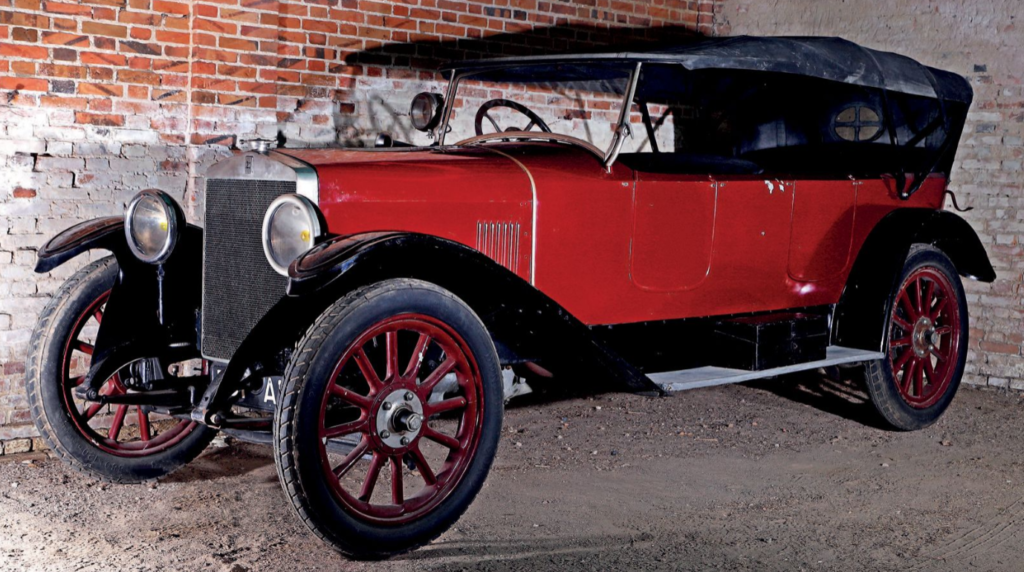
Demeester Torpedo

1905 Demeester 8HP Torpedo

Offered by Aguttes | Neuilly, France | March 21, 2021

Photo – Aguttes

Reading is hard. It has taken me far too long to realize that this car was built by Demeester, of Courbevoie, France, and not by Deemster, of London. Automobiles Demeester was founded in late 1905 by Leon Demeester and Dominique Lambejack.

The company built small cars, starting with twins and singles and eventually progressing to a line of four-cylinder cars before the company closed in 1914. This very early example is powered by a 1.1-liter inline-four that made eight horsepower. Demeester bragged that its eight-horsepower four-cylinder engine was the smallest such powerplant in the world.

This car has been in the ownership of the same family since 1966. It even retains its original bodywork. Side note, based on other sources, the 1.1-liter four may not have been introduced until 1907, meaning this car could’ve been built a little later than it is currently titled. It should sell for between $24,000-$36,000. Click here for more info and here for more from this sale.
Update: Sold $126,439.

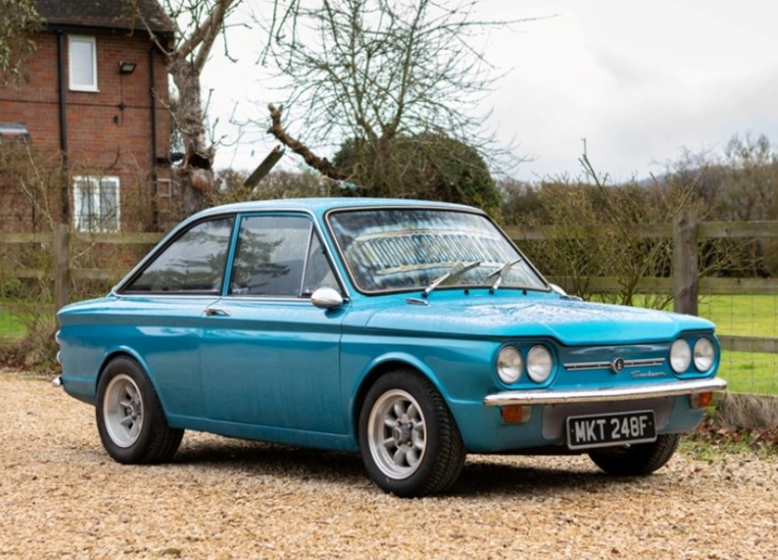
Sunbeam Stiletto

1968 Sunbeam Stiletto

Offered by Historics Auctioneers | Ascot Racecourse, U.K. | April 17, 2021

Photo – Historics Auctioneers

The Rootes Group was like England’s version of AMC, and to continue the metaphor, that would make BMC Britain’s GM. So, BMC had a hit on their hands with the Mini, and Rootes introduced a small car competitor called the Hillman Imp. It featured a rear-mounted engine and a rear-wheel-drive layout.

Much like the Mini, the Imp was sold under a few different nameplates, including the Singer Chamois, Hillman Husky, and the Sunbeam Stiletto. The Stiletto was a “sporty” version of the Imp and it went on sale in 1967. The body style was different too, as this car is more of a fastback coupe than the 2-door sedan Imp. Production lasted through 1972.

The stock engine was a 55-horsepower, 875cc inline-four. This hot-rodded example has a Rover K-Series 1.8-liter inline-four making 120 horsepower. It is also teal (check) and has Minilite-style wheels (check). Stilettos are rare: only 4,735 of the first series examples were produced. This one will sell at no reserve. Click here for more info and here for more from this sale.

Update: Sold $26,892.

Chrysler Turbine Car

1963 Chrysler Turbine Car

For Sale by Hyman Ltd. | St. Louis, Missouri

Photo – Hyman Ltd.

The Jet Age was about more than just planes. Jet-inspired styling was all over cars of the era. Different companies even teased jet-powered cars. But none of those companies moved the needle more than Chrysler did with their Turbine Car.

The body was designed by Ghia, and the car was meant to be a public-road test program to study, I guess, the real-world viability of this whacky concept. Kind of like how autonomous Volvos are running over people in Arizona in today’s world.

Power is from a Chrysler-designed turbine engine that weighed 410 pounds and made 130 horsepower at 36,000 rpm (!) and 425 lb-ft of torque. The car could do 120 mph – and it could run on just about any fuel aside from leaded gasoline, including diesel and cooking oil.

They built 55 of these between 1963 and 1964. 50 of those were lent to the general public on three-month leases that wrapped up in 1966. Much like GM did with their EV1, Chrysler had 45 of the cars destroyed at the end of the program. Nine cars ended up being saved, all of which still exist. Only two are in private hands, with this being one of them.

These are cars that don’t change hands often. This one went from Chrysler to the Harrah collection, stopped at Tom Monaghan’s collection, and then to the current collection in the 1980s. It is operational but hasn’t been used much. This is a rare chance to get a car that is impossible. Impossible that it was built. Impossible that it works. And impossible to find. Click here for more info.