Chrysler 300E

1959 Chrysler 300E Convertible Coupe

Offered by RM Auctions | North Palm Beach, Florida | December 1, 2012

The 1959 300E was powered by Chrysler’s “Golden Lion” wedge-head V8. It was 6.8-liters in capacity but still made about 380 horsepower. Production sank even further to just 647 cars – 522 coupes and 125 convertibles. Are you watching the styling evolve as you scroll down this post? I am. Estimate: $150,000-$200,000. Check out more on this car here.

Update: Sold $176,000.

Siata Spring

1968 Siata Spring

Offered by Artcurial | Paris, France | November 11, 2012

In the 1950s, Siata was known for their little two-seat sports cars, namely the highly desirable 208S. Steve McQueen had one and he called it the “Little Ferrari.” They have that classic 1950s Italian sports car look. As you can see from the photo above, something changed.

The marque was relatively dormant from about 1958 until 1967 when Siata introduced the Spring, a car whose design and introduction was dictated by market research. It might look like an MG in kit-car form, but it isn’t. There were other cars at the time going for the retro-look, as cheap as it looks today.

The Spring is based around a Fiat 850 – so it is rear-engined. It’s a straight-four of 843cc making 46 horsepower. This unusual (and maybe a little under-powered for a “sports car”) rarity was restored in the 1990s, turning very few miles since. Spring’s were produced by Siata through 1970 when production was taken over by ORSA, who built them for another five years. Only a few thousand were built. It is expected to sell for between $10,500-$18,000. For more information, click here. And for more from Artcurial’s sale, click here.

Update: Sold $15,900.

Kissel Gold Bug

1920 Kissel 6-45 Gold Bug Speedster

For Sale at Hyman Ltd | St. Louis, Missouri

Tracing the evolution of sports cars is fairly easy until you get back to about 1945. Cars of the Post-War sports car craze are easy to distinguish from more mundane automobiles. Trying to trace it back before the war gets a little trickier. Sure, there were race cars and specials and cars you could drive to Le Mans, race, and drive home. But as far as the earlier cars go, you’re looking at Genesis (or one of a few that qualify for that title).

The Mercer Raceabout and the Stutz Bearcat are two of America’s first sports cars. The Kissel 6-45 Speedster, nicknamed “Gold Bug” (due to it’s signature color) is the third. The Kissel Motor Car Company was founded by Louis Kissel in Hartford, Wisconsin in 1906. They built high-quality cars, trucks, and emergency vehicles. After WWI ended, they saw a market niche they could fill for the exciting decade to come. So in 1919 they introduced the Gold Bug Speedster and it was far and away their most popular model.

The low-slung two seater – with two additional seats that extend out of the body over the running boards for the crazy and/or brave – is powered by a 61 horsepower six-cylinder engine. Performance is sporty – thus it being known as an early sports car. Kissel closed shop in 1930 after producing some 35,000 vehicles. Only about 150 are known to exist today. This one can be yours for $159,500. For more information and photos, click here.

Here are some videos of a similar car:


A Real Hemi ‘Cuda Convertible

1971 Plymouth Hemi ‘Cuda Convertible

Offered by Barrett-Jackson | Scottsdale, Arizona | January 19, 2013

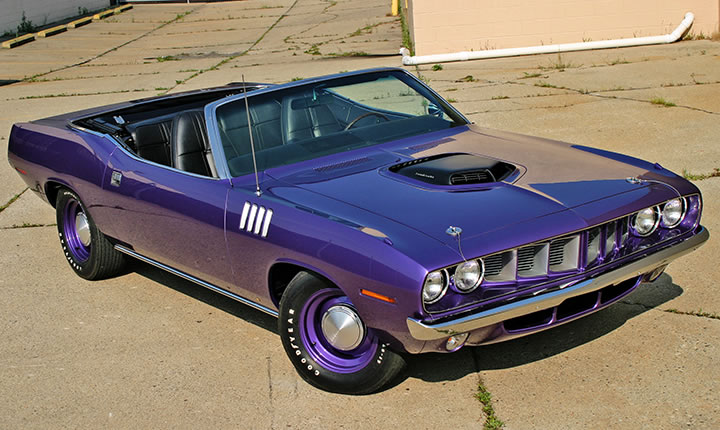
There are muscle cars that are desirable and then there are desirable cars that happen to be muscle cars. This is as close to the latter half of that sentence as you can get. This is the most desirable muscle car there is. It’s also just about the rarest – with only 11 built.

When people make “re-creation” or “clone” or “tribute” cars, they usually start with a run-of-the-mill car – a V6 or a base V8 engine and base or mid-level trim. Then they go to the Mopar catalog and order a Hemi crate engine and stuff it under the hood. It’s not desirable. It might be fun to drive or show your friends, but it just cheapens the real thing.

But this is the real thing and boy is it pretty. It’s the only Plum Crazy Hemi ‘Cuda Convertible (it is the original factory color and, in my opinion, the best). This is one of two  that were built for Canadian export. And it’s got that magical 7.0-liter 427 Hemi under the shaker hood.

These don’t come up for sale very often – obviously, there’s only 11 of them. One sold for $2 million a few years ago and, while a little extreme, that was the going rate – a few years ago. This is not a $2 million car today – even though any Barrett-Jackson employee near a microphone during the car’s sale will surely be telling you otherwise. This will undoubtedly be one of the top sellers of the auction. Read more here and check out more from Barrett-Jackson in Scottsdale, here.

Update: Sold $1,320,000.

A Wonderful 1904 Delaugère & Clayette

1904 Delaugère & Clayette Type 4A Side-Entrance Tonneau

Offered by Bonhams | London, England | November 2, 2012

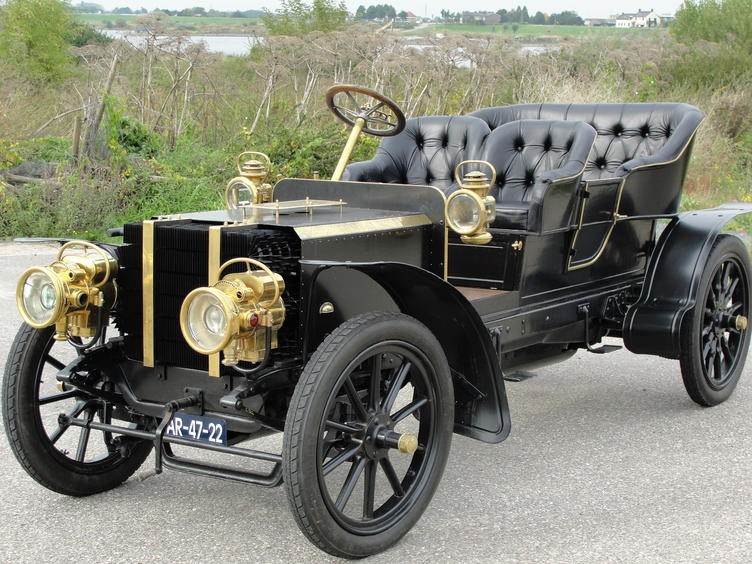
Isn’t that a beautiful machine? Delaugère & Clayette is one of, what I refer to, as the “French De’s” – a list of French automotive manufacturers including: De Dietrich, Decauville, De Dion-Bouton, Delahaye, Delage, Delaunay-Belleville and, of course, Delaugère & Clayette. Such an exotic-sounding list, isn’t it?

Delaugère began as a carriage maker in the mid-1800s. Around 1898, they built their first powered three-wheeler and come 1901 they were an established automotive manufacturer. In 1904, Maurice Clayette joined the company named after Jean-Pierre Delaugère, the original founder, and the automotive concern was renamed Delaugère & Clayette. The 1920s were a struggle for the company and their factory was purchased by Panhard, with production ceasing in 1926.

This is a model 4A. It uses a 6.3-liter four-cylinder F-head engine making 24 horsepower (Delaugère & Clayette produced another model using a 15.0-liter four-cylinder!). Double chains drive the rear wheels through a four-speed transmission. This car was completely restored about a year ago and it is stunning. The body is not original – it’s a period-correct replacement that replaced another non-original body that was on the car previously. This one looks better in black with brass trim. Look at where the engine resides – underneath that big, square black box with those big radiators out front held on with brass bars. It’s amazing to look at.

This car is expected to sell for between $350,000-$420,000. For more information, click here. And for the rest of Bonhams’ Veteran Car Sale lineup, click here.

Update: Sold $360,500.

1903 Barré Tonneau

1903 Barré Twin-Cylinder Fout-Seat Tonneau by Labourdette

Offered by Bonhams | London, England | November 2, 2012

Gaston Barré, like many early automobile producers, started with a bicycle shop. He opened his in 1894 but by 1899 realized what the new wave was going to be and started constructing quadricycles. Later that year he received some backing from a wealthy local in Niort and moved to a larger facility. Automobile production started in 1900 and Barré quickly became one of the many French automobile companies that rallied a strong following and had a steady output of cars for a number of years.

What helped Barré become a fairly large regional manufacturer was that he came up with the idea of post-sale service. Barré would support his cars in private hands when they entered them in events. He expanded with a Parisian office and during the first World War he built military vehicles. After the war, the pre-war models remained with little changes and the company had to be reorganized in 1927 but it could never get past its out-of-date designs. Production stopped in 1930 and the firm was liquidated in 1933. About 2,500-3,000 Barré’s were produced over the years.

This twin-cylinder Barré has four-seat tonneau coachwork from Henri Labourdette of Paris. Barré’s are known for their dependability and build-quality and this car, at almost 110 years old, is no exception. It is expected to sell for between $190,000-$240,000. For more information click here. And for more from Bonhams in London, click here.

Update: Sold $214,000.

DB6 Shooting Brake

1967 Aston Martin DB6 Shooting Brake by FLM Panelcraft

Offered by RM Auctions | London, England | October 31, 2012

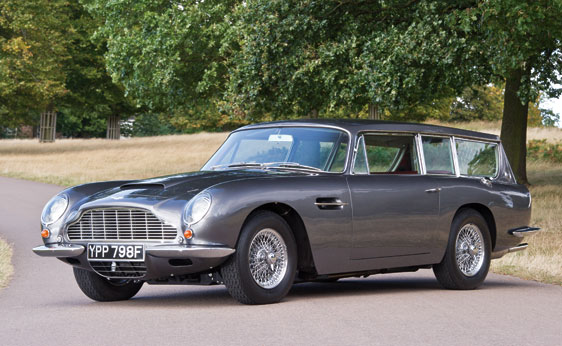
I suppose this is what James Bond drove to the supermarket. Or the hardware store. Or when he wanted to take his dogs out to the countryside… you get the idea. It’s what happens when you take one of the great GT cars of all time and make it super-functional.

This car was purchased new by famed racing driver Innes Ireland in 1967. Two years later, he took the car to FLM Panelcraft in London to have it converted to a shooting brake – aka: a two-door wagon. FLM Panelcraft also did the conversion on the other Aston Martin estate we’ve featured, the ’71 DBS Wagon. This is one of two (according to RM) DB6 Shooting Brakes built by FLM.

Everything under hood is the same, the 4.0-liter straight-six making 282 horsepower is unchanged. And it’s still a quick car – there is a quote from Ireland in the lot description (here) that says he had the car humming along at 120 mph with three passengers and their luggage. Functional indeed!

The car was restored by Aston Martin Works Service and this is the first time it has been seen since 1995. The sale price should range between $525,000-$600,000. For the rest of RM’s London lineup, click here.

Update: Not sold.

Maserati MC12

2005 Maserati MC12

Offered by RM Auctions | London, England | October 31, 2012

Give me this beautiful Italian beast any day over the Ferrari Enzo, the car upon which it is based. Okay, so the only things these two cars have in common, besides a corporate overlord, is their chassis and engine. The purpose of this car, unlike the Enzo, was to go racing – specifically in the FIA GT Championship, winning it in 2005. Although introduced in 2004, MC12s could still be seen on the circuit through 2010. They also competed in the FIA GT1 Champhionship, Italian GT and the American Le Mans Series.

The engine is a Ferrari-sourced 6.0-liter V12 making 620 horsepower. It’s slower than an Enzo, hitting 62 mph in 3.8 seconds on the way to its 205 mph top speed. The Ferrari has a higher top speed and also brakes better. But this car has style and soul. It’s sleeker, longer, taller and wider than the Enzo (and wider than just about everything else on the road) and somehow it has a lower coefficient of drag. It’s much, much prettier and the top is removable, which could prove useful should you try and use reverse – as there is no rear window. This is the only color combination in which they were offered from the factory.

As a homologation special (something we don’t see too much of nowadays), the MC12 was offered in limited numbers – only 50 road cars were built in total, 30 in 2004 and 25 in 2005. So it is very rare. They cost $800,000 when new and they have already appreciated in price. This one is expected to sell for between $1,000,000-$1,250,000. For more information, click here. And for more from RM in London, click here.

Update: Did not sell.

Here’s some video of a similar car:

1904 Wilson-Pilcher

1904 Wilson-Pilcher 12/16hp Four-Cylinder Four-Seat Phaeton

Offered by Bonhams | London, England | November 2, 2012

In 1898, Walter Wilson and his partner, Percy Pilcher, attempted to make an aero-engine and beat the Wright Brothers to powered flight. Unfortunately, Pilcher was killed in a gilding accident in 1899. So, in 1900, Wilson set up shop in Westminster, London to build automobiles bearing both his name and that of his late friend.

The car seen here is powered by a 2.7-liter four-cylinder making 12/16 horsepower. Wilson was a brilliant engineer who designed and built everything himself, inventing numerous things along the way. In 1903, the company was bought by Armstrong-Whitworth and moved to Newcastle-upon-Tyne. Production continued until 1907.

When the First World War broke out, Wilson joined the Royal Navy but eventually found himself working alongside William Tritton and developing the world’s first tank, receiving a sizable reward for doing so. In the late 1920s, he would invent the pre-selector gearbox which would be used on various vehicles from Armstrong-Siddeley cars to buses and railcars.

This particular car is the 52nd Wilson-Pilcher built after they moved to Newcastle. It is believed about 100-200 cars were built in total and this is thought to be the only survivor. It was retained by the factory from new and given to Walter Wilson’s son as a gift. He eventually passed it on to his son who loaned it out to museums – including The Tank Museum in Bovington. In 2006, the Rolls-Royce Heritage Trust volunteered to restore the car and now it is being offered for sale for the first time in history.

It is expected to sell for between $290,000-$350,000. For more information, click here. And for more from Bonhams in London, click here.

Update: Sold $325,000.
All-Cars Charly

1978 All-Cars Charly

Offered by Mecum | St. Charles, Illinois | October 26, 2012

I am ecstatic that this car exists in this condition and is being offered for sale. So many cars have been built over the years and their collectibility can fluctuate wildly from the time they are built. For some cars, people think they will never be collectible and they disappear from the earth. Other are used – as they should be – and then neglected. This one is all-original, complete, and unrestored. It looks as if it were vacuum-sealed off the end of the production line. It’s unusual – but it isn’t exotic and someone had to really love it to keep it this nice for this long. Thank you, whoever you are.

Autozodiaco was an Italian company that built dune buggies based on VW Beetles in the 1970s. At some point, they designed this strange-looking three-wheeled microcar and then sold the rights to All-Cars Srl of Pianoro, Italy. In production from 1974 through 1985, the Charly used a 49cc single-cylinder engine from Moto Morini. I’m not sure what the power rating was, but the transmission has 4-speeds so it may have a decent top end.

All-Cars built variations of the Charly for a number of years and it was sold as the “Snuggy” in some countries. The body is fiberglass and you don’t see them often – especially not in this incredible condition. The price won’t be extreme, but it should be a high-water mark for the model. I hope you like microcars, because the world’s foremost museum of microcars is going to be auctioned off by RM Auctions in February and we’ll be featuring as many as possible. You can read more about this car here and check out the rest of Mecum’s St. Charles lineup here.

Update: Sold $5,250.