Two Trucks

1910 Autocar Stake-Bed Truck

Offered by RM Sotheby’s | Hershey, Pennsylvania | October 10, 2019

Photo Courtesy of RM Sotheby’s

Autocar remains the oldest surviving vehicle brand in the United States, but they haven’t built a passenger car in over 100 years. It’s been heavy trucks for most of that time. Well, since 1907 to be exact.

This stake-bed truck is powered by a two-cylinder engine and has solid 35″ rubber tires, no weather protection, and a giant ship-like headlight. It’s basic. But that’s exactly what trucks were in 1910. They served a purpose – and it’s amazing that this one is still around. Look for a price between $20,000-$25,000 next week. Click here for more info.

Update: Sold $33,000.


1912 International Model AW Auto Wagon

Offered by RM Sotheby’s | Hershey, Pennsylvania | October 10, 2019

Photo Courtesy of RM Sotheby’s

It’s hard to really draw a line in the sand as to when International switched from cars to trucks, as all of their high-wheeled cars were sort of truck-like from the start. In a way, 1911 was the last official year for passenger cars, as their 1912 announcement centered on delivery wagons (though you could get car-like appointments by request on their smallest commercial chassis for years afterward).

These “Auto Wagons” were available in two models for a few years: the AW and the MW. They evolved through 1915, but in 1916 IHC moved to a more modern style and things just kept going from there. With the rear bench seats, I like to think of this as an early SUV, a territory that IHC would dabble in all the way through the early 1980s.

The difference between the AW and MW was their cooling systems. This is where it gets weird. The AW was the air-cooled car, and the MW was water-cooled. The red car above is listed as an AW in RM’s catalog and is clearly water-cooled. The blue car below is listed as a 1913 Model MW. But it is air-cooled. Something is wrong here, or these cars got their running gear swapped at some point.

Both engines were 3.2-liter flat-twins, but the air-cooled version was good for 18 horsepower, three more than its water-cooled sibling.

Regardless, both cars are expected to fetch between $20,000-$30,000 each. So pick one and then rename it. More info on the red car is available here, and you can see the blue one here. Check out more from this sale here.

Photo Courtesy of RM Sotheby’s

Update: Sold (red one): $33,000. (Blue one): $28,600.

1910 IHC Auto Wagons

1912 International Model AW Auto Wagon

Offered by RM Sotheby’s | Hershey, Pennsylvania | October 10, 2019

Photo Courtesy of RM Sotheby’s

It’s hard to really draw a line in the sand as to when International switched from cars to trucks, as all of their high-wheeled cars were sort of truck-like from the start. In a way, 1911 was the last official year for passenger cars, as their 1912 announcement centered on delivery wagons (though you could get car-like appointments by request on their smallest commercial chassis for years afterward).

These “Auto Wagons” were available in two models for a few years: the AW and the MW. They evolved through 1915, but in 1916 IHC moved to a more modern style and things just kept going from there. With the rear bench seats, I like to think of this as an early SUV, a territory that IHC would dabble in all the way through the early 1980s.

The difference between the AW and MW was their cooling systems. This is where it gets weird. The AW was the air-cooled car, and the MW was water-cooled. The red car above is listed as an AW in RM’s catalog and is clearly water-cooled. The blue car below is listed as a 1913 Model MW. But it is air-cooled. Something is wrong here, or these cars got their running gear swapped at some point.

Both engines were 3.2-liter flat-twins, but the air-cooled version was good for 18 horsepower, three more than its water-cooled sibling.

Regardless, both cars are expected to fetch between $20,000-$30,000 each. So pick one and then rename it. More info on the red car is available here, and you can see the blue one here. Check out more from this sale here.

Photo Courtesy of RM Sotheby’s

Update: Sold (red one): $33,000. (Blue one): $28,600.
Fiat-Daniela

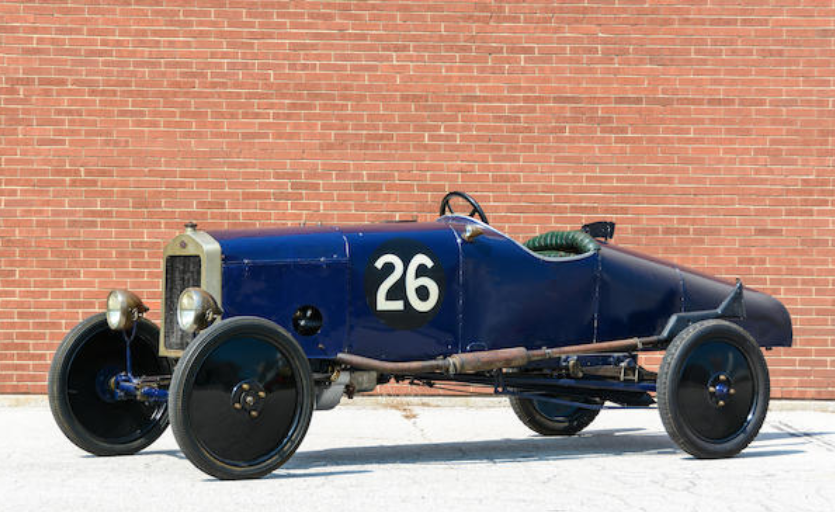
1950 Fiat-Daniela 750 Testa d’Oro

Offered by Bonhams | Philadelphia, Pennsylvania | October 7, 2019

Photo – Bonhams

Small Fiats were the basis for many Italian sports cars after WWII. What quite a few enterprising individuals did was take a Fiat 500, bore it out to 750cc, replace some other internals, and go racing.

Daniela built five or six cars powered by 750cc Fiat engines. This car’s original engine went missing, and it’s now powered by a 105 horsepower, 1.1-liter Fiat inline-four. It hasn’t really been used much since the 1990s and is begging for restoration.

A previous owner had the car from 1958 through 1990, during which time it was raced in Nassau, Watkins Glen, Bridgehampton, and Lime Rock. It’s a pretty cool little thing and should sell for between $35,000-$45,000. Click here for more info and here for more from this sale.

Update: Sold $106,400.

Two Buckboards

1907 Waltham Orient Buckboard Surrey

Offered by RM Sotheby’s | Hershey, Pennsylvania | October 10-11, 2019

Photo Courtesy of RM Sotheby’s

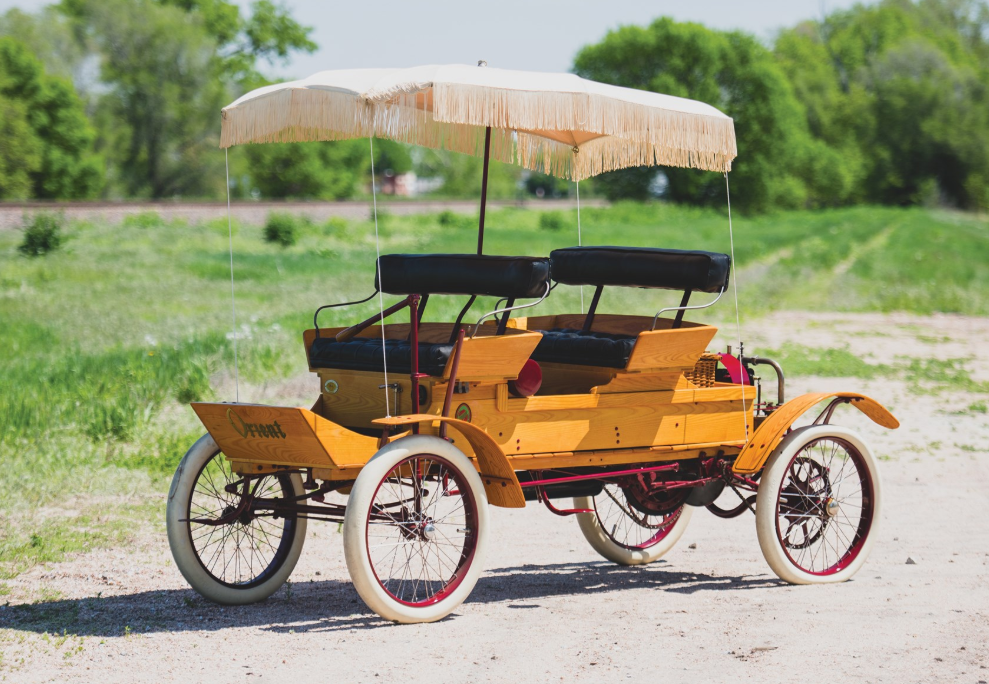
Charles Metz’s Waltham Manufacturing Company of Waltham, Massachusetts began producing bicycles in 1893. Their first automobile was built in 1899 and it was electric. Different cars followed for 1900-1902, and their most famous product, the Buckboard, debuted in 1903. They used “Orient” as a brand name through 1905 when it shifted to Waltham-Orient or just Waltham.

This 1907 model was from the final year of Orient Buckboard production and is quite different from most of their products. Called the Surrey, it features two-rows of bench seating and a surrey top that made it look downright luxurious compared to other two-passenger buckboard cars. Power is from a four horsepower two-stroke single-cylinder engine.

Only 1,020 examples were built. This one should bring between $10,000-$15,000. Click here for more info and here for more from this sale.

Update: Sold $27,500.


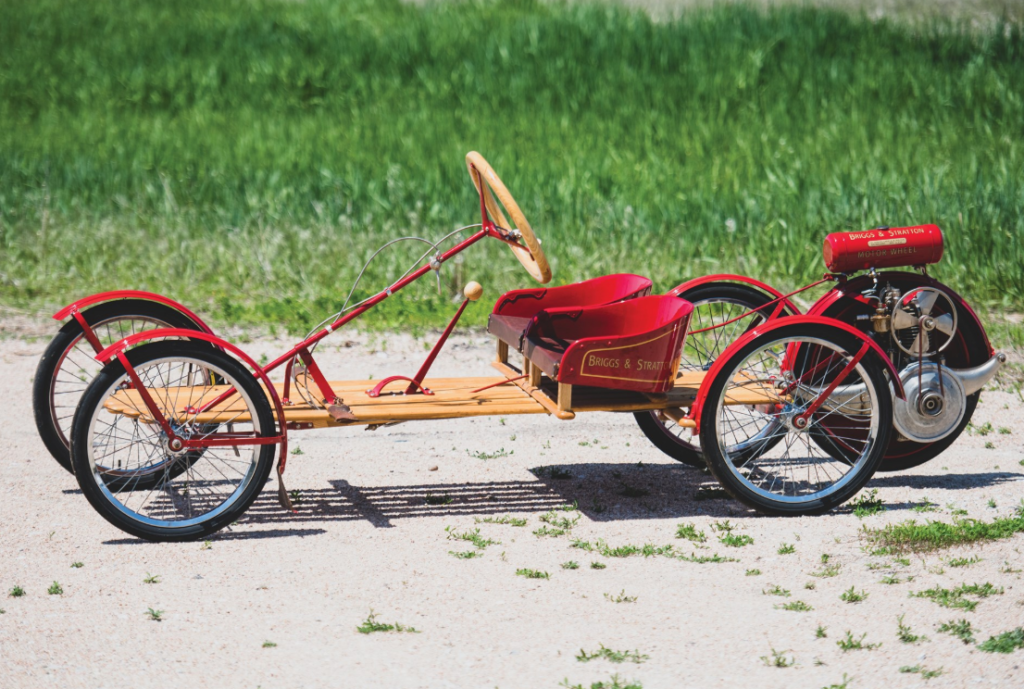
1919 Briggs & Stratton Flyer

Offered by RM Sotheby’s | Hershey, Pennsylvania | October 10-11, 2019

Photo Courtesy of RM Sotheby’s

When A.O. Smith stopped producing his “Smith Flyer,” he sold the rights to Briggs & Stratton, they of more recent lawn mower-engine fame. The company has been around since 1908 building small engines. When they acquired the rights to the Flyer in 1919, they improved upon it a little and continued production with their motors through 1923.

After that, the design was sold to a different company that produced it as the Red Bug. This five-wheeled car has a top speed of 25 mph and a single-cylinder engine. It should sell for between $10,000-$15,000. Click here for more info and here for more from this sale.

Update: Sold $27,500.

Briggs & Stratton Flyer

1919 Briggs & Stratton Flyer

Offered by RM Sotheby’s | Hershey, Pennsylvania | October 10-11, 2019

Photo Courtesy of RM Sotheby’s

When A.O. Smith stopped producing his “Smith Flyer,” he sold the rights to Briggs & Stratton, they of more recent lawn mower-engine fame. The company has been around since 1908 building small engines. When they acquired the rights to the Flyer in 1919, they improved upon it a little and continued production with their motors through 1923.

After that, the design was sold to a different company that produced it as the Red Bug. This five-wheeled car has a top speed of 25 mph and a single-cylinder engine. It should sell for between $10,000-$15,000. Click here for more info and here for more from this sale.

Update: Sold $27,500.

Vignale Aurelia B52 Spider

1953 Lancia Aurelia B52 Spider by Vignale

For sale by Girardo & Co.

Photo – Girardo & Co.

The Aurelia is a very historic nameplate in Lancia’s past, yet it was produced in fairly limited numbers between 1950 and 1958. Only 18,201 were built in total across all body styles. They revised the chassis over the years during the various series of Aurelias built.

The B50 was the less-pedestrian version, and they make up a very small percentage of Aurelia production. Offered as a bare chassis to coachbuilders, B50s would turn up with some fantastic coachwork. In 1952, Lancia updated the chassis to B52 specification, and they built 98 examples through 1953.

Power is provided by a 1.8-liter V6 – the Aurelia was the first mass-produced car with a V6. This example was bodied by Vignale and debuted at the Brussels Motor Show, where it may have caught the eye of the Belgian royal family…

It remained in Belgium through 2007 and was later restored to its motor show stand-livery. It was shown at Villa d’Este in 2016 where let’s be honest, a car like this absolutely belongs. This right-hand drive example is one of 12 B52s built in 1953. You can read more about it here.

Kearns Roadster

1910 Kearns Model G Roadster

Offered by RM Sotheby’s | Hershey, Pennsylvania | October 10-11, 2019

Photo Courtesy of RM Sotheby’s

The Kearns Motor Buggy Company was founded by Maxwell Kearns in Beavertown, Pennsylvania in 1909 after he purchased the former Eureka plant. High-wheelers were still in fashion so that’s what they started building. It was also almost the same car Eureka had been building.

Kearns advertised the cars as different than your standard high-wheeler, which they were with their more conventional setup. They eventually moved into four-cylinder cars and cyclecars. Ultimately, the company stopped passenger car production in 1916 to focus on commercial vehicles, which lasted through 1928.

The Model G as one of six models offered in 1910 and one of two powered by a 20 horsepower, three-cylinder two-stroke engine. It has dual-chain drive, a right-hand steering wheel, and other features not found on many of its contemporaries. This former Henry Austin Clark Jr. car is one of about 100 examples of the Model G produced, and it should sell for between $20,000-$30,000. Click here for more info and here for more from this sale.

Update: Sold $66,000.

A.B.F. Prototype

1923 A.B.F. Boattail Prototype

Offered by Bonhams | Philadelphia, Pennsylvania | October 7, 2019

Photo – Bonhams

If you were to say “there are zero automakers that can claim a 100% survivability rate among their cars (one-offs notwithstanding),” I think it would be easy to agree. And then A.B.F. comes along. Albert Ford was born in Canada but resided in England when he tried to get a company called All-British Ford off the ground in the 1920s.

It didn’t go great, but he did manage to complete two cars. Both of which still survive. This was the first of the two examples, and it is powered by a 1.2-liter V4. The body was actually purchased by Ford from the owner of a racing Alvis who was looking for something different. A.B.F. closed down shortly after, as the owner changed course to hospital furniture manufacturing.

Both cars were rescued from Mr. Ford’s garage after WWII. This one was restored in the 1950s and again in the late 1970s. It’s a pretty cool little car with great period bodywork. It is expected to bring between $75,000-$125,000. Click here for more info and here for more from this sale.

Update: Not sold.

Two Cars in Hershey

1914 Jeffrey Six Model 96 Five-Passenger Touring

Offered by RM Sotheby’s | Hershey, Pennsylvania | October 10-11, 2019

Photo Courtesy of RM Sotheby’s

The Jeffrey was kind of an important marque. It was founded by Thomas B. Jeffrey and his son Charles. They started by building the Rambler, but after Thomas died, Charles changed the name to Jeffrey. In 1917, the company was sold to Charles Nash (after Charles survived the Lusitania sinking), and the name changed again. Nash eventually merged into AMC, which is now part of Chrysler… which is now part of Fiat. So this is just like an old Fiat.

Jeffrey cars were only sold between 1914 and 1917. Three models were offered in 1914 and the Six was the largest. It is powered by a 48 horsepower inline-six. Over 10,000 Jeffreys were sold in 1914, and this one should bring between $30,000-$50,000. Click here for more info and here for more from this sale.

Update: Sold $52,250.


1909 Enger Model B High-Wheel Runabout

Offered by RM Sotheby’s | Hershey, Pennsylvania | October 10-11, 2019

Photo Courtesy of RM Sotheby’s

Frank J. Enger set up shop in Cincinnati in 1909 to build high-wheelers. More traditional touring cars followed in 1910, but the company folded in 1917 after Frank’s suicide in his office. This high-wheeler is from the first year of production.

The Enger high-wheeler was actually a normal car but with big wheels. It’s pretty much the original donk. Three models were offered that year, and the Model B was the least expensive at $1,600. It’s powered by a 14 horsepower flat-twin. This one should bring between $15,000-$25,000. Click here for more info and here for more from this sale. Also, I really want this car.

Update: Sold $45,100.

Gwynne Eight

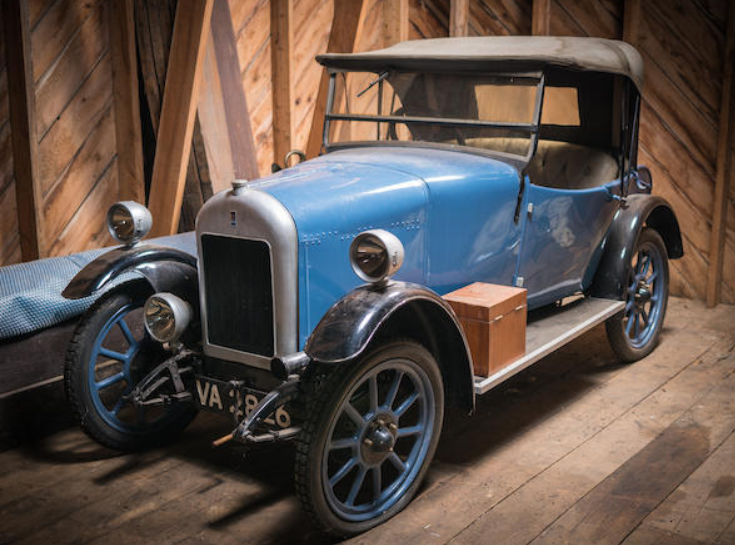
1923 Gwynne Eight

Offered by Bonhams | Philadelphia, Pennsylvania | October 7, 2019

Photo – Bonhams

October in Pennsylvania is a great place to buy an old American car. But it should take no more than a quick glance to notice that this car is from the other side of the pond. It looks like an Austin or Morris of the same period but was built by Gwynnes Limited, an engineering company that dated back to 1856. They built a few thousand cars between 1920 and 1929.

The Eight was powered by an 850cc inline-four capable of 24 horsepower. About 2,250 examples were built, and it is said that this is the only example wearing this body. It is currently not in running order but is complete.

It’s been in the U.S. since 1975 and should bring between $15,000-$25,000 in 2019. Click here for more info and here for more from this sale.

Update: $8,680.