Offered by Mecum | Kissimmee, Florida | January 15, 2021
Photo – Mecum
Since 1965, there have been quite a few Shelby-branded products that weren’t Cobras. And this is the best of them. They were built around the early, light first-run Mustangs. The first-generation GT350 was technically built in 1965 and 1966, but the ’65s are better.
All 562 first-year GT350s were finished in Wimbledon White, and most had Guardsman Blue Le Mans stripes. Power is from a 4.7-liter (289) V8 rated at 306 horsepower. This particular car was originally used as a Shelby factory demonstrator.
It has less than 7,000 original miles, having pretty much sat in storage with every one of its many owners of the years. Mecum estimates it to be worth between $400,000-$500,000. Click here for more info and here for more from this sale.
Offered by RM Sotheby’s | Paris, France | February 13, 2021
Photo Courtesy of RM Sotheby’s
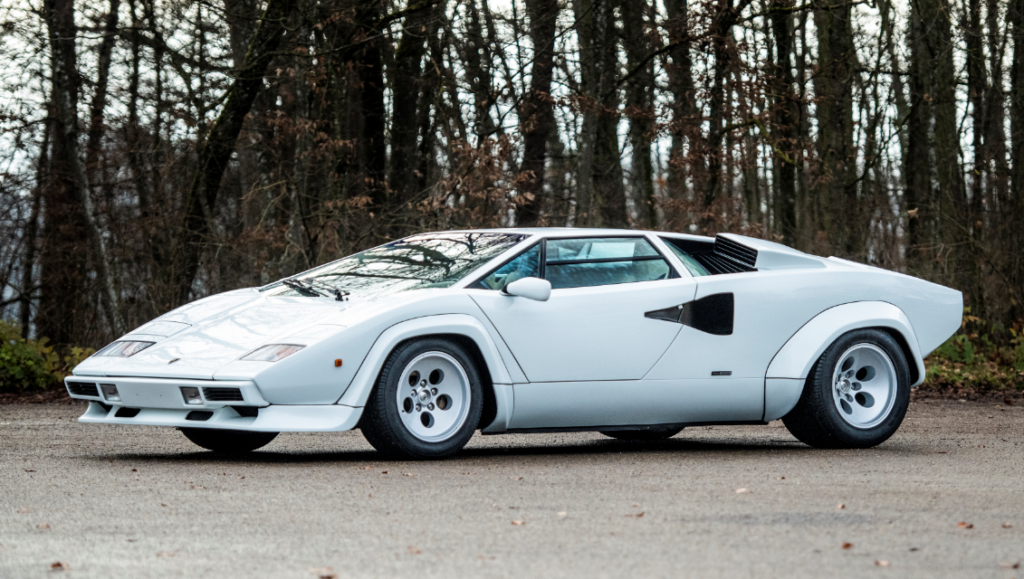
This is the middle child of the Countach family. The Countach launched in 1974 in LP400 configuration. That was the cleanest, sleekest Countach: no fender flares, no boxy bumpers, no horrendous wing.
1978’s LP400 S started to get boxy. And 1982’s LP500 S (sometimes referred to as the 5000 S) continued that trend. The LP500 S was produced until 1985, and in total, 321 examples were built. It’s not the rarest variant, but not the most common either. Things would get even boxier by the time the 25th Anniversary model rolled out in 1988.
This car is powered by a 4.8-liter V12 rated at 370 horsepower. Top speed was 182 mph, a big jump from the LP400 S, and 60 arrived in 5.2 seconds. I’m sure owning one of these in the early 80s was a nightmare from a servicing standpoint, but the knowledge exists now, and this should make a fun, occasional ride for someone. You can read more about this one here, and see more from RM here.
1947 Mercury Series 79M Marmon-Herrington 4×4 Wagon
Offered by Worldwide Auctioneers | Auburn, Indiana | January 23, 2021
Photo – Worldwide Auctioneers
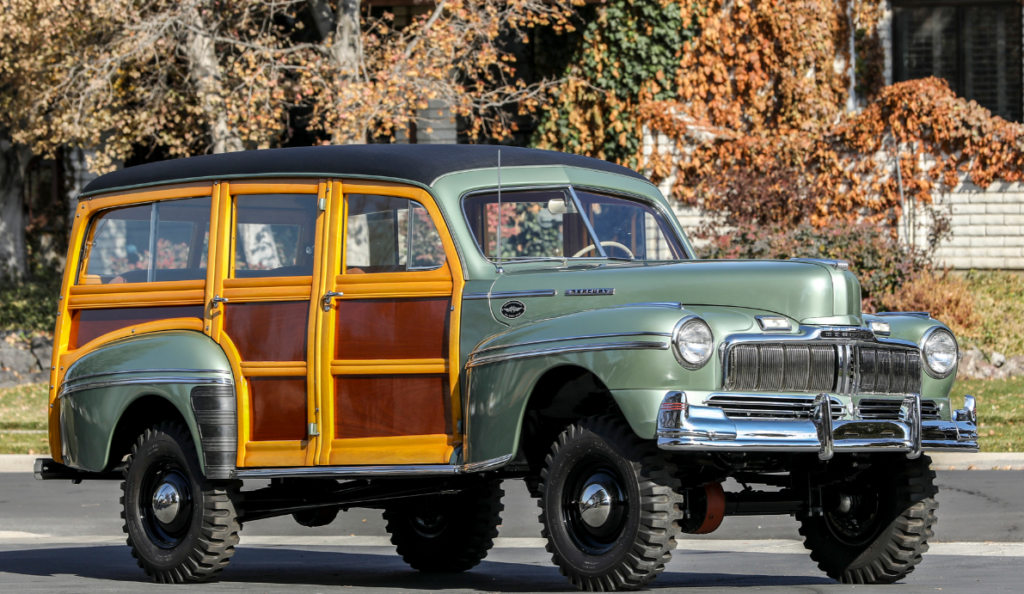
Mercury’s immediate pre- and post-war models consisted of the “Eight.” They are often referred to by their series name, and 1947’s was the 79M. You could go downtown and buy a Mercury or two. Or five, as that’s how many body styles of the 79M were offered, including a station wagon.
The wagons were rare. Only 3,558 were built for the model year. They were all powered by 3.9-liter V8s rated at 100 horsepower. What makes this one special is also the reason this one looks so incredibly badass. Two words: Marmon. Herrington.
Marmon-Herrington was the successor to the Marmon Motor Car Company. Walter Marmon teamed up with Arthur Herrington to create this new company, and they bought the old Duesenberg plant in Indianapolis to make the magic happen (part of this building can be seen in one of our rotating header banners). Their business was focused on turning station wagons into 4x4s. It started in the 1930s, and they were popular in the 1940s for turning cars like Ford wagons into mid-century monster trucks.
Ford even sold them through their dealerships. The price included a whopping 100% markup. Meaning this car would’ve cost $4,414 when new. Only three 1946-1948 Marmon-Herrington Mercurys are known to exist. This one was once part of the Nick Alexander collection and is now selling at no reserve. Click here for more info and here for more from this sale.
Offered by RM Sotheby’s | Paris, France | Sometime in 2021
Photo Courtesy of RM Sotheby’s
Well here we go. Two years ago, Historics auctioned a Lister Storm road car and I said “now if you could just snag an Isdera Commendatore” you’d win my heart. Well, RM Sotheby’s is doing it. The one and only Commendatore 112i is going under the hammer in Paris next year.
Isdera was founded by Eberhard Schulz in Germany in 1982. The company’s biggest success on the production car front was the Imperator 108i, which was a production version of the Mercedes-Benz CW311 concept car (which was designed by Schulz). Thirty were built between 1984 and 1993. Apparently, Isdera has produced 70 cars since 1993, but nobody really knows what they are.
The Commendatore 112i launched as a concept car at the 1993 Frankfurt Motor Show. It was named for Enzo Ferrari and was originally fitted with a 6.0-liter Mercedes-Benz V12 capable of 408 horsepower. A Ruf six-speed manual transaxle was fitted, and the car could do 211 mph.
The body is fiberglass over a spaceframe chassis. Production never materialized, and only this prototype was built. It reappeared in 1999 under the care of a Swiss businessman who updated it to the name “Silver Arrow.” It was offered for sale a few times in the ensuing years, but Isdera managed to reacquire it in 2016. It was then restored back to 1993 specification, including it’s awesome periscope mirror.
Offered by Mecum | Kissimmee, Florida | January 15, 2021
Photo – Mecum
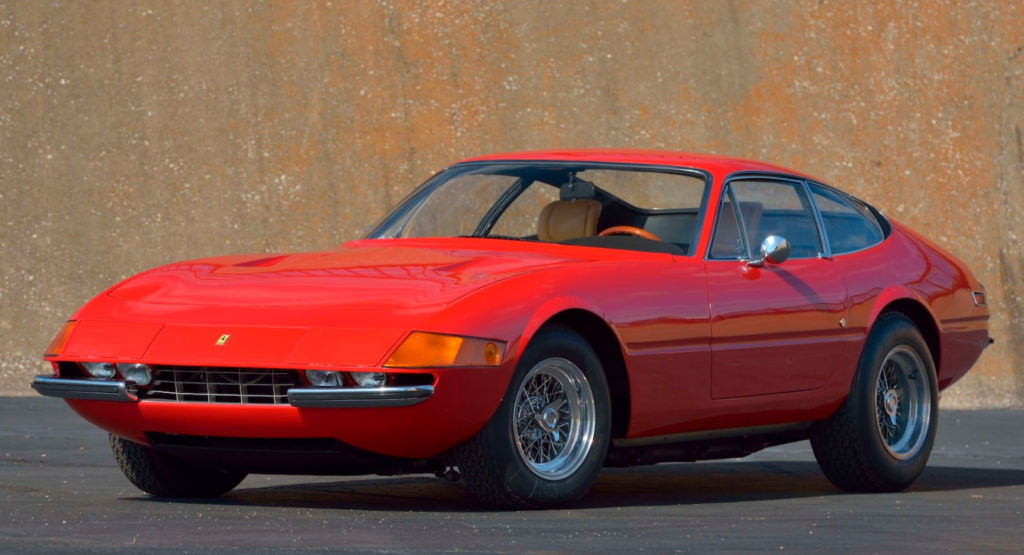
Here’s another “blue chip” collector car. The Ferrari Daytona is one of the last “classic” Ferraris, in my opinion. Before things got all boxy. The 365 GTB/4 was styled by Leonardo Fioravanti at Pininfarina – not really a household name, which is a shame because this car is gorgeous.
Ferrari built 1,383 Daytona coupes between 1968 and 1973, and they also made just 122 Spyders, or “GTS/4”s. Power is from a 347-horsepower, 4.4-liter V12. Top speed is 174 mph. This car has six Weber carburetors, a limited-slip differential, Borrani wire wheels, Ansa exhaust, and air conditioning.
The Daytona Spyder is a million-dollar car every day of the week. The Berlinetta version has been creeping up over the years, and this one is estimated between $650,000-$700,000. Click here for more info and here for more from this sale.
Offered by Mecum | Kissimmee, Florida | January 16, 2021
Photo – Mecum
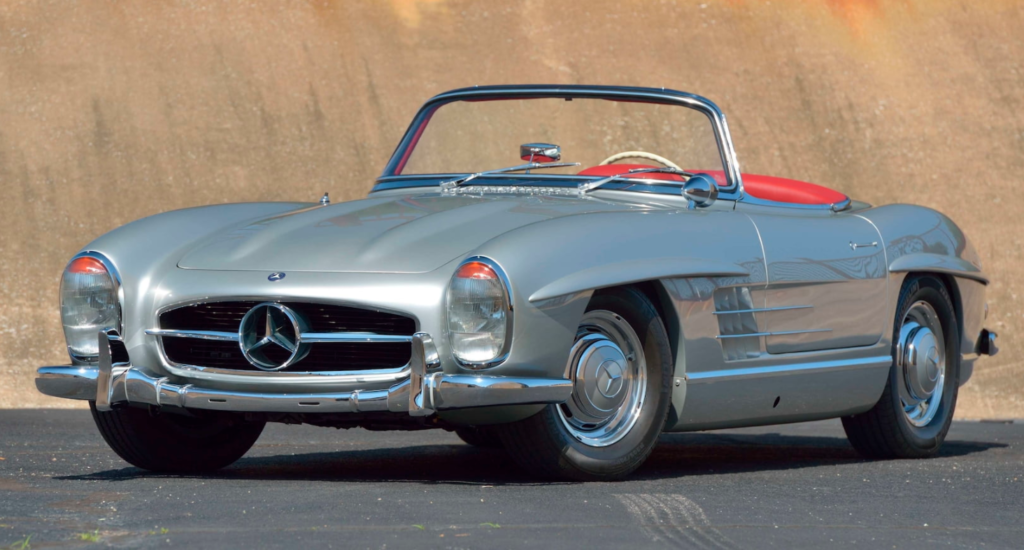
I think we all know at this point that the Mercedes-Benz 300SL is one of the poster children for “collector cars.” The Gullwing coupe version is probably in the dictionary next to the phrase. The roadster was introduced in 1957 when the coupe was discontinued. It would be built through 1963.
Power is from a fuel-injected 3.0-liter inline-six. Output was rated at 240 horsepower when new. Also, keep in mind that fuel injection was no common sight in 1960. Or even 1970. The 300SL was really a landmark car and deserves its reputation as an amazing machine.
With its extended production run, the roadster was more common than the coupe, with 1,858 built. This restored example is finished in Silver Gray Metallic over red leather. It’s good-lookin’ stuff. A little over a decade ago, these were $500,000 cars. They’ve been trading right at about a million dollars now for the last five years or so. This one carries an estimate of $1,100,000-$1,300,000. Click here for more info and here for more from this sale.
Offered by Mecum | Kissimmee, Florida | January 7-16, 2021
Photo – Mecum
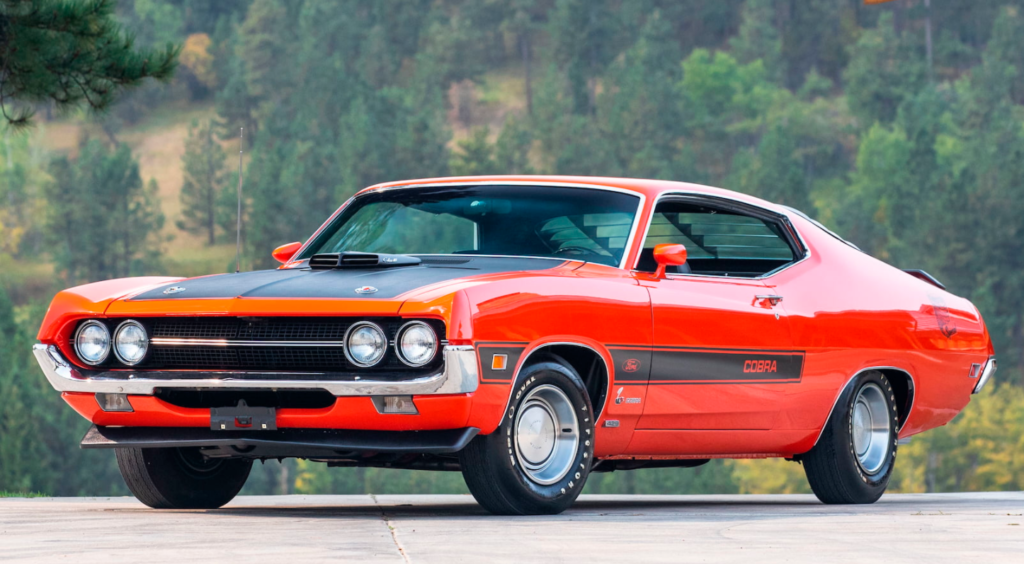
What a great looking car. The 1970 Torino is one of Ford’s styling highpoints of the era. This model year had a dizzying assortment of models, sub-models, trims, body-style, and engine combos. The Torino Cobra was the top sport-level trim, slotting in above the Torino GT. It was available as a two-door Sportsroof fastback only.
The dealers in Ford’s Kansas City sales district were selling a limited edition Twister Special of the Mustang for 1970. Only 96 were ordered. Alongside those, the dealers opted to outfit 90 Torinos with a similar package. Only 30 of those had a four-speed manual transmission like this car has.
Power is from a 7.0-liter (429) Cobra Jet V8 rated at 370 horsepower when new. The Twister Special package added some blacked-out trim and graphics. This car has rear window sport slats and spoilers up front and out back. Fully restored, it’s going to sell at no reserve. Click here for more info and here for more from this sale.
Offered by Bring a Trailer Auctions | December 2020
Photo – Bring a Trailer Auctions
The Falls Machine Company of Sheboygan Falls, Wisconsin, was founded in 1901. They made milling machines, and in 1908 expanded into single-cylinder agricultural engines. Their engine program spread, and soon they were supplying engines for automobile manufacturers, like Dort and Elgin.
They built three of their own cars in 1921, and in 1923, they introduced an inline-eight engine. They only built eight of those engines, and three of them were destined for Elgin, who ended up going out of business before using them. Falls ended up building a single car using one of their eight-cylinder engines in 1924. It was thought to be a sedan or a touring car.
That car does not exist. But its engine does. In this car. So this car is said to be a 1920, but it is thought that the race car using the Falls engine was built sometime between 1924 and WWII. It sure has a 1920s race car look to it. It is claimed to have attempted to qualify for the 1923 Indy 500, though no record seems to exist.
The interesting part is that this car was gifted to a young Bruce Mohs in 1944. And from here the story is more well known. Mohs was a big personality, so who knows how much of the story that pre-dates his ownership is actually true or just his story. At any rate, this car has been known for quite some time and was even once owned by Phil Hill.
The engine is a 5.0-liter inline-eight. The whole package sure looks to be the real deal, there just isn’t much of anything known about it between 1924-ish and 1944. Oh well, it’s still cool and eligible for many historic events. Click here for more info.
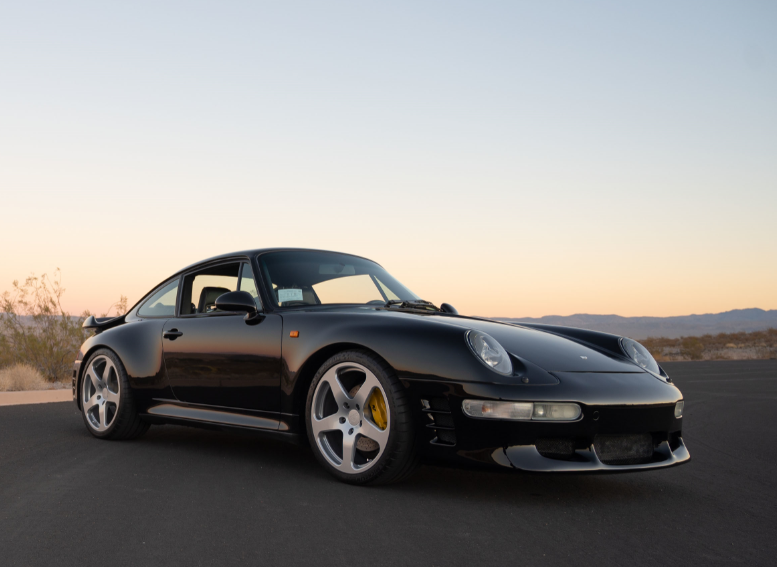
The Turbo R is based on the 933-generation of the Porsche 911, which was produced between 1994 and 1998. The 993 was the last air-cooled variant of the 911. And it’s Turbo model was a beast. That’s where the Turbo R gets it start.
Ruf took the 993 Turbo’s twin-turbocharged 3.6-liter flat-six and tweaked it to put out 490 horsepower (about 88 more than stock). It also got a revised suspension and a Ruf body kit and wheels. An integrated roll cage was helpful if things went wrong on the way to the Turbo R’s 204-mph top speed. This example has all-wheel drive.
The Turbo R was only produced in 1998, and just 14 were built. A 993 Turbo S can bring upwards of $300,000. This should easily sail into that range. You can read more about it here and see more from this sale here.
Offered by Mecum | Kissimmee, Florida | January 7-16, 2021
Photo – Mecum
Giorgio Stirano was an F1 car designer that worked at Osella, where he was chief engineer for a period of time. Later, with a few partners, he founded Alba Engineering. Their first product was a Formula 3 car, and in 1982 they designed their first Group C prototype.
The AR3 was built in 1984, and this is chassis #001. This car was built to race in IMSA GTP, which had a similar ruleset to that of Group C. It features carbon/kevlar bodywork, a turbocharged 4.0-liter Buick V6, and a Hewland gearbox. A bunch of spares accompanies the car, including a 4.5-liter V6.
During the 1984 IMSA GTP season, this car ran a handful of races with drivers Gianpiero Moretti and Fulvio Ballabio behind the wheel, securing four top 10s and a single top five in the process. No pre-sale estimate is available, but you can read more about it here and see more from Mecum here.