Callaway C12

1997 Callaway C12

Offered by Mecum | Dallas, Texas | September 8, 2012

If you don’t know, or can’t tell, this car is based around a Chevrolet Corvette. 1997 was the first year for the C5 and the first year for the Callaway C12 – and this is the very first C12 built.

Callaway was founded in Connecticut in 1977 by Reeves Callaway. They began tuning Corvettes in 1987 and have dabbled in aftermarket tuning of other cars over the years, including Range Rovers and Alfa Romeos. But it’s mostly been Corvettes with the occasional Camaro thrown in for good measure. And it was mostly engine and performance modifications. That is, until 1993 when they introduced the Callaway C7, a GT1 racecar produced for the 24 Hours of Daytona.

The C12 was a continuation of that ultimately doomed attempt at building a successful racing car. Reeves Callaway wanted his cars to compete in the 24 Hours of Le Mans. And he got his wish – they scored a pole in the GT2 class in 2001, the final year for C12 production. In order to compete, the company needed to homologate the car for the road and 20 examples were built.

Callaway reworked every part of the Corvette except the roof and greenhouse. Everything else was modified, so it’s essentially its own car. The 5.7-liter V-8 underhood makes 440 horsepower, allowing the car to sprint to 60 mph in 4.2 seconds on its way to a top speed in excess of 190 mph. Originally, these cars were supposed to cost $140,000 – but they were built to an exacting standard for high-profile customers who would have likely paid more if asked. The cars were also built under license in Germany as the IVM C12 from 1998 through 2003 and these were available as a coupe, hardtop or cabriolet.

With only 20 built, getting your hands on one won’t be easy. Here’s a good opportunity. For more information, click here. And for the rest of Mecum’s Dallas lineup, click here.

Update: Not sold.
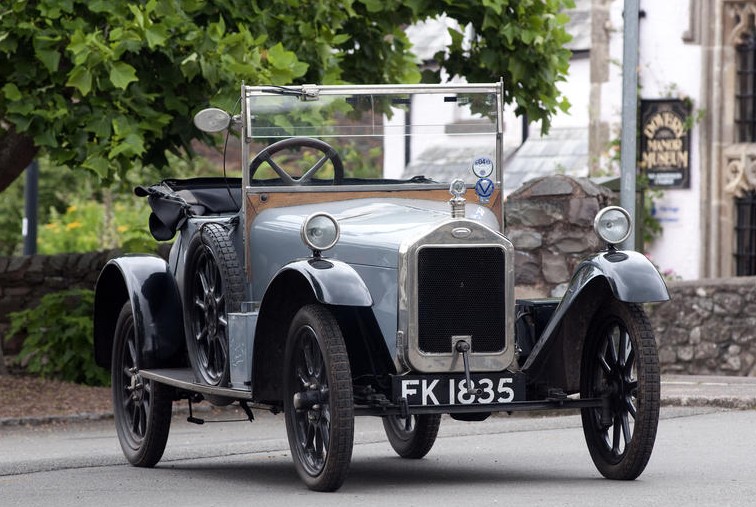
Wolseley Seven

1922 Wolseley Seven Tourer

Offered by Bonhams | Beaulieu, U.K. | September 8, 2012

Here’s another small British convertible. The name Wolseley is probably familiar to you, as they produced cars in Birmingham from 1901 until 1975. The Seven name might also be familiar to you, as the Austin Seven (or 7, as it is usually seen) was one of the most popular British cars during the years of its production of 1922 through 1939. I kind of think of the Austin 7 as the British Ford Model T. Sure, the Model T came first and the British had them too, but the Austin 7 had the same kind of effect on the British automotive market as the Model T did in the U.S.

Wolseley and Austin were independent manufacturers in the 1920s, although Austin tried to buy Wolseley in 1927, but were outbid by Morris. But Austin and Morris merged in 1952 anyway as British automotive firms began to consolidate time and again. For a while  thereafter, Austin and Wolseley produced badge-engineered versions of the same cars.

But this was not the case in 1922 when the Wolseley Seven was introduced. The car was high in quality but it was at the bottom end of the market with its flat-twin engine of 986cc making just 8.5 horsepower. The Austin 7, introduced the same year, used a 747cc straight-four making 10.5 horsepower. And, to make matters worse, the Wolseley was considerably more expensive. This led to only about 1,000 being made before production halted at the end of 1923.

Only about 10 of these very rare cars survive today – and this one is in drop-top form. It’s a former museum car in good shape. The pre-sale estimate is between $13,000-$19,000. For more information, click here. And for the rest of Bonhams’ lineup for this sale, click here.

Update: Sold $18,773.

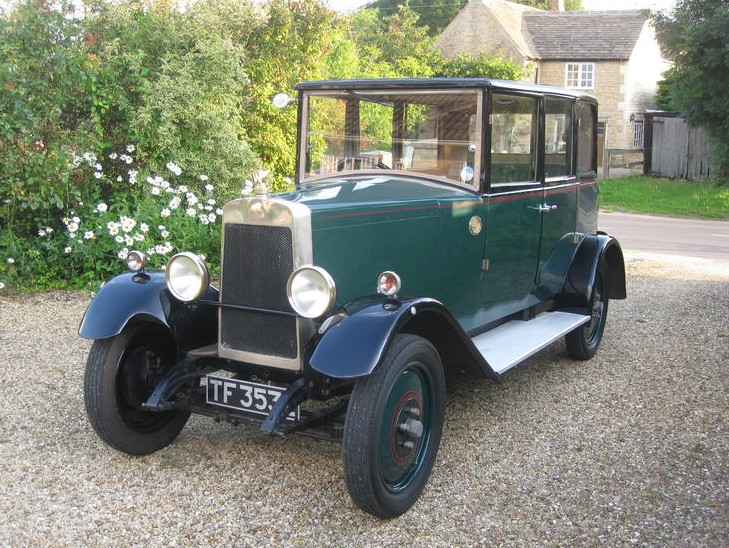
1913 Humberette

1913 Humber Humberette 8HP Two-Seater

Offered by Bonhams | Beaulieu, U.K. | September 8, 2012

Like many automotive manufacturers, Humber began as a bicycle company. Founded as such in 1868 by Thomas Humber, their first car didn’t appear until 1898, a three-wheeler. Four-wheelers appeared in 1901. “Humberette” was applied to light (single-cylinder) Humbers in 1903 and 1904 and then it went missing until after 1910.

The cyclecar fad was sweeping the U.K. in the early teens and Humber eagerly opted in, bringing the Humberette name back from the great beyond for their v-twin powered cyclecars, like the one you see here. This has a 996cc V-Twin making eight horsepower. Unlike most of its competition, this cyclecar has shaft drive, as Humber was not a fan of the much more common chain drive.

Humberette was not technically its own marque but the cars are often referred to as if they were. The Humberette name disappeared again at the start of WWI. The Humber name lasted until 1976, being killed during the Chrysler Europe fiasco. This car was restored at some point and has seen little use over the last quarter century in the hands of its current owner. The pre-sale estimate is $17,000-$22,000. For the complete description, click here and for more from Bonhams at the National Motor Museum, click here.

Update: Sold $36,809.

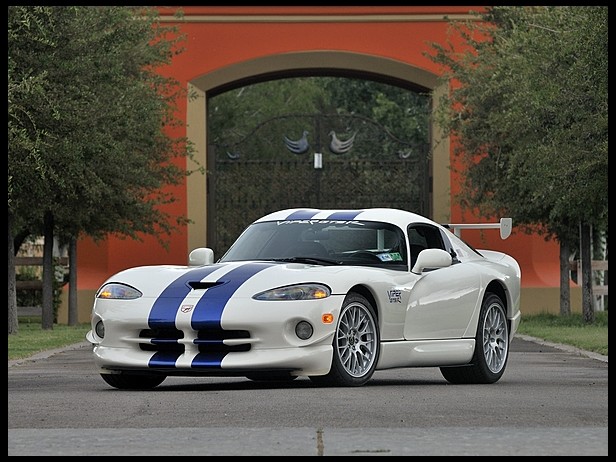
Viper GTS-R GT2

1998 Dodge Viper GTS-R

Offered by Mecum Auctions | Dallas, Texas | September 6, 2012

The second-generation Dodge Viper was introduced in 1996. It was the first time the car could be had in two-door hardtop coupe form. Generation one cars were only available as a roadster. Stylistically, the cars were unlike anything else on the road – especially at their price point.

Chrysler took the Viper racing in 1997. It competed in the FIA Championship in GT2 guise. The Viper won the GT2 Championship in 1997 with the French Oreca team. The team’s colors were white with blue stripes (they would adopt the famous red with white stripes for 2000). Vipers would also win their class at Le Mans in 1998 and a few more GT Championships over the years.

To celebrate and commemorate their 1997 FIA GT2 Championship, Chrysler released a special edition of the Viper road car for 1998. It was called the GTS-R (sometimes referred to as the GT2). They came only in Stone White with twin Viper Blue stripes. The cars had the racing aerodynamic package with the big spoiler out back, BBS-style wheels and some small giveaway graphics. Power was increased by 10 horsepower to 460 over stock in the 8.0-liter V10.

This one has had one owner its whole life and has covered only 3,600 miles. There aren’t too terribly many special edition Vipers that have been built and this is the coolest, most well-known of the handful. And it’s legitimately rare – although there are some imitations out there. If I were to own a Viper, it would be this one (or a Ketchup and Mustard Roadster).

For the complete lot description, click here. And for more from Mecum in Dallas, click here.

Update: Sold $83,000.

Waldron Wayfarer

1928 Waldron Wayfarer

Offered by Bonhams | Beaulieu, U.K. | September 8, 2012

The Waldron Wayfarer – that’s right the, there was only one made, was built over a period of years ranging from 1928 until 1931 by Frederick Barnes Waldron in Lancashire, England. Waldron was a mechanical engineer by trade and designed the car from the ground up – designing and building his own engine during a time when many automobile manufacturers used engines from other, larger companies. His was a 1.3-liter straight-four.

The body was designed and built by St. Helen’s Carriage Works, a firm that specialized in commercial vehicles. Waldron drove the car approximately 20,000 miles by the end of the 1930s, when he dismantled the car.

In 1976, the car was acquired and re-assembled using Waldron’s original drawings and all of the original parts, including the body panels. In 2005 it was purchased at auction and used as reliable summer transportation in the English countryside. It has had another owner since and is being offered with an estimate between $13,000-$16,000 – not too steep considering it’s one of a kind. For the complete description, click here. And for more from Bonhams at the National Motor Museum, click here.

Update: Withdrawn.

Russo & Steele Monterey Highlights 2012

Russo & Steele’s Monterey Auction is the last of the Pebble Beach sales we’ve got to cover. Neither of our feature cars, the Fiat Stanguellini Bertone and the Apollo 5000 GT, sold. Top sale went to a 1965 Shelby Cobra 289 for $781,000.

1965 Shelby Cobra 289

Other interesting sales included a pair of Devins. First, the 1959 Devin SS for $165,000.

1959 Devin SS

Then there was this 1957 Devin Triumph S “Gary Special” for $66,000.

Another special-like car was this 1962 Allard L-390 CC hillclimb car. The car is one of a few dozen Allard hillclimb specials built and it was actually built in 1948. But it was not registered until 1962, which is why it is listed as such. The competition car (CC) bodywork was added around this time. It sold for $66,000.

1962 Allard L-390 CC

Two other cars of note are both rather recent. First is this 1999 Acura NSX Alex Zanardi Edition. If you want to own an NSX, this is the one to get because it is named after one of the greatest, most entertaining open-wheel drivers you will ever have had the chance to seeing. Only 50 were ever built and it sold for $64,900.

1999 Acura NSX Alex Zanardi Edition

And finally this 2010 Superlite SLC Coupe is hand-built one-off supercar with a 632 horsepower LS7. It sold for $105,600.

For complete results, click here.


Woodill Wildfire

1953 Woodill Wildfire Series II

Offered by Worldwide Auctioneers | Auburn, Indiana | August 31-September 1, 2012

Like the Californian featured yesterday, this is another 1950s fiberglass special. Well not really a “special” as it did enter production – in fact, 1953 was the first year for Robert Woodill’s sports car. It came assembled from the factory or could be had as a kit. Series II Cars were Ford based – although mechanicals from other manufacturers were used on occasion (Series I cars had Willys engines). This one has a 3.3-liter Ford V8. The car also only weighs 1,600 pounds, so it should be a performer.

The Wildfire was among the first all-fiberglass sports cars available – barely beating the Corvette to market. Only 24 are believed to have been built – 15 Series I (Willys-based) cars and nine Series II cars. This is the second-to-last Series II car built and one of only two known to exist. Woodill also sold between 100-300 kits.

This car is all-original, having been maintained since the 1970s by a Corvette collector familiar with early fiberglass sports cars. It has only covered 1,602 miles in its life. I’ve seen another Wildfire for sale a few years ago and it was red. I like this one in white better. It could be mine – or yours – for $110,000-$140,000. For the complete lot description, click here. For the rest of Worldwide’s Auburn lineup, click here.

Update: Sold $66,000.

Californian Sport Special

1955 Californian Sport Special Roadster

Offered by Worldwide Auctions | Auburn, Indiana | August 31, 2012

There are quite a number of fiberglass specials built in the United States in the 1950s when fiberglass was all the rage. This is one of the rarer ones. Many of these cars were built are 1940s-era Fords – engine and chassis.

This car has a 125 horsepower 3.6-lite Ford V8. This one has been restored and looks to be in fantastic shape. It looks sporty and racy. And pretty light, if not spartan. This car was introduced in 1955 – two years after the Corvette, which had a lot more going for it than any  Los Angeles-based startup.

It is estimated that only three of these were built in the 1950s – I’d bet that even less have survived. This is the only one I’ve ever seen. The estimate is $50,000-$60,000 and this car has been for sale for quite a while in Sarasota, Florida for $59,900. For more information from Worldwide Auctions, click here. To see more photos at Vintage Motors Sarasota, click here.

Update: Not sold.

Schuppan 962CR Prototype

1992 Schuppan 962CR Prototype

For Sale at Coys | Richmond, U.K.

A couple of weeks ago (or perhaps months ago, the days have been flying by) we featured a Dauer 962 Le Mans, a road car variant of the dominant race car, the Porsche 962. This is a similar idea, although the two cars look quite different – and they should, as they were designed by two different people.

Vern Schuppan, an Australian race car driver who has competed in the Indianapolis 500 and Formula One, designed this car as a tribute to his 1983 24 Hours of Le Mans winning 962. The engine is a 3.3-liter twin turbo flat-6 pushing out about 600 horsepower – basically lifted straight from the race car.

It’s a serious supercar. Sixty miles per hour comes in 3.5 seconds on the way to 230 mph. The chassis and body were designed and built by Schuppan (unlike the Dauer, which were 962s converted for road use). The price when new was $1.5 million. This was the first one built, chassis number one. Funding for the project was pulled shortly after this was built and only five or six were built in total.

This is an extremely rare opportunity to purchase an extremely rare car with unbelievable performance that still holds up against even the most modern of supercars. You’ll never pass another one on the road. To see/read more, click here. Unfortunately, Coys isn’t listing an asking price.

Duesenberg J-310

1935 Duesenberg Model J Sedan by Derham

Offered by Auctions America | Auburn, Indiana | August 30-September 2, 2012

Okay, one more Model J to close out Duesenberg Week. This one is still available for you to purchase, coming up for sale at Auctions America’s Auburn Fall Sale here in a few days. This car has a somewhat convoluted history and is, like many Duesenbergs, a combination, of sorts, of two separate cars.

The body, the Derham Sedan style you see here was originally attached to J-551. The owner didn’t like the new aerodynamic design updates and waterfall grille and had Duesenberg reinstall the 1929-style grille and trim bits to the car.

Sometime later, the body was removed and the engine and chassis of J-551 were used for another project. The owner of J-310 used the original body from his car (a Judkins Limousine) for a separate project as well. Well, the remnants of both J-551 and J-310 ended up in the hands of the same owner, Homer Fitterling, who mounted the Derham body you see here on J-310. So two leftovers were combined to build this car. When Fitterling reassembled it, he added the updated Duesenberg parts to the Derham body that the original owner did not care for.

This car was owned by a number of people during the 1980s and 90s and has spent the last 10 years or so in a museum, being driven on a limited basis. It is ready to be used and you will not find another one like this as the body, with the factory updates, is one-of-a-kind. Auctions America hasn’t published an estimate, but expect it to sell for north of $500,000. The complete catalog description can be found here and click here for more from Auctions America’s Fall Auburn sale.

Update: Sold $456,500.