Silk Cut Jaguar

1987 Jaguar XJR-8

Offered by Bonhams | Chichester, U.K. | September 14, 2013
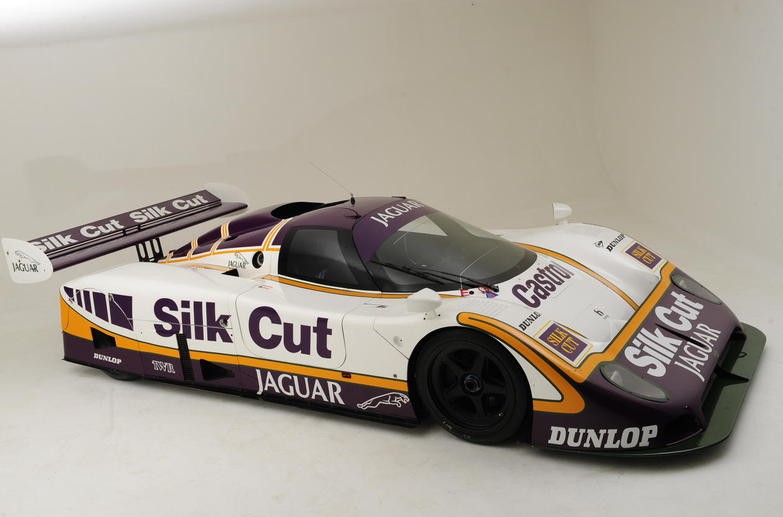
1987 Jaguar XJR-8

The XJR-line of Jaguar sports racing cars was a nine-year program that Jaguar initiated (with the help of the race car specialists at Tom Walkinshaw Racing) with the aim of dominating both the World Sportscar Championship and the IMSA Camel GTP Series. The cars were impressive – winning Le Mans twice – and the experience led Jaguar to produce two other-worldly road-going supercars: the XJ220 and XJR-15.

The XJR-8 was the fourth iteration and it was focused solely on the WSC. The Silk Cut livery began in 1986 and was a staple of Jaguar endurance cars through the early 1990s. The difference between and XJR-6 and the XJR-8 is mostly engine-related, as they share the same basic structure underneath. The engine is a 7.0-liter V-12 making in the neighborhood of 750 horsepower.

The racing resume of this car includes:

  • 1987 24 Hours of Le Mans – 5th (with Eddie Cheever, Raul Boesel, and Jan Lammers)
  • 1987 1000km Spa – 1st (with Martin Brundle, Johnny Dumfries, & Boesel)

Raul Boesel would go on to win the 1987 WSC Driver’s championship, with TWR-Jaguar winning the Teams Championship. After it’s racing career, the car was acquired from the TWR team by an unnamed racing driver who has owned it since. It has been freshened and is ready to run. Apparently, only four were built (or at least run by this team that had factory support). It should sell for between $1,400,000-$1,900,000. Click here for more info and here for more from Bonhams at Goodwood.

Update: Sold for a mysterious sum of less than $1.4 million.

S/N: 3.87
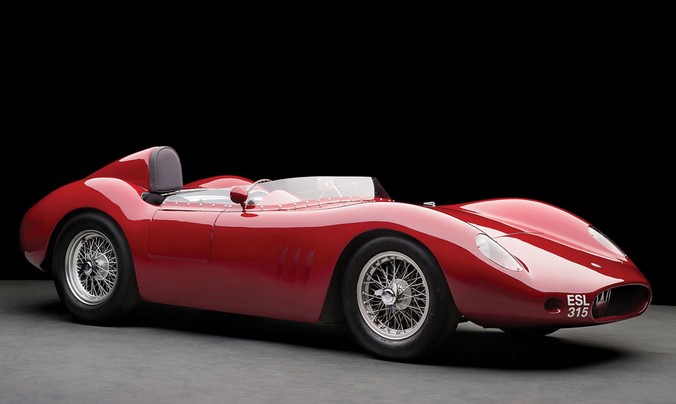
Maserati 250S

1957 Maserati 250S by Fantuzzi

Offered by RM Auctions | London, U.K. | September 8-9, 2013

1957 Maserati 250S by Fantuzzi

In 1955, Maserati moved to replace its A6GS sports racing cars with a new car called the 200S, later the 200SI. In 1957, they upgraded the 200SI with a bigger engine and re-christened it the 250S. Only four were built. This is one of them.

The engine is a 2.5-liter twin cam straight-four making 253 horsepower. They were enlarged versions of the 2.0-liter from the 200SI and they were very quick cars – faster than the Ferrari V12s they competed against early on. But the program was cancelled when Maserati gave up racing after 1957. The sleek body is by Fantuzzi.

This is the only 250S that was actually born with a 2.5-liter engine (the other three all had 2.0-liter engines that were bored out to 2.5-liters). It went from the factory to the Jim Hall/Carroll Shelby distributorship in Dallas, Texas. Jim Hall raced it in some SCCA events in the South in 1958. Carroll Shelby drove it too.

This car is in almost entirely original condition – which is remarkable because it appears to be exquisite. It’s been used in some historic events and they engine had a massive overhaul in 2010, but the body has never been restored. It is race ready and should sell for between $3,900,000-$4,600,000. Click here for more info and here for more from RM in London.

Update: Sold $3,340,000.

S/N: 2432.

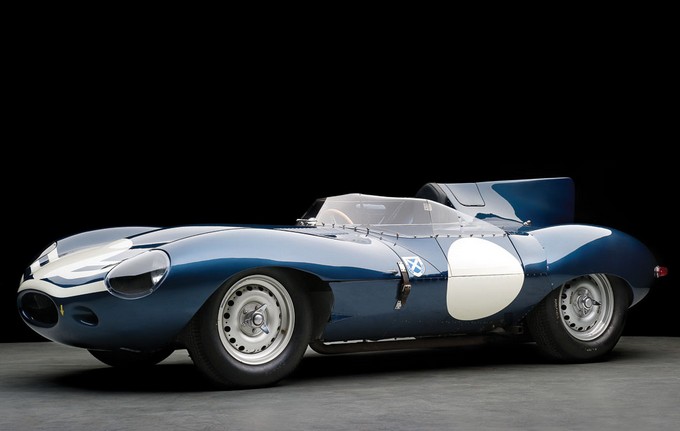
D-Type Jaguar

1955 Jaguar D-Type

Offered by RM Auctions | London, U.K. | September 8-9, 2013

1955 Jaguar D-Type

The Jaguar D-Type is one of the all-time classics. It comes from the Golden Era of Le Mans competition – the mid-1950s. D-Types, while a descendant of the earlier C-Type, look radically different from just about everything else on track in those years. That big fin was mounted at the rear for stability while it blasted down the Mulsanne Straight. It uses monocoque construction and a lot of aluminium.

The engine is a 3.8-liter straight-six pushing out in the neighborhood of 300 horsepower. Production began in 1954 with a debut at the ’54 24 Hours of Le Mans. Production continued through 1957 with road-going versions (called XK-SS) built as well. This particular example was a works tester from the start. It was the first of five long-nose cars built by the factory in 1955. It didn’t race at Le Mans that year (it was the backup car) but was campaigned by Jaguar on at least two occasions (both were retirements).

In 1957, it was sold to Ecurie Ecosse and they ran it all season. Some of it’s racing history is as follows:

  • 1957 1000km Nürburgring – 11th (with Ivor Bueb and Jock Lawrence)
  • 1958 12 Hours of Sebring – 61st, DNF (with Bueb and Ninian Sanderson)
  • 1958 1000km Nürburgring – 34th, DNF (with Bueb and Sanderson)
  • 1958 24 Hours of Le Mans – 54th, DNF (with Sanderson and Lawrence)

There were many more races, but those are the biggest. Later in ’58, it was sold into privateer hands and raced in more minor events. In 1963 it was crashed in destructive fashion and had to be sent to Jaguar for a new frame (from a Le Mans-winning D-Type, which it has today). It was used as a road car in the mid-to-late-60s. It’s been rebuilt a few times over its life but it looks good now and has both successfully and unsuccessfully competed in historic events.

Of old race cars, this is one of the big ones. It’s a must-have for serious collectors (I think) and they are exceptionally rare and almost never come up for sale. RM is selling another one in Monterey with an estimate between $4,000,000-$5,000,000 – but it was not a Jaguar factory team car nor a long-nose example. This one has an estimate between $8,600,000-$10,100,000.

Only 11 long-nose variants were built of the total of about 71 D-Types built (not counting XK-SS). 18 of the 71 were factory team cars. You can read more here and see more from RM’s Mercedes-heavy London sale here.

Update: Not Sold. High bid of $6,292,000.

S/N: XKD 504.

F40 LM

1990 Ferrari F40 LM

Offered by Gooding & Company | Monterey, California | August 17-18, 2013

1990 Ferrari F40 LM

The Ferrari F40, while not the first “supercar,” can safely be considered the first “modern supercar” – outrageous styling and outrageous performance with exclusivity to top it all off. The F40 threw the gates open for the decades of ridiculous cars that followed it.

But unlike many of the supercars after it, this one went racing. Ferrari is first and foremost a race car builder (or so they’d like you to believe). Even Ferrari hasn’t sent their halo car into competition since. Based on the road car, this racer has much of the same styling, although with more lightweight body panels. Under the rear engine cover is a 760 horsepower 3.0-liter twin-turbocharged V-8.

Ecurie Pozzi was a race team that had campaigned Ferraris for many years. They saw the potential of the F40 and, in conjunction with Ferrari and Michelotto, the F40 LM was born. Ecurie Pozzi received two of the 18 LMs built and theirs were the only ones that ever saw sanctioned racing. This is the second of the two.

The competition history of this car is as follows:

  • 1990 Camel Grand Prix at Heartland Park, Topeka, Kansas – 25th, DNF (with Jean-Pierre Jabouille and Jean-Louis Schlesser)
  • 1990 Grand Prix of Ohio at Mid-Ohio – 3rd (with Jabouille and Olivier Grouillard)
  • 1990 Mosport GP – 2nd (with Jacques Lafitte and Hurley Haywood)
  • 1990 300km Road America – 33rd, DNF (with Michel Ferte)
  • 1990 Lime Rock IMSA GTO – 32nd, DNF (with Haywood)

And that was it for the F40 LM. This car remained in the Charles Pozzi collection until 2000. It has spent the last few years in a New York collection and has remained in race-ready condition in its original 1990 livery. There were other F40 race cars built for customers back in the day, but this is one of only two Ferrari-backed Michelotto F40 LMs that ever raced and it’s the only one in private ownership. Get it now for a cool $2,000,000-$2,500,000. Click here for more info and here for the rest of Gooding’s Pebble Beach lineup.

Update: Sold $2,090,000.

S/N: ZFFGX34X0K0079891

An American F1 Car

1966 AAR Gurney-Weslake Eagle Mk I

Offered by Gooding & Company | Monterey, California | August 17-18, 2013

AAR Gurney-Weslake Eagle Mk I

Dan Gurney is one of America’s best historical driving talents. He is one of few Americans to win a Formula One race – along with winning just about everything else imaginable in just about every kind of car. In the early 1960s he raced for a few teams but always wanted to race – and win with – a car that he designed himself.

With a little help from Carroll Shelby, Gurney secured funding to start his own race team in California: All American Racers (AAR). Their original goal was to build an Indy 500 winner but he also wanted to build an F1 car. He developed the cars simultaneously – the Ealge Mk I was intended for F1 and the Mk II for USAC. For engines, Gurney looked to Weslake in Britain who supplied him with a 3.0-liter V-12 that made 390 horsepower at 10,500 rpm.

This car was the second Mk I chassis built (the first chassis used a reliable but out-dated four-cylinder Coventry-Climax engine as the Weslake wasn’t yet available) and its race history consists of:

  • 1966 Italian Grand Prix – 17th, DNF (with Dan Gurney)
  • 1966 United States Grand Prix (at Watkins Glen) – 18th, DNF (with Gurney)
  • 1966 Mexican Grand Prix – 15th, DNF (with Bob Bondurant)
  • 1967 Brands Hatch International Race of Champions – 1st (with Gurney)
  • 1967 Monaco Grand Prix – DNQ (with Richie Ginther)
  • 1967 French Grand Prix – 11th, DNF (with Bruce McLaren)
  • 1967 British Grand Prix – 18th, DNF (with McLaren)
  • 1967 German Grand Prix – 22nd, DNF (with McLaren)

As you can see, this car suffered from a host of reliability problems. None of those DNFs were crash-related. Every one was a mechanical failure, with the exception of Gurney’s blistering win at Brands Hatch (which was not a Formula One-sanctioned race). Gurney would win an F1 race in one of his Eagles, just not this one.

After the ’67 season, AAR focused solely on USAC and this car was sold. It bounced between owners and continents and has been used in many historic events – including the Goodwood hillclimb with Gurney himself at the wheel.

It may not have been successful, but it is a beautiful Formula One car. The color, the big engine and that beak at the front of it – incredible. No pre-sale estimate is available but you can read more here and see the rest of Gooding’s lineup here.

Update: Sold $3,740,000

S/N: AAR 102

Maserati A6GCS/53

1953 Maserati A6GCS/53 Spyder by Fantuzzi

Offered by RM Auctions | Monterey, California | August 16-17, 2013

1953 Maserati A6GCS53 Spyder by Fantuzzi

In the early 1950s, Maserati was winning races in Formula Two. They thought, “if we can win races at this level, why can’t we go sports car racing too?” Their single-seater was based off of their A6 road car – and so is this.

The World Sportscar Championship was what they were after with the clunky-sounding A6GCS/53. The engine is a version of the 2.0-liter straight-six used in the Formula Two racer – it makes 170 horsepower. Most bodies for the A6GCS were built by Fantuzzi using aluminium. You have to admit, this is one good-looking race car.

This car was sold new to an American Maserati distributor and while he never raced it, Juan Manuel Fangio drove this car on a publicity photo shoot. This car did a lot of amateur road racing in its day although the biggest race of its career was:

  • 1954 12 Hours of Sebring – 33rd, DNF (with Don McKnought and William Eager)

The car has had many owners and was acquired by the current one in 2006. The restoration is as old as 1999 and it is eligible for just about every historic racing even in the world. Only 58 A6GCS/53 were built and only 52 had Fantuzzi coachwork. This one should sell for $2,450,000-$2,950,000. Click here for more info and here for more from RM.

Update: Did not sell (high bid of $2,200,000)

S/N: 2053

FXX Evo

2005 Ferrari FXX Evoluzione

Offered by Gooding & Company | Monterey, California | August 17-18, 2013

2005 Ferrari FXX Evoluzione

Photo – Gooding & Company

The Ferrari Enzo was the epitome of supercars when it came out in 2002. But some people are really hard to please and Ferrari realized they could capitalize on these people and sell them an upgraded Enzo for double the money.

So in 2005 they took a street-legal Enzo and made it entirely street-illegal. The engine was enlarged – to a 6.3-liter V-12 making 789 horsepower. Then they threw in their Formula One transmission, upgraded brakes, and custom-made racing slicks.

Then they sought out customers (you weren’t allowed to approach Ferrari with the intent to buy one). You would purchase the car (at something like $1.8 million a pop) and you would be allowed to drive it on Ferrari-designated track days all over the world. Then Ferrari would house the car for you – forget taking your new $2 million toy home! Owners and drivers (including Michael Schumacher) would send all their track day data back to Ferrari for whatever purposes they saw fit.

The Evoluzione program began after all 30 FXXs had been built. It was a kit that bumped horsepower up to 850, lowered aerodynamic drag, and increased shift times. This car has that kit. This was the first FXX built and has had a single-owner from new. Thankfully, Ferrari has removed restrictions on taking the car home so now you can take this one to yours. It is still the ultimate example of Ferrari engineering superiority and track prowess. It should sell for between $2,300,000-$2,600,000. Click here for more info and here for more from Gooding’s sale.

Update: Not sold.

S/N: ZFFHX62X000145369

Ferrari 500 Mondial

1954 Ferrari 500 Mondial Spider Series I by Pinin Farina

Offered by RM Auctions | Monterey, California | August 16-17, 2013

1954 Ferrari 500 Mondial Spider Series I by Pinin Farina

We featured a Ferrari 750 Monza a few weeks back. Well this car, even though it’s called a “Mondial,” is part of that family of cars. In fact, it directly preceded the 750 Monza. The 500 Mondial was built for 1954 only.

Ferrari began building four-cylinder engines for Formula Two in 1952 and walked away with the championship in ’52 and ’53. Back in these days, the Scuderia would transfer those race engines directly into other cars – many of which were sold to customers (imagine Ferrari or McLaren doing that today). In this case, the 2.0-liter Lampredi straight-four was dropped into the 500 Mondial sports racing car. It makes 170 horsepower.

This was one of four cars entered by Ferrari in the 1954 Mille Miglia – but because the organizers of that race kept such poor records, nobody knows for sure who drove it or where it finished. It was sold upon completion of that race and used by a privateer in Italy before making its way to its second owner in Venezuela the following year.

It entered American ownership in 1964 and it was restored for the first time in 1987 and again 10 years later in 1997. Only 20 Series I cars were built, with an additional 10 Series II cars – making there just 30 examples of the 500 Mondial built. This is car #6. It has Scuderia Ferrari team history and Mille Miglia history. And it’s one of those great cars that is perfect for classic car rallies and tours. It is expected to sell for between $2,750,000-$3,250,000. Click here for more info and here for more from RM.

Update: Sold $3,520,000.

S/N: 418MD

Birdcage Maserati

1960 Maserati Tipo 61

Offered by RM Auctions | Monterey, California | August 16-17, 2013

1960 Maserati Tipo 61

In my mind, this is the most-famous Maserati ever built. If you want a classic race car from the Trident People, there are no other cars to consider. It’s a Birdcage or nothing.

The Tipo 61 was introduced in 1959 and it uses an intricate space-frame chassis with hundred of tiny steel tubes connecting everything – hence the nickname “Birdcage.” The cars were used for assaults on Le Mans and every other major sports car race in the early 1960s. The cars were very quick – but the mechanicals were unreliable, so they never won the big races they were supposed to.

This car is from 1960 – the final year was 1961. Only 16 were built in total over the three years (this was the 11th made). The engine is a 2.9-liter straight-four making 250 horsepower. It also weighed practically nothing – only 1,300 pounds. This was a team car of the Camoradi squad – headed by American Lloyd Casner. Its competition history includes the following:

  • 1960 12 Hours of Sebring – DNS (blew engine in practice, with Jim Rathmann)
  • 1960 1000km of Nürburgring – 1st (with Stirling Moss and Dan Gurney)
  • 1960 24 Hours of Le Mans – 53rd, DNF (with Giorgio Scarlatti and Gino Munaron)
  • 1960 Swedish Grand Prix – 2nd (with Jo Bonnier)

It then competed in (and won) some SCCA races in privateer hands later that year. It was sold a few more times before ending up in the U.K. in the early 1970s when it was restored and subsequently damaged during a historic event. A few more European owners enjoyed it after that, restoring it again in 1986 and using it in the Goodwood Revival and Festival of Speed. The most recent restoration was carried out in 2006.

This is a very rare car and one of the most desirable and legendary race cars of the 1950s/1960s. And if you’re going to buy one – this is the one to have. It has some of the best competition history and the best paint scheme. It should sell for between $3,000,000-$4,000,000. Click here for more info and here for more from this sale.

Update: Sold $2,090,000.

S/N: 2461

1971 Bizzarrini Prototype

1971 Bizzarrini 128 Sport Barchetta

Offered by Russo & Steele | Monterey, California | August 15-17, 2013

1971 Bizzarrini 128 Sport Barchetta

Ever seen this car before? Me neither. Giotto Bizzarrini was active in automotive design and engineering back in the day. Specifically, he got his start at Alfa Romeo in the mid-1950s. He wasn’t there long before he jumped ship to Ferrari (you can thank him for the 250 GTO). In the early-1960s, he worked for Iso Rivolta.

In 1964, he left Iso and founded his own company, Bizzarrini S.p.A. He wanted to build race cars and as an aside to that, he built precious few road cars. This lasted until 1969. Strangely, however, once his company shut down, Bizzarrini continued to churn out cars – and still does today – mostly one-off prototypes. In the early-1970s, he built a pair “single-seat competition barchettas” – and this is the prototype (the other is a race car).

Though titled as a 1971, the car was built in 1972 and shown at the 1972 Turin Motor Show. The engine is a 1.3-liter straight-four from Fiat. It makes 130 horsepower and can power the car up to 140 mph.

The race car variant is in the Italian National Car Museum in Turin – making this 128 the only one in private hands. And it can be yours. No pre-sale estimate is available. Click here for more info and here for more from Russo & Steele in Monterey.

Update: Sold $77,000.

Update: Sold, Bonhams Retromobile 2019, $110,907.