Ferrari 750 Monza

1954 Ferrari 750 Monza Spider by Scaglietti

Offered by Mecum | Monterey, California | August 17, 2013
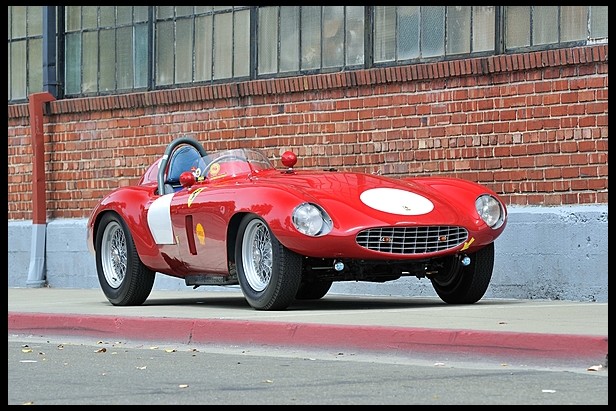
1954 Ferrari 750 Monza Spider by Scaglietti

Ferrari has always been a company focused on racing. The saying has always been “they build road cars so they can afford to go racing.” And it’s true. While, this is a race car, it was successful because of earlier race cars.

To wit: the engine. Alberto Ascari’s second Formula One championship was at the helm of a Lampredi straight-four-powered car. Because this engine was so successful in F1, Ferrari decided to install it in their sports racing cars, beginning in 1953. The 750 Monza (which used a 250 horsepower 3.0-liter variant of the engine) was the fourth iteration of what is now referred to as the “Monza” line of sports cars. It was built for 1954 only.

This car has known ownership history from new and was driven by Mike Hawthorn at Goodwood during its first racing season. It was then acquired by Jaguar and used for testing purposes (for comparisons to the D-Type). They sold it to one of their drivers (1951 Le Mans-winner Peter Whitehead) who sold it to Jack Brabham, who took it to Australia and hired drivers to race it in the 1955 season down under.

It entered its first historic race in 1987 and has been used and cared for since. It has been restored at some point and is a driveable and raceable race car. It is among the first of the 35 750 Monzas built and should bring about $2.5 million at auction. Click here for more info and here for the rest of Mecum’s Monterey lineup.

Update: Failed to sell (high bid of $3,250,000).

S/N: 0462MD
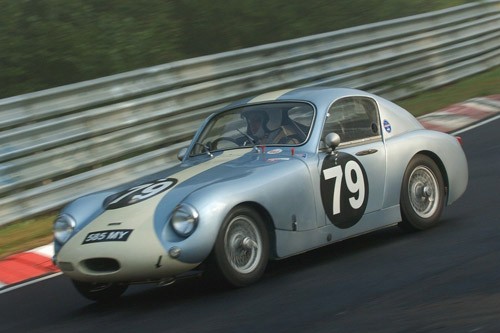
Speedwell GT

1960 Austin-Healey Speedwell GT

Offered by Coys | Woodstock, Oxfordshire, U.K. | June 29, 2013

1960 Austin-Healey Speedwell GT

The Speedwell GT was a version of the Austin-Healey Sprite that was intended for racing. It was developed by Speedwell – an outside tuning company – and there were some noticeable differences between the Sprite and the GT.

First of all, the Sprites are commonly referred to as “Bugeye” (or Frogeye) Sprites because of their inset headlights that gave them a unique – if not dorky – look. This car has the lights in a more traditional place and it’s a fixed-top coupe.

Speedwell was founded by John Sprinzel, Len Adams and George Holbert in the late-1950s. The GT was designed by Frank Costin, brother of Cosworth co-founder Mike Costin. This is one of very few factory-built Speedwell GTs and it is based around a 1961 Sprite Mk I. The engine is a 948cc straight-four making 43 horsepower. Many of the new body panels were aluminium to save weight. It’s a quick car for its class.

The car was campaigned in the 1960s. It’s racing history includes:

  • 1966 500 Miles of Brands Hatch – 17th (with Keith Grant and Grahame White)
  • 1966 1000km Nürburgring – 32nd, 2nd in class (with Grant and White)
  • 1966 GP Mugello – Not Classified, 2 laps down (with Grand and White)

In the 1970s, it was raced and then parked and forgotten until it was rediscovered in the late-1980s and restored. It has appeared at the Goodwood Revival three times since and is in race-ready condition. It should sell for between $75,000-$95,000. Click here for more info and here for the rest of Coys’ Blenheim Palace sale.

1945 Deutsch-Bonnet Race Car

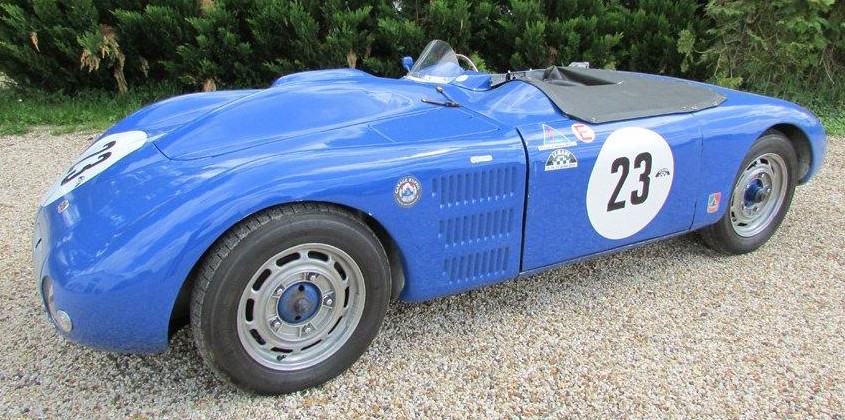
1945 Deutsch-Bonnet Type DB Sport

Offered by Osenat | Fontainebleau, France | June 23, 2013

1945 Deutsch-Bonnet Type DB Sport 2

Deutsch-Bonnet (which would later become known simply as “D.B.”) began building racing cars in the late-1930s, just prior to war breaking out. They picked up right where they left off immediately after the conclusion of World War II.

This car competed in the first race held in France after the war and it was one of only two cars entered that had actually been built after the war (both were Type DBs) – and they had front-wheel drive and four-wheel independent suspension. This car uses a 2.0-liter straight-four engine.

I’ll attempt to break down this car’s complete racing record:

  • 1945 Coupe de Paris – 6th (with René Bonnet)
  • 1946 Grand Prix of Nice – DNF (with Bonnet)
  • 1946 Grand Prix of Marseille – 3rd (with Bonnet)
  • 1946 Coupe de la Ville de Saint Etienne – 2nd (with Bonnet)
  • 1946 120km Cup – 2nd (with Bonnet)
  • 1946 Belgian Grand Prix – DNF (with Bonnet)
  • 1946 Grand Prix de Bourgogne – DNF (with Bonnet)
  • 1946 Cup of Nantes – DNF (with Bonnet)
  • 1947 Coupe de Paris – DNF (with Bonnet)
  • 1948 Coupe de Pairs – 5th (with Bonnet)
  • 1948 12 Hours of Paris – 14th (with Bonnet)
  • 1949 Grand Prix d’Aix-les-Bains – 3rd (with René Abbo)
  • 1949 24 Hours of Le Mans – 24th, DNF (with Bonnet and Charles Deutsch)
  • 1949 Grand Prix de l’ACF du Comminges – DNF (with René Simone)
  • 1949 Côte de Bellevue – 2nd (with Simone)
  • 1949 Coupes du Salon – 7th (with Simone)
  • 1950 Coupe de Marseille – 2nd (with Simone)
  • 1950 Coupes de Vitesse – 5th in class (with Simone)
  • 1950 Mille Miglia – DNF (with Simone and Bruno Marchio)
  • 1950 24 Hours of Le Mans – 50th, DNF (with Simone and Michel Arnaud)
  • 1950 Grand Prix de Rouen – 2nd (with Simone)
  • 1950 German Grand Prix (at Nurburgring) – 8th in Class (with Simone)
  • 1950 Grand Prix of Cadours – 1st (with Simone)

It competed here and there from 1951 through 1958, but it had quite the important race history up to then. It spent the next 25 years being driven around Nice on the French Riviera. In 1974 it was purchased by the current owner who dug into the history of the car to find out what he had. Yes, he had scored big.

The chassis (chassis no. 5) is original and it is stated that so is 80% of the bodywork. The car has competed in a number of historic races including five appearances in the Le Mans Classic. It is eligible for almost every historic event and is road legal. This is one of the first race cars (actually the second) built in France (and maybe Europe) after the conclusion of the Second World War. No estimate is given so that should be a sign that it could be rather pricey. Click here for more info and for a ton of old photos. And here for the rest of Osenat’s auction lineup.

Update: Not sold.

Jag XJR-5

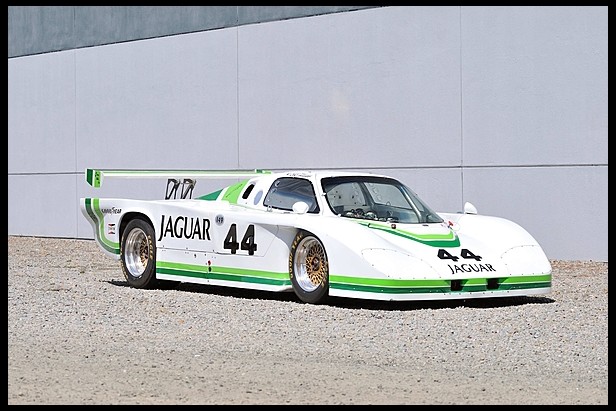
1982 Jaguar XJR-5

Offered by Mecum | Monterey, California | August 17, 2013

1982 Jaguar XJR-5

Jaguar really didn’t do much for itself as a sporting marque between the years of about 1955 and 1980. Sure, some of their cars competed in the hands of privateers over the years, but a factory effort was missing. That changed when Bob Tullius’ Group 44 race team was staring down a shut down.

Jaguar came calling and essentially absorbed the race team to be their factory effort in the prototype arena. The goal was to compete in IMSA GTP and the FIA World Endurance Championship (and later, Le Mans). It’s very aerodynamic and uses an aluminium tub, Kevlar composite body panels and Lockheed disc brakes. The engine is a mid/rear-mounted 6.0-liter V-12 making 625 horsepower. If geared correctly, this thing can do 217 mph.

You’re looking at the first XJR-5 built. It wears serial number 001 and it’s race history consists of the following:

  • 1982 Road America 500 Miles – 3rd overall, 1st in class (with Bob Tullius and Bill Adams)
  • 1982 Six Hours of Mid-Ohio – DNS after a practice crash (with Tullius and Adams)
  • 1983 100 Mile Laguna Seca – 2nd (with Tullius)

Bob Tullius owned this car after its brief racing career ended and he drove it at the 2000 Goodwood Festival of Speed. It was acquired directly from him by its current owner. It has been recently restored and track-tested.

This is a historically significant race car: it was the first XJR prototype and it spawned a series of successful prototypes (and even a sports car) that were competitive for the next 11 years. One of these last sold in 2006 for less than $250,000. Things may have changed little since then. We’ll see. Click here for more info and here for more from this sale.

Update: Failed to sell (high bid of $475,000).

S/N: 001

Tojeiro Barchetta

1952 Tojeiro Barchetta

Offered by Russo & Steele | Newport Beach, California | June 20-21, 201

1952 Tojeiro Barchetta

John Tojeiro was born in Portugal but relocated to England when he was very young. That move was important because after World War II, in which John served, England would become a hotbed for race car building.

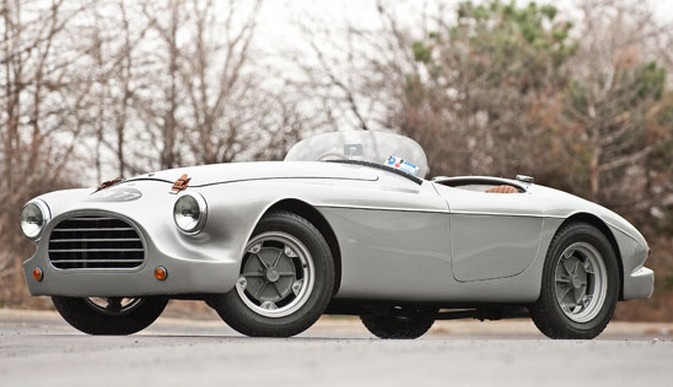
Tojeiro made his name as a chassis engineer and once he was established, customers were contacting him and commissioning him to build one-off race cars. Tojeiro’s first car was powered by a Bristol engine and the body was supposed to look like a Ferrari 166 MM. Shortly after that, Tojeiro built two or three MG powered cars with a similar body. This is one of those cars.

The engine is a 1.5-liter MG straight-four, power output unknown – but likely less than 125. One of the three cars like this was driven to the AC headquarters and AC repainted it blue, put one of their engines in it, and displayed it as the AC Ace. So this car (which was not used by AC) is sort of the prototypical AC Ace. Which is pretty cool if you think about it (and if you refuse to think about it, I’ll tell you: the Ace became the Cobra. Shelby Cobras can directly trace their origin to this car).

This car was raced on road courses by privateers until the end of the 1954 season. It finished every race. It has bounced between owners quite a bit since then (and even a fair amount in the past five years). This car sold in Monterey last year at a different auction for a touch more than $150,000 and it sold twice in 2011 for about the same price (a little less). We’ll see what it brings this time around as the market continues to improve. Click here for more info and here for the rest of Russo & Steele’s Newport Beach lineup.

Update: Sold $159,500.

Update: Not sold, RM Sotheby’s, Arizona 2021.

The Only 1962 Davies Special

1962 Davies Special

Offered by Bonhams | Francorchamps, Belgium | May 25, 2013

1962 Davies Special

Can-Am was one of the most interesting race series ever devised. The rules were essentially “anything goes” when it came to car construction – something that leads to innovation, unlike most of the “spec” series that operate in the U.S. today. The lot description calls this a “Cam-Am” Special but Can-Am didn’t start until 1966. This car was likely intended for the USRRC, which was also innovative and interesting.

Fred Davies was a race car engineer who worked for Bill Sadler (who built cars that looked similar to this in Canada). In 1961 he left Sadler and moved to California to build cars under his own name and design. He built one car – this one – with the intention of entering it into American road races.

The engine is a Chevrolet V-8 (displacement unknown, although I know it’s big) and the body is aluminium. The gearbox is by Huffaker – a name heavily associated with road racing back in the day. But Davies never ended up racing it. In fact, he used is as a road car for a few years before parking it. In 1975 he sold it to a dealer overseas who sold it three years later to a Belgian – who had no idea what it was. He registered it with the FIA as a Huffaker Genie – a car it resembles.

He restored it once and raced it until he sold it in 1983 to a Swedish amateur driver. It was raced in Sweden until 2004 when the current Belgian owner acquired it. This is a one-off race car and the only “Davies” out there. It is entirely raceable and can be yours for $120,000-$160,000. Click here for more and here for more from Bonhams at Spa.

Update: Did not sell.

Ferrari 599XX

2010 Ferrari 599XX

Offered by RM Auctions | Lake Como, Italy | May 25, 2013

2010 Ferrari 599XX

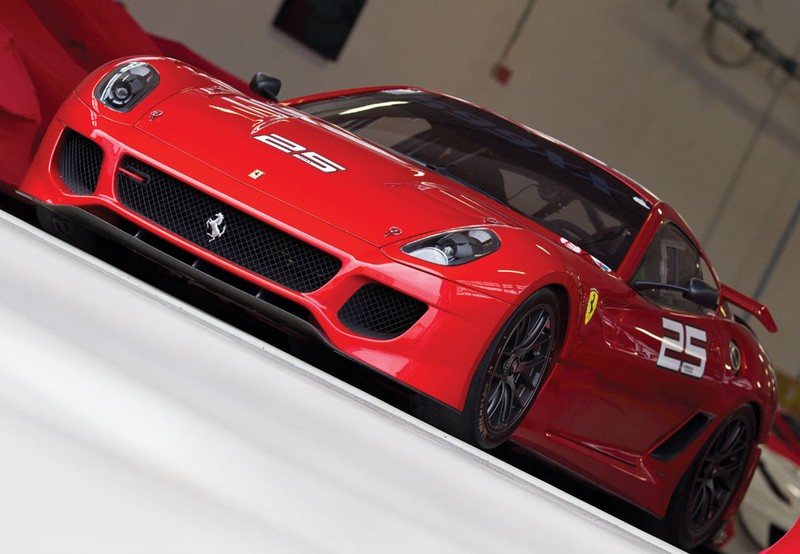
Every once in a while – more so lately than ever – Ferrari goes about building some ridiculous race-going variant of one of their road-going models. They aren’t street legal but they look like they could be. They build the cars, sell them, and offer track days to go with ownership. This car is eligible for Ferrari track events all over the world.

The 599XX is the balls-to-the-wall track variant of the 599 GTB Fiorano. This version was produced for 2009 and 2010 while the Fiorano was built from 2006 through 2012. In 2011 Ferrari would up the stakes even more by offering an “Evolution” package for the 599XX. But let’s stick with what we’ve got.

And what we’ve got is the 6.0-liter V-12 with horsepower upped to 720. Ferrari threw everything they had at this car to make it faster around the track. It was faster around the Nürburgring than the Enzo and faster around Ferrari’s test track than super-Enzo: the FXX. It was about as fast as Ferrari’s Formula One lap record at the Nürburgring from the 1970s.

This car is eligible for the Evo upgrade and is a one owner car that has seen a track only once. In fact, it has been stored at the Maranello factory its entire life. It is one of only 29 built and it’s basically brand new. The brand new price for a 599XX in 2010? $1,500,000.  The pre-sale estimate? $1,000,000-$1,400,000. Click here for more info and here for more from RM in Italy.

Update: Sold $1,193,920.

Talbot-Lago T150C

1936 Talbot-Lago T150C

Offered by Artcurial | Paris, France | February 8, 2013

1936 Talbot-Lago T150C

This Grand Prix car was built by Talbot-Lago to compete in the ACF Grand Prix and the 24 Hours of Le Mans. Only four were built for 1936 (and two in 1937). This car was first used by a privateer for a single race before being sold back to Talbot-Lago, who sold it to a more well-known driver: Luigi Chinetti.

It competed regularly until 1950 (14 years!) under the ownership if Chinetti, Pierre Levegh, and Louis Rosier. It was rebodied in 1947 .It was sold a few more times and restored in the U.K. in 1983, when the current “replica” Grand Prix body was rebuilt. It was restored again around 2000. It was active in historic motorsports in the 1980s and early-1990s.

The sporting history of this car is long, varied and complete. Here is a very brief version of this car’s competition history (including its first and last race and every appearance at Le Mans):

  • 1936 ACF Grand Prix (Montlhéry) – 31st, DNF (with Francique Cadot & Henry Stoffel)
  • 1937 24 Hours of Le Mans – 48th/last, DNF (with Luigi Chinetti & Louis Chiron)
  • 1938 24 Hours of Le Mans – 18th, DNF (with Pierre Levegh & Jean Trévoux)
  • 1938 24 Hours of Spa – 18th, DNF (with Levegh & Trévoux)
  • 1939 Grand Prix d’Anvers – 4th (with Levegh)
  • 1939 Grand Prix of Luxembourg – 3rd (with Levegh)
  • 1939 24 Hours of Le Mans – 28th, DNF (with Levegh & René Le Begue)
  • 1946 Nantes Grand Prix – 2nd (with Levegh)
  • 1947 Grand Prix de la Marne (Reims) – 5th (with Jose Scaron & Edmund Mouche)
  • 1948 Grand Prix di Pescara – 3rd (with Louis Rosier)
  • 1949 24 Hours of Le Mans – 44th, DNF (with Louis & Jean-Louis Rosier)
  • 1949 Grand Prix du Salon (Montlhéry) – 2nd (with Jean Estager)
  • 1950 Grand Prix de Rouen – 8th (with Estager)

The engine is a 4.0-liter straight-six making 170 horsepower. Top speed is about 130 mph.   It’s a Grand Prix car, so the performance is there. It should be eligible for just about every kind of historic racing event. Only six T150C GP cars were built and this one has a complete history. It should sell for between $1,600,000-$2,100,000. Click here for the complete racing history, historical photographs and more. And here for the rest of Artcurial’s auction lineup at Rètromobile.

Update: Sold $1,861,738.

Porsche RSK

1959 Porsche 718 RSK

Offered by Gooding & Company | Scottsdale, Arizona | January 19, 2013

1959 Porsche 718 RSK

The Porsche RSK-series of sports racing cars got its start in 1957 on the heels of the 550 Spyder program. They stuck with the mid-engine, rear-wheel drive layout for this car, and some of the styling cues seem to have bee carried over from the 550 as well. The engine had more power: it was a 1.5-liter flat-four making 148 horsepower. The cars were nimble and quick, grabbing class wins all over the world. This was a privateer car all its racing life, and it’s race record includes the following:

  • 1959 4 Hours of Alamar (Cuba) – 4th (with owner Roy Schechter)
  • 1959 Nassau Speed Week, Nassau Trophy Race – 14th (with Schechter)
  • 1960 12 Hours of Sebring – 2nd (with Schechter, Bob Holbert & Howard Fowler)
  • 1960 Riverside Grand Prix – 3rd (with Schechter)

After Riverside, Schechter sold the car and it would become a fixture in a prominent Porsche collection for many years, until 1999. It was restored in 2006, but it is still one of the most correct and undamaged 718s you will likely find. It should sell for between $2,800,000-$3,200,000. Click here for more info and here for more from Gooding in Arizona.

Update: Sold $3,315,000.

Maserati Tipo 26 Four-Seater

1930-31 Maserati Tipo 26 Sport

Offered by Bonhams | Goodwood, England | September 15, 2012

If you can believe it, there are actually two 1930 Maserati Tipo 26s up for auction at this sale. One is a two-seater, and the one seen here is a four-seater – you know, the more useful of the two when hauling the kids to soccer practice. Both cars come out of the same collection and having similar histories, as they were both imported into the U.K. for racing purposes in 1930. We’ll focus on the four-seater from here on.

The car is powered by a supercharged 2.5-liter straight-8, taking direct aim at Alfa Romeo’s 8C competition cars. This car competed against Alfa 8Cs, driven by the likes of Henry “Tim” Birkin, in the 1931 Eireann Cup in Dublin, Ireland. This car finished second to Birkin in an 8C. It was driven by Giuseppe Campari, who mid-race, was temporarily blinded when mud and debris from another car came off the track and shattered his goggles, sending glass into one of his eyes. Giulio Ramponi, a sometimes riding mechanic who was working in the pits, took over the car while Campari had his eye tended to. Before long, Campari ran back onto the track, flagged Ramponi down, and resumed his race.

The car was entered at Brooklands earlier that year, but only one of the two cars offered here actually competed (chassis unknown, based on price, I’d say likely this one). This car did compete at Brooklands in 1933 and a few other races over the next few years. It passed through numerous hands – and numerous drivetrain configurations – before being acquired by its current owner in 1952. All of its original pieces were located and reinstalled, making this a highly original example of an already extremely rare car.

It is very impressive, in both history, rarity and condition. It is an exquisite alternative to the comparatively common Alfa Romeo 8C. The pre-sale estimate is $2,900,000-$3,500,000. For the complete lot description, click here. And from more from Bonhams at Goodwood, click here.

Update: Sold $2,727,000.