Gulf GT40

1968 Ford GT40 Gulf/Mirage Lightweight

Offered by RM Auctions | Monterey California | August 17, 2012

The genesis of the Ford GT40 is a well-known story. Henry Ford II wanted Ferrari. Enzo said no. Ford set out to destroy them on the track – and succeeded brilliantly. The Gulf-Mirage story isn’t quite as popular, but it’s just as interesting.

While the GT40 was conceived and designed in Dearborn, it was built in England by Ford Advanced Vehicles (FAV). After the 1967 season, Ford cancelled the project, effectively ending FAV. A number of road-going models (as well as race cars) had already been produced.

The head of FAV was John Wyer, a former race engineer and team manager. He was actually the team owner of the winning 1959 24 Hours of Le Mans team – when Carroll Shelby, head of the GT40 race team, was driving. Anyway, when FAV was scuttled, Wyer stepped up and reformed it as John Wyer Automotive Engineering (JWAE).

One of the customers of the road-going cars happened to be Grady Davis, Vice-President of Gulf Oil. He liked the car and thought it might be a good platform to carry the Gulf Oil name in competition. He funded JWAE to build race cars specifically for the purpose. These cars were badged as “Mirage”s.

Wyer based the first Mirage prototype (the M1) very closely on the, unsuccessful in competition, Mk I GT40. The car you see here was the third of three lightweight Mirage M1 race cars built. The Mirage M1 was competing against the very successful Ford’s Mk II and Mk IV GT40s in 1967. When the 1968 rules were announced, Ford pulled out of the GT40 project and it was left to privateer teams. Wyer found a curious loophole: prototypes would be limited to 3.0-liters while sportscars (with at least 50 road version having been constructed) were allowed 5.0-liters. Wyer took the Mirage M1 cars back to Slough, where JWAE was based, and converted two of them to GT40s.

Now Wyer had quite a car on his hands. These “Mk I” GT40s (built after the Mk II, III and IVs) won the 1968 and 1969 24 Hours of Le Mans. The competition history of this car, Mirage M.10003/Ford GT40 P/1074, is as follows:

  • 1967 1000km Spa (as a Mirage M1) – 1st (with Jacky Ickx and Dick Thompson)
  • 1967 24 Hours of Le Mans – 47th, DNF (with Ickx and Brian Muir)
  • 1967 BOAC 500 (Brands Hatch) – DNF (with Thompson and Pedro Rodríguez)
  • 1967 1000km Paris at Montlhéry – 1st (with Ickx and Thompson)
  • 1968 Daytona 24 Hours (as GT40) – 33rd, DNF (with Paul Hawkins and David Hobbs)
  • 1968 12 Hours of Sebring – 28th (with Hawkins and Hobbs)
  • 1968 1000km Monza – 1st (with Hawkins and Hobbs)
  • 1968 1000km Nürburgring – 6th (with Hobbs and Brian Redman)
  • 1968 Six Hours of Watkins Glen – 2nd (with Hawkins and Hobbs)
  • 1968 24 Hours of Le Mans – 34th, DNF (with Hawkins and Hobbs)
  • 1968 1000km of Paris at Montlhéry – 8th (with Jean Blaton & Hughes de Fierlandt)
  • 1969 BOAC 500 (Brands Hatch) – 5th (with Hobbs and Mike Hailwood)

Perhaps, one of this car’s more interesting assignments was that of camera car for the 1971 film Le Mans starring Steve McQueen. The roof was cut away and heavy 1960s-era 35mm cameras were installed. The car was driven at speeds up to 150 mph with a daring camera operator in the passenger seat. The car made runs of the pit lane prior to the start of the 1970 24 Hours of Le Mans for filming. Whether or not it ran during the race, however, is unknown.

The car passed through a few hands, being reconstructed as a GT40 in the 1970s and restored again in 1983. The most recent restoration was completed in 2002. Behind the driver sits a 440 horsepower Ford 289 V8. And all around the driver shines the brilliant blue/marigold Gulf colors that gives this car away as something truly special. The original Mirage M1 bodywork is included with the car.

If a Ford GT40 is a car you feel you must own, there is perhaps no other example, save for the Le Mans-winning Mk IV sitting in the Henry Ford Museum, that you should rather have than this. RM listed the estimate as “available upon request” – hinting that if you need even inquire, it is out of your reach. Expect it to go for millions. For the complete description, click here. And for more from RM in Monterey, click here.

Update: Sold $11,000,000.
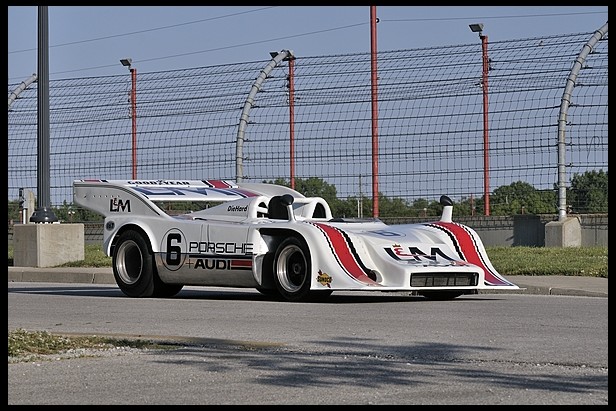
1972 Can-Am Champion Porsche 917/10

1972 Porsche 917/10 Spyder

Offered by Mecum Auctions | Monterey, California | August 18, 2012

Can-Am was an amazing race series with innovation and pure power and speed being the most important things. There were few rules and the cars were over the top. Porsche had little success in 1970 with its underpowered 908 and 917PA models (they won a single race with a privateer team). In 1971, with factory backing, the 917/10 was introduced into the series, as the hardtop 917 was not eligible. The engine was a flat-12, but it didn’t make enough power.

So for 1972, Porsche strapped two turbochargers to the engine of 5.0-liters (this car was upgraded to 5.4-liters mid-1973), and with enough boost they could crank the power up over 1150. The wins came about as quick as this cars 0-60mph sprint of 2.9 seconds. This Penske-prepped car won the 1972 Can Am Championship. Here is a breakdown of chassis #003’s competition history:

  • 1972 Road Atlanta Can-Am – 1st (with George Follmer, who drove in all following races)
  • 1972 Watkins Glen Can-Am – 5th
  • 1972 Buckeye Can-Am (Mid-Ohio) – 1st
  • 1972 Road America Can-Am – 1st
  • 1972 Minneapolis Tribune Grand Prix (Donnybrooke) – 4th
  • 1972 Klondike 200 (Edmonton) – 3rd
  • 1972 Monterey Castrol GTX Grand Prix (Laguna Seca) – 1st
  • 1972 Los Angeles Times Grand Prix (Riverside) – 1st
  • 1972 Can-Am Championship – 1st
  • 1973 Interserie Nürburgring 300km – 17th, DNF
  • 1973 Interserie Imola  – 11th, DNF
  • 1973 Labatt’s Blue Trophy (Mosport) – 13th, DNF
  • 1973 Watkins Glen Can-Am – 20th, DNF
  • 1973 Buckeye Cup (Mid-Ohio) – 2nd
  • 1973 Road America Can-Am – 3rd
  • 1973 Molson Cup (Edmonton) – 2nd
  • 1973 Monterey Castrol Grand Prix (Laguna Seca) – 11th, DNF
  • 1973 Los Angeles Tims Grand Prix (Riverside) – 20th, DNF
  • 1973 Can-Am Championship – 2nd

As you can see, this car was only raced by one guy, George Follmer, and he was no slouch behind the wheel. The car didn’t stand a chance in the 1973 championship, as it was competing with the mighty 917/30 driven by Mark Donohue. But second place that year is kind of like a win.  The car was destroyed in a testing crash in late 1973 and that was the end of its brief career.

Obviously, it is back to as-new/as-raced condition. With this being only one of 18 cars built, and the fact that it is an ex-Penske Can-Cam Championship-winning car, it is quite valuable. Mecum does not publish estimates, but the Sunoco-liveried 917/30 sold for $4.4 million. I think this would bring less as it isn’t iconic, but it certainly has provenance. But what do I know? For more information, click here. And for more on Mecum in Monterey, click here.

Update: Sold $5,500,000.

Peugeot 905 Evo

1991 Peugeot 905 Evo 1B

Offered by Artcurial | Le Mans, France | July 7, 2012

Photo – Artcurial

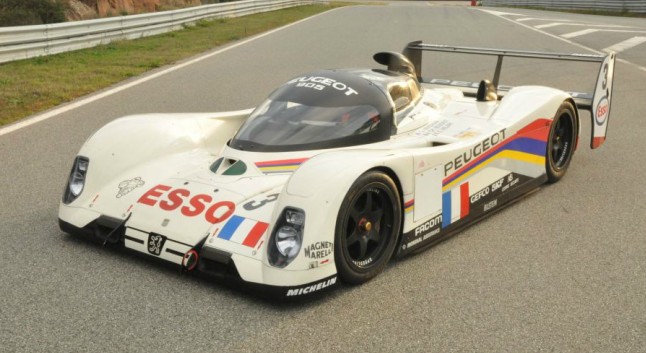
Earlier this week we talked about Audi’s rivalry with the Peugeot 908. Say hello to the 908’s older brother: the Peugeot 905. Built to the World Sportscar Championship’s new-for-1991 rules, the 905 was a little slow at first, being beaten regularly by Jaguar’s mighty XJR-14. It also suffered from reliability problems. And it was ugly.

For 1992, Peugeot made some revisions and the car was much more competitive (and attractive) – sweeping the podium at Le Mans and winning the WSC outright. Unfortunately for Peugeot (you know, because of all that money invested), the WSC ceased to exist in 1993. But that didn’t stop them from sweeping the podium at the 24 Hours yet again.

This car, chassis EV13, debuted in 1991 and was upgraded to Evo 1B specifications later on. It has a 3.5-liter V10 making something like 715 horsepower at a screaming 12,500 rpm. The carbon fiber chassis was produced by aircraft manufacturer Dassault. Eight of these machines were built. Here is the competition history for this one:

  • 1991 430km of Suzuka – 1st (with Mauro Baldi and Philippe Alliot)
  • 1991 430km of Monza – 11th, DNF (with Keke Rosberg and Yannick Dalmas)
  • 1991 430km of Silverstone – 6th (with Baldi and Alliot)
  • 1991 24 Hours of Le Mans – 36th, DNF (with Baldi, Alliot and Jean-Pierre Jabouille)
  • 1991 430km of Nurburgring – 11th, DNF (with Baldi and Alliot)
  • 1991 430km of Magny-Cours – 2nd (with Baldi and Alliot)
  • 1991 430km of Mexico City – 2nd (with Baldi and Alliot)
  • 1991 430km of Autopolis – 4th (with Baldi and Alliot)
  • 1992 500km of Silverstone – 8th, DNF (with Baldi and Alliot)
  • 1992 24 Hours of Le Mans – 3rd (with Baldi, Alliot and Jabouille)
  • 1993 24 Hours of Le Mans – 3rd (with Baldi, Alliot and Jabouille)

This was an awesome race car in the early 1990s. And it would be an awesome race car to take on the historical circuit today. You can do it – for somewhere between $875,000-$1,500,000. For more information click here. And for more from Artcurial at Le Mans, click here.

Update: Sold $833,855.

Ligier JS2

1974 Ligier JS2

Offered by Artcurial | Le Mans, France | July 7, 2012

Guy Ligier began his career as a rugby player before he went sportscar racing in the 1960s, which led to a brief Formula One ride with a privateer team. He moved on to his own race team but after his partner and friend, Jo Schlesser, was killed racing one of their Honda F1 cars, Ligier retired from driving and focused on building cars instead. The “JS” prefix is so named for Schlesser.

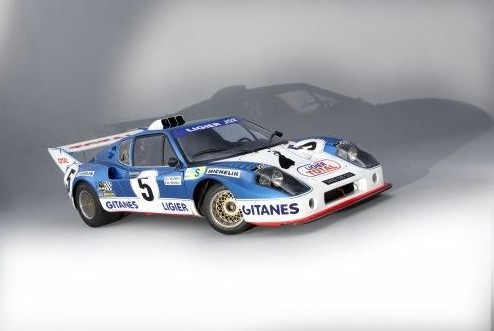
The JS2 was the second model made by the company and it was introduced in 1971. They were produced for both the road and the track – with racing being the focus (the Ligier name would appear on Formula One cars for 20 years). Only 280 copies of the JS2 were built. The one you see here is a race car – and an important one.

I like the “competition history” format we’ve used on other posts, so I’m doing it here again, too – even though the history is somewhat short:

  • 1974 Tour de France Automobile – 1st (with Gérard Larrousse, Jean-Pierre Nicolas and Johnny Rives)
  • 1975 24 Hours of Le Mans – 2nd (with Jean-Louis Lafosse and Guy Chasseuil)

The engine in this car is a 3.0-liter Cosworth DFV V8 making 460 horsepower and is one of only three factory JS2 race cars built and raced by Ligier. Only two survive and this one has more competition success than the other. However, it has been a while since this car was last used. As such, it is being sold “in need of an overhaul” and comes with a variety of spares.

There are other rare Ligers at this sale – you can find them here. This one is expected to bring between $935,000-$1,350,000. For more information, click here.

Update: Did not sell.

Audi R10 TDI

2007 Audi R10 TDI

Offered by Artcurial | Le Mans, France | July 7, 2012

Oh boy. This is one of my all-time favorite cars. A few months ago we featured this car’s largest rival – the Peugeot 908 HDi FAP. The Peugeot is very pretty and very fast. But it did not dominate everything quite like the Audi R10 did. That Peugeot was the first 908 to come up for public sale and this is the first Audi R10 to come up for auction.
The R10 TDI was introduced to replace the other-worldly Audi R8 (a car that only lost 16 races in seven years. It never lost at Le Mans with factory backing). What was shocking, was that the R10 was diesel-powered. Only a handful of diesel-powered cars had ever competed at Le Mans (1949, 1950 and 2004 all saw one diesel entry). But for a powerhouse team to switch its power plant after being so dominant? How would it play out?

Splendidly. The R10 never lost a race at Le Mans before it was replaced by its successor, the R15. The engine is a 5.5-liter diesel V12 making somewhere around 650 horsepower. Torque is monstrous at 811 lb/ft. The R10 was capable of great things in the right hands. It was the first diesel to win the 24 Hours of Le Mans and the 12 Hours of Sebring. One particular memory of these cars occurred at the 2008 Petit Le Mans at Road Atlanta, when Allan McNish wrecked the car on the warmup lap on the way to the grid. The team had to replace most of the front end of the car. It basically started the race two laps down. Co-drivers Emanuele Pirro and Dindo Capello put in solid drives throughout the 1000km event. But a determined drive by McNish in the final stint gave the team the win. It was one of the most incredible performances from a driver I’ve ever seen. McNish is a god among men in Audi prototypes. But I have to admit the car probably had something to do with it.

Anyway, the competition history of this car (chassis #201) is as follows:

  • 2007 Grand Prix of Mosport – 4th (with Marco Werner and Emanuele Pirro)
  • 2007 Petit Le Mans – 17th (with Lucas Luhr and Werner)
  • 2007 Monterey Sports Car Championships at Laguna Seca – 3rd (with Mike Rockenfeller and Werner)
  • 2008 12 Hours of Sebring – 3rd, and 1st in class (with Rinaldo Capello, Allan McNish and Tom Kristensen)
  • 2008 1000km of Nurburgring – 3rd (with Alexandre Prémat and Rockenfeller)
  • 2008 1000km of Silverstone – 4th (with Prémat and Rockenfeller)
  • 2009 1000km of Catalunya – 27th (with Michael Krumm, Charles Zwolsman Jr. and Andrew Meyrick)
  • 2009 1000km of Spa – 6th (with Narain Karthikeyan, Meyrick and Zwolsman)
  • 2009 24 Hours of Le Mans – 7th (with Karthikeyan, Zwolsman and André Lotterer)
  • 2009 1000km of Algarve – 27th, DNF (with Karthikeyan, Meyrick and Zwolsman)
  • 2009 1000km of Nurburgring – 4th (with Karthikeyan, Meyrick and Zwolsman)
  • 2009 1000km of Silverstone – 6th (with Karthikeyan, Meyrick and Zwolsman)
  • 2009 1000km of Okayama – 5th in race one and 6th in race two (with Christijan Albers, Matteo Cressoni and Hideki Noda)
  • 2010 24 Hours of Le Mans – 32nd, DNF (with Christian Bakkerud, Oliver Jarvis and Albers)

Yeah, that’s quite the history. The list of names that have driven this car is amazing – legends of contemporary motorsport. I really wanted that Peugeot 908 when it went up for auction. But my want for this car exceeds the Peugeot by a factor so big I can’t even describe it. These are amazing machines. And they don’t come cheap. The pre-sale estimate for this car is $1,625,000-$2,000,000 – which is nothing as it cost Audi about $15 million per year to operate this team. For more information, click here. And for more from Artcurial at Le Mans, click here.

Update: Did not sell.

Lotus Eleven

1956 Lotus Eleven Le Mans

Offered by Bonhams | Goodwood, England | June 29, 2012

Photo – Bonhams

Bonhams’ Goodwood sale includes the Glasius Lotus Collection, featuring quite a few rare, storied Lotuses (Loti?) including race cars, road cars, and concepts. This 1956 Eleven is a wonderfully restored example that has an important competitive background.

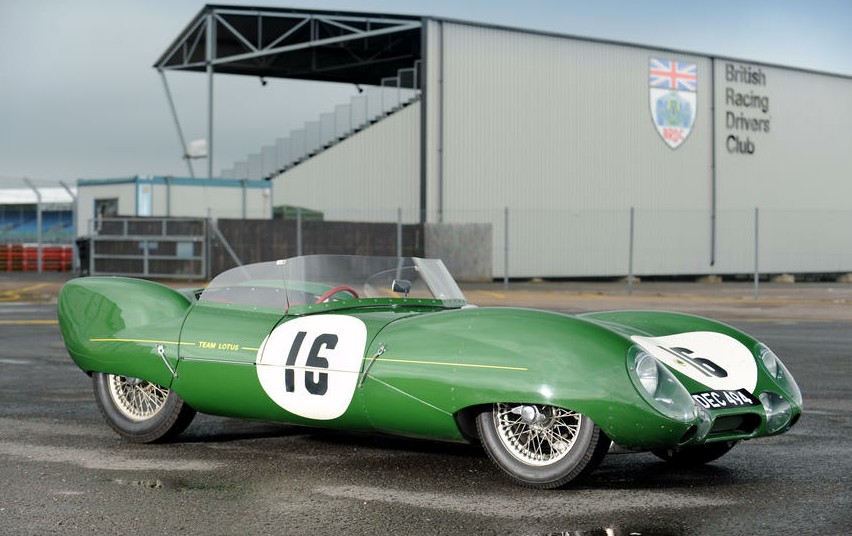
The Lotus Eleven was introduced by Colin Chapman in 1956. It featured this slippery body designed by Frank Costin, brother of Cosworth co-founder Mike Costin. (Frank Costin would go on to co-found Marcos before building a few cars that bore his last name in its entirety).

The ‘Le Mans’ spec car had the option of a 1.1-liter (FWA) or 1.5-liter (FWB) Coventry-Climax straight-four. This one has the 1.1-liter and the standard tubular space frame, for a weight around 1,100 pounds – making it capable of over 130mph. This car does not have the headrest that was fitted to some of the later models (the Eleven was produced up to 1958). About 270 were built, inclusive of all versions.

Proper sporting cars should have a competition history – as this one does. It was a factory Lotus team car that competed in the 1956 24 Hours of Le Mans with drivers Cliff Allison and Keith Hall. A retirement – when Allison hit a dog on the Mulsanne Straight – placed the car 26th in the standings. After the race, the car ended up in the hands of an American and passed through an unknown number of owners before it was finally restored to the as-or-better-than-new condition it is in today.

This Eleven – with Lotus factory racing history – is being offered in this glorious condition for the first time. It is estimated to sell for between $210,000-$270,000. For more information click here. And for more from Bonhams in Goodwood, click here.

Update: Sold $239,464.

Itala Grand Prix Car

1908 Itala Grand Prix Car

Offered by Bonhams | Goodwood, England | June 29, 2012

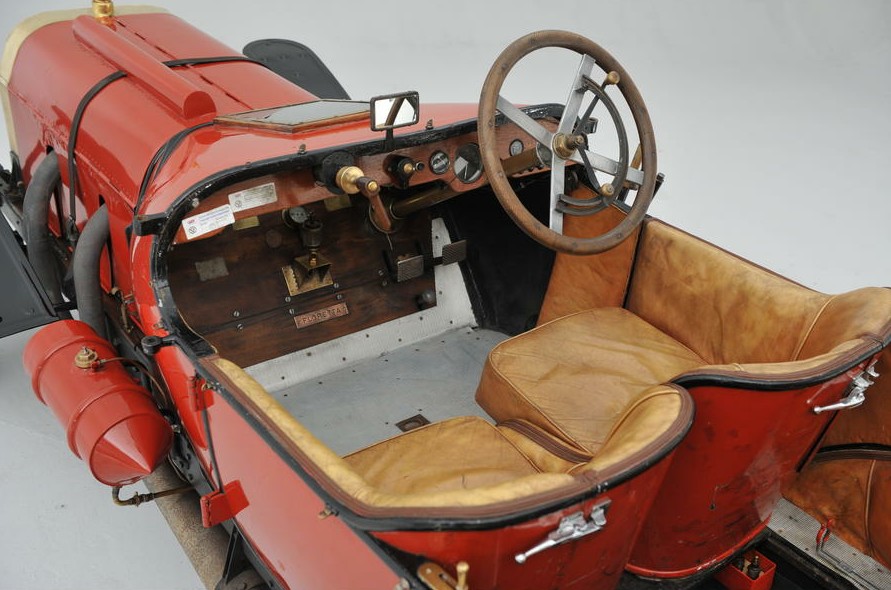
The Itala marque was founded in 1904 and is fairly well-known among enthusiasts and collectors for its racing prowess prior to 1910. The company existed until bought out by Fiat in the mid-1930s. That’s 30 years of history but it’s so rare to see one come up for public sale. And yet here is one – but not just any Itala. This car, known as “Floretta” is a somewhat famous model with known, detailed history.

Itala racing cars won the Coppa Florio in 1905, the Targa Florio in 1906 and the Peking-to-Paris race in 1907. 1908 was the first year for a fixed “formula” for the Grands Prix of Europe. Itala built three four-cylinder cars for the 1908 season, utilizing drivers Alessandro Cagno, Henri Fournier and Giovanni Piacenza. It was thought until very recently that this car was the one driven by Cagno. New evidence (such as wheelbase and weight comparisons) suggest that this may have been the one driven by Piacenza, as it had a longer wheelbase and thus, more weight, than either of the other team cars.

In 1909, the car was in possession of a Mr. R. Wil-de-Gose who lapped the Brooklands circuit at 93mph. The next year he returned and eventually bumped the speed up to 101mph, faster than the Mercedes race cars it competed against in 1908. Shortly after this, the original racing body was replaced with the four-seat touring body you see here. After World War I, the car was parked in a garage in England until discovered in 1927. The car was brought back to life and has changed hands only a few times since. I highly recommend going to Bonhams site here and reading the entire description, which includes snippets of stories by people who have driven this monstrous machine. It’s very interesting.

The engine is a massive 12-liters in capacity. It has four-cylinders with cylinders cast in two blocks. It makes about 100 horsepower and is good for cruising comfortably at speeds over 80 mph. The last Itala I can find that sold at auction went for less than $100,000. The estimate on this one is slightly more at $2,300,000-$3,900,000. It’s an amazing machine and an amazing opportunity. For more info click here and for more on Bonhams in Goodwood, click here.

Update: Sold $2,724,748.

Dauer 962

1989 Dauer 962 Le Mans

For Sale at Taylor & Crawley | London, England

The 1990s were a crazy time for supercars. Little (and large) companies were coming out with more and more over-the-top race cars for the road. This is about right at the top of the list, as it is literally a race car for the road.

Jochen Dauer drove Porsches in various racing series’ before concentrating full-time on team ownership in 1987. This car was once his team’s Porsche 962 and it was raced by Bob Wolleck, Hans-Joachim Stuck, Derek Bell, Henri Pescarolo and one of the Unsers. In 1992, the World Sportscar Championship altered its rules, essentially barring the 962 from competition. Porsche, being the clever motorsports company it is, found a loophole that would allow them to keep the 962s on the track.

Basically, the GT rules said that the race cars had to be based on a road-going car – with no minimum production number. Dauer had converted one of their 962s to a road-going car and, because of it, Porsche was back in business on the track. A Dauer 962 won the 24 Hours of Le Mans in 1994, beating all comers in classes with cars that were supposed to be higher-performing. The ACO (who sets the rules for Le Mans) quickly closed that loophole and the 962 was set out to pasture for historic racing.

But Dauer wasn’t done. They received a few orders here and there for road-car conversions of the 962. About 13 in total were built between 1993 and around 1997. The cars were amazing – using a twin-turbocharged 3.0-liter flat-6 making an insane 730 horsepower. Because they were essentially built on the back of a race car (a new, wider body made of carbon-kevlar was fit so a passenger could ride along in terror), the cars were sleek and capable of about 251 mph!

It has leather interior, air conditioning and hydraulic suspension so you don’t scrape the chin on any curbs. It also has what appears to be a DVD player, because if you can afford this car, it is likely you don’t also own some large theater in which to watch your movies, so a cramped cabin of a two-seat race car is the next logical option. It’s listed as a 1989, but that is likely the date on the racing chassis, as the conversion was performed sometime after 1993.

The price is, not surprisingly, withheld. I’ve never seen another come up for sale (this is one of those cars that is so rare that no one is exactly sure how few were actually built), so I don’t know what it’ll cost you. But you can check out more pictures and get some more information from the dealer’s website here.

Auctions America Auburn Spring Sale Highlights

Auctions America’s three-day spring sale in Auburn, Indiana, (held last weekend) saw more than 170 cars sell for a wide variety of prices. Top sale was a 1930 Duesenberg Model J Boattail Speedster. The car is a re-creation, but uses an original engine (J-249). I’m not sure of the car’s history, but it sounds like the original car is no longer extant and this one was built around the original mechanicals to take the place of the lost car. It sold for $484,000, which is a lot less than it would have cost were it the real deal. Still looks amazing, though.

Both of our feature cars sold. The awesome Mercury Marauder Concept Convertible brought $51,700 and the De Tomaso Mangusta sold for $75,900. We also featured an Avelate Corvette, which either didn’t sell or was withdrawn as I couldn’t find it in the results.

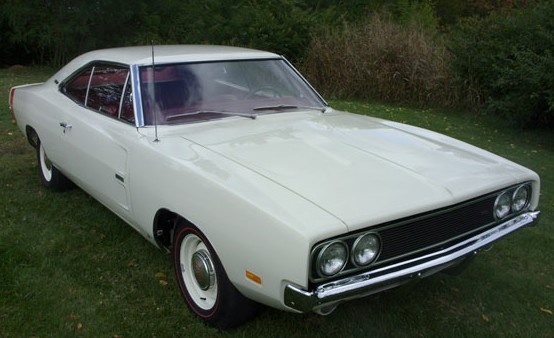
Another big sale was a 1969 Hemi Dodge Charger, one of only 119 built in 1969 with that monster engine. It’s white and entirely unassuming – perfect for a car that will take just about anything at the stoplight. It sold for $130,000.

Other interesting sales included this 1995 Lola T9500-HU24 Cosworth XB Indy car. It was driven by Scott Sharp to 10th place in the 1996 Indy 500 for A.J. Foyt Racing and by Eddie Cheever in 1995. It is a complete, running Indy car with Indy 500 history. It sold for $62,700.

Finally, from the bargain bin (sort of), is this 1956 Pontiac Star Chief Catalina Custom. The second-generation Star Chief is one of my favorite Pontiacs and it’s such a great-looking car with those two chrome strips running the length of the hood. This one has a 5.2-liter V8 and appears to be in great shape. It sold for $14,300. For complete results (and to see what cars are still available), click here.

Abarth OT 1300

1966 Abarth OT 1300

Offered by Oldtimer Galerie International | Zurich, Switzerland | June 10, 2012

Photo – Oldtimer Galerie

Carlo Abarth is mainly known for his hot rod Fiats, but he also built cars of his own – well, kind of. He constructed his own cars, usually using bits and pieces of other cars. The one you see here is based on a SIMCA chassis with SIMCA and Fiat parts and a 1.3-liter, four-cylinder engine based on a SIMCA design, but built at a race shop in Italy. It makes 140 horsepower and can do a little more than 150 mph.

Between 1965 and 1966, 50 examples of the OT 1300 were built. There were also OT 1000, OT 1600, and OT 2000 models (I’m not sure of their production numbers off-hand). All OT models were intended for the track when built, however this particular car is road-legal (and in Switzerland at that).

Personally, I quite like the styling and the competition history of the model makes it seem like a performer (the OT 1300 won its class at Le Mans). I wouldn’t mind taking one for a spin. But I’m not sure if I can afford it – as the estimate is “on request.” Perhaps it’s my fault that the two cars I picked from this sale were the only two with “on request” estimates. Then again, they were the pick of the litter.

For more information and photos, click here. And for more on this sale, click here.