Ferrari 225 by Vignale

1952 Ferrari 225 Sport Spyder ‘Tuboscocca’ by Vignale

Offered by RM Auctions | Monaco | May 12, 2012
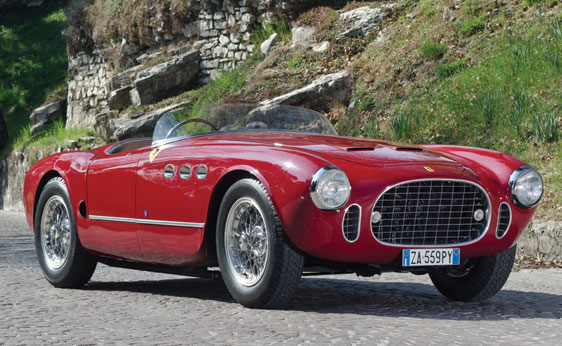
When production of the Ferrari 212 ended in 1951, Ferrari introduced the interim 225 model – an enlarged 212 that was produced for one year, 1952, before the Ferrari 250 was introduced in 1953. Mainly sold to privateer sportsmen, the 225 was a successful racer in many parts of the world. This particular example was bought by an Alfa Romeo dealer who split his time between Milan and Buenos Aires. The car remained in South America until 1980 when it was brought back to Italy and restored.

Since its restoration, it has been campaigned in vintage races, but in its day, it also had a few victories. It’s competition history includes:

  • 1952 Bologna-Raticosa Hill Climb (first race) – 1st (with Pietro Palmieri)
  • 1953 Argentine Sports Car Championship – 1st (with José Maria Ibañez, where it won two races and placed on the podium fives more times)

Of all of the super-rare and early Ferraris offered at RM Auctions’ Monaco sale, this is my favorite. It’s not the fastest and it’s not the rarest, but that Vignale coachwork is near-perfect. It’s well-proportioned and don’t even get me started on those portholes.

The 225 features a 210 horsepower 2.7-liter V12 and “Tuboscocca” refers to the frame layout. Just 12 Sport Spyders were produced (and seven Berlinetta coupes) – all by Vignale. There was also one non-Vignale 225S. While fairly rare, a 225 will pop up for sale every now and then. The estimate on this one is $2,380,000-$2,900,000. For the complete catalog description, click here. And for more on RM in Monaco, click here.

Update: sold $3,263,400.

Peugeot 908 HDi FAP

2007 Peugeot 908 HDi FAP

Offered by RM Auctions | Monaco | May 12, 2012

The 24 Hours of Le Mans has had some historic battles between manufacturers since it began back in 1923. The latest of these battles has been between Audi and Peugeot. Beginning in 2007, Peugeot took Audi head on with this car, the 908 HDi FAP. Like its competitor, it is diesel-powered – a 5.5-liter twin-turbocharged V12 making in excess of 700 horsepower.

I should probably come clean and admit that I am a massive Audi fan. However, I will also admit that these cars are far more attractive than any of the Audi prototypes they raced against. They are gorgeous – and those wheels! The 908 was a worthy competitor to Audi’s R10 and R15, but it only got the better of them at Le Mans once – in 2009 when they finished 1-2.

The competition history of this car includes:

  • 2007 1000km Monza – 1st, in it’s debut race (with Nicolas Minassian and Marc Gené)
  • 2007 1000km Valencia – 36th, DNF (with Minassian and Gené)
  • 2007 24 Hours of Le Mans – 30th, DNF (with Minassian, Gené and Jacques Villeneuve)
  • 2007 1000km Nürburgring – 2nd (with Minassian and Gené)
  • 2007 1000km Spa – 46th, DNF (with Minassian and Gené)
  • 2007 1000km Silverstone – 1st (with Minassian and Gené)
  • 2007 Mil Milhas Brasil – 1st (with Minassian and Gené)
  • 2008 12 Hours of Sebring – 11th (with Minassian, Stéphane Sarrazin and Pedro Lamy)
  • 2008 1000km Catalunya – 1st (with Minassian and Gené)
  • 2008 1000km Monza – 5th (with Minassian and Gené)
  • 2008 1000km Spa – 1st (with Minassian, Gené and Villeneuve)
  • 2008 24 Hours of Le Manes – destroyed in practice crash (with Gené)

Peugeot suddenly cancelled it’s LMP program in 2012. If you never had a chance to see these cars come whistling by you at Tertre Rouge or come flying at you at the Indianapolis and Arnage corners, well you’ve missed something beautiful. When a gasoline-powered prototype car races past, they are burbling and popping and spitting fire at an incredible volume. Not so with these cars. They are eerily quiet and you can hear them punch a hole in the air. It’s amazing. If you missed out on it, I’m sorry – but here’s your chance to buy one – and it’s the first time one has been offered for public sale.

It is expected to bring $2,000,000-$2,400,000 and is being sold directly from Peugeot. It comes with a commitment to three years of technical support from Peugeot Sport, as modern race cars are technology-laden. But it isn’t free. For the complete description, click here. And for more on RM in Monaco, click here.

Update: sold $2,175,600.

1980 Ferrari Sedan

1980 Ferrari Pinin

Offered by Bonhams | Monaco | May 11, 2012

Ferrari’s new FF two-door shooting brake seemed to rile some purists when first revealed – for why would their beloved car company build a wagon? Well, the same thing happened when Porsche built, first the Cayenne and then the Panamera. Lamborghini has taken the wraps off it’s new SUV concept – as have Bentley and Maserati. But for Ferrari to think beyond two doors, I fear, would be too much for most purists to handle.

Enter Pininfarina, possibly the most famed of all Italian design houses – and the one most closely associated with Ferrari. In 1980, Pininfarina celebrated 50 years of coachbuilding and they did it by building this four-door Ferrari – and Bonhams claims it is the only Ferrari sedan in existence (the Sultan of Brunei has a few Ferrari four-door wagons, but no sedan that anyone is aware of).

The car was introduced at the 1980 Turin Motor Show with a 5.0-liter V12 out of a Berlinetta Boxer. Only in this case, the engine was in the front instead of the rear. The car appeared at a few more auto shows in 1980 and 1981 and then Ferrari removed the mechanicals and the display car was eventually sold to the Belgian Ferrari importer, who showed the car in 2005 for the 75th anniversary of Pininfarina.

The car was sold in 2008 and the new owner commissioned Ferrari to re-install the drivetrain so the car could be driven. Another 360 horsepower 5.0-liter V12 was installed and the car was finally driven in 2010.

If you’ve always dreamed of owning a Ferrari sedan, this is bound to be your only chance. The current owner paid €176,000 for it at an RM Auction in 2008 and then paid God-knows-how-much to get it running. The pre-sale estimate this time around is $660,000-$790,000. For the complete catalog description, click here and for more on Bonhams in Monaco, click here.

Update: did not sell.

Duesenberg J-462

1932 Duesenberg Model J LWB Custom Speedster

Offered by Worldwide Auctioneers | Houston, Texas | May 5, 2012

Quick, somebody call Fran Roxas or someone similarly talented, ’cause this Duesey needs a new body. Chassis no. 2522 was one of the later cars built and some records show that it may not have actually been completed and sold until 1935, although it is currently titled as a 1932. Engine J-462 is under the hood, making the standard 265 horsepower.

The original body was a Murphy Beverly Berline – which is attractive. It is thought that the original body was removed and replaced by what you see here sometime in the late 1940s or 1950s. Most of the body panels came off of GM cars of the era. Exotic.

The car is often referred to as the “Tom Mix Duesenberg.” Tom Mix was a silent movie star known for his roles in westerns (I’ve seen a lot of silent films, but never one of his. He is kind of the archetypal movie cowboy). As you can see, this car sports a western motif – but it is also thought that Tom Mix had nothing to do with this car – he died in 1940 and the story attaching his name to the car didn’t appear until the 1970s. Make of it what you will. But it is a Duesenberg.

This car is being offered from the estate of John O’Quinn. It failed to sell at a Bonhams auction in Monterey in 2011. It is being offered in Houston at no reserve with an estimate at $400,000-$500,000, which is pretty cheap as far as Model Js go. Then again, who knows what it will cost to return the car to a more… Duesenberg-like state – if you are so inclined. Or keep it how it is and don’t be just another guy with just another Murphy-bodied Duesenberg (if it’s even legal to say that). This one’s certainly one-of-a-kind.

For the complete catalog description, click here. And for more from Worldwide Auctioneers in Houston, click here.

Update: Sold $297,000.

Rondeau-Cosworth

1978 Rondeau M378 Ford-Cosworth

Offered by RM Auctions | Monaco | May 12, 2012

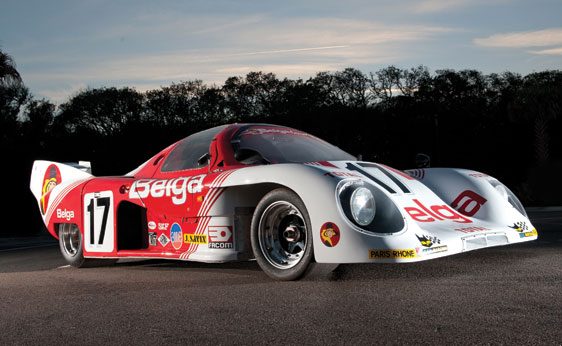
What is it about Le Mans that inspires racecar drivers to want to become manufacturers? Yves Courage, Henri Pescarolo, Alain de Cadenet all caught the bug – and so did Jean Rondeau, who began constructing and racing his own cars at the famed 24 Hours in 1976. 1978 was the first year that the cars actually bore his name and this was the first of them. Rondeau would win the 1980 race in a car of his own design – the only time this has ever happened.

This car, chassis no. 001 holds the record for the most starts at the race with 10. No longer are single cars competitive for an entire decade. It’s an impressive feat. Here’s a rundown of those years:

  • 1978 24 Hours of Le Mans – 9th overall, 1st in class (with Rondeau, Bernard Darniche, and Jacky Haran)
  • 1979 24 Hours of Le Mans – 30th, DNF (with Rondeau and Haran)
  • 1980 24 Hours of Le Mans – 3rd (with Gordon Spice, Philippe Martin and Jean-Michel Martin)
  • 1981 24 Hours of Le Mans – 2nd (with Haran, Jean-Louis Schlesser and Philippe Streiff)
  • 1982 24 Hours of Le Mans – 10th (with Pierre Yver, Bruno Scotty and Lucien Guitteny)
  • 1983 24 Hours of Le Mans – 28th, DNF (with Vic Elford, Joël Gouhier and Anne-Charlotte Verney)
  • 1984 24 Hours of Le Mans – 11th (with Jean-Philippe Grand, Jean-Paul Libert and Pascal Witmeur
  • 1985 24 Hours of Le Mans – 43rd, DNF (with Michel Dubois, Hubert Striebig and Noël del Bello)
  • 1986 24 Hours of Le Mans – 17th (with del Bello, Scotty and Lucien Rossiaud
  • 1988 24 Hours of Le Mans – 27th, not classified (with Scotty and Pierre-Alain Lombardi)

Jean Rondeau was killed in a road car accident in 1985, but his name lived on at the race he lived for – on this car, through 1988. This car also competed in nine other European endurance events, with at least one win.

The engine is a 3.0-liter V8 from Cosworth making 415 horsepower. It’s a race car and weighs next to nothing. So it’s quick. And it’s a piece of history – although it never won the big race, it holds an impressive record and is eligible for historic events. The pre-sale estimate is $790,000-$990,000. To read the complete description, click here. And for the entire RM in Monaco offering, click here.

Update: sold $464,128.

Ex-Ferrari Alfa Romeo

1930 Alfa Romeo 6C 1750 Gran Sport Spyder

Offered by Bonhams | Monaco | May 11, 2012

Photo – Bonhams

Enzo Ferrari founded his race team, Scuderia Ferrari, in 1929 and the team entered its first race in 1930. It was the Mille Miglia and they entered three cars. This was one of them. It’s competition history includes the following:

  • 1930 Mille Miglia – DNF (with Luigi Scarfiotti and Guglielmo Carraroli)
  • 1930 Coppa Gran Sasso – 5th (with Scarfiotti)
  • 1930 Coppa Pierazzi – 4th (with Scarfiotti)
  • 1931 Mille Miglia – 6th (with Scarfiotti and Piero Bucci)

The car was used on the road by Scarfiotti for a while before he sold it back to Alfa Romeo. It was registered in Italy until the mid-1930s and then it’s history goes dark. That is, until 1960 when it was rediscovered (in Modena) and restored. The body is probably new (and not the original supplied by Zagato) but in period style but it retains the original mechanicals and chassis. It is also said that five of the pistons on this car are marked with an “SF” – the early Scuderia Ferrari marking, making this the oldest car with such markings.

The 6C was produced by by Alfa Romeo from 1925 until 1954, with the 1750 model seen here produced only from 1929 through 1933 in six different “series.” This is a Series IV model with the same 1752cc straight-six as previous series. However, this was the first 1750 model available with a supercharger, increasing output to just over a claimed 100 horsepower. Of the 2,635 6C 1750s built, less than 200 were Series IV Gran Sport models.

Early Alfa Romeo’s like this are quite valuable on their own, but adding in the significance of this being one of Scuderia Ferrari’s first three race cars, it only makes it more so. The pre-sale estimate is listed at $1,100,000-$1,200,000. For the complete lot description, click here and to see more of Bonhams’ Monaco lineup, click here.

Update: Not sold.

1901 Darracq

1901 Darracq 6.5 Two-Seater

Offered by Bonhams | Hendon, U.K. | April 30, 2012

Earlier this week we talked about Alexandre Darracq and how he founded the company that would ultimately become Gladiator – and how that company was intertwined with Adolphe Clément’s automotive exploits as well as those of Charles Chetwynd-Talbot. Well, after Darracq left Gladiator, he founded Société A. Darracq near Paris. The first car designed and built in-house by Darracq arrived in 1900 which was a 6.5 horsepower single-cylinder car of 785cc, such as the 1901 model you see here.

This car was found in France in the 1960s and brought to England where it was restored and has been well known in Veteran car circles since. The body is a period style, but not original. It’s been well kept and is eligible for the all-important London to Brighton Veteran Car Run.

So, knowing that this company was founded by Alexandre Darracq, what other names did it go by during it’s existence? Good question. In 1902, the cars were introduced in Germany where they were sold as an ‘Opel Darracq’, in conjunction with Adam Opel and his company. This partnership lasted for but a few years and Darracq began looking for other markets, particularly car-hungry England.

In 1919, Sunbeam merged with Clément-Talbot, the English importer of the French Clément-Bayard cars (see the Gladiator post from Monday for more on this). This created Sunbeam-Talbot, and cars were sold under this name. In 1920, Darracq merged with Sunbeam-Talbot to form Sunbeam-Talbot-Darracq (or STD Motors, which is a less-than flattering name). There were cars badged as ‘Talbot-Darracq’. When STD went bust in 1935, the factory and company was acquired by A.F. Lago, beginning the Talbot-Lago make. The name of Alexandre Darracq, who had cashed out in 1913, slowly evaporated from the automotive landscape and was long gone by the time Simca swept up Talbot-Lago in 1958.

The detailed history of the early automotive industry is fascinating and this is a car from a company that played a pivotal role. The pre-sale estimate is $87,000-$100,000. For the complete description, click here and for the rest of Bonhams at the RAF Museum, click here.

Update: Did not sell.

International Travelall

1969 International Travelall 1000D

Offered by Auctions America | Carlisle, Pennsylvania | April, 26-27, 2012

Produced for 22 years, the International Travelall introduced a few things to America that became really popular about 20-30 years later. It was the first six-passenger four-door truck (the Suburban didn’t get four doors until 1973). The Chevrolet Suburban was the prime competition for the Travelall, which was first introduced in 1953.

The model you see here was the freshened body style available from 1969 until the model’s demise in 1975. It features a 145 horsepower 302cid International V-8 engine and 58,000 original miles. It’s an original California car that looks fantastic.

International Harvester has been around since 1902. Passenger-car (or light truck) production ended in 1980 and the company exists today as Navistar International, a leading maker of heavy trucks that still carry the International name.

While I don’t have the production figures for the Travelall sitting in front of me, I can assure you that they are far less than that of the Suburban – and survival rates are even lower. The estimate on this truck/wagon is $22,000-$28,000. It would definitely be a different way to travel, and must have been in 1969 as well. For those that loathed the faux-wood paneled station wagons of the day, this must have been a breath of fresh air, faux-wood paneling or no.

For the complete catalog description, click here. And to see the rest of Auctions America’s Carlisle lineup, click here.

Update: Did not sell.

Ferrari 206 S Dino

1966 Ferrari 206 S Dino Spyder

Offered by RM Auctions | Monaco | May 12, 2012

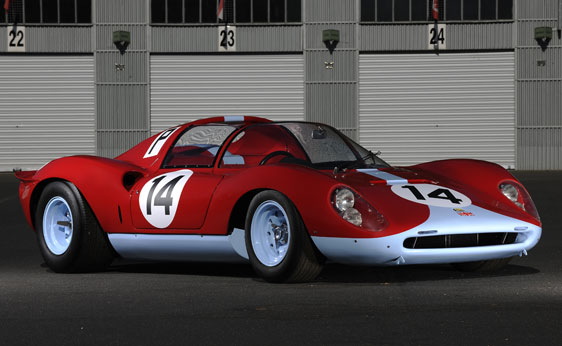
In 1966 Ferrari introduced their gorgeous V-12 powered 330 P3 race car to compete against the big boys in the biggest sports car races on the continent. Alongside the 330, there was a new, smaller race car, powered by a 2.0-liter V6 making 218 horsepower. It was called the 206 Dino S.

With a body penned by Pierre Drogo and built by his company, Carrozzeria Sports Cars, it was certainly a looker. And it was no slouch on the track, placing second at the Targa Florio and taking the bottom two podium spots at the Nürburgring. The car here (chassis #006) was actually the third car built for sale. Some of it’s competition highlights include:

  • 1966 1000km Nürburgring – DNF (with Richard Attwood and David Piper)
  • 1967 Brands Hatch – 6th overall, 1st in class (with Michael Parkes)
  • 1968 Targa Florio – 22nd (with Hans Wangstre and Evert Christofferson)

Most of its brief competition history was at the hands of amateur drivers and it was placed into storage in the early 1970s. When it was removed, it was carefully restored over a number of years to it’s original condition as it was campaigned at the ’66 Nürburgring race.

Ferrari’s original intention was to build 50 homologation examples but they ended up building only 18. And this is a very early example. I love the striking light blue on red color scheme – it’s not something you see everyday. But then again, a 206 S isn’t something you see everyday either, regardless of paint scheme. The price proves it, with an estimate between $2,875,000-$3,600,00. For the compete catalog description, click here and here for the complete lot list.

Update: sold $3,263,400.

Here’s video of a similar car:

Lancia Hyena

1995 Lancia Hyena

Offered by RM Auctions | Monaco | May 12, 2012

In the late 1980s and early 1990s, Lancia was achieving success on the Rally circuit with their series of Delta Integrale rally cars. They also had to produce homologation models for street use in order to compete. Some of these are highly sought after. They were boxy and fast but not necessarily the epitome of Italian automotive style and grace.

Enter Zagato, the famed Italian design house that penned the design you see here – a small two-dour coupe version of the five-door Integrale hatchback. They proposed a limited edition run of these coups, to which Lancia said: “Uh, no thanks.” Their loss, as Zagato went ahead and built them anyway by purchasing Integrales, stripping them down, and fitting them with the body you see here. The cars were lighter and had more power and the same rally-bred all-wheel drive system.

The original Zagato plan pitched to Lancia called for 500 units to be built. But, doing it themselves, the costs soared and only 24 were built and sold for about $75,000 each. They had a 250 horsepower (although the one for sale here has been upped to about 300) 2.0-liter turbocharged straight-four.

These are very rare cars and the price shows it, estimated between $130,000-$185,000. For the complete catalog description, click here. For more on RM in Monaco (including a tremendous collection of Ducati motorcycles) click here.

Update: sold $116,032.