Shelby Turbine Indy Car

1968 Shelby Turbine Indy Car

Offered by Mecum | Monterey, California | August 14-16, 2014

Photo - Mecum

Photo – Mecum

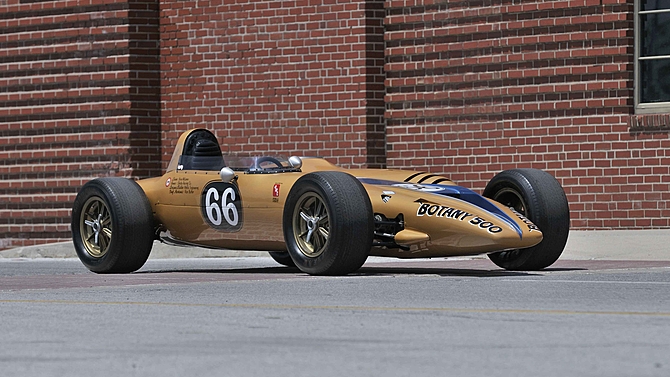
Everyone remembers Andy Granatelli’s STP turbine indy cars from 1967 and 1968 – back in the day when the Indianapolis 500 stood for speed and innovation. The STP-Paxton Turbocars were driven by Parnelli Jones and Joe Leonard and dominated the races but always failed prior to the finish.

Well in 1968, Carroll Shelby also built a similar turbine-powered open-wheel racer and entered it in the Indy 500. The team practiced two cars – this one was driven by Bruce McLaren. USAC changed the rules surrounding turbine cars and while the STP cars were still legal, the Shelby cars were not able to compete and were withdrawn prior to qualifying.

The powerplant here is a General Electric T-58 shaft-drive turbine putting out a crazy 1,325 horsepower. This car is pristine and is currently on display the Indianapolis Motor Speedway Museum in their Turbine Indy Car exhibit. It’s a pretty cool opportunity that should command a pretty princely sum. You can read more here and see more from this sale here.

Update: Not sold, high bid of $450,000.

A Pretty Packard

1935 Packard Super Eight Coupe Roadster

Offered by RM Auctions | Plymouth, Michigan | July 26, 2014

Photo - RM Auctions

Photo – RM Auctions

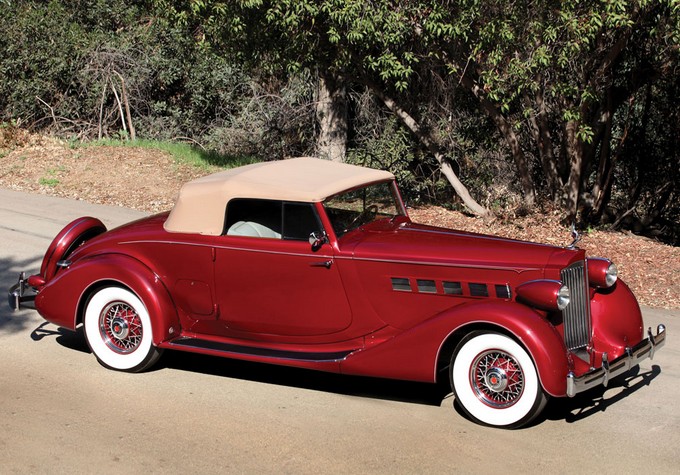
So there’s really nothing super exotic about this Packard. But when I looked through the catalog for this sale, it caught my eye. It’s just pretty, isn’t it? Packards are quite stately as-is, but this one – and maybe it’s that deep ruby red paint – I really like.

The Super Eight appears to have been new for 1933 as a deviation of the then-three-year-old Eight. The engine is a 150 horsepower 6.3-liter straight-eight. These are still usable cars… although the wonderfully styled rear-hinged doors aren’t something you see much of anymore.

The car was actually restored decades ago but has been freshened and detailed more recently. It still looks excellent. This Series 1204 Coupe Roadster should sell for between $150,000-$200,000. Click here for more info and here for more from RM in Michigan.

Update: Sold $181,500.

1913 Michigan Touring

1913 Michigan Model R Touring

Offered by RM Auctions | Plymouth, Michigan | July 26, 2014

Photo - RM Auctions

Photo – RM Auctions

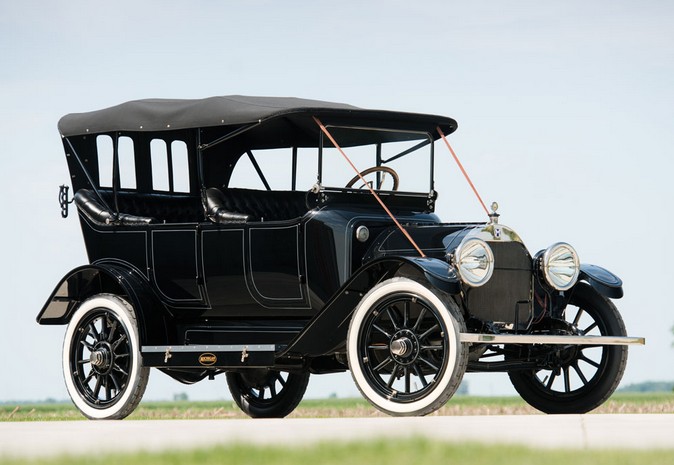
Michigan was one of many short-lived American automobile manufacturers that existed prior to WWI. It is, in fact, amazing that a car so rare from so long ago is now readily available in such fantastic condition. Michigan was founded in 1904, but production didn’t really take off until 1911. And the company closed its doors after 1913 because, strangely, company officials were shady as can be. Many of their employees were on paper only (with the managers taking their “employees” paychecks home). One of the managers actually gambled away a large portion of company funds at a horse track.

This Model R was for the 1913 model year only. It uses a 4.9-liter straight-four making 40 horsepower. Available as a two-passenger Roadster or five-passenger Touring, the original owners of this car opted for the larger of the two options.

The Michigan Buggy Company boasted of over 6,000 cars sold, but it is thought (with how honest the company was) that the number is likely closer to 1,200. This car was restored in 2002 from a complete survivor. It last sold in 2008 for $154,000 and this time is expected to bring between $140,000-$180,000. Click here for more info and here for more from RM in Michigan.

Update: Sold $132,000.

Update: Not sold, RM Sotheby’s, Ft. Lauderdale 2018.

1906 Studebaker

1906 Studebaker Model G Touring

Offered by RM Auctions | Plymouth, Michigan | July 26, 2014

Photo - RM Auctions

Photo – RM Auctions

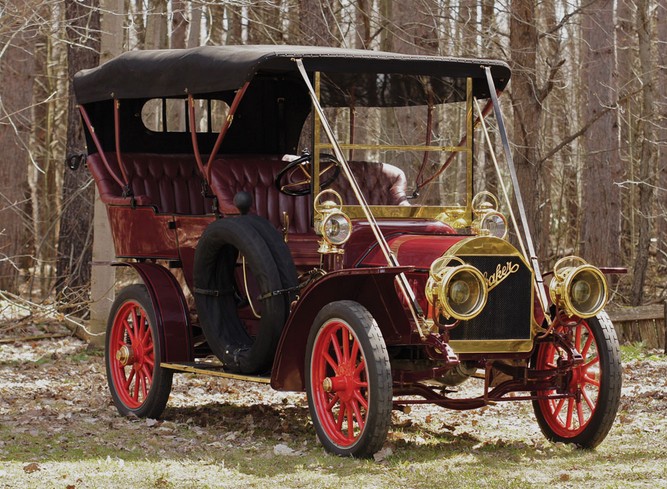
Studebaker was the quintessential American automobile manufacturer. Like many of the great, early European marques, Studebaker had a long history dating back to the 1850s. They started by building wagons. Cars came in 1897. The early cars (until about 1911) were actually sold as Studebaker-Garfords.

The Model G was new for 1906 and it was the highest-priced, most decked out model in the Studebaker lineup. The engine is a 4.6-liter straight-four making 30/35 horsepower. It could cruise at 45 mph and was only offered in this five-passenger touring configuration.

This car has somewhat known history since new. It was discovered by Henry Austin Clark Jr. in the 1940s and put in his museum until 1968 when it was sold to – guess who – Bill Harrah. It remained in his collection until 1982. It is said that this is the oldest known four-cylinder Studebaker in existence. And its ownership history doesn’t get much better. Add your name to that list for between $325,000-$450,000. Click here for more info and here for more from this sale.

Update: Sold $275,000.

Update II: Not sold, RM Sotheby’s Amelia Island 2017.

Benz Toy Tonneau

1911 Benz 45/60HP Toy Tonneau by J.E. Demar

Offered by Bonhams | Stuttgart, Germany | July 12, 2014

Photo - Bonhams

Photo – Bonhams

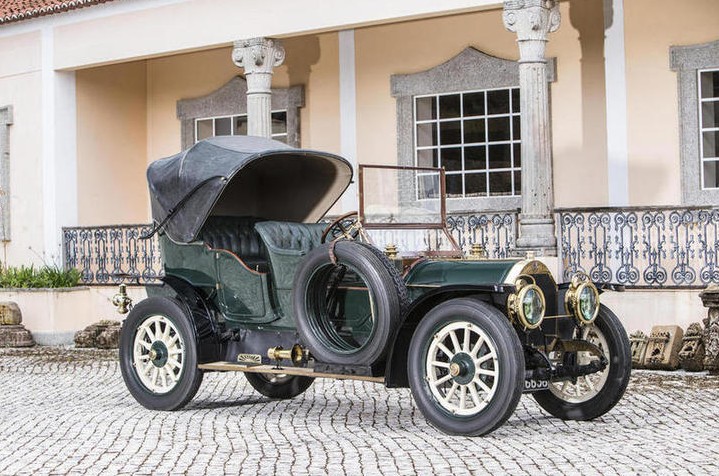
Benz built cars as a separate marque up until it merged with Daimler in 1926, but it seems like you so rarely see them. This 1911 45/60HP is a marvelous example. And so is that giant castle of a house in the background.

This car was imported as a bare chassis into New York City from Germany in 1911. In those days, a Benz chassis could cost an insane $8,500. So this was among the highest of luxuries in its day. It uses a 6.75-liter straight-four that makes 45/60 horsepower. The body is by Joseph Edward Demar, a coachbuilder in New York who operated for only four short years.

The car was discovered in Philadelphia around 1980. The restoration was completed in 1984 in the U.K. and the current collection acquired the car in 1994. It has spent some time in a Portuguese museum and has its original engine, body and chassis – rare for a car so old with such little history known. But it really is spectacular – and the price reflects it: there is an estimate of $1,200,000-$2,000,000. Click here for more info and here for the rest of Bonhams’ Mercedes-Benz lineup.

Update: Not sold.

Falcon Caribbean

1963 Falcon Caribbean

Offered by H&H Auctions | Buxton, U.K. | July 23, 2014

Photo - H&H Auctions

Photo – H&H Auctions

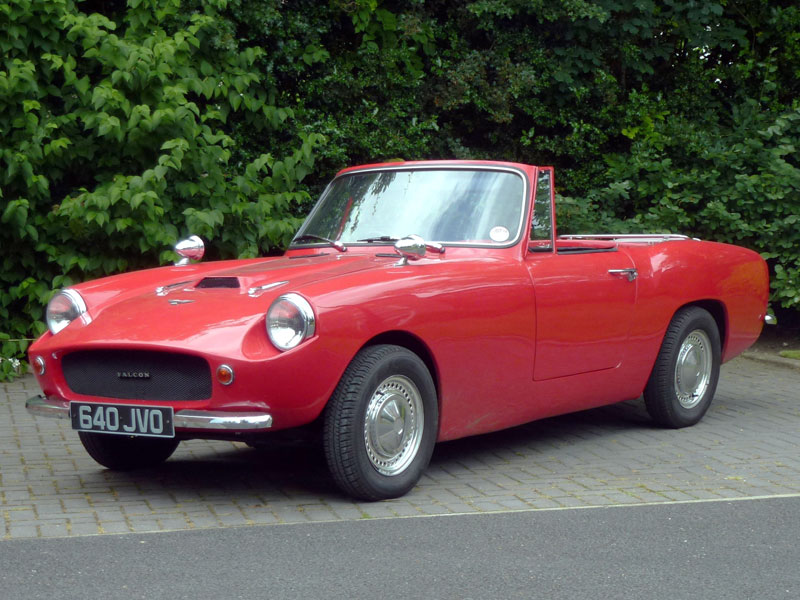
Peter Pellandine was involved in the design and manufacture of three separate automobile marques: Pelland/Pellandine, Ashley, and Falcon. The latter two were British special (or kit car) constructors. Essentially, the company built bodies to replace the less sporty bodies that their customers’ cars originally came with.

Pellandine founded Falcon Shells after he left Ashley Laminates in 1956. The company produced fiberglass cars – seven different models in all. The Caribbean was manufactured in kit (body-only) form between 1959 and 1963 with more than 2,000 sold. They were designed to fit on the pre-war chassis of the British Ford Ten. I’m unsure as to the chassis of this car, but the engine is a 1.3-liter straight-four.

The Caribbean was Falcon’s most popular model and it would be a fun, easy-to-maintain, and cheap-to-buy starter collector car. This one should sell for between $10,300-$13,700. Click here for more info and here for the rest of H&H’s Pavilion Gardens lineup.

Update: Not sold.

Mercedes 10/40/65

1924 Mercedes 10/40/65PS Sport Phaeton

Offered by Bonhams | Stuttgart, Germany | July 12, 2014

Photo - Bonhams

Photo – Bonhams

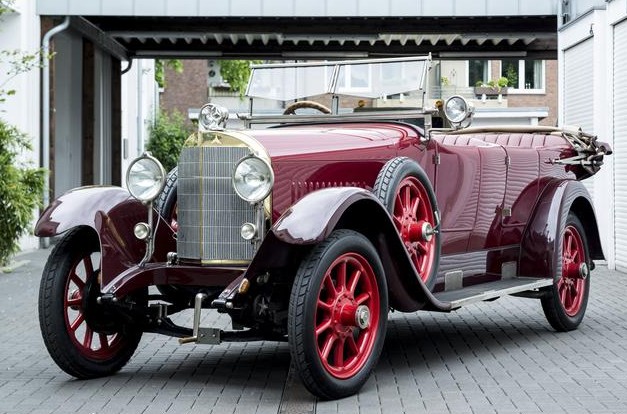
This pretty Mercedes touring car was built by Mercedes – before the “hyphen Benz.” In fact, it was produced just two years before Daimler (Mercedes’ controlling company) merged with The House that Karl Built in 1926.

The confusing model nomenclature used by Mercedes with the three numbers separated by slashes is like that for good reason: these were the first production cars fitted with superchargers and the numbers reflected the horsepower during various driving stages. The first number is the nominal horsepower (which was and is an outdated way of estimating power – it’s what they used for steam engines), the second number is the engine during normal operating procedure, and the third is when the supercharger is engaged.

So this 2.6-liter straight-four put out 40 horsepower – 65 when the “Kompressor” was engaged. It was the more powerful of the two four-cylinder cars Mercedes was producing at the time. My favorite part of the catalog entry for this car is that this car is currently owned by a collector of mainly post-war Mercedes and this car “does not fit his collection.” Must be a nice problem to have.

Only 851 10/40/65s were built. And this one should sell for between $610,000-$890,000. Click here for more info and here for more from this sale.

Update: Not sold.

Mercedes-Benz Tourenwagen

1934 Mercedes-Benz 500 Nürburg Offener Tourenwagen

Offered by Bonhams | Stuttgart, Germany | July 12, 2014

Photo - Bonhams

Photo – Bonhams

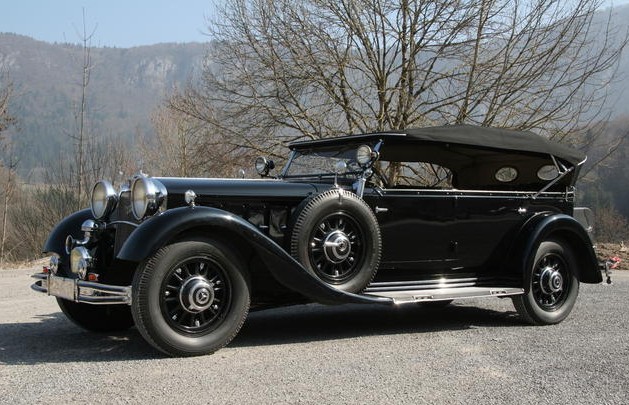
The Mercedes-Benz Nürburg 500 was part of the Mercedes-Benz W08 line (in MB-internal speak). Originally introduced in 1928 in Nürburg 460 spec, the 500 was new for 1931. And it was glorious. Just look at it. Oh, and it was based on the 460, which was designed by Ferdinand Porsche.

What the 500 had over the 460 was displacement. It uses a 4.9-liter (5.0 if you’re feeling generous) straight-eight making 99 horsepower. It could do 75 mph – which is a lot in such a big car that has such modest power figures (keep in mind you could buy a Duesenberg with more than three times the power at this point).

What is excellent about this particular car is that it is a convertible – which was quite rare among Nürburgs. It is one of only 931 Nürburg 500s built and if you look at it, you can easily see design hints of the much-loved 500K/540K cars that would come a couple of years later. Ownership history is known from new and it has never been restored – just taken care of as needed and would be a lovely driver after a brief freshening upon purchase.

And that purchase price figures to be somewhere between $680,000-$820,000. You can read more here and see more from this sale here.

Update: Sold $703,541.

Five Additional Military Vehicles

The Littlefield Collection

Offered by Auctions America | Portola Valley, California | July 11-12, 2014


 1973 Alvis FV721 Fox Prototype
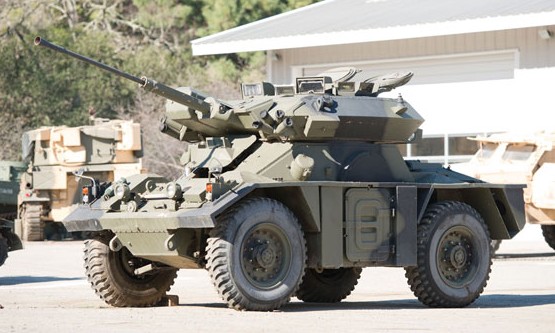
Photo - Auctions America

Photo – Auctions America

The Fox was Britain’s replacement for the Ferret armored scout car. It was designed and manufactured by Alvis, beginning in 1973. The final Foxes were withdrawn from service in 1994.

The Fox here is one of the original prototypes and remains in original condition. The engine is a 4.2-liter straight-six from Jaguar making 190 horsepower. It should sell for between $30,000-$40,000. Click here for more info.

Update: Sold $57,500.


1942 Baldwin M3A5 Grant II
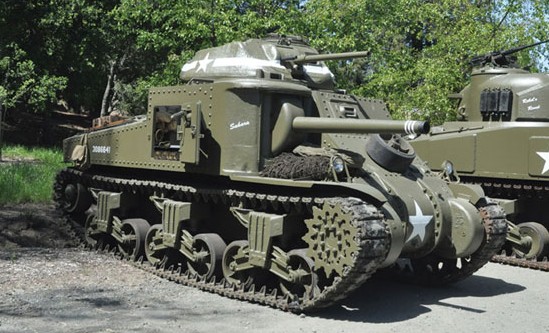
Photo - Auctions America

Photo – Auctions America

The M3 Lee was designed prior to America’s entry into WWII. They were operational around the time Pearl Harbor was attacked. In 1942, a new variant, the M3A5 was introduced. The “Grant II” – as it was called – used a GM engine and was built by Baldwin Locomotive Works.

This tank was shipped new to Australia and uses a 12-cylinder diesel making 375 horsepower. It will do 25 mph and cost the new owner between $300,000-$400,000. Click here for more info.

Update: Sold $276,000.


ca.1963 Panhard EBR-90

Photo - Auctions America

Photo – Auctions America

The Panhard EBR (which is the French abbreviation for “Armored Reconnaissance Vehicle”) was designed prior to World War II but didn’t actually go into production until 1950. It was produced in three versions, with the 90-mm cannoned version you see here starting production in 1963.

It’s an impressive setup: eight-wheel drive. It’s powered by a 200 horsepower Fiat 6.0-liter flat-12. About 1,200 were built and the last ones left the French military in 1987. This one should cost between $100,000-$125,000. Click here for more.

Update: Sold $28,750.


ca.1960 ZiL BTR-152
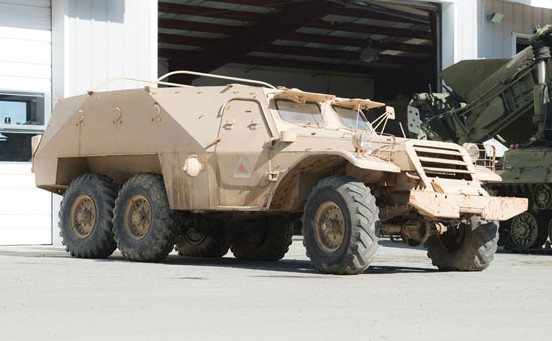
Photo - Auctions America

Photo – Auctions America

The BTR-152 was built by ZiS (from 1950 until 1956) and later by ZiL (through 1962). In total, about 15,000 were built. It’s an armored personnel carrier from the Soviet Union. The engine is a 107 horsepower straight-six.

This example isn’t in the best of shape, but it does run and drive “very well,” according to the auction catalog. This one wears Egyptian Army markings and should sell for between $15,000-$25,000. Click here for more info.

Update: Sold $34,500.


1945 ACF M37 105-mm Howitzer Motor Carriage
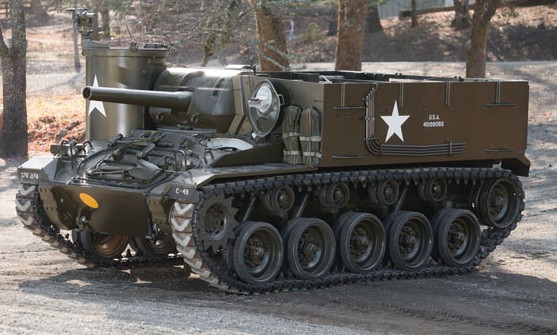
Photo - Auctions America

Photo – Auctions America

This beautiful HMC (basically a motorized Howitzer… artillery on wheels) was built in late 1945 and therefore didn’t see action in WWII. It was built by the American Car and Foundry Company (ACF for short). It was based on the American M24 Chaffee tank.

The engine is actually two Cadillac 8-cylinder engines – making it a 16-cylinder monster putting out a combined total of 220 horsepower. Only 316 were delivered out of a total of 448 orders. Everything on this one still works – so if you’re celebrating the 4th of July today, here’s your firework machine. It’ll cost you between $200,000-$250,000. Click here for more info and here for the rest of this amazing collection.

Update: Sold $195,500.
ZiL BTR-152

ca.1960 ZiL BTR-152

Offered by Auctions America | Portola Valley, California | July 11-12, 2014

Photo - Auctions America

Photo – Auctions America

The BTR-152 was built by ZiS (from 1950 until 1956) and later by ZiL (through 1962). In total, about 15,000 were built. It’s an armored personnel carrier from the Soviet Union. The engine is a 107 horsepower straight-six.

This example isn’t in the best of shape, but it does run and drive “very well,” according to the auction catalog. This one wears Egyptian Army markings and should sell for between $15,000-$25,000. Click here for more info.

Update: Sold $34,500.