Offered by Bonhams | Milan, Italy | November 18, 2022
Photo – Bonhams
This special was built around an Italian car by an Australian living in the U.K.. Graham Smith didn’t like his kit car options, so he devised his own. This, the Huntsman Spyder, was built between 1986 and 1988.
It’s based around Alfa Romeo Alfasud Sprint Veloce mechanicals. That’s a 1.5-liter flat-four making 175 horsepower. It’s got an Alfa five-speed gearbox and weighs less than 1,400 pounds. Zero to 60 happens in less than five seconds.
The body is fiberglass, and the frame is constructed of square tubular steel. Suspension is sourced from Triumph, a Royale F3 car, and Bilstein. It’s the only one ever built and carries an estimate of $40,000-$60,000. Click here for more info.
Offered by Bring a Trailer Auctions | November 2022
Photo – Bring a Trailer Auctions
Imagine this thing in your rearview mirror on a race track. Pretty scary. Now imagine it sneaking up behind you on the highway. Either is possible: it’s got a license plate mounted out back.
Let’s start at the beginning: the first T70 debuted in the mid-1960s as an open-top sports racing prototype. The Mk II Spyder came later and preceded the Mk 3 coupe. A slightly revised Mk.3B debuted in 1969 and featured front-hinged doors instead of the gullwing doors of the regular Mk 3.
Some of the Mk.3Bs were actually converted to road cars by Sbarro, who would soon after produce a run of replicas. That’s where things start getting confusing. This car was converted to road spec by Sbarro prior to their production of replicas, apparently. Funnily enough, there is another car with this same chassis number floating around (RM sold it in Paris 2014). That auction catalog initially advertised it as a Lola Mk.3B and laid out the early history of this yellow car. Then, shortly before the auction, they added a line that said “After further research it has come to light that this Lola T70 was built by Sbarro; it is very unlikely that this car was ever raced by Chuck Parsons” – which negated the entire history of their car they had written after it.
This car was reconstructed by Lola guru Mac McClendon in the 2010s. It’s powered by a 5.7-liter Chevrolet V8. The comments on the Bring a Trailer auction seem to be full of reading comprehension issues. Yeah, this car has had pretty much everything on it rebuilt or replaced (as has pretty much every race car of this era), but as someone wise said over there “a continuous history as being a particular car is what makes it original… more than the parts currently on the car.” Not to mention, if Mac McClendon says it’s the real deal… who are you to argue.
The other great bit of wisdom from a BaT commenter on thinking about cars like this: “The idea of the car is what matters; each replacement part occupies the same space as the original, and so to our mind the car is original even if none of the component parts are — the car has occupied the same space since 1969, and therefore remains the original car.”
Think about what this represents from 1969. It’s right there with a Miura or McLaren M6GT in terms of late 1960s supercars. It might not be as pretty as a Miura, but it’s more purposeful, and probably faster.
Bidding ends in a few days. You can read more about it here.
Offered by Bonhams | London, U.K. | November 4, 2022
Photo – Bonhams
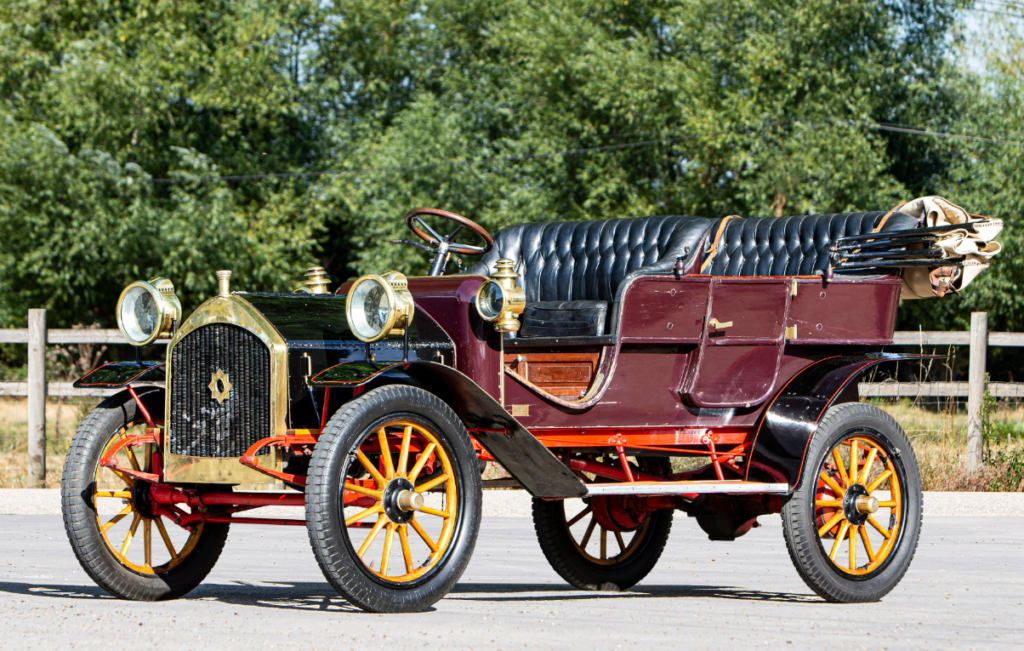
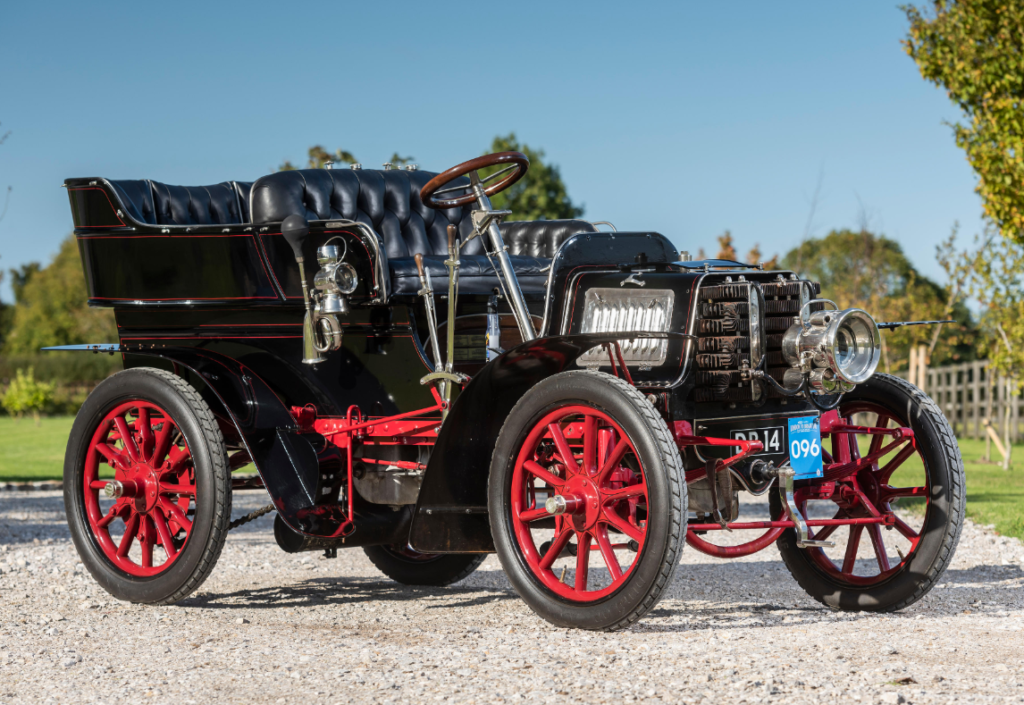
The Northern Manufacturing Company was founded by Charles King and Jonathan Maxwell, both of whom had previously worked for Oldsmobile. Their first cars, powered by singles, were sold in 1902. Twins followed in 1904, and four-cylinder cars would join the lineup in 1906.
The Type C was offered in 1906 and 1907 as the two-cylinder offering. The flat-twin here made 20 horsepower when new. This is a fairly large car for just two cylinders. They also built a five-passenger limousine in this model range, in addition to a runabout and another touring car.
Northern merged with the Wayne Automobile Company in 1908, and the combined company was quickly acquired by E-M-F. Maxwell had left in 1903 (to form Maxwell, which would become Chrysler), and King left after the acquisition and would form his own eponymous company. Studebaker would purchase E-M-F a few years later.
We’ve featured a few single-cylinder Northern runabouts before, but this is the first “big” Northern on this site. It should sell for between $21,000-$25,000. Click here for more info.
Offered by Bonhams | London, U.K. | November 4, 2022
Photo – Bonhams
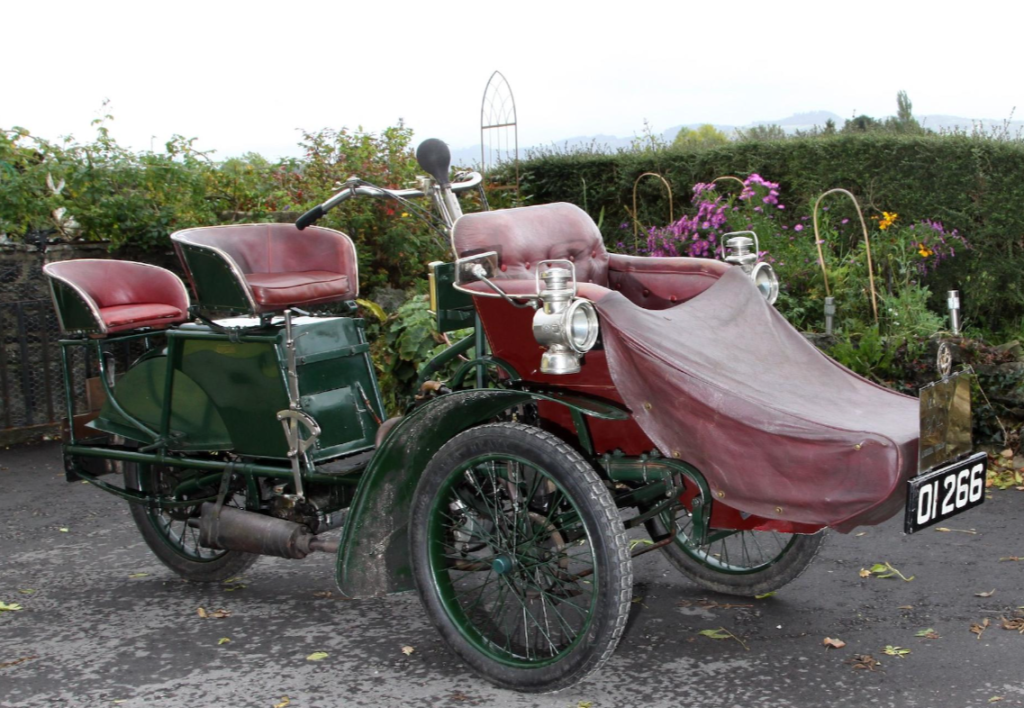
There’s nothing scarier on Halloween than being the front passenger in a tricar. You are the bumper and crumple zone.
Wilbur Gunn was actually born in the United States. He was an opera singer that became a British citizen in the 1890s and got his start in the automotive realm by building motorcycles in his backyard around 1904. He named them Lagonda, after a place in Ohio. Naturally.
The first four-wheeled cars arrived in 1907, meaning this tricar predates Lagonda “cars.” It’s thought to be the oldest known example of the marque and is powered by a 1.2-liter V-twin that was rated at 10 or 12 horsepower, depending on which rating system you subscribed to.
A Lagonda tricar was victorious in its class in a London-Edinburgh trial in 1906. This car is considered a prototype of its kind and is the only Lagonda eligible for the London-to-Brighton run. It was restored in 1936 and again in the 1990s (and in the ’90s it was Lagonda that did the work). It’s been under current ownership since 2004. The estimate is $85,000-$90,000. Click here for more info.
Offered by Bonhams | London, U.K. | November 4, 2022
Photo – Bonhams
Amazingly, the Type 15 was the 15th model introduced by Peugeot when it went on sale in 1897. It remained available through 1901, as it was fairly popular. Up to that point, it was the most mass-produced Peugeot model with 276 constructed.
It was also the company’s first car powered by a proprietary engine, as previous Peugeot engine’s were based on Daimler designs. It’s a 2.2-liter flat-twin that made about eight-horsepower and drove the rear wheels via a four-speed (plus reverse) gearbox.
This one was sold new in France and has known history back to the 1950s. Museum duty called from that point and for the next 30 years, and it’s current owner bought it some time after a restoration was completed in 1996. It’s a London-to-Brighton veteran and should bring between $310,000-$367,000. Click here for more info.
Offered by Bonhams | London, U.K. | November 4, 2022
Photo – Bonhams
Siddeley is a fairly well-known name in the historical British car world. However, most of the time it is connected to other names, like Deasy, Wolseley, or, most famously, Armstrong. But the first Siddeleys were built by John Davenport Siddeley’s Siddeley Autocar Company, which was founded in 1902. The cars were actually built by Vickers and were based on Peugeots.
In 1905, J.D. Siddeley became the manager of Wolseley and then added his name to that brand. In 1909, he left Wolseley (and so did his name) and took over Deasy, again appending his name to that marque’s as well. In 1919, Siddeley-Deasy was bought by Armstrong Whitworth. Armstrong-Siddeley cars remained in production until 1960. The Siddeley name stuck around on various aircraft companies through a few mergers, eventually winding up as part of BAE Systems.
So that’s the history. Here’s this car. It is said that 31 examples of the 12hp model were built, with this being the only survivor. It’s powered by a vertical twin that can push the car to 28 mph, never exceeding 1,800 rpm (and dropping as low as 80 rpm!). The rear-entrance tonneau body was fabricated in the ’90s to replace a replacement two-seater (previously added in lieu of the original tonneau body).
A former London-to-Brighton participant, this car should sell in the $125,000-$155,000 range. Click here for more info.
Offered by Mecum | Kissimmee, Florida | January 4-15, 2022
Photo – Mecum
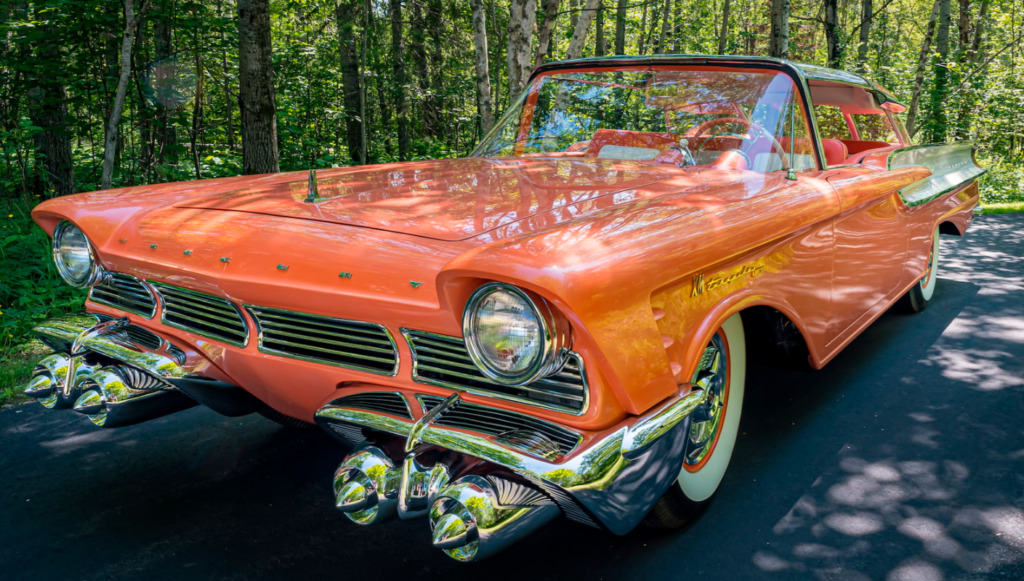
This poorly photographed mid-century concept car is a pretty wild thing. First of all, it’s built on a 1954 Ford F-250 chassis, and it was designed by Mercury yet actually built by Ghia in Italy. Which seems backward of how it is supposed to have been done. Power is from a 4.8-liter V8.
But let’s talk styling. First off, we have split dual-Dagmar front bumpers. The exhaust has dual tips sticking through each quarter panel, and the fins have a weird rotated-3D look to them that are surrounded by a flat rear deck and vertical tail panel. The C-pillar buttresses are actually glass, and brake lights are also located at the rear top base of the roof. The four-seat interior is full-on jet age, too.
It toured around the show circuit in 1956 and was used as a pace car in Daytona in 1957. From there, it sat parked outside at Ford HQ, deteriorating. The owner restored it between 2017 and 2022. It’s as fresh now as it’s ever been.
It’s actually been a while since a good 1950s concept car came up for sale. And this is one that hasn’t been seen in a long time. Click here for more info.
Offered by Bonhams | London, U.K. | November 4, 2022
Photo – Bonhams
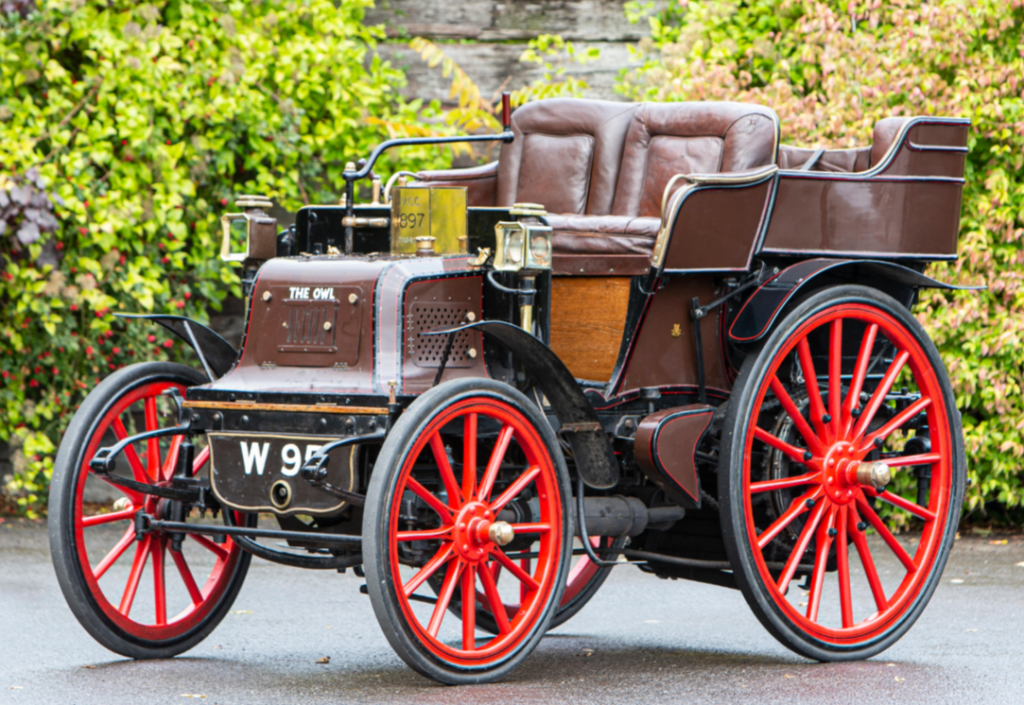
We have featured a four-horsepower 1897 Daimler before, believe it or not, but that car was a wagonette. This is a more passenger-friendly tonneau. It was built by Daimler in England, which at the time was just a year-old company.
In fact, this car was just the second built by the British Daimler. It is powered by the oldest known Daimler engine, which is a 1.6-liter vertical twin that was rated at four horsepower. Its first owner is known, and it was demonstrated for the future King Edward VII at Buckingham Palace before taking part in the London-to-Bright Run. In 1897.
Updates were performed by Daimler in 1900, and some of them have been undone (for instance, someone backdated it to its original tiller steering configuration). It’s participated in more than 50 London-to-Brighton runs. It’s now got an estimate of $255,000-$310,000. Click here for more info.
Offered by Bonhams | London, U.K. | November 4, 2022
Photo – Bonhams
MMC seemed to have been named in a hurry. The Motor Manufacturing Company didn’t get a fancy name, probably because company backer Harry J. Lawson was in a hurry. MMC was formed out of the remnants of the Great Horseless Carriage Company in 1898. The company went out of business in 1904 when Lawson was sent to prison for fraud. It reorganized twice before disappearing for good in 1908.
The 1902 model line included three front-engined options: a single, a twin, and a four-cylinder car. This car is the middle offering, powered by a 2.1-liter vertical twin rated at 10 horsepower.
This example has known history back to 1951, when it was found in a scrapyard. It took a while to get it back on the road, with the reconstructed body not being completed until the 1990s. It now carries an estimate of $195,000-$250,000. Click here for more info.
Offered by Bonhams | London, U.K. | November 4, 2022
Photo – Bonhams
The Lanchester Motor Company was founded by Frederick, George, and Frank Lanchester, a trio of brothers who built their first car in 1895. The company was acquired by BSA in 1930, and it wound up as part of Daimler, which came under the control of Jaguar in 1960. But by that time, the Lanchester marque had been discontinued for five years.
This car is very striking. Early Lanchesters were kind of funky looking, with the driver more or less sitting over the engine, no front hood, and an upright radiator directly in front of the passenger compartment, which was still rearward of the front axle. It was… awkward.
The Sporting Forty was introduced near the end of 1913. It had a more conventional layout, with the engine moved forward in the chassis. Imagine a company bragging about that today. It’s powered by a 5.5-liter inline-six. Just six were built before WWI broke out. In 1919, the “40” was re-introduced, but it was a somewhat different car.
This example was Lanchester’s demonstrator and is the only remaining Sporting Forty. A restoration was completed around 2004. Bonhams has an estimate of $200,000-$245,000 on it. Click here for more info.