Saleen S7 LM

2007 Saleen S7 LM

Offered by Bring a Trailer Auctions | Online
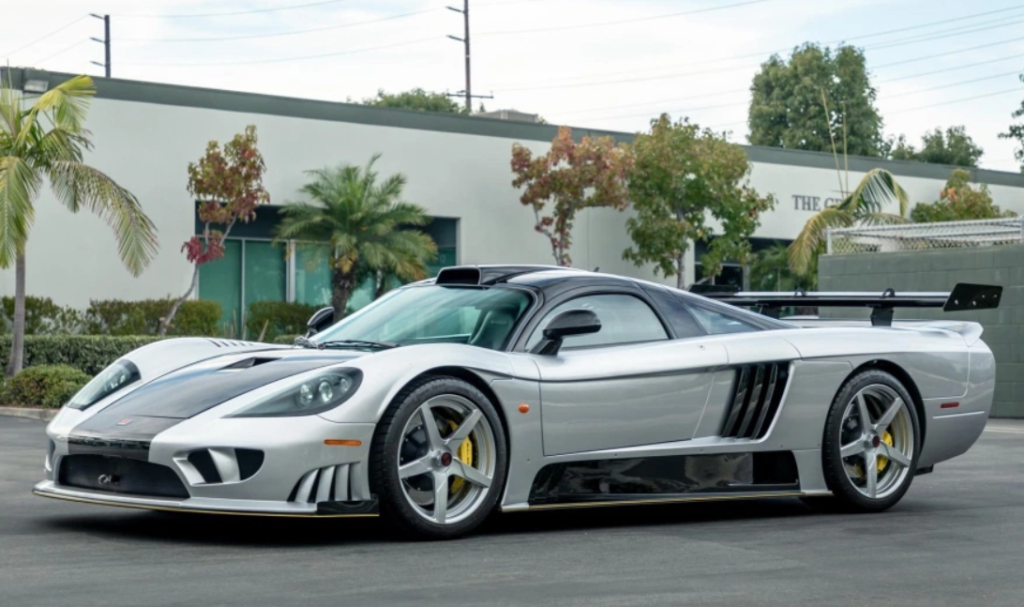
Photo – Bring a Trailer

The S7 was introduced by Saleen in 2000, and production officially trickled on through 2009. Road cars were offered in base and Twin Turbo versions. The S7R (the racing variant) competed in different sports car series all over the world, including running at Le Mans, where it landed on the class podium in 2001.

Saleen has a complicated corporate history, and the short version is that in 2017 they formed a joint venture with a Chinese city to build cars for China. Part of that grand launch was an updated version of the S7 dubbed “LM” to trumpet their brief motorsport success.

Instead of building new cars, they sort of just dressed up existing S7s, including this 2007 model that was recommissioned as an LM in 2018. It retains the S7’s natural good looks but somehow makes it look even better with a two-tone finish and a big rear wing. The five-spoke wheels also help. A lot. I was never a fan of the stock chrome wheels these came with originally.

Power is from a twin-turbocharged 7.0-liter V8 rated at 1,000 horsepower. The top speed is supposed to be in excess of 240 mph. This car carries a plaque identifying it as LM #007, which I guess means there are at least six more out there. No word on how many have been built, or even if they are done building/converting cars. My guess: if you show up at Saleen HQ with an S7 and a bag of cash, they’d convert your car too. The bidding on this example is already going strong; click here for more info.

Update: Sold $1,200,000.

Update: Sold, RM Sotheby’s Monterey 2021, $1,022,500.
’96 Impala SS

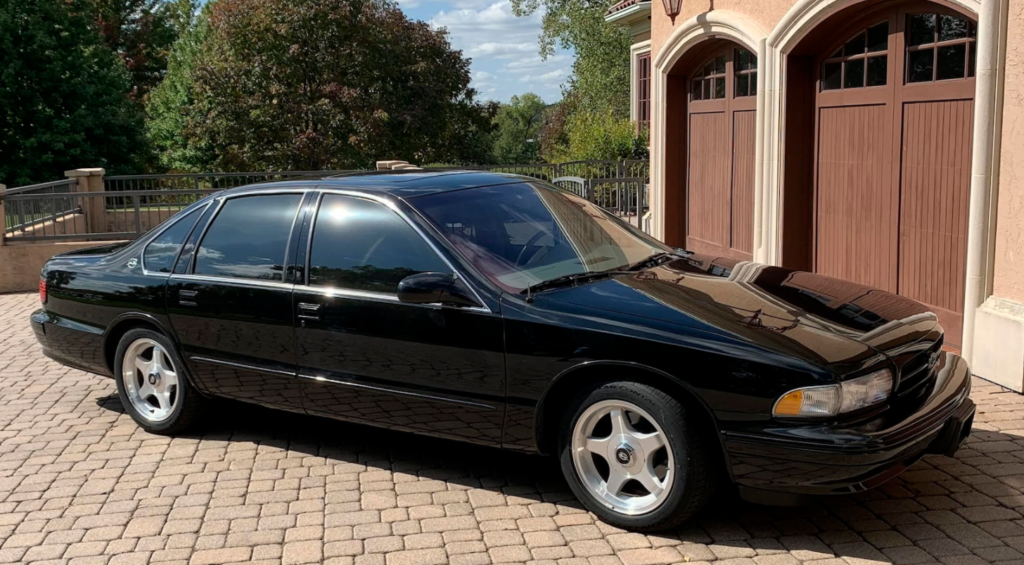
1996 Chevrolet Impala SS

Offered by Mecum | Kansas City, Missouri | November 20-21, 2020

Photo – Mecum

This is one of my favorite cars. It will be a car I own in the near future. A little history: the Impala model is a classic dating back to 1958 when it was a sub-model of the Bel Air. It became its own line in 1959, and the glory years lasted through 1970. Things trended downhill beginning in ’71, and the 1977-1985 models killed the Impala nameplate for a decade (though I secretly like this generation).

Then, in 1994, GM revived the Impala SS as a standalone model (even though their VINs decode as a Caprice). It was essentially a Caprice cop car with a bunch of heavy-duty items (suspension, brakes, cooling system), in addition to a Corvette-based 5.7-liter LT1 V8. Power was rated at 260 horsepower.

It was produced only between 1994 and 1996, and 60,768 were built in total. Black was the best color, but Dark Cherry Metallic and Dark Grey Green were also available beginning in 1995. 1996 models are differentiated from earlier cars by having an analog speedometer and a floor shifter for the automatic transmission. They. Are. Awesome. And this one has 12,000 miles. Click here for more info and here for more from this sale.

Update: Sold $19,800.

1922 Lexington Sedan

1922 Lexington Series S 7-Passenger Sedan

Offered by Bring a Trailer Auctions | Online

Photo – Bring a Trailer

The Lexington Motor Company was founded in its namesake Kentucky city in 1909 by a man named Kinzea Stone, who relocated the company to Connersville, Indiana, in 1910. E.W. Ansted bought the company in 1913, which by this time had already competed in the Indianapolis 500. The company won the Pikes Peak hill climb in 1920 before succumbing to the financial realities of the early 1920s. In 1927, the marque was purchased by E.L. Cord, who merged it into Auburn.

The Series S was produced alongside the more powerful Series T in 1921 and 1922. Power is from a 47-horsepower Ansted inline-six. This car was actually owned by William Ansted, a descendant of Lexington’s 1920’s president, Frank B. Ansted (who I assume was related to E.W.). William, who owned A.J. Foyt’s 1964 Indy 500-winning car, donated this very car to the IMS Museum in the 1960s.

And that’s where it has remained since. It has apparently been sitting stagnant for at least the last 15 years and requires a tad bit of work to become roadworthy again. Lexington is one of those interesting early Indiana-based motor companies that attempted to make a name for themselves at the Speedway. And this car’s Speedway connection makes it even more interesting. Click here for more info.

Update: Sold $15,500.

Grand Prix 2+2

1986 Pontiac Grand Prix 2+2 Richard Petty Edition

Offered by Mecum | Kansas City, Missouri | November 20-21, 2020

Photo – Mecum

The Pontiac Grand Prix debuted in 1962 and was produced in seven different generations until they killed off the nameplate in 2008. This example is from the fourth generation, which was produced from 1977 through 1987. The Grand Prix was Pontiac’s NASCAR entry for 1986, so they introduced a homologation variant called the 2+2 (the Chevy version was called the Monte Carlo SS Aerocoupe) that essentially had a glass fastback. It was supposed to gain an aerodynamic advantage on track.

The 2+2 was supposed to be equipped with a 5.0-liter V8 making 165 horsepower when new. Mecum lists this car as having a 3.8-liter V6. The 2+2 ended up being a 1986-model-year-only variant. It’s a weird product of the times.

Richard Petty raced a NASCAR version of this car, hence the special edition and “Richard Petty” graphics on the doors. Apparently only 2,000 such examples were produced. This one has some weird options, like radio delete and the addition of air conditioning (why?). Anyway, you can see more here and see more from this sale here.

Update: Not sold, high bid of $11,500.

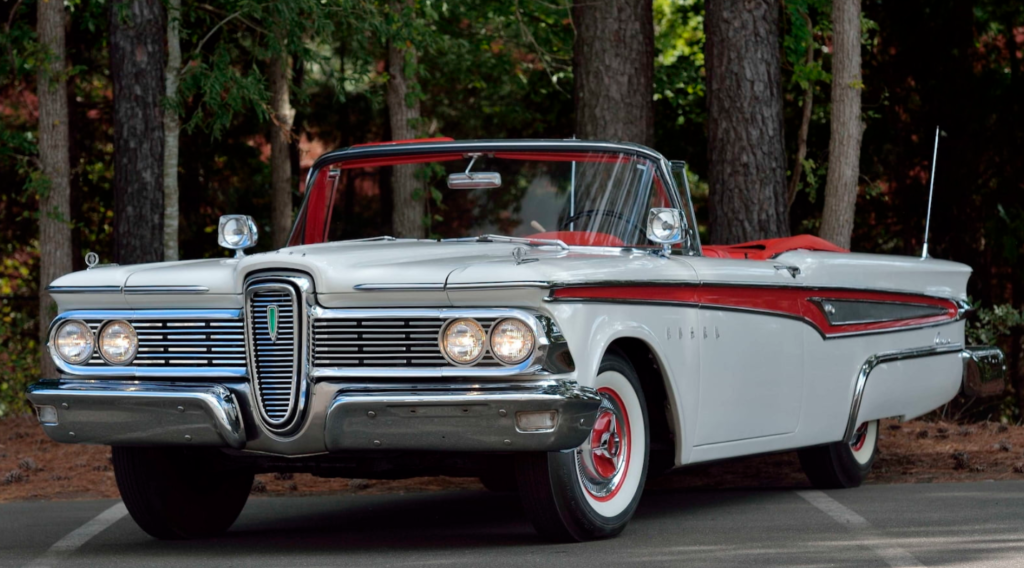
1959 Edsel Corsair

1959 Edsel Corsair Convertible

Offered by Mecum | Kissimmee, Florida | January 7-17, 2021

Photo – Mecum

Edsel was only around for three model years, and each year saw fairly different styling. The 1958 cars were the most polarizing, and the 1960 cars are quite pretty but also pretty much forgotten about. The 1959 cars are the most common, and, style-wise, the most mainstream, if you can call them that.

I love them, not as much as the ’58s, but I still find them to be quite stylish cars. Two models were offered in ’59: the Ranger and the Corsair (there were also wagons with different names). The Corsair was the higher-trim level and looked exactly like a Ranger. It just had a bigger engine and some styling/equipment differences. This car is powered by a non-original 5.9-liter V8. The stock 5.4-liter, 225-horsepower V8 is missing.

Only 1,343 Corsair convertibles were produced in 1959, making it the rarest body style for the model year. You can read more about this one here, and see more from Mecum here.

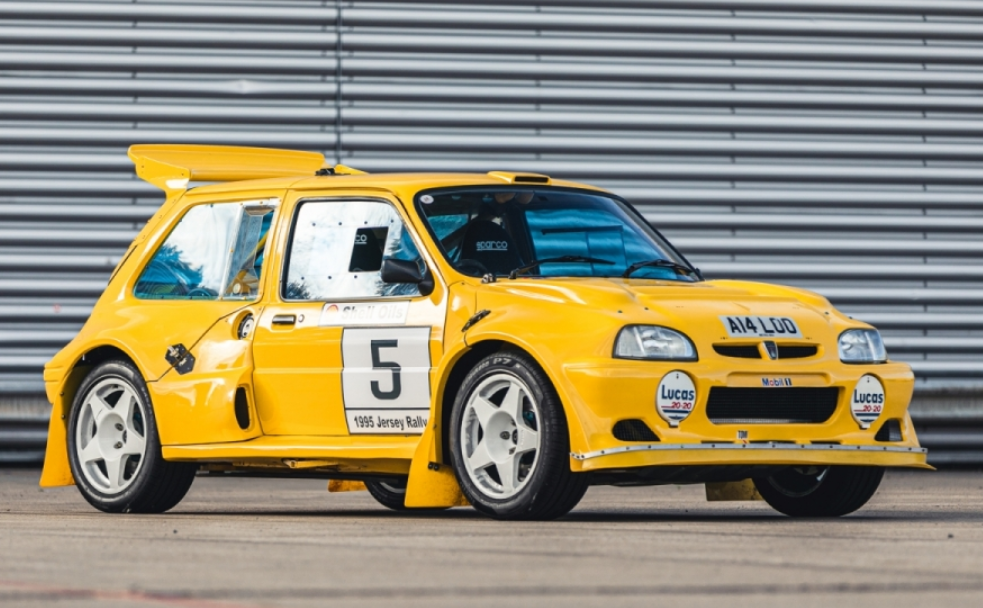
DAM/TPR 4100

1987 DAM 4100

Offered by Silverstone Auctions | Online | November 13-14, 2020

Photo – Silverstone Auctions

Group B rallying was one of the best classes of motorsport since… well, since motorsports. In the 1980s, there were some outrageous rally cars, and one such example was the MG Metro 6R4. Badged as a derivative of the frumpy Austin/MG Metro front-wheel-drive hatchback, the 6R4 was a rear-mid-engined four-wheel-drive monster powered by a naturally aspirated 3.0-liter V6 capable of over 400 horsepower.

There were 220 examples of the 6R4 built, 20 of which were high-level competition cars. The other 200 were Clubman cars, which were sold to the public. Many of them ended up in the hands of privateer rally drivers. So what is this car then?

Well, Tony Pond was a works Austin-Rover rally driver. One of the team engineers was a man named David Appleby. When Austin-Rover (MG) pulled out of rallying in 1987, Pond and Appleby set up shop updating Clubman cars. Thus, the DAM/TPR 4100 was born.

This is the prototype. Pond and Appleby parted ways shortly after this car was built, but Appleby soldiered on without Pond and ended up producing 5-10 examples. Power is from a Cosworth-derived 2.5-liter V6 rated at 295 horsepower at an impressive 10,250 rpm. It’s got four-wheel drive, too.

This is like a cottage industry British supercar from the 90s (even though it was built in the late 1980s). It’s a car that never appears at public sales (or in public generally). The estimated price reflects it. The estimate is $190,000-$215,000. Click here for more info and here for more from this sale.

Update: Not sold. Silverstone actually says sold for an “undisclosed amount,” which is about the sketchiest thing I’ve ever seen on an online auction.

Update II: Sold, Silverstone Auctions, March 2021, $124,501.

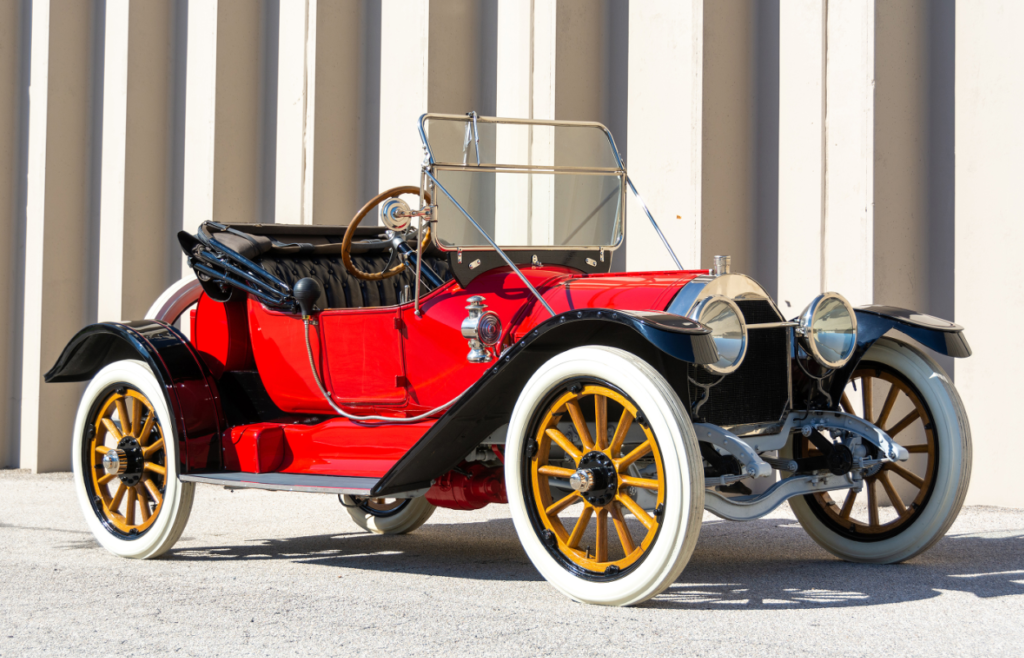
Kissel Semi-Racer

1912 Kissel Kar Thirty Model C Semi-Racer

Offered by RM Sotheby’s | Online | November 11-20, 2020

Photo Courtesy of RM Sotheby’s

Kissel, who still badged their automobiles “Kissel Kars” in 1912 (and would do so through 1918), is most famous for their 1920s sports car, the Gold Bug Speedster. But for a decent amount of time before and after the Gold Bug, they produced a wide variety of other cars.

Kissel Kar’s “Thirty” was sold in 1912 and 1913. Power was from a 30-horsepower inline-four, though the engine’s rating would dip a bit for 1913. The Semi-Racer body style appears to be mostly marketing talk, as this looks like many other convertibles offered around the same time. It was one of four styles offered in 1912, and one of two that would make the jump to ’13.

The example presents fairly well, and the white tires are always a selling point. No pre-sale estimate is available, but you can read more about this car here. The rest of RM’s lineup is available here.

Update: Sold $48,400.

Leyland Tiger PS1

1947 Leyland Tiger PS1

Offered by H&H Classics | Online | November 25, 2020

Photo – H&H Classics

Well, last week we featured a lot of commercial vehicles. I said that we’d pick it up again on Monday. It’s now Tuesday, but here we are. The Tiger is a model of bus produced by Leyland Motors between 1927 and 1968, and again from 1981 through 1992. They looked different over the years, and this front-engined Tiger is of the post-war PS variety.

It is said to be one of two known survivors with coachwork by Barnaby (of four built). It was part of a private bus line for its commercial career, and it is powered by a 7.4-liter diesel inline-six.

This bus was restored in the 2000s, and it was restored to “bus-spec” and not converted into an RV like so many old buses have been. I’m a big fan of classic busses, and despite this one being overseas, I dig it a lot. It carries a pre-sale estimate of $26,000-$31,000. Click here for more info and here for more from this sale.

Update: Not sold.

Mohs Safarikar

1973 Mohs Safarikar

For Sale at Hyman Ltd | St. Louis, Missouri

Photo – Hyman Ltd

Well here’s a car I never thought I’d get to feature. Bruce Mohs had his hand in a lot of various ventures, including his namesake seaplane company (though it is unclear if he ever made a seaplane). In 1967, he introduced a wild thing of a car called the Ostentatienne Opera Sedan. It was based on an International truck and was crazy expensive. Only a prototype was built (and it survives).

In 1972, he introduced the Safarikar. It was also based on an International, using a Travelall frame, aluminum panels, and an exterior covered in padded Naugahyde. The radiator surround is cartoonish, and the car features a retractable multi-piece hardtop. The doors just slide straight out (so the people in the car could hunt while moving, thus the safari part of the name). Seating is from three abreast buckets up front and a rear bench that folds into a bed. Power is from a 6.4-liter V8.

Three of these were built, and two are known to survive. The story of this car is that it was found in a parking lot in Georgia. It was later restored over a period of four years. It’s now for sale in St. Louis. The price? Well, it’s less than $350,000 if you were worried about being able to afford it. Click here for more info.

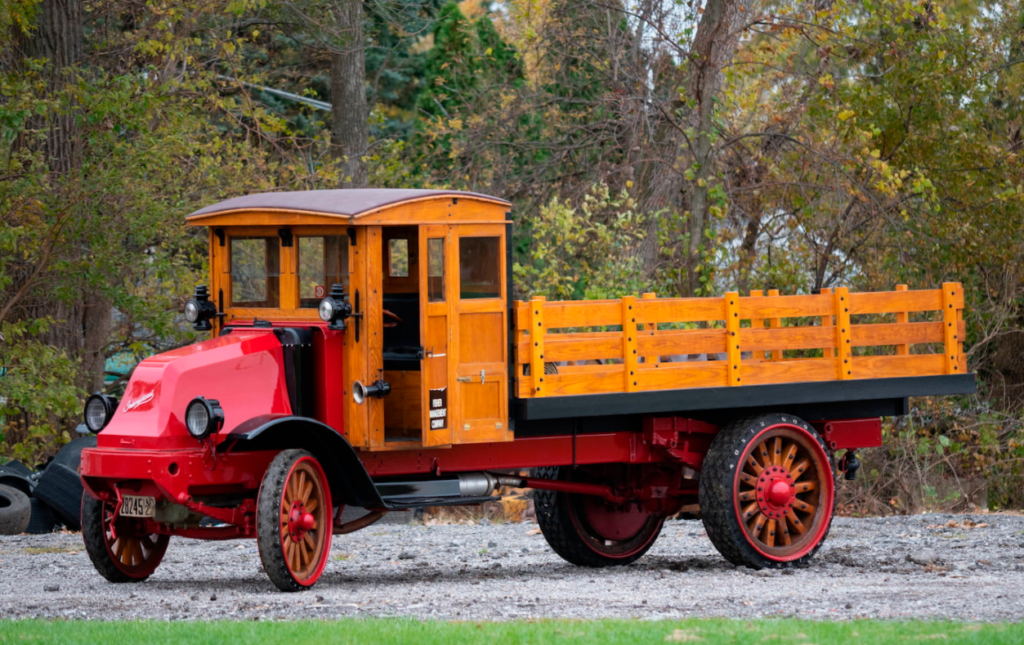
1921 International

1921 International 101 Stake Bed

Offered by Mecum | Davenport, Iowa | November 19-21, 2020

Photo – Mecum

Somehow this week became “classic commercial vehicle week.” Not sure how that happened. But I do know that it will continue at least through Monday. This is a pretty interesting one. International Harvester was founded in 1902 when McCormick and Deering merged. Agricultural equipment was first, followed by passenger vehicles and heavy trucks.

The International brand is still a leader in the truck business. This was one of their early revolutionary designs. Apparently, the 101 was the first truck that could haul more than its own weight. It’s insane that this took until 1921 to accomplish.

Mecum states that only 27 examples of the 101 were built. They look like Renaults from the front (but many trucks of the era did, and for good reason: it was to protect the radiator by placing it behind the engine so angry Teamsters carriage drivers couldn’t damage the front-mounted radiator). It’s a downright frightening machine. Huge, heavy, and with badass wheels. Power is from a 4.6-liter inline-four good for 29 horsepower. Top speed is 14 mph. I imagine this was used to move big loads small distances. What a beast. Find out more here and see more from Mecum here.

Update: Sold $33,000.