Delta Integrale 16V

1990 Lancia Delta Integrale 16v

Offered by Silverstone Auctions | Silverstone, U.K. | May 23, 2015

Photo - Silverstone Auctions

Photo – Silverstone Auctions

The first generation Lancia Delta went on sale in 1979 and continued in production through 1994. That’s a long time. But it wasn’t the same stale car for 15 years – as it grew closer to the end, the cars got more and more extreme.

The Delta was also Lancia’s rally car for the late-1980s. The Delta Integrale 8v won the 1988 World Rally Championship. A variant of that car was sold to the 4WD-buying public as the Delta HF 4WD beginning in 1986. At the end of 1987, it was replaced by the Delta Integrale 8v. In 1989, the Delta Integrale 16v went on sale.

The engine is a 2.0-liter turbocharged straight-four making 200 horsepower. This was the ultimate hot hatch for 1990. Top speed was 137 mph and with its 47/53 front-rear torque split, the 4WD car could hit 60 mph in 5.5 seconds. That’s quicker than a Ferrari Mondial, which was on sale at the same time and had twice the cylinder count. More extreme versions were yet to come. This is a recently-serviced, 71,000-mile car that can be yours for between $20,000-$25,000. Click here for more info and here for the rest of Silverstone’s lineup.

Update: Sold $27,540.

Maurer C87

1987 Maurer-BMW C87

Offered by Bonhams | Francorchamps, Belgium | May 24, 2015

Photo - Bonhams

Photo – Bonhams

Group C racing was awesome. Loads of major automobile manufacturers built ridiculous prototype sports racing cars – some of the fastest race cars ever built. They had huge engines with big turbos and they all looked like wedges with wheels. And lost among the Sauber-Mercedes, Jaguars and Porsches were some privateers cars, like this Maurer.

Walter Maurer was an artist known in the car world as being part of BMW’s “Art Cars” projects as well as a part-time racing driver. The car was designed by an ex-Sauber engineer and the body was built by Dornier Aerospace. Maurer’s ties to BMW landed him a sweet 2.0-liter turbocharged BMW straight-four that could produce 1,350 horsepower in qualifying trim. Maurer designed the paint scheme himself.

Maurer drove the car in competition with co-drivers Helmut Gall and Edgar Dören lending a hand during endurance events. This car did not compete in the World Sportscar Championship, and instead raced in Supercup, a German series that also used Group C cars. It’s best result was 10th in 1988 and a 12th place finish in 1989. It has been used recently and would be great to take vintage racing. It should sell for between $1,000,000-$1,300,000. Click here for more info and here for the rest of Bonhams’ Spa lineup.

Update: Not sold.

The First McLaren Road Car

1969 McLaren M6GT Coupe

Offered by Bonhams | Francorchamps, Belgium | May 24, 2015

Photo - Bonhams

Photo – Bonhams

New Zealander Bruce McLaren founded the racing team that still bears his name to this day in 1963. McLaren was killed in 1970 in his own Can-Am car in a crash at Goodwood. Needless to say, his legacy is alive and well.

McLaren Can-Am cars were some of the best in the late-60s and early-70s. The M6A was their car for 1967. 1968 brought the M6B and for the 1969 24 Hours of Le Mans, the company was developing a closed-coupe sports car called the M6GT. In order to race it in a sports car class, they had to build models for the road. The plan didn’t work out, and only three prototypes were completed – two of which were converted from M6B Can-Am cars, and one, which was a road car built from scratch. The first road car was sold to a customer in the U.S.

The two converted M6Bs were converted to road cars and Bruce McLaren used one as a daily driver. This is the other one. It was sold to a racer named David Prophet who actually raced it for a little while. It was restored in 1996 and is perfect for the road today. It uses a 5.0-liter Chevrolet V-8 making 370 horsepower. It’s as sleek as a race car and can do 180 mph. While it may look like a kit car or something, this is a legitimate McLaren road car – the grandfather of the F1. It should sell for between $210,000-$260,000.  Click here for more info and here for more from Bonhams.

Update: Not sold.

Lechner Sports Prototype

1991 Lechner-BMW LSC1 Spyder

Offered by Bonhams | Francorchamps, Belgium | May 24, 2015

Photo - Bonhams

Photo – Bonhams

Walter Lechner Racing is a racing team and a racing school based in Austria. They’ve competed in Porsche Supercup for over the past decade, but in the early 1990s they tried their hand at prototype sports car racing. They commissioned Reynard to build them a car. It was called the Lechner Spyder SC91. This is actually that car, but with newer bodywork and a different name.

This chassis was raced competitively between 1991 and 1999 under a variety of different names with revised bodywork as it went. The chassis is from ’91, hence the model year listed, but the bodywork (and name) it currently carries come from later on in the decade. It was originally fitted with a 3.5-liter Judd V-10 but now wears a 4.0-liter BMW V-8. Some highlights for this car include:

  • 1991 Interserie Siegerland – 2nd (with Walter Lechner as Lechner Spyder SC91)
  • 1991 Interserie Zeltweg II – 2nd (with Lechner)
  • 1992 Interserie Zolder – 2nd (with Lechner)
  • 1993 Interserie Siegerland – 2nd (with Lechner as Reynard Spyder)
  • 1993 Interserie Donington – 1st (with Lechner)
  • 1993 Interserie Zeltweg – 2nd (with Lechner)
  • 1994 Interserie Zeltweg – 1st (with Lechner)
  • 1994 Interserie Division I Championship (Lechner as driver, using this car for one race)
  • 1997 Interserie Spa – 2nd (with Josef Neuhauser as Reynard-Judd Can-Am)
  • 1997 Interserie A1-Ring (with Neuhauser)
  • 1997 Interserie Hungaroring (with Neuhauser)
  • 1997 Interserie Division I Championship (with Neuhauser)
  • 1998 Interserie Most – 1st (with Neuhauser as Horag-Reynard-Judd Can-Am)
  • 1998 Interserie A1-Ring – 1st (with Neuhauser)
  • 1998 Interserie Hungaroring – 1st (with Neuhauser)
  • 1998 Interserie Division I Championship (with Neuhauser)
  • 1999 Interserie Most – 3rd (with Neuhauser)

Good Lord! That’s a lot of podium finishes, not to mention an extended racing life for a type of car that normally doesn’t stay that competitive for that many years. At any rate, this thing has been raced privately and is ready to run. You can buy it for between $130,000-$200,000. Click here for more info and here for more from this sale.

Update: Sold $119,038.

Fiat 1100S Speciali

1948 Fiat 1100S Berlinetta by Carrozzerie Speciali

Offered by Coys | Ascot Racecourse, U.K. | May 16, 2015

Photo - Coys

Photo – Coys

The Fiat 1100 was produced in many forms between 1937 and 1969. Post-war cars didn’t technically go on sale until 1949 as the 1100E, but between the end of the war and resumption of passenger car production, Fiat built a racing variant based on the pre-war 1100 and called it the 1100S

Based on the 1100B, the car featured a 1.1-liter straight-four making 51 horsepower. Bodies were offered from a few coachbuilders and all were relatively streamlined. The effect was a top speed of nearly 100 mph. This is perhaps one of the best examples of the streamlined coachwork with a sleek front end and a sweeping rear.

The body is by Carrozzerie Speciali – Fiat’s own in-house coachbuilder. It’s gorgeous. It is quoted that Fiat built 401 examples of the 1100S, but that number is likely pretty high. In reality, far fewer were actually built. A car with this much style seems like a bargain with an estimate between $65,000-$72,500. Click here for more info and here for the rest of Coys’ lineup.

Update: Sold $63,500.

Veritas RS

1948 Veritas RS

Offered by Coys | Ascot Racecourse, U.K. | May 16, 2015

Photo - Coys

Photo – Coys

Veritas was a short-lived sports and race car manufacturer from West Germany that set up shop in 1948. The company was started by a few ex-BMW employees (Ernst Loof, Georg Meier, and Lorenz Dietrich) who wanted to build cars based on the BMW 328 (that BMW built before the war). They closed in 1950 but reformed for a few short years before the marque disappeared after 1953.

The RS was the sports racing car (there was also an open-wheeler and a road car, which was based on the RS). The RS is powered by a BMW 328 2.0-liter straight-six making about 125 horsepower. Only about 20-25 of the RS model were built, with about 15 known to still be in existence.

This car was owned by a BMW and Veritas collector until 2001. After he passed, the car was sold, restored and campaigned in vintage races throughout Europe. It is for sale now in ready-to-run condition. It will cost you between $225,000-$270,000. Click here for more info and here for more from this sale.

Update: Sold $263,700.

Frazer Nash TT Replica

1937 Frazer Nash TT Replica

Offered by Brightwells | Leominster, U.K. | May 13, 2015

Photo - Brightwells

Photo – Brightwells

I don’t know what Archibald Frazer-Nash’s obsession was with naming his road models “Replicas” but he had at least two cars that featured that word. Imagine if Jaguar would’ve called their F-Type an “E-Type Replica” – it would have been chaos. “Replica” isn’t necessarily a word full of positive connotations.

But in this case it served a purpose. They were based on the cars that competed in the 1931 Tourist Trophy race, a race in which Frazer Nash entered three cars. The road car could be had with two engines, this one features the smaller 1.5-liter Meadows straight-four. The chassis was from an earlier FN car – the Boulogne – and is chain-drive.

The TT Replica was the second-most popular Frazer Nash model built, with 83 constructed between 1932 and 1938. These light, British sports cars were among the first of their kind and led the way for many light, British sports cars to come. This one should bring between $210,000-$240,000. Click here for more info and here for more from this sale.

Update: Sold $337,550.

Low-Mileage Hemi ‘Cuda

1970 Plymouth Hemi ‘Cuda

Offered by Mecum | Indianapolis, Indiana | May 12-17, 2015

Photo - Mecum

Photo – Mecum

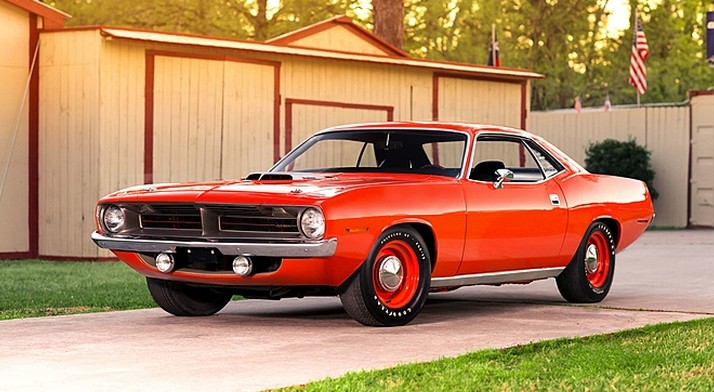
The third-generation Plymouth Barracuda was new for 1970 and the top-of-the-line ‘Cuda, when properly equipped, was the absolute king of muscle cars. The 1970 and 1971 ‘Cudas are particularly collectible, but the 1970 model was a little cleaner in design.

This car has the biggest and baddest engine that was available: Chrysler’s stunning 426 Hemi – a 7.0-liter V-8 rated at 425 horsepower. This car was ordered new just as you see it – in high impact Tor Red with painted wheels. The new owner, who was in his 60s at the time, used the car exclusively at the drag strip.

When he passed away shortly after a handful of quarter miles, the car was sold and the new owner covered just a single mile in the car in 16 years. The next owner drove it the most – 73 miles. That’s right. This car has 81 miles on it. It is the lowest-mileage ’70 Hemi ‘Cuda known to exist and short of Chrysler discovering a warehouse full of unsold cars that rolled right off the factory floor into storage, you will never find anything like this again. It is a time warp car – unrestored but completely roadworthy. It is one of the final 10 Hemi ‘Cudas built in 1970 – but it’s the mileage that sets it apart. Look for a price between $600,000-$800,000 when it crosses the block. Click here for more info and here for more from this sale.

Update: Not sold, high bid of $450,000.

Dare DZ

1998 Dare DZ Convertible

Offered by Brightwells | Leominster, U.K. | May 13, 2015

Photo - Brightwells

Photo – Brightwells

DARE (UK) Limited is the company that brought you this wild car in the late-1990s. It was also founded by the same family who founded (and later sold) Ginetta. The company is still around, currently building new versions of a pair of old Ginetta models. Interesting.

The DZ was a courageous design that fit squarely in the time period in which it was manufactured (i.e. the late-90s). These were the years of the Ford Indigo Concept and the Plymouth Prowler. Apparently, the burning question in the 90s was “How do I drive an open-wheel car on the highway?”

It is powered by a mid-engined 2.0-liter straight-four making 130 horsepower (although this car was originally turbocharged to 210 ponies, it has since been bumped back to natural aspiration). It might not seem like a lot, but this car is extremely light. It was targeted at Lotus cross-shoppers. Ultimately, only ten were built, with this being the first and factory demonstrator. It’s pretty awesome and should bring somewhere between $18,000-$21,500. Click here for more info and here for more from this sale.

Update: Sold $15,385.

DB4 Vantage Convertible

1962 Aston Martin DB4 Series IV Vantage Convertible

Offered by Bonhams | Newport Pagnell, U.K. | May 9, 2015

Photo - Bonhams

Photo – Bonhams

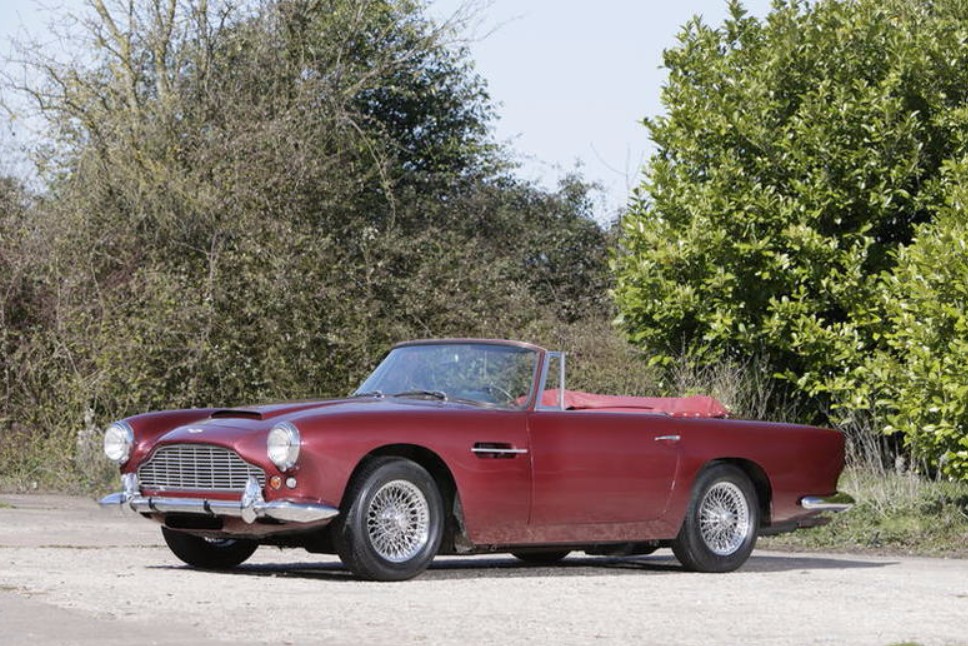
The Aston Martin DB4 is the car that started a styling trend that would continue for over a decade in a handful of models. They’re beautiful cars with a lightweight body, as designed by Carrozzeria Touring. They were built between 1958 and 1963 in five different series with each successive series featuring slight styling tweaks.

This is a Series IV car. It is also a “Vantage” car – Aston speak for the biggest and baddest available. In this case, it means it features a triple-carbureted version of the DB4’s 3.7-liter straight-six, making an impressive 266 horsepower. Vantage cars were only available beginning with the Series IV launch in 1961.

Of the total 1,110 DB4s built (not counting DB4GTs), only 136 hard tops were built with the Vantage engine. An even fewer 32 convertibles had the same motor. Only 70 DB4 Convertibles were built in total. And yes, this car is a pre-Volante terminology Aston Martin “convertible.” It’s a rare car.

This car was purchased new by actor Peter Utsinov and it is left-hand drive. It has seen very little use since the mid-1980s and has never been restored. It will need a little attention before you take it out on the road, but that shouldn’t hamper the price too much – it is estimated to bring between $1,400,000-$1,500,000. Click here for more info and here for more from this sale.

Update: Sold $2,332,827