1904 Siddeley

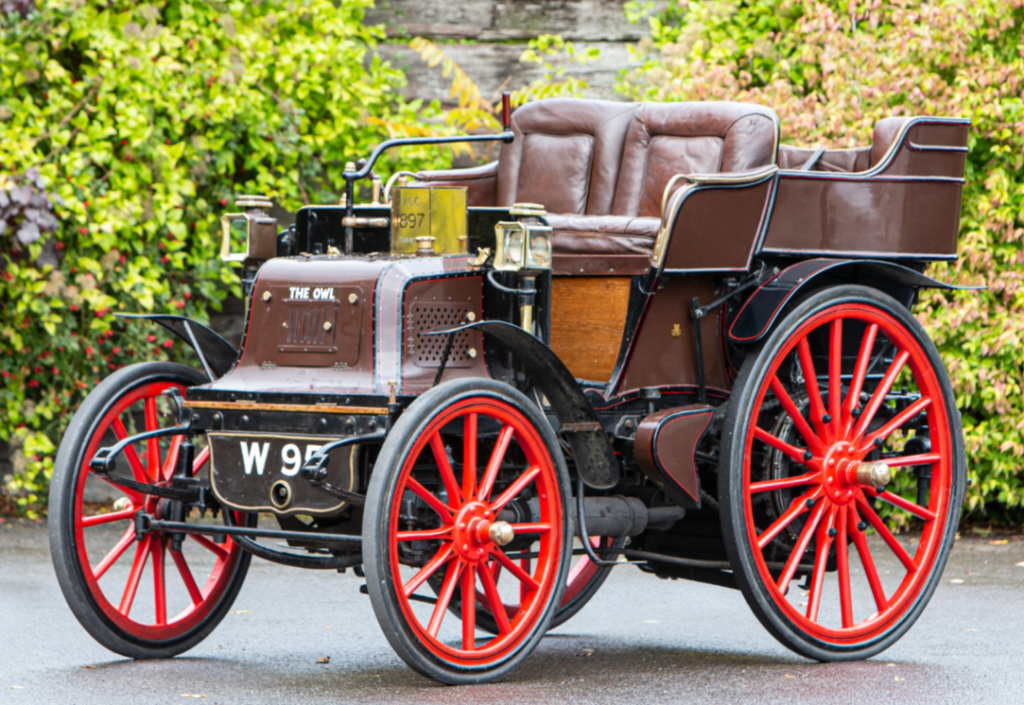
1904 Siddeley 12hp Twin-Cylinder Rear-Entrance Tonneau

Offered by Bonhams | London, U.K. | November 4, 2022

Photo – Bonhams

Siddeley is a fairly well-known name in the historical British car world. However, most of the time it is connected to other names, like Deasy, Wolseley, or, most famously, Armstrong. But the first Siddeleys were built by John Davenport Siddeley’s Siddeley Autocar Company, which was founded in 1902. The cars were actually built by Vickers and were based on Peugeots.

In 1905, J.D. Siddeley became the manager of Wolseley and then added his name to that brand. In 1909, he left Wolseley (and so did his name) and took over Deasy, again appending his name to that marque’s as well. In 1919, Siddeley-Deasy was bought by Armstrong Whitworth. Armstrong-Siddeley cars remained in production until 1960. The Siddeley name stuck around on various aircraft companies through a few mergers, eventually winding up as part of BAE Systems.

So that’s the history. Here’s this car. It is said that 31 examples of the 12hp model were built, with this being the only survivor. It’s powered by a vertical twin that can push the car to 28 mph, never exceeding 1,800 rpm (and dropping as low as 80 rpm!). The rear-entrance tonneau body was fabricated in the ’90s to replace a replacement two-seater (previously added in lieu of the original tonneau body).

A former London-to-Brighton participant, this car should sell in the $125,000-$155,000 range. Click here for more info.

Update: Sold $170,857.
XM Turnpike Cruiser Concept Car

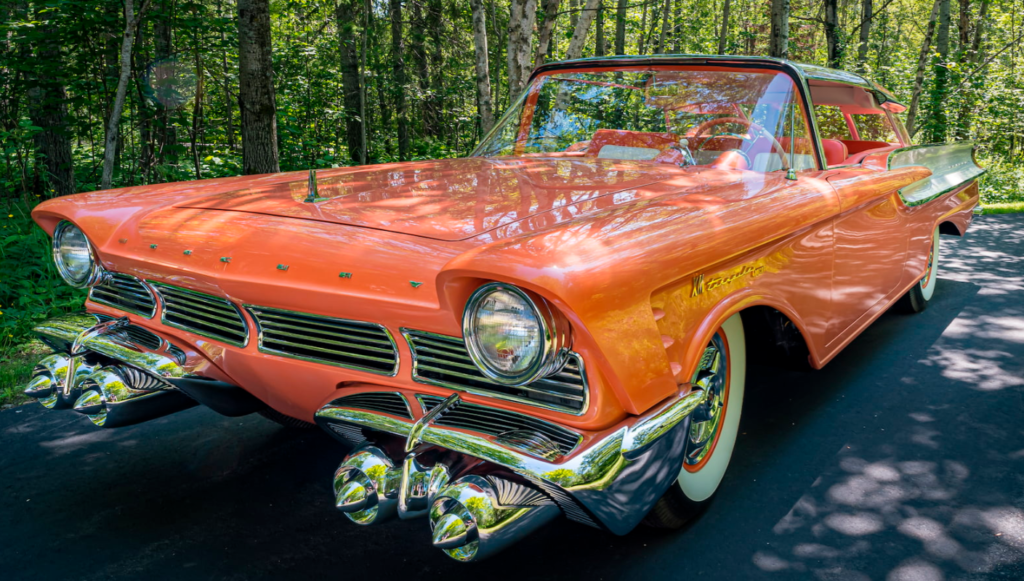
1956 Mercury XM Turnpike Cruiser Concept Car

Offered by Mecum | Kissimmee, Florida | January 4-15, 2022

Photo – Mecum

This poorly photographed mid-century concept car is a pretty wild thing. First of all, it’s built on a 1954 Ford F-250 chassis, and it was designed by Mercury yet actually built by Ghia in Italy. Which seems backward of how it is supposed to have been done. Power is from a 4.8-liter V8.

But let’s talk styling. First off, we have split dual-Dagmar front bumpers. The exhaust has dual tips sticking through each quarter panel, and the fins have a weird rotated-3D look to them that are surrounded by a flat rear deck and vertical tail panel. The C-pillar buttresses are actually glass, and brake lights are also located at the rear top base of the roof. The four-seat interior is full-on jet age, too.

It toured around the show circuit in 1956 and was used as a pace car in Daytona in 1957. From there, it sat parked outside at Ford HQ, deteriorating. The owner restored it between 2017 and 2022. It’s as fresh now as it’s ever been.

It’s actually been a while since a good 1950s concept car came up for sale. And this is one that hasn’t been seen in a long time. Click here for more info.

Update: Not sold.

1897 Daimler Tonneau

1897 Daimler Twin-Cylinder 4HP Tonneau

Offered by Bonhams | London, U.K. | November 4, 2022

Photo – Bonhams

We have featured a four-horsepower 1897 Daimler before, believe it or not, but that car was a wagonette. This is a more passenger-friendly tonneau. It was built by Daimler in England, which at the time was just a year-old company.

In fact, this car was just the second built by the British Daimler. It is powered by the oldest known Daimler engine, which is a 1.6-liter vertical twin that was rated at four horsepower. Its first owner is known, and it was demonstrated for the future King Edward VII at Buckingham Palace before taking part in the London-to-Bright Run. In 1897.

Updates were performed by Daimler in 1900, and some of them have been undone (for instance, someone backdated it to its original tiller steering configuration). It’s participated in more than 50 London-to-Brighton runs. It’s now got an estimate of $255,000-$310,000. Click here for more info.

Update: Sold $427,144.

10HP MMC

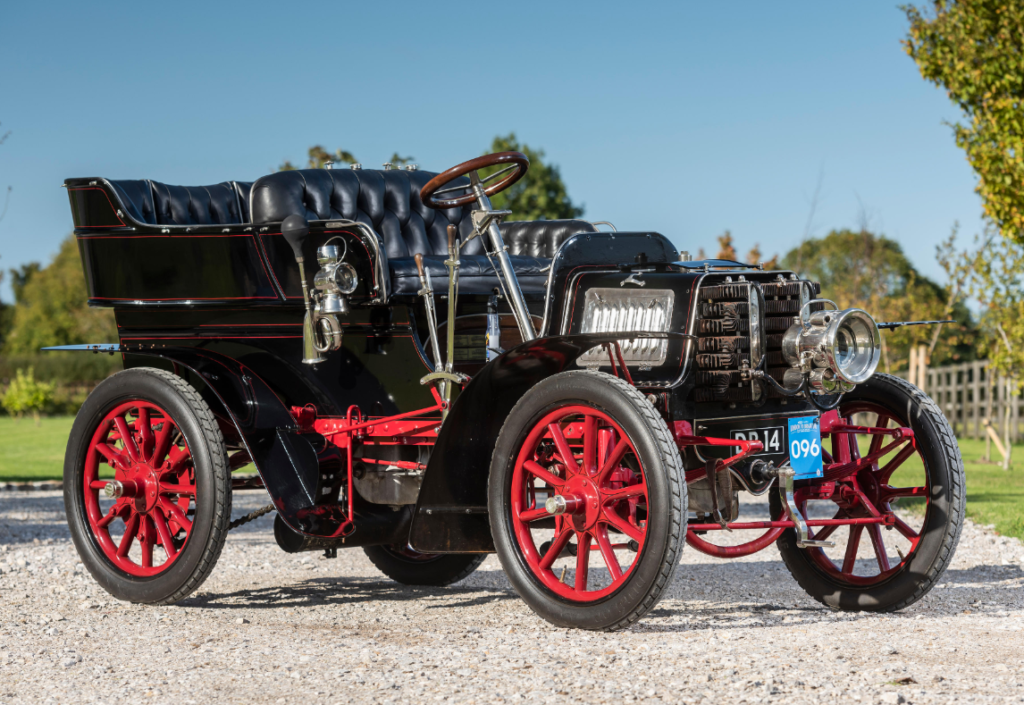
1902 MMC 10HP Twin-Cylinder Rear-Entrance Tonneau

Offered by Bonhams | London, U.K. | November 4, 2022

Photo – Bonhams

MMC seemed to have been named in a hurry. The Motor Manufacturing Company didn’t get a fancy name, probably because company backer Harry J. Lawson was in a hurry. MMC was formed out of the remnants of the Great Horseless Carriage Company in 1898. The company went out of business in 1904 when Lawson was sent to prison for fraud. It reorganized twice before disappearing for good in 1908.

The 1902 model line included three front-engined options: a single, a twin, and a four-cylinder car. This car is the middle offering, powered by a 2.1-liter vertical twin rated at 10 horsepower.

This example has known history back to 1951, when it was found in a scrapyard. It took a while to get it back on the road, with the reconstructed body not being completed until the 1990s. It now carries an estimate of $195,000-$250,000. Click here for more info.

Update: Sold $281,915.

S1 Elise

1998 Lotus Elise

Offered by H&H Classics | Duxford, U.K. | October 20, 2022

Photo – H&H Classics

The Elise is one of the most vaunted cars to be produced by Lotus… ever. The Series 1 launched in 1996 and remained in production until 2001. It was never sold in the United States (the Series 2 was). It was a light car – just under 1,600 pounds – with a fiberglass body and an aluminum chassis. It’s pretty much the direct descendent of the Lotus Seven.

The base model was powered by a mid-mounted 118-horsepower, 1.8-liter Rover inline-four. A five-speed manual was the only gearbox option, and all cars featured a targa roof. This car has small hidden upgrades, like S2 suspension and upholstery.

These cars are very active track day participants and are still used regularly. So whether or not they have officially become collectable is debatable, but I think these early cars are just on the cusp of it. This one has 28,000 miles, and that mileage is likely to be kept very low by future owners. It should sell for between $27,000-$29,000. Click here for more info.

Update: Sold $30,642.

A Long, Low Lanchester

1915 Lanchester Sporting Forty Torpedo Tourer

Offered by Bonhams | London, U.K. | November 4, 2022

Photo – Bonhams

The Lanchester Motor Company was founded by Frederick, George, and Frank Lanchester, a trio of brothers who built their first car in 1895. The company was acquired by BSA in 1930, and it wound up as part of Daimler, which came under the control of Jaguar in 1960. But by that time, the Lanchester marque had been discontinued for five years.

This car is very striking. Early Lanchesters were kind of funky looking, with the driver more or less sitting over the engine, no front hood, and an upright radiator directly in front of the passenger compartment, which was still rearward of the front axle. It was… awkward.

The Sporting Forty was introduced near the end of 1913. It had a more conventional layout, with the engine moved forward in the chassis. Imagine a company bragging about that today. It’s powered by a 5.5-liter inline-six. Just six were built before WWI broke out. In 1919, the “40” was re-introduced, but it was a somewhat different car.

This example was Lanchester’s demonstrator and is the only remaining Sporting Forty. A restoration was completed around 2004. Bonhams has an estimate of $200,000-$245,000 on it. Click here for more info.

Update: Sold $256,286.

Frazer Nash Mille Miglia

1952 Frazer Nash Mille Miglia

Offered by RM Sotheby’s | London, U.K. | November 5, 2022

Photo Courtesy of RM Sotheby’s

Frazer Nash built pre-war and post-war sports cars. They were also the U.K. distributor for BMW in the 1930s. This is a post-war sports car, obviously, as it’s from the early 1950s. The last Frazer Nash cars were built in 1957, which was about eight years before Archibald Frazer-Nash died.

In 1948, the company built a car called the Fast Tourer, which was also the name of a pre-war model. This morphed almost immediately into the Mille Miglia model, of which 11 were built through 1953. Power is provided by a 2.0-liter Bristol inline-six that made somewhere between 110 and 126 horsepower depending on the compression ratio.

This car was damaged in the 1960s or ’70s, spending a period in storage after that. A restoration that started in the late 1970s dragged on for decades, eventually being completed around 2005. You can read more about it here.

Update: Not sold.

McLaren MP4/9A

1994 McLaren-Peugeot MP4/9A

Offered by Aguttes | Sochaux, France | October 23, 2022

Photo – Aguttes

McLaren’s MP4/9 was used for the 1994 season, which was the only season that McLaren partnered with Peugeot as their engine supplier. This was Peugeot’s first season as an F1 engine supplier, and things did not start out well.

Their 3.5-liter A4 V10 was unreliable. Both McLarens failed to finish the first two races. For race number three at San Marino, they upgraded to their “A6” spec V10, which was also a 3.5-liter unit. It made about 740 horsepower, and this chassis, number seven, still has it in there. The competition history for this chassis is confusingly listed, but it was driven in races and as a reserve car during the 1994 season by Mika Hakkinen and Martin Brundle.

It was later stored at McLaren for 26 years and is being sold from Peugeot-Citroen’s collection. The pre-sale estimate is $1,165,000-$1,450,000. Click here for more info.

Update: Not sold.

MG ZT Wagon

2002 MG ZT-T 190

Offered by Oldtimer Galerie Toffen | Toffen, Switzerland | October 15, 2022

Photo – Oldtimer Galerie

This car? Big fan. The ZT was one of the last MGs before they were resurrected by a Chinese company. The ZT was the big car, offered as a sedan or wagon. The car was based on the Rover 75, but looks a lot better. V8-powered models received rear-wheel drive.

The wagons were called “ZT-T”, and this particular example is a “190” – meaning it’s powered by a 2.5-liter V6 that was rated at 187 horsepower when new. A manual transmission was the only option on this model. Top speed was 137 mph.

ZT and ZT-T production was not huge. Over five model years, a combined total of 27,000 cars were built. Apparently, only 1,756 of those were 190 wagons. This one is expected to fetch $3,500-$4,500. I’ll take it. Click here for more info.

Rallye Raid Citroen ZX

1995 Citroen ZX Rallye Raid Evo 5

Offered by Aguttes | Sochaux, France | October 23, 2022

Photo – Aguttes

A rally raid is a long-distance off-road race that lasts for days on end. Think the Paris-Dakar Rally, for starters. It’s something Europeans like to compete in. The French seemingly especially so. Citroen actually won the Rally Raid constructor’s championship from 1993-1997 before withdrawing from the sport. They won the Paris-Dakar rally five times in the 1990s.

The ZX was a small car built by Citroen between 1991 and 1998 as either a four-door sedan, a wagon, or a hatchback. This Rallye Raid Evo 5 has pretty much nothing in common with that car aside from the name. It’s a purpose-built off-road race car. The first ZX Rallye Raid debuted in 1990. They were powered by a turbocharged 2.5-liter inline-four mounted behind the driver and good for 330 horsepower.

The Evo 5 was built for the 1995 season and featured suspension refinements over earlier cars and also was outfitted with four (!) spare tires. This example is one of five Evo 5 examples produced, but it actually started out as a 1993 Evo 2. It’s competition history includes:

  • 1993 Rally Atlas – 4th (with Pierre Lartigue and Michel Perin), as Evo 2
  • 1993 Rallye de Pharoans – 1st (with Lartigue and Perin), as Evo 2
  • 1994 Paris-Dakar Rally – 2nd (with Hubert Auriol and Gilles Picard), as Evo 3
  • 1994 Rally Atlas – 1st (with Lartigue and Perin), as Evo 3

This was actually the prototype for the Evo 5, so it never competed as such, although the four Evo 5s that followed won every race they entered.

This is a pretty cool opportunity to acquire a type of car that rarely changes hands – and directly from the manufacturer. It has a pre-sale estimate of $195,000-$292,000. Click here for more info.

Update: Sold $456,107.