Offered by Mecum | Kissimmee, Florida | January 4-15, 2022
Photo – Mecum
The DeSoto marque was founded by Walter Chrysler shortly after he took over Maxwell and founded Chrysler. DeSoto was set to compete with the likes of Pontiac and Willys in the mid-price range. Well, they did so for the next 30 years, but the brand was wound up in 1961.
In the late 1950s, Chrysler’s brands were competing against each other, which was a major reason DeSoto was axed. DeSoto introduced a few upmarket, expensive cars during that time, including the Firedome and Fireflite. DeSoto’s 1957-1959 styling was one of Chrysler’s great ideas of the 1950s. In 1958, The Firedome was powered by a 5.9-liter V8 rated at 295 horsepower. The Firedome slotted in the lineup below the Fireflite and Adventurer.
Convertible production in 1958 totaled just 519 units for the Firedome, making the body style rarer on this platform than in the upmarket Fireflite. This one is finished in a lovely ’50s two-tone green paint scheme with a matching interior. You can check out more about it here.
This is an intriguing one. Zagato has dabbled in microcar design over the years, including with the Zele, which they made about 500 of in the mid-1970s. The weird part here is that the auction catalog lists this as a 1989.
But it sure doesn’t look very 1989. Zagato actually debuted the Milanina concept car at the Milan International Fair in 1972. It is unclear how many were built aside from the prototype. They certainly weren’t still making them in 1989.
It’s an electric car reminiscent of the later Ligier JS4. It’s a mystery, but an interesting one. The estimate is $15,000-$20,000. Click here for more info.
Offered by RM Sotheby’s | Munich, Germany | November 26, 2022
Photo Courtesy of RM Sotheby’s
We’ve featured some early BMWs before, but this is the earliest of them all. It’s not even a BMW, it’s a Dixi, which was built by Dixi-Werke AG, a company born out of Fahrzeugfabrik Eisenach in Germany. BMW would acquire the company in late 1928 and continue production of the Dixi for a few more years.
The Dixi itself was just a license-built version of the Austin Seven. It’s powered by a 748cc inline-four rated at 15 horsepower. The original DA-1 variant was built between 1927 through 1929. Top speed was 47 mph.
This example was delivered new in Memmingen, Germany, and was restored in the 1960s. It will sell in Munich at no reserve. Click here for more info.
Offered by Bonhams | Milan, Italy | November 18, 2022
Photo – Bonhams
This special was built around an Italian car by an Australian living in the U.K.. Graham Smith didn’t like his kit car options, so he devised his own. This, the Huntsman Spyder, was built between 1986 and 1988.
It’s based around Alfa Romeo Alfasud Sprint Veloce mechanicals. That’s a 1.5-liter flat-four making 175 horsepower. It’s got an Alfa five-speed gearbox and weighs less than 1,400 pounds. Zero to 60 happens in less than five seconds.
The body is fiberglass, and the frame is constructed of square tubular steel. Suspension is sourced from Triumph, a Royale F3 car, and Bilstein. It’s the only one ever built and carries an estimate of $40,000-$60,000. Click here for more info.
Offered by Bring a Trailer Auctions | November 2022
Photo – Bring a Trailer Auctions
Imagine this thing in your rearview mirror on a race track. Pretty scary. Now imagine it sneaking up behind you on the highway. Either is possible: it’s got a license plate mounted out back.
Let’s start at the beginning: the first T70 debuted in the mid-1960s as an open-top sports racing prototype. The Mk II Spyder came later and preceded the Mk 3 coupe. A slightly revised Mk.3B debuted in 1969 and featured front-hinged doors instead of the gullwing doors of the regular Mk 3.
Some of the Mk.3Bs were actually converted to road cars by Sbarro, who would soon after produce a run of replicas. That’s where things start getting confusing. This car was converted to road spec by Sbarro prior to their production of replicas, apparently. Funnily enough, there is another car with this same chassis number floating around (RM sold it in Paris 2014). That auction catalog initially advertised it as a Lola Mk.3B and laid out the early history of this yellow car. Then, shortly before the auction, they added a line that said “After further research it has come to light that this Lola T70 was built by Sbarro; it is very unlikely that this car was ever raced by Chuck Parsons” – which negated the entire history of their car they had written after it.
This car was reconstructed by Lola guru Mac McClendon in the 2010s. It’s powered by a 5.7-liter Chevrolet V8. The comments on the Bring a Trailer auction seem to be full of reading comprehension issues. Yeah, this car has had pretty much everything on it rebuilt or replaced (as has pretty much every race car of this era), but as someone wise said over there “a continuous history as being a particular car is what makes it original… more than the parts currently on the car.” Not to mention, if Mac McClendon says it’s the real deal… who are you to argue.
The other great bit of wisdom from a BaT commenter on thinking about cars like this: “The idea of the car is what matters; each replacement part occupies the same space as the original, and so to our mind the car is original even if none of the component parts are — the car has occupied the same space since 1969, and therefore remains the original car.”
Think about what this represents from 1969. It’s right there with a Miura or McLaren M6GT in terms of late 1960s supercars. It might not be as pretty as a Miura, but it’s more purposeful, and probably faster.
Bidding ends in a few days. You can read more about it here.
Offered by Bonhams | London, U.K. | November 4, 2022
Photo – Bonhams
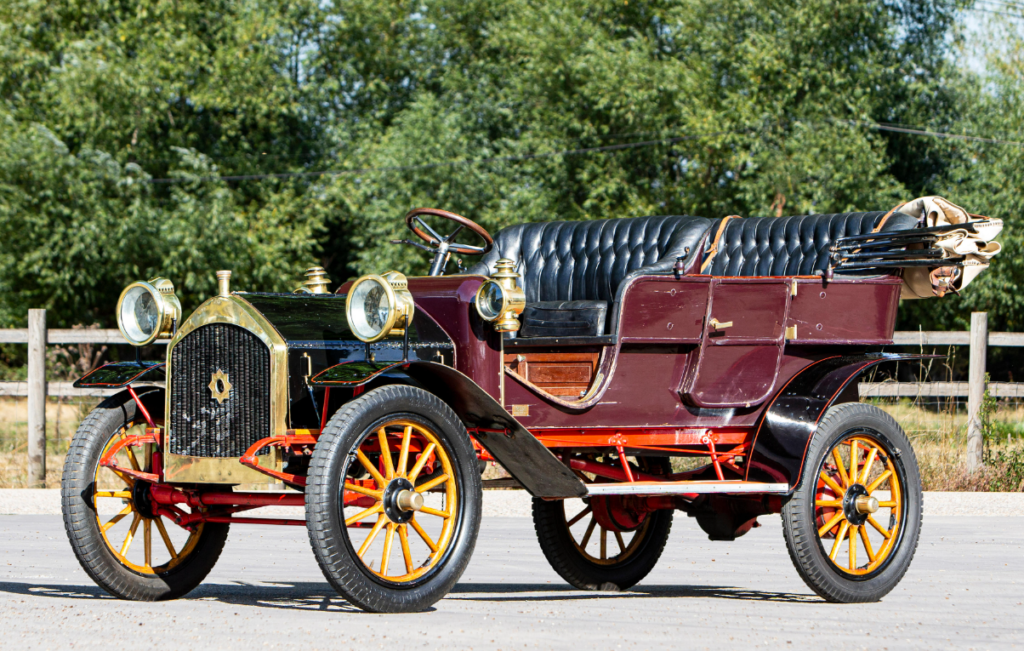
The Northern Manufacturing Company was founded by Charles King and Jonathan Maxwell, both of whom had previously worked for Oldsmobile. Their first cars, powered by singles, were sold in 1902. Twins followed in 1904, and four-cylinder cars would join the lineup in 1906.
The Type C was offered in 1906 and 1907 as the two-cylinder offering. The flat-twin here made 20 horsepower when new. This is a fairly large car for just two cylinders. They also built a five-passenger limousine in this model range, in addition to a runabout and another touring car.
Northern merged with the Wayne Automobile Company in 1908, and the combined company was quickly acquired by E-M-F. Maxwell had left in 1903 (to form Maxwell, which would become Chrysler), and King left after the acquisition and would form his own eponymous company. Studebaker would purchase E-M-F a few years later.
We’ve featured a few single-cylinder Northern runabouts before, but this is the first “big” Northern on this site. It should sell for between $21,000-$25,000. Click here for more info.
Offered by Bring a Trailer Auctions | November 2022
Photo – Bring a Trailer Auctions
Mosler produced the Consulier GTP in the 1980s (it was also known as the Mosler Intruder and Raptor, which were actually around through the 1990s). A new prototype called the MT900 debuted in 2001. It was quite different and modern looking. It never really entered production, but the racing variant was on the track shortly thereafter.
From 2003 through 2010, the MT900S was offered in a limited-production form. Think of it as a competitor to the Saleen S7. A Photon variant would be produced in that time frame as well. The MT900S was available with a few different Corvette-sourced engines. This particular one, which has never been registered with a private owner, is powered by a twin-turbocharged 7.0-liter LS7 V8 that is said to make about 750 horsepower.
This is a real-deal homegrown American supercar. They didn’t build many of them, and they don’t come up for sale often. The bidding on this one ends shortly. Click here for more info.
Offered by Bonhams | London, U.K. | November 4, 2022
Photo – Bonhams
There’s nothing scarier on Halloween than being the front passenger in a tricar. You are the bumper and crumple zone.
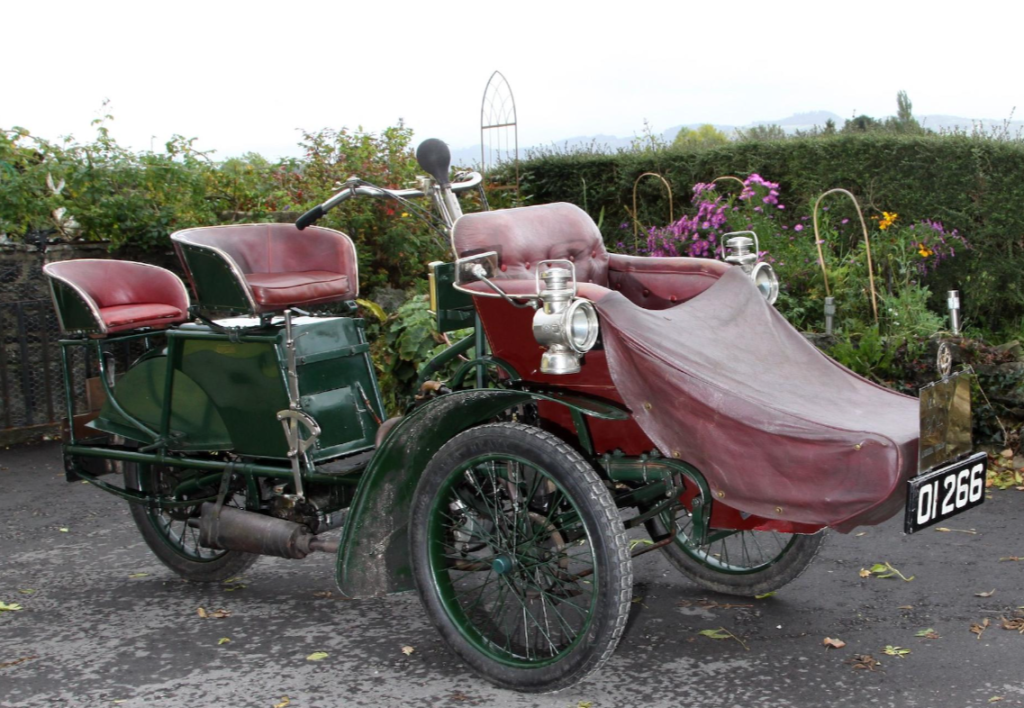
Wilbur Gunn was actually born in the United States. He was an opera singer that became a British citizen in the 1890s and got his start in the automotive realm by building motorcycles in his backyard around 1904. He named them Lagonda, after a place in Ohio. Naturally.
The first four-wheeled cars arrived in 1907, meaning this tricar predates Lagonda “cars.” It’s thought to be the oldest known example of the marque and is powered by a 1.2-liter V-twin that was rated at 10 or 12 horsepower, depending on which rating system you subscribed to.
A Lagonda tricar was victorious in its class in a London-Edinburgh trial in 1906. This car is considered a prototype of its kind and is the only Lagonda eligible for the London-to-Brighton run. It was restored in 1936 and again in the 1990s (and in the ’90s it was Lagonda that did the work). It’s been under current ownership since 2004. The estimate is $85,000-$90,000. Click here for more info.
Offered by Bonhams | London, U.K. | November 4, 2022
Photo – Bonhams
Amazingly, the Type 15 was the 15th model introduced by Peugeot when it went on sale in 1897. It remained available through 1901, as it was fairly popular. Up to that point, it was the most mass-produced Peugeot model with 276 constructed.
It was also the company’s first car powered by a proprietary engine, as previous Peugeot engine’s were based on Daimler designs. It’s a 2.2-liter flat-twin that made about eight-horsepower and drove the rear wheels via a four-speed (plus reverse) gearbox.
This one was sold new in France and has known history back to the 1950s. Museum duty called from that point and for the next 30 years, and it’s current owner bought it some time after a restoration was completed in 1996. It’s a London-to-Brighton veteran and should bring between $310,000-$367,000. Click here for more info.
Offered by RM Sotheby’s | Geneva, Switzerland | November 9, 2022
Photo Courtesy of RM Sotheby’s
Ferrari was on fire in this era of F1. This, the F2003-GA (the GA standing for Gianni Agnelli, the previous head of Fiat), gave Michael Schumacher his sixth and penultimate world championship. Rubens Barrichello was the team’s other driver this season, and he won two races in his F2003-GA. Schumacher won five. And they didn’t even use the car for the first four races of the season.
This particular chassis, #229, has a competition history that includes:
2003 Spanish Grand Prix – 1st (with Michael Schumacher)
2003 Austrian Grand Prix – 1st (with Schumacher)
2003 Monaco Grand Prix – 3rd (with Schumacher)
2003 Canadian Grand Prix – 1st (with Schumacher)
2003 European Grand Prix – 5th (with Schumacher)
2003 French Grand Prix – 3rd (with Schumacher)
2003 Italian Grand Prix – 1st (with Schumacher)
2003 U.S. Grand Prix – 1st (with Schumacher)
2003 Japanese Grand Prix – 8th (with Schumacher)
Apparently there are only four Schumacher-era Ferrari F1 cars that won five or more races, and this is one of them. It’s powered by a 3.0-liter V10 that made 845 horsepower in race trim. It’s fully serviced and ready to go. It has an estimate of $7,500,000-$9,500,000. Click here for more info.