Gumpert Apollo

2008 Gumpert Apollo

Offered by RM Sotheby’s | Paris, France | February 13, 2021

Photo Courtesy of RM Sotheby’s

Roland Gumpert previously worked for Audi Sport and founded his own company in Germany in 2004. The next year the company launched the Apollo supercar. Production would continue until Gumpert’s bankruptcy in 2013. In 2016, the remnants of the company were acquired by a business out of Hong Kong that also owns the rights to the De Tomaso brand. Apollo Automobil (the new company) can offer parts assistance for exiting Apollos and are working on their own new models.

The Apollo is powered by an Audi-sourced twin-turbocharged 4.2-liter V8 rated at 641 horsepower. This was the base model, and it would do 223 mph and 60 in 3.1 seconds. Two more-powerful variants were also offered. This particular car was used as a factory demonstrator and was sold new in Italy. At a 2013 track day at Monza, it experienced a rear-wheel hub failure and crashed into the pit wall. Unfortunately this coincided with Gumpert’s bankruptcy, so the car was unable to be repaired at that time.

But once Apollo Automobil sprang up, a complete overhaul (RM calls it a “restoration”) was performed, wrapping in 2017. This is the 20th Apollo built, although I have no idea how many were built in total (it’s at least 40). You can see more about this one here, and more from RM here.

Update: Not sold.

Matra MS670

1972 Matra-Simca MS670

Offered by Artcurial | Paris, France | February 5, 2021

Photo – Artcurial

Matra, the French car company, had been giving prototype racing a go since the mid-1960s. They struck gold in the early 1970s with the MS670, which would win at Le Mans in 1972, and again in ’73 and ’74 in MS670B/C forms respectively. It was a monster. And this chassis is the actual 1972 Le Mans winner.

This was the first MS670 produced, and it was one of four cars entered at the 1972 24 Hours of Le Mans. It’s powered by a 416-horsepower, 3.0-liter V12. It was driven to victory by Henri Pescarolo and Graham Hill.

The car has been the property of Matra since new, residing in their museum since 1976. It has been restored, and there was some kind of court judgment about the car in 2020 that is forcing it to be sold, which is kind of a shame. But perhaps someone with the $5,000,000-$9,200,000 it’s going to take to buy it will also have the resources to demonstrate it. You can read more about it here and see more from this sale here.

Update: Sold $6,907,200.

1957 Eldorado Brougham

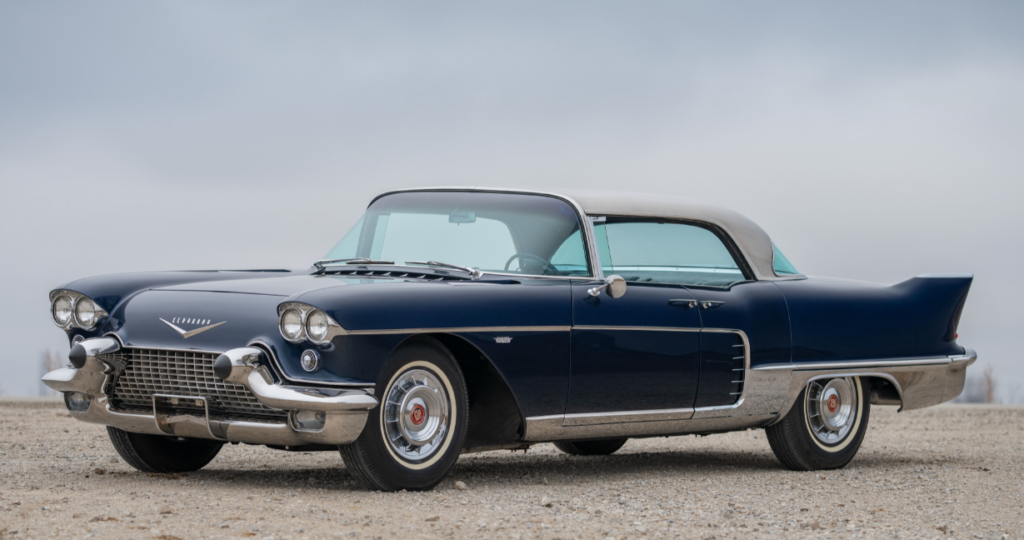
1957 Cadillac Eldorado Brougham

Offered by RM Sotheby’s | Phoenix, Arizona | January 22, 2021

Photo Courtesy of RM Sotheby’s

Many people think that peak American cars of the 1950s culminated in the outlandish 1959 Cadillac Eldorado Biarritz. Not so. It peaked more mid-decade, with cars like the Continental Mark II and this, the Eldorado Brougham. These were in a class of their own. The ultra-luxury class.

The Brougham was based on Cadillac’s Orleans and Park Avenue concept cars and featured a pillarless four-door hardtop body with suicide rear doors. The roof was finished in brushed stainless steel, and the car featured a self-leveling suspension, power seats with memory, cruise control, an automatic trunk opener, automatic high-beam headlights, and air conditioning. So basically, it was loaded with all of the stuff (and more) than that of your average 2020 mid-size sedan.

Over-the-top features included drink tumblers, a leather-trimmed cigarette case, a vanity, and a bunch of other stuff Cadillac threw in so everyone could know how high-maintenance you were. Power is from a 6.0-liter V8 that makes 325 horsepower courtesy of dual Rochester carburetors.

So what does all of this run in 1957? Well, how about $13,074 – nearly three times the price of a base Series 62 hardtop sedan from the same year. It also bested the Continental Mark II, which up to that point was the most expensive American car. This car cost more new than a Rolls-Royce. The Brougham was actually the Series 70, to set it apart, and only 400 were built this year. The 1958 model was even rarer. This one should sell for between $80,000-$120,000. Click here for more info and here for more from this sale.

Update: Sold $184,800.

Bristol 405

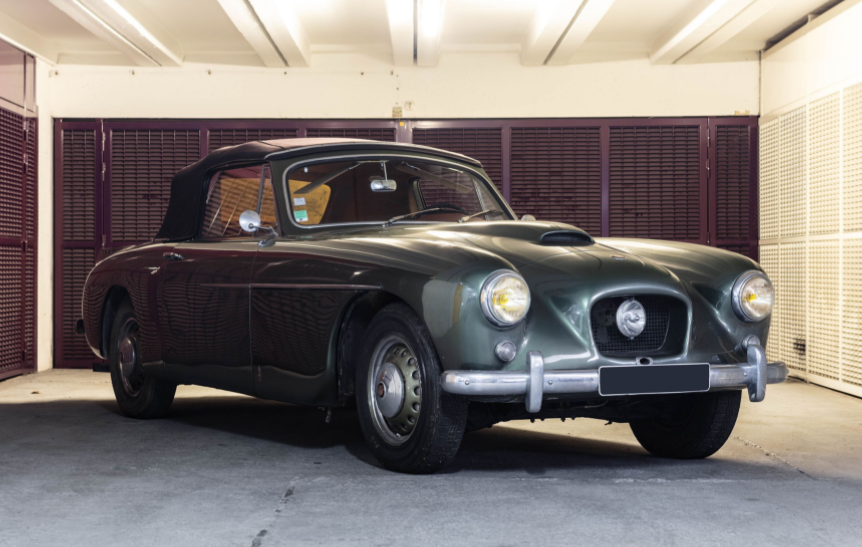
1955 Bristol 405 Drophead Coupe

Offered by Artcurial | Paris, France | February 5, 2021

Photo – Artcurial

Bristol’s “400” line of cars began with the company’s first vehicle, the 400, in 1947 and continued through the 412, which was built through 1981. And, until now, we’ve featured an example of each one in the sequence, except for the 409 and this, the 405.

The 404 and 405 were built roughly alongside one another, with the 404 being a two-seat coupe, and the 405 was available as a ragtop or a sedan. It was the better seller, with 308 built between 1955 and 1958. Only 43 of those 308 were convertibles.

This one is powered by a 2.0-liter inline-six rated at 125 horsepower. It was restored decades ago and entered its current collection in 2006. The pre-sale estimate is $125,000-$185,000. Click here for more info and here for more from this sale.

Update: Sold $172,840.

Koenigsegg Regera

2019 Koenigsegg Regera

Offered by RM Sotheby’s | Phoenix, Arizona | January 22, 2021

Photo Courtesy of RM Sotheby’s

Here’s another rule-breaker (kind of, more on that in a minute). Introduced in 2016, the Regera was designed to be more practical and luxurious than its sister car, the Agera, which was built from 2011 through 2018.

So what does the Regera bring to the table? How about a twin-turbocharged 5.0-liter V8 combined with three electric motors for a combined system output of 1,500 horsepower? the car has active aero, carbon fiber wheels, a fixed-gear direct-drive transmission, and, of course, dihedral doors. It has an electronically limited top speed of 251 mph. Sixty is gone in 2.8 seconds. It can hit 249 mph in 22.8 seconds. And this is their grand touring car.

Koenigsegg planned to build just 80 examples of the Regera, and as of the end of 2020, they have apparently all been built. So there we go, it’s technically out of production. Interestingly, this is the 175th Koenigsegg car built – talk about low volume. It was delivered new to a dealer in Illinois, has over $215,000 in options, and is the first Regera to hit the public auction block.

Gotta love supercars. And this one is pretty awesome. It carries an estimate of $2,600,000-$2,900,000. Click here for more info and here for more from this sale.

Update: Not sold.

Bertone DB2/4 Drophead Coupe

1954 Aston Martin DB2/4 Drophead Coupe by Bertone

Offered by Gooding & Company | Online | January 18-22, 2021

Photo – Gooding & Company

The DB2/4 was the follow-up to Aston Martin’s earlier DB2 model. It was succeeded by the DB Mk III, and yeah, Aston’s early naming scheme didn’t make a whole lot of sense. Anyway, the DB2/4 was built in two series between 1953 and 1957. The base car was a 2+2 hatchback, but both fixed head and drophead coupes were also offered, some with fancy coachbuilt bodies.

This 1954 example is one of 565 Series I cars (out of a total run of 764 units). Of those 565, 102 were drophead coupes. Just two of those wear beautiful Bertone coachwork like this. It is recognizable as an Aston if you look at it, but it could easily be confused for something Italian.

Power is from a 2.6-liter inline-six making 125 horsepower. This car is good for 120 mph, and cars built shortly after this example began receiving the 140-horsepower 2.9-liter engine. Bonhams sold this car for over $800,000 in 2011, and now Gooding is offering it without an estimate. Click here for more info and here for more from this sale.

Update: Sold $968,000.

Monarch Station Wagon

1950 Monarch Station Wagon

Offered by Worldwide Auctioneers | Auburn, Indiana | January 23, 2021

Photo – Worldwide Auctioneers

Monarch was sort of Ford’s attempt to sell Mercurys in Canada. The marque was in existence between 1946 and 1957, although it reappeared again in 1959 and lasted through 1961. While they largely mirrored their American Mercury counterparts, Monarchs did have Canadian-market-specific trim.

Model names varied depending on the years, and between 1949 and 1951, there really weren’t model names. Just body styles hanging off of the marque. Four body styles were offered in 1950, and the two-door station wagon – which was always a woodie – are among the rarest. Well, they’re all rare, as just 6,056 Monarchs were built in 1950 in total, 43 of which were wagons. Only three of those are known to exist.

Power is from a 4.2-liter flathead V8 rated at 110 horsepower. This car was restored in the 1990s and is now offered at no reserve. Click here for more info and here for more from this sale.

Update: Sold $117,600.

Boss 429

1970 Ford Mustang Boss 429 Fastback

Offered by Mecum | Glendale, Arizona | March 18-20, 2021

Photo – Mecum

This is the top dog among first-gen Mustangs. The Boss 429 was offered in 1969 and 1970 only, and it was more of a pure muscle car when compared to its namesake relative, the Boss 302 (which was produced for Trans Am homologation). The 429 was all engine, and that’s really the reason exists.

Ford needed to offer the 429 in a road car in order for it to be allowable in NASCAR. The Z-code 429 was a, well, 429-cubic-inch (7.0-liter) V8 rated at 375 horsepower. Only 499 were produced in 1970, and this one is finished in Grabber Green with a matte black hood scoop over black. The ’70 model was rarer than the ’69.

It features a limited-slip differential, a front spoiler, the Drag Pack, and a competition suspension. Only manual transmissions were available, and air conditioning was not an option. These are exceptionally cool Mustangs, and they are very rare. This is why they cost a lot more than their 302 Boss counterparts. You can check out more about this one here and see more from this sale here.

Update: Sold $385,000.

McLaren Speedtail

2020 McLaren Speedtail

Offered by RM Sotheby’s | Phoenix, Arizona | January 22, 2021

Photo Courtesy of RM Sotheby’s

Ever since McLaren got back into the production car game with the 12C, people have been waiting for the “successor to the F1.” McLaren has churned out supercar after supercar but didn’t start with their “Ultimate Series” until the P1, which some consider being the F1’s successor (but not here). Deliveries of the Speedtail began in 2020, and it is considered as “more of a successor” to the F1 than the P1. But I don’t think the F1 needs a successor. Even if this car shares the F1’s three-seat, center-driver layout.

Maybe just consider this as a 21st Century take on the F1. Top speed was the target here, and although it won’t take the worldwide record for the fastest production car as the F1 did, it is still capable of 250 mph, making it McLaren’s fastest road car. The twin-turbocharged 4.0-liter V8 is combined with an electric motor for a combined output of 1,306 horsepower.

This car has over $170,000 in MSO options on it and is the 36th Speedtail constructed. They are not street legal in the U.S., so this one is likely here on a Show or Display exemption.

The fact that this car is still in production does fly in the face of our “no current production cars” rule. But, the Speedtail is supposed to be limited to 106 units, matching that of the F1. When production wraps is TBD, but it will likely be in the next year or two.

This is the first Speedtail to come up for auction, and because all Speedtail owners were selected by McLaren, this is the first chance most people will have to buy one. I doubt this will ever be a $20 million classic like the F1, but time will tell. Click here for info and here for more from this sale.

Update: Sold $3,277,500.

Runge RS010

2017 Runge RS010

Offered by Bonhams | Scottsdale, Arizona | January 21, 2021

Photo – Bonhams

I’m not sure I would classify Runge Cars as a manufacturer… they’re more of a combination coachbuilder and tuner, building modern Porsche-derived outlaws. The cars are all vaguely 356/550/RSK-esque, but with modern touches. They’re just custom cars, but all with a similar theme, which makes them identifiable as Runges. They are not an exact replica of anything… kind of like art you can drive, but based on this one going up for sale two years after completion, they are probably the kind of art that is more comfortable to just look at.

This is the RS010, a one-off that was built between 2017 and 2019 but is titled as a 1960, the latter part of which is eye-roll-inducing thus why I labeled it as a “2017.” Power is from a mid-mounted 2.3-liter flat-four good for 195 horsepower. I’m unclear as to what chassis this rides on, and the gauges and switches are from 1950s-era aircraft.

According to their website, and the naming convention, this is the 10th Runge car built, and the most recent. I can’t recall seeing many other change hands publicly, and Bonhams hasn’t listed a pre-sale estimate yet. Click here for more info and here for more from this sale.

Update: Sold $240,800.