1918 Cadillac Coupe

1918 Cadillac Type 57 Victoria Coupe

Offered by Mecum | Kansas City, Missouri | December 7, 2013
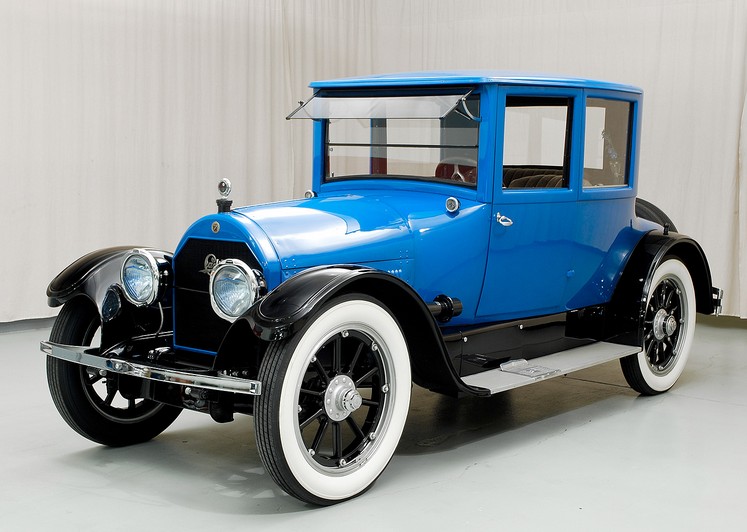
1918 Cadillac Type 57 Coupe

I think this is a very good-looking car. Cadillac has long touted that they are the “Standard of the World” and it’s early cars like this that make you believe it. Yes, they produced cars with twice as many cylinders, but this was one of the first big-engined road cars you could buy.

Cadillac’s L-Head V-8 engine was introduced in 1914 and became the first mass-produced V-8 engine in Cadillac’s 1915 models. It featured 5.2-liters of capacity and made 70 horsepower. The Type 51 was the first model to carry this motor and it evolved over the years, with the Type 61 ending the model’s run in 1923.

The Type 57 was available in the late Teens and this Victoria Coupe was an attractive, if not restrained design that offered a lot of power for those who wanted luxury without all the flash. I’m estimating that this car sells for between $40,000-$50,000. Click here for more from Mecum and here for more on this car.

Update: Sold $29,000.
Sunbeam Tourer

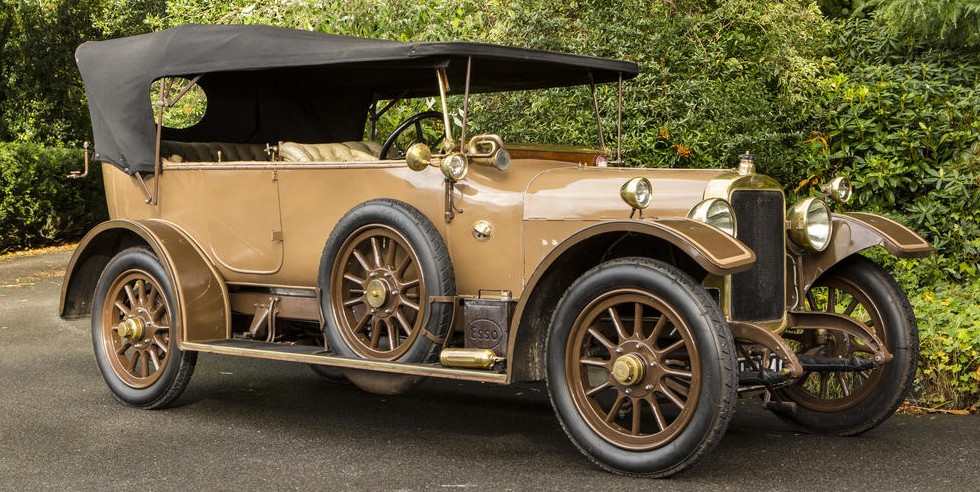
1919 Sunbeam 16/40 Tourer

Offered by Bonhams | Oxford, U.K. | December 9, 2013

1919 Sunbeam 16HP Tourer

Sunbeam is one of the oldest names in automobiles. Of course, they aren’t around anymore, but the company did date back to 1888, when it was founded as a bicycle manufacturer by John Marston. In 1902, the first cars appeared, under the Sunbeam-Mabley marque, and 1905 brought Sunbeam as a standalone make.

In 1919, the company merged with Talbot and Darracq. That didn’t go so well, and in 1935 the trio became part of the Rootes Group. The final Sunbeam-branded cars rolled off the assembly lines in 1978 and the name continued on as a Talbot model into the 1980s.

The Sunbeam 16/40 was re-introduced in 1919 after WWI ended. It was a slightly updated version of the pre-war 16/20 that dated to 1912. It uses a 3.0-liter straight-four making 40 horsepower.

This Sunbeam is the oldest-known example of the marque backdated to the end of the Great War (in other words, one of the earliest cars made after the armistice). It was parked sometime around 1928 and entered the National Motor Museum at Beaulieu in 1957. It spent 11 years on display before re-entering private ownership and being restored.

This is a good-driving old touring car that can be bought for somewhere in the neighborhood of $73,000-$89,000. Click here for more info and here for the rest of Bonhams’ auction lineup.

Update: Sold $60,369.

Frazer Nash-BMW

1937 Frazer Nash-BMW Type 319/2 Cabriolet

Offered by Bonhams | Oxford, U.K. | December 9, 2013

1937 Frazer Nash-BMW Type 3192 Cabriolet

We featured a Frazer Nash last week and described a bit of the history of the company. In the early years, Archibald Frazer-Nash (why is his name hyphenated and the company not?) formed AFN Ltd. after the GN cyclecar failed.

Their original purpose and business model was to import BMWs from Germany and assemble them in the U.K. The cars were marketed as “Frazer Nash-BMW”s and not BMWs. The company was the official British BMW importer between 1934 and 1939, before things between Germany and Britain got a little tense – to say the least.

The BMW 319 was introduced in 1935 and lasted through 1937. It was a version of the 303, which dated back to 1933. The engine is a 1.9-liter straight-six making 45 horsepower. This car has known ownership before the war and it picks up again in the 1960s. The current family who owns the car acquired it in 1978.

This car has covered about 54,000 miles in its life and shows an older restoration that could use attention in spots. It’s been in a museum recently and might need a little work to get it roadworthy. A total of 6,646 BMW 319s were built – a small fraction of which were sold as Frazer Nash-BMWs. This is a cool car that will bring between $65,000-$73,000. Click here for more info and here for more from Bonhams’ Oxford sale.

Update: Failed to sell.

Vulcan Touring Car

1908 Vulcan 20HP Roi-des-Belges

Offered by Bonhams | Oxford, U.K. | December 9, 2013

1908 Vulcan 20HP Roi-des-Belges

There were a couple of Vulcan automobile companies active in the early part of the 20th Century. The car you see here comes from the Vulcan Motor & Engineering Company, which was founded in 1902 in Lancashire, England. And it was the longest-lasting “Vulcan” – the company stopped building passenger cars in 1928 to focus on commercial vehicles and truck production ran through 1953 when it was stopped as the company was under control of the Rootes Group.

Thomas and Joseph Hampson’s first Vulcan was a single-cylinder model, but the model range soon proliferated. This car uses a 3.9-liter straight-four making 20 horsepower. The engine is clean and largely original. This car was delivered new to Australia and didn’t return home to the U.K. until 1989.

Vulcan motor cars are pretty rare today and this one has been recently repainted and the upholstery was recently redone. It’s very drivable and comes with a trailer! It can be bought for somewhere in the neighborhood of $97,000-$110,000. Click here for more info and here for more from Bonhams.

Update: Sold $126,479.

Mercedes-Simplex

1905 Mercedes-Simplex 28/32 Phaeton

Offered by Coys | London, U.K. | December 3, 2013

1905 Mercedes-Simplex 28-32 Phaeton

Daimler was one of the first automobile companies founded anywhere in the world. It was started in 1890 by Gottlieb Daimler and Wilhelm Maybach. In 1902, they introduced a model called “Mercedes” and it soon became the name under which Daimler sold cars. In 1926, Daimler would merge with Benz and Mercedes would become Mercedes-Benz.

One of the first Mercedes models was the Simplex. Shortly after its introduction, they followed it with a number of other Mercedes Simplex models (hence I classify it as a separate, short-lived marque).

This model is powered by a 5.5-liter straight-four making 35 horsepower. The 28/32 model was in production from 1902 through 1909. This regal Phaeton was delivered new to the U.S., spending time in the Arturo Keller collection and was restored under his ownership. The restoration still looks outstanding and the mechanicals have been rebuilt more recently.

The Simplex was an important automobile – as it made often-clunky early automobiles easy to operate and standardized the way in which their controls were laid out. These are very rare today and this one is one of the best examples still around. You can read more here and check out the rest of Coys’ lineup here.

Update: Sold $1,174,900.

Victor Electric Highwheeler

1907 Victor Electric Runabout

Offered by Coys | London, U.K. | December 3, 2013

1907 Victor High Wheel Electric Runabout

There is some confusion as to the origin of this car, but one thing is certain: it is called Victor. It has electric power and it is also a highwheeler of American origin. There was a company in St. Louis which operated from 1907 to 1911 called the Victor Automobile Manufacturing Company and they specialized in highwheelers for the first two years of their existence.

Coys mentions that this is the only Victor ever produced (there is even a tacky homemade plaque on the side of the car proclaiming this “fact”). They mention that the car could’ve been a one-off built in Nebraska, but that there isn’t any proof.

I offer a third possibility: Victor of St. Louis built highwheelers in 1907 that used a two-stroke engine. Perhaps they experimented with an electric drivetrain on one? Who knows. At any rate, the electric system has been completely redone lately and this thing will do about 70 miles on a charge and tops out around 30 mph.

It’s in the U.K. now, but it is available for purchase. It should sell for between $61,000-$88,500. Click here for more info and here for more from Coys in London.

Update: Not sold.

Update II: Sold, Historics at Brooklands, June 2016, $54,145.

1903 Clement

1903 Clement 12/16HP Rear-Entrance Tonneau

Offered by Bonhams | London, U.K. | December 1, 2013

1903 Clement 12-16HP Rear-Entrance Tonneau

Here is yet another vehicle (from yet another marque) that can be traced back to Adolphe Clement-Bayard. If you’re keeping score at home, please let me know how many this makes, because I’ve lost count. That mustachioed Frenchman sure had a knack for starting car companies.

Clement began producing cars in 1899. Between then and 1903, they were sold under the Clement and Clement-Gladiator names. In 1903, they became known as Clement-Bayard. Clement-Talbot and that whole story is separate from these companies (although very closely related).

Anyway, this car was sold new to a Spaniard named Don Francisco Serramalera Abadal. He was a major automotive importer and salesman who sold mainly French cars to wealthy clients. He would produce cars under his own name in the 1910s. He managed to win a hillclimb in this car in 1904 (so it does have “competition history”). The restoration is about 40 years old and the flimsy-looking wooden top is removable to turn this into a nice roadster.

The engine is a 2.1-liter straight-four making 12/16 horsepower. This Clement is from the final year of Clement production (of the four short years they were available). It is very nice, even though the restoration is older, and should bring a still-big price. The estimate is between $480,000-$640,000. Click here for more info and here for the rest of Bonhams’ London auction catalog.

Update: Sold $569,937.

Jaguar C-Type

1952 Jaguar C-Type

Offered by Bonhams | London, U.K. | December 1, 2013

1952 Jaguar C-Type

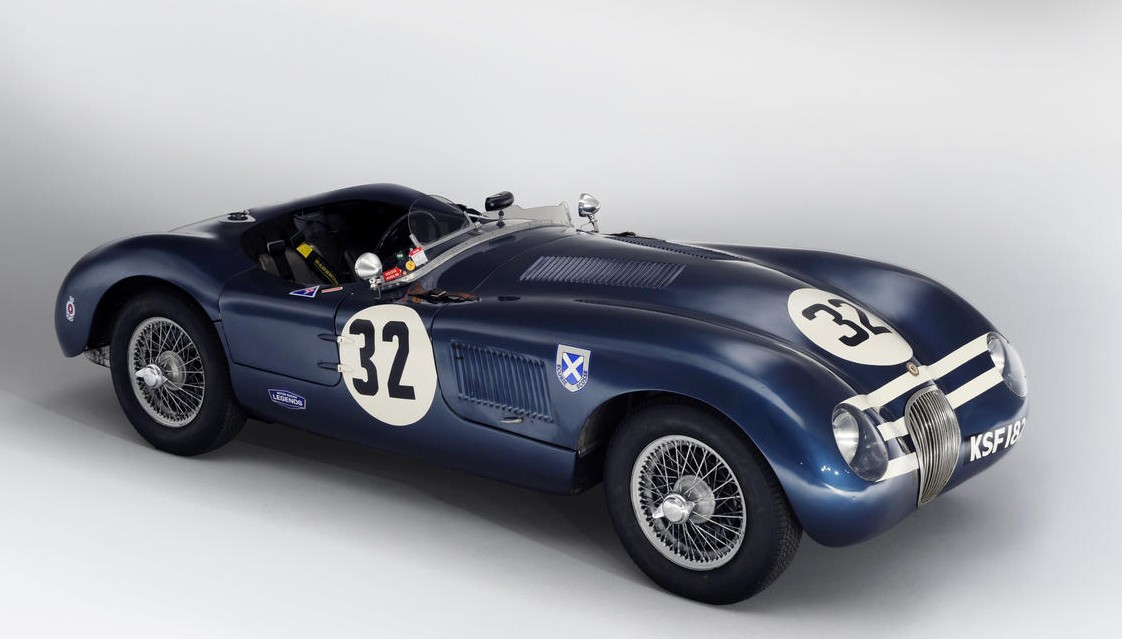
The C-Type was the first purpose-built racing car by Jaguar – although calling it a purpose-built racing car seems wrong, as these were entirely roadable as well. Jaguar did win Le Mans in 1951 with a C-Type (in its first attempt). It kind of set the tone for the next few decades of sports racing cars.

Based around the XK120s mechanicals, the C-Type uses a tuned version of the XK120s 3.4-liter straight-six. Horsepower output was around 205. The chassis and frame were different – this car used a lightweight frame and a sleek aluminium body.

This particular car was originally bought by the Scottish racing team Ecurie Ecosse – it was one of a handful of C-Types that the team would use. Highlights of its competition history include:

  • 1953 9 Hours of Goodwood – 5th (with Jock Lawrence & Frank Curtis)
  • 1953 1000km Nurburgring – 6th (with Lawrence & Jimmy Stewart)

After the 1953 season, David Murray, the founder and head of Ecurie Ecosse, sold the Jaguar to a privateer, who raced it around Europe. The car bounced between owners (and countries) for decades before becoming the backbone of this incredible Ecurie Ecosse collection in 1992.

It is being offered for sale by Bonhams, who call this (of all of the cars from this collection), the one that is “most pure” and “with the best provenance.” It can be yours for between $3,200,000-$4,800,000. Click here for more info and here for more from this sale.

S/N: XKC 042

Update: Sold $4,762,011.

Frazer Nash Targa Florio

1952 Frazer Nash Targa Florio

Offered by Bonhams | London, U.K. | December 1, 2013

1952 Frazer Nash Targa Florio

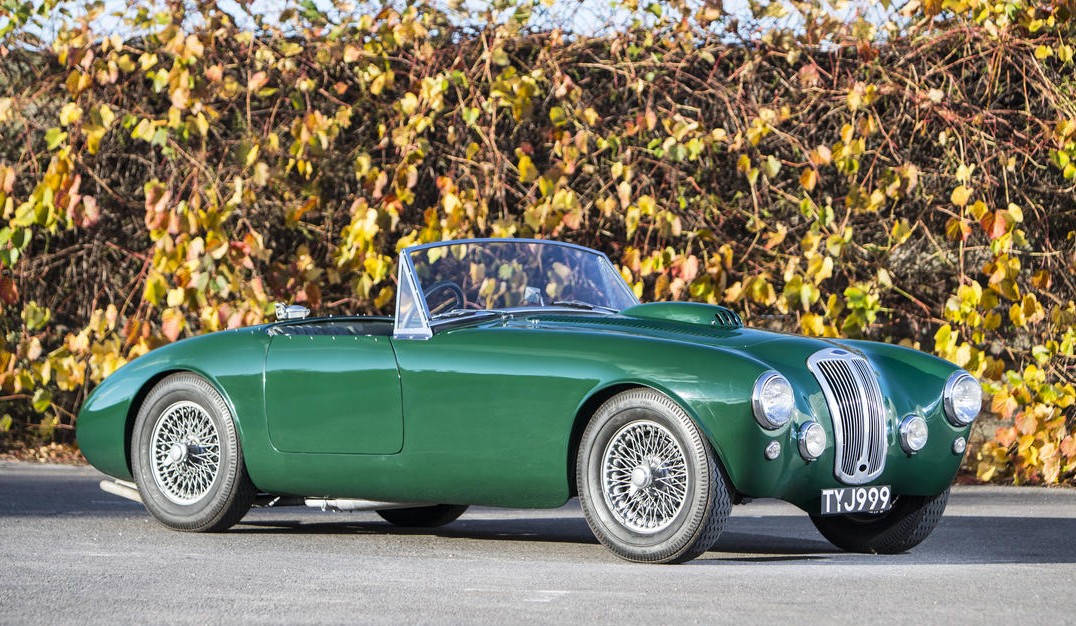
Archibald Frazer-Nash built some cool, exciting cars in his day – but he never built many of them. His pre-war cars were all very similar in design and many of them were called “replicas” because they were made to look like a car he used in competition. They were original cars, but painted in “replica” fashion or some such thing that makes them hard to distinguish (in name) from actual replicas today.

Anyway, after the war, the company went back to sports cars. The Targa Florio was a sports car introduced in 1952 at the London Motor Show – and this was the very car they exhibited. This was the fourth example produced and it was purchased off the show stand by Briggs Cunningham. Cunningham entered it in the 1953 12 Hours of Sebring where it finished about 45th, a DNF, with drivers John Gordon Bennett and Charles Moran.

Moran, head of the SCCA in the mid-1950s, bought the car after Sebring. It has had numerous owners over the years and was repainted and freshened in 2011. The Targa Florio could be hand in two trim levels: base Turismo or hotted-up Grand Sport. This is a Grand Sport, so it uses a more powerful Bristol engine. The motor is a 2.0-liter straight-six making 125 horsepower.

This is one of only 14 Targa Florios built – so it is extremely rare. Strangely, of the seven models Frazer Nash built after the war, this was the second most popular. It is strikingly good-looking and can be yours for between $400,000-$480,000. Click here for more info and here for more from Bonhams.

Update: Sold $441,795.

Tojeiro EE

1962 Tojeiro EE Buick Coupe

Offered by Bonhams | London, U.K. | December 1, 2013

1962 Tojeiro EE-Buick Coupe

Bonhams 2013 London sale has something amazing going for it: seven Ecuri Ecosse team cars and their famous team transporter are all being offered for sale. Let’s start with the team’s story…

Ecurie Ecosse – which is French for “Team Scotland” – was a Scottish racing team whose cars were always painted in this dark “Flag Blue Metallic” paint. The team was founded in 1952 by David Murray and Wilkie Wilkinson. They competed in Formula One, Formula Two and the 24 Hours of Le Mans – which they won, twice. The original team disbanded in the 1960s but their roster of former drivers is illustrious to say the least: Innes Ireland, Masten Gregory, Roy Salvadori, John Tojeiro and Jackie Stewart.

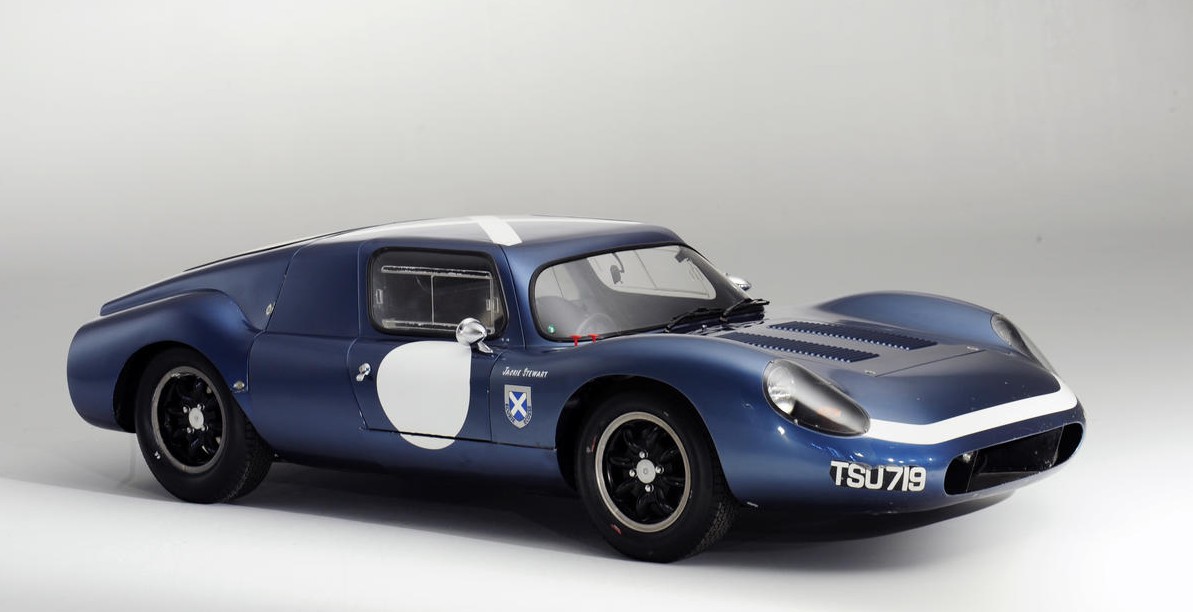
The last two have something in common: this car. The team had raced Jaguar D-Types in the 1950s and by 1962, they needed something new. So Murray met with Tojeiro, who had been designing his own sports racers for a few years, and had him build the team a new race car. The Tojeiro EE (for Ecurie Ecosse) was the result.

It was ready, literally, just in time for the 1962 24 Hours of Le Mans. It was Climax-powered for that race where it finished 38th (a DNF) with drivers Jack Fairman and Tom Dickson. For the 1963 British national sports car season, the team fitted a new aluminium-block 3.5-liter Buick V-8 making around 230 horesepower and hired a young man named Jackie Stewart to drive the car. He managed to win one race with it.

This car has been at Goodwood a few times in the past decade and is coming from an amazing Ecurie Ecosse collection. Only two of these cars were built (the other had a Ford V-8 the last time it was raced). This one should sell for between $290,000-$370,000. Click here for more info and here for more from this awesome sale.

Update: Sold $350,265.