Sunbeam Grand Prix

1922 Sunbeam Grand Prix

Offered by Bonhams | Chichester, U.K. | September 17, 2022
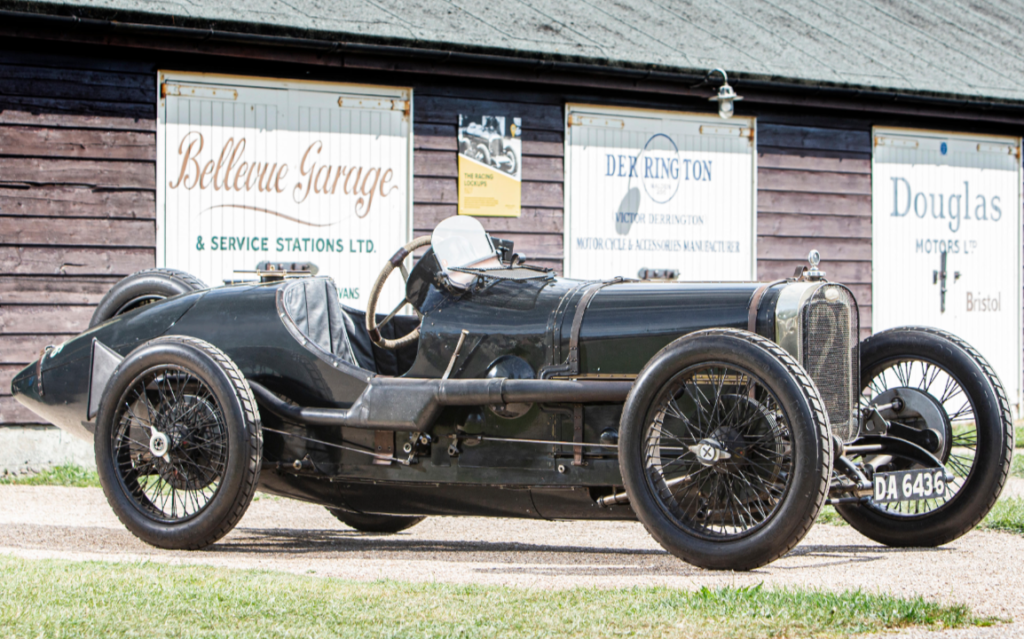
Photo – Bonhams

Something I did not know: according to Bonhams, Sunbeam was Britain’s most successful Grand Prix entrant during the period in which this car was built. I don’t know what the means in terms of wins, but it sounds nice. The first Sunbeam cars were built in 1901, and they got pretty heavily into racing after WWI.

Four Grand Prix racers like this were built in 1922. It was designed to compete under the 2.0-liter rule with it’s inline-four displacing just that and making 88 horsepower. Two-seater body work was required, as was a tail that could extend beyond the rear axle by no more than 1.5 meters.

This is the prototype of the four 1922 Sunbeam GP cars and was initially road registered by driver Jean Chassagne before being put to use on track. It was raced as late as 1938 and was re-bodied by John Wyer in 1942. In 1973, it was restored. It now has an estimate of $805,000-$920,000. Click here for more info.

Update: Sold $686,929.

Aston DB3

1952 Aston Martin DB3

Offered by Bonhams | Chicester, U.K. | September 27, 2022

Photo – Bonhams

The DB3 was Aston Martin’s sports racing car for the early ’50s, with the cars being built in 1951 and 1952. It was their first post-war purpose-designed race car and was usurped by the somewhat-prettier and more famous DB3S in 1953. This car is number five of 10 built, and the the first five were all Aston team race cars. The remainder of the run were sold to privateers.

The first cars were powered by a 2.6-liter Lagonda inline-six, and later cars got a 2.9-liter version of the same powerplant that was good for up to 163 horsepower. This chassis has period competition history as a works racer, including:

  • 1952 24 Hours of Le Mans – 19th, DNF (with Lance Macklin and Peter Collins)
  • 1953 12 Hours of Sebring – 2nd (with George Abecassis and Reg Parnell)
  • 1953 Mille Miglia – DNF (with Abecassis)

The nose was damaged during the Mille Miglia DNF. The entire body was removed, and the rolling chassis was sold to a driver who fitted a closed body. It wasn’t until 1990 that the car was restored with an original-style DB3 body. Now, this incredibly rare 1950s race car is offered with “estimate upon request.” You can read more about it here.

Update: Not sold.

Force India VJM08

2015 Force India VJM08B

Offered by Bonhams | Chichester, U.K. | September 17, 2022

Photo – Bonhams

Another Bonhams sale in England and another car from the former Force India reserves. The VJM08 was the car used by the Sahara Force India F1 Team during the 2015 season, during which the team employed drivers Sergio Perez and Nico Hulkenberg. They upgraded the car to VJM08B spec after the first eight races. That upgrade was just revised aerodynamics.

Mercedes engines were used in conjunction with the VJM08 chassis. Mercedes, naturally, also used that power source, as did Williams and Lotus. This car no longer has an engine. It is chassis #2, and its competition history includes:

  • 2015 Australian Grand Prix – 10th (with Sergio Perez)
  • 2015 Malaysian Grand Prix – 13th (with Perez)
  • 2015 Chinese Grand Prix – 11th (with Perez)
  • 2015 Bahrain Grand Prix – 8th (with Perez)
  • 2015 Spanish Grand Prix – 13th (with Perez)
  • 2015 Monaco Grand Prix – 7th (with Perez)
  • 2015 Canadian Grand Prix – 11th (with Perez)
  • 2015 Austrian Grand Prix – 9th (with Perez)
  • 2015 British Grand Prix – 9th (with Perez)
  • 2015 Hungarian Grand Prix – 13th, DNF (with Perez)
  • 2015 Belgian Grand Prix – 5th (with Perez)
  • 2015 Italian Grand Prix – 6th (with Perez)
  • 2015 Singapore Grand Prix – 7th (with Perez)
  • 2015 Japanese Grand Prix – 12th (with Perez)
  • 2015 Russian Grand Prix – 3rd (with Perez)
  • 2015 United States Grand Prix – 5th (with Perez)
  • 2015 Mexican Grand Prix – 8th (with Perez)
  • 2015 Brazilian Grand Prix – 12th (with Perez)
  • 2015 Abu Dhabi Grand Prix – 5th (with Perez)

It can now be yours, as a roller of course. The estimate is $60,000-$82,500. Click here for more info.

Update: Sold $89,919.

TVR Tuscan Challenge

1999 TVR Tuscan Challenge

Offered by Silverstone Auctions | Silverstone, U.K. | August 26-27, 2022

Photo – Silverstone Auctions

The first TVR Tuscan was a car built in the 1960s. It was essentially a V8- (or V6)-powered version of the Grantura. The name was reused on the somehow more-wild Tuscan Speed Six of 1999-2006. In the intervening years, a Tuscan Challenge one-marque racing series took place.

Beginning in 1989, the Tuscan Challenge spec race car ran in a single-make series put on by TVR. The last season was around 2006. The cars resembled the early-1990s Griffith and Chimaera but actually debuted before either car. It’s somewhat unclear how many race cars were built in 1989 and later updated and modified, or how many they continued to build new over the next decade. This one was built new by TVR in 1999.

It’s powered by a either a 4.4-liter or 4.5-liter V8. Race wins for this chassis totaled four in the 1999 season and three the following year in which it took second in the championship. It now has an estimate of $79,000-$91,000. Click here for more info.

Update: Not sold.

Ferrari 625 F1

1954 Ferrari 625 F1

Offered by RM Sotheby’s | Monterey, California | August 18-20, 2022

Photo Courtesy of RM Sotheby’s

Formula One didn’t technically come into existence, by that name anyway, until 1950. Prior to that there was just a European Championship, in which Ferrari debuted in 1948. So this car, then, is from the first decade of Ferrari’s open-wheel racing program.

In 1952 and 1953, Formula Two was actually the pinnacle of motorsport, as determined by its governing body, the FIA. So the best drivers all tooled around in F2 cars for a couple of years before Formula One again became the World Championship decider in 1954.

Ferrari’s Aurelio Lampredi-designed F2 car for 1952 and 1953 was the 500. When the Scuderia had to shift back to F1, they took 500 chassis and modified them into 625 F1 spec. And this, chassis 0540, is one of those cars. The engine in the 625 was a 2.5-liter inline-four equipped with dual Weber carburetors for an output of up to 227 horsepower.

This car started out as the fourth of five 500 F2 cars before being retrofitted and re-serialed by the factory as a 625 F1. It was campaigned at both levels by Ecurie Francorchamps, a Belgian F1 team. It was later owned by Donald Healey and Pierre Bardinon.

This real-deal Ferrari monoposto from the golden age of F1 racing now has an estimate of $3,000,000-$4,000,000. Click here for more info.

Update: Not sold.

Zink Z-8

1969 Zink-Volkswagen Z-8 Daytona Prototype

Offered by Gooding & Company | Pebble Beach, California | August 19-20, 2022

Photo – Gooding & Company

Ed Zink is most remembered for his Formula Vee open-wheel race cars, but in the 1960s, it was hard not to get caught up in prototype sports car racing, apparently. The Z-8 featured a space-frame chassis wrapped in fiberglass bodywork.

For power, project cheerleader and idea man Hugh Heishman (a Virginia Volkswagen dealer) turned to VW for their new Type 3E fuel-injected flat-four. The 1.9-liter unit is carbureted now and is estimated to make about 150 horsepower. The car was run in period, including:

  • 1969 24 Hours of Daytona – 18th, 3rd in class (with Bill Scott, Jim McDaniel, and Steve Pieper)
  • 1969 12 Hours of Sebring – 68th, DNF (with Scott, McDaniel, and Pieper)

It went SCCA racing in privateer hands after that, eventually being stored in a disassembled state. A restoration that completed in 2017 brought it to its current condition. Gooding estimates a price of $150,000-$200,000. Click here for more info.

Update: Sold $75,000.

Ferrari F300

1998 Ferrari F300

Offered by RM Sotheby’s | Monterey, California | August 18-20, 2022

Photo Courtesy of RM Sotheby’s

This was Ferrari’s 1998 F1 contender. It was very similar to 1997’s F310B, which itself was an evolution of 1996’s F310. The main differences between 1998 and 1997 were a narrower track and redesigned sidepods.

Ferrari supplied their own 3.0-liter V10, which made about 805 horsepower in this application. The season’s drivers were Michael Schumacher and Eddie Irvine, and the competition history for this particular chassis, 187, includes:

  • 1998 Canadian Grand Prix – 1st (with Michael Schumacher)
  • 1998 French Grand Prix – 1st (with Schumacher)
  • 1998 British Grand Prix – 1st (with Schumacher)
  • 1998 Italian Grand Prix – 1st (with Schumacher)

Not bad. Unfortunately, Mika Hakkinen’s McLaren was still too strong, and Schumacher ended up second in the World Championship. Ferrari also took second place in the constructors race. Ferrari sold this car late the following year to a private owner.

Race-winning cars from former world champions are hard to come by, especially with their engines intact. The price reflects it here: the estimate is $6,000,000-$8,000,000. Click here for more info.

Update: Sold $6,220,000.

Miller-Ford

1935 Miller-Ford

Offered by Gooding & Company | Pebble Beach, California | August 19-20, 2022

Photo – Gooding & Company

Few names are as synonymous with Indianapolis as Harry Miller. Maybe Andy Granatelli would be up there for people in the know. And Tony Hulman. Well, all three are in play here, but let’s start with this: legendary Indy car designed Harry Miller was approached by Preston Tucker to design an Indy car around a road car-based engine. This was the “junk formula” era.

Tucker then got his friend Edsel Ford to persuade his dad Henry to fund it. Henry ended up making his franchised dealers foot the bill, but the project went ahead. The result was a two-seater, front-wheel-drive chassis powered by a Ford flathead V8. The bodies were built by Emil Diedt, a famous Indy car name on its own.

Ten examples were produced, but just four qualified for the 1935 Indy 500. None finished due to a design flaw with the steering. Henry Ford scooped all of them up, apparently out of embarrassment/rage, and hid them away in Dearborn. They would slowly be sold off to private customers.

This car escaped not long after, and, just after WWII, was owned by a California-based race team owner who had a 4.4-liter Offenhauser inline-four put in it in place of the flathead. Output now is estimated to be 350 horsepower. In 1948, the car was purchased by team owner Andy Granatelli, who entered it in the 1948 race. So the known competition history for this car, chassis #5, consists of:

  • 1948 Indianapolis 500 – DNQ (with Granatelli)

He actually destroyed the car in practice and it was later rebuilt. In 1949, it was purchased by Indianapolis Motor Speedway owner Tony Hulman and remained with the IMS Museum until 1993. This is a hard car to come by, and it has an estimate of $750,000-$1,000,000. Click here for more info.

Update: Sold $830,000.

Dexter Sports

1906 Dexter Two-Seat Sports

Offered by Osenat | Fontainebleau, France | July 18, 2022

Photo – Osenat

Constructions d’Automobiles Dexter was founded by Auguste Faure as a spinoff of his Lyon-based bicycle company that dated back to the turn of the century. Dexter cars were produced from 1906 through 1909. And right up front, Faure wanted to prove his cars’ worth by taking them racing.

All of the cars he built – which was not many – had big powerful engines, and most of them were competition examples. This particular car is a reconstruction of a period racing car, one of two of its kind built. It’s powered by a 6.5-liter inline-four, with each cylinder in its own block, that was good for 120 horsepower. Most of the company’s other cars made at least 100 horsepower.

Dexters came with four-speed transmissions and dual carburetors in 1906. Uncommon stuff for the day. This chain-driven racing car means business and completely looks the part. It’s got an estimate of $125,000-$155,000. Click here for more info.

Update: Not sold.

Ferrari 410 Sport Spider

1955 Ferrari 410 Sport Spider by Scaglietti

Offered by RM Sotheby’s | Monterey, California | August 18-20, 2022

Photo Courtesy of RM Sotheby’s

Enzo Ferrari wanted a car that could win the Carrera Panamericana in 1955. The company developed a new sports car chassis and fitted it with the 5.0-liter V12 from the 410 Superamerica. The twin-plug racing engine produced 400 horsepower, which was 40 more than the two single-plug customer cars that Ferrari delivered to some independent drivers.

Two twin-plug cars were built, with this being one of them. The Carrera was cancelled, so this car was saved for the 1956 World Sportscar Championship. This chassis, #0598, was driven by Fangio at the 1000 km of Buenos Aires before being sold into privateer hands.

From there, it was used at a variety of hillclimbs and SCCA events in the U.S., with wins racked up by Carroll Shelby. Other drivers in period included Phil Hill, Richie Ginther, Masten Gregory, Jo Bonnier, Jim Rathmann, and Fireball Roberts.

The full history of this car is pretty interesting and can be read here. Other notable events include decades under ownership of Luigi Chinetti. It was cosmetically refreshed in the 1980s, and the engine was rebuilt in 2012. With only four produced, and only two in this specification, this is a monster among golden-era Ferrari sports racing cars. RM won’t even publish an estimate.

Update: Sold $22,005,000.