300ZX V8 IMSA

1994 Nissan 300ZX V8 IMSA GTS

Offered by Bring a Trailer Auctions | May 2023

Photo – Bring a Trailer Auctions

So this may be a purely purpose-built, tube-frame race car with composite bodywork, but it does have your standard Z32 road car tail panel, which is excellent. Nissan was around for the Group C era, and they eventually transitioned to the GTS class in IMSA.

Initially, they started campaigning second-generation 300ZX race cars with their twin-turbocharged V6s. But those became a little too dominant for IMSA’s liking (in 1994, a 300ZX won the 24 Hours of Daytona and the 12 Hours of Sebring outright before winning their class at Le Mans). So for 1995, IMSA outlawed the twin-turbo V6.

And Nissan said “okay, we’ll raise you two cylinders.” The next season’s cars, including this one, were powered by a 4.5-liter V8. Two such chassis were so equipped, and the racing history for this one, #008, includes:

  • 1995 24 Hours of Daytona – 21st (with Steve Millen, Johnny O’Connell, and John Morton)
  • 1995 12 Hours of Sebring – 5th, 1st in class (with Millen, O’Connell, and Morton)

This is a pretty serious machine that I suspect would be terrifyingly fast at 50%. You can read more about it here.

Update: Not sold, high bid of $156,000.

Rondeau M482

1983 Rondeau-Cosworth M482

Offered by Bonhams | Brussels, Belgium | May 13, 2023

Photo – Bonhams

Jean Rondeau raced at Le Mans a few times before he decided he could do better designing, building, and competing in his own cars. The first Rondeau cars arrived at Le Sarthe in 1976, although they were branded as Inalteras due to their sponsorship with the wallpaper company.

The Rondeau M378 was the first Rondeau-branded car at the race, and the last would be this: the 1983 M482. It had power in-period from a 3.9-liter Cosworth V8. There is currently no engine installed, but a Cosworth DFV V8 accompanies the car. The competition history for this chassis, #003, includes:

  • 1983 24 Hours of Le Mans – 48th, DNF (with Jean-Pierre Jaussaud and Philippe Streiff)
  • 1985 24 Hours of Le Mans – 46th, DNF (with Christian Bussi, Jack Griffin, and Marion L. Speer)

Only three M482s were built. And they did not do well at Le Mans in 1983. So bad, in fact, that Rondeau has to file for bankruptcy, which is how this car ended up in the hands of a privateer in 1985. Successful or not, the car carries a pre-sale estimate of $275,000-$390,000. Click here for more info.

Update: Sold, though Bonhams is being LAME and not telling anyone how much.

Ferrari 312 PB

1972 Ferrari 312 PB

Offered by RM Sotheby’s | Cernobbio, Italy | May 20, 2023

Photo Courtesy of RM Sotheby’s

Big-time Ferrari prototype sports racers don’t change hands very often. At least not publicly. The 312 PB was a Group 6 prototype race car built and campaigned between 1971 and 1973. Fun fact, this car was technically called the 312 P, but Ferrari also had an older 312 P, so it’s been retroactively dubbed “PB.”

Another fun fact is that these cars took so much focus from Ferrari that their Formula One program had begun to suffer. So after the 1973 sports car season, they walked away from prototype racers to focus on F1 again. So this was sort of the last of the line for a while.

The car is powered by a 3.0-liter flat-12 that made 460 horsepower. It’s unclear how many were produced, but the catalog says this chassis, 0886, is one of six used as works racers during the 1972 season. Its competition history includes:

  • 1972 1,000km of Buenos Aires – 1st (with Ronnie Peterson and Tim Schenken)
  • 1972 12 Hours of Sebring – 2nd (with Peterson and Schenken)
  • 1972 1,000km of Monza – 3rd (with Peterson and Schenken)
  • 1972 1,000km Nurburgring – 1st (with Peterson and Schenken)

This car was then present at the Monterey Historics as early as 1975. Ferrari won the sports car manufacturer’s championship in ’72, with a huge helping hand from this chassis. It now carries a massive estimate of $15,500,000-$19,750,000. Click here for more info.

Update: Sold $12,766,856.

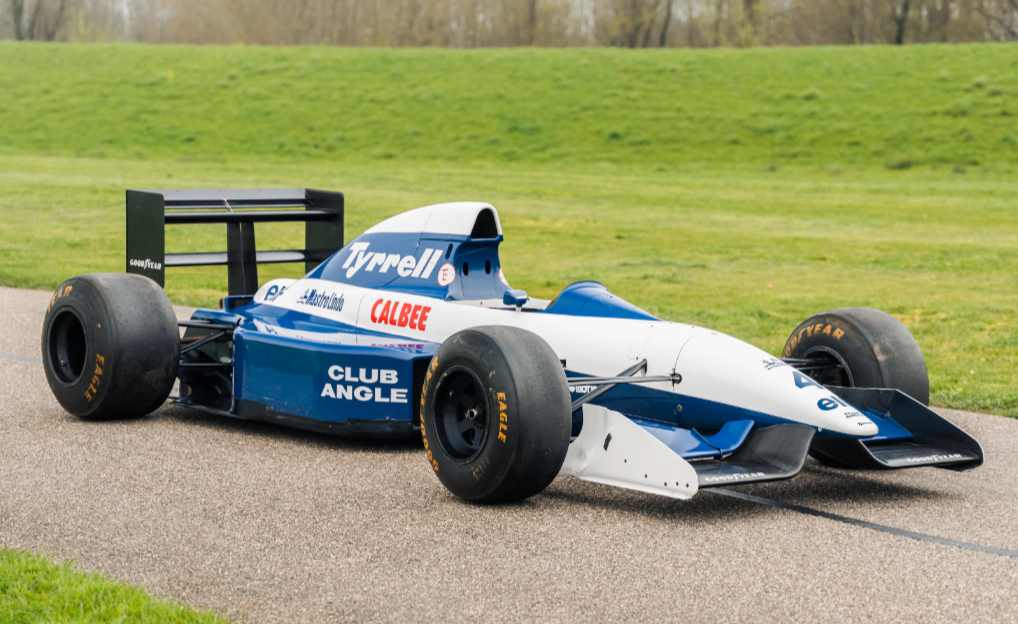
Tyrrell 020B

1991 Tyrrell 020B

Offered by Bonhams | Brussels, Belgium | May 13, 2023

Photo – Bonhams

Ken Tyrrell’s Formula One racing team had been around since the 1960s and entered the 1990s already struggling. The 1971 constructor’s champion was a far cry from the peak. Their 020 chassis was designed by Harvey Postlethwaite and George Ryton and debuted for the 1991 season.

For that year, the car had a Honda V10 powerplant. For 1992, they upgraded the 020 (including this chassis, 020-6), to 020B spec, which meant that it now used 3.5-liter Ilmor V10 that made 680 horsepower. The competition history for this car includes:

  • 1991 Canadian Grand Prix – 10th (with Satoru Nakajima)
  • 1991 Mexican Grand Prix – 12th (with Nakajima)
  • 1991 French Grand Prix – 22nd, DNF (with Nakajima)
  • 1991 British Grand Prix – 8th (with Nakajima)
  • 1991 German Grand Prix – 18th, DNF (with Nakajima)
  • 1991 Hungarian Grand Prix – 15th (with Nakajima)
  • 1991 Belgian Grand Prix – 23rd, DNF (with Nakajima)
  • 1991 Italian Grand Prix – 19th, DNF (with Stefano Modena)
  • 1991 Portuguese Grand Prix – 18th, DNF (with Modena)
  • 1991 Spanish Grand Prix – 16th (with Modena)
  • 1991 Japanese Grand Prix – 16th, DNF (with Nakajima)
  • 1991 Australian Grand Prix – 26th, DNF (with Nakajima)

For 1992, it was used as a spare car for seven races. It later entered private ownership – sans V10 – and is offered as a roller out its current collection, where it’s been since 2003. The estimate is $55,000-$77,000. Click here for more info.

Update: Sold $67,054.

Ferrari 500 TR Spider

1956 Ferrari 500 TR Spider by Scaglietti

Offered by RM Sotheby’s | Cernobbio, Italy | May 20, 2023

Photo Courtesy of RM Sotheby’s

The Ferrari 500 TR was actually part of Ferrari’s Monza line of sports racing cars, and not part of the 250 Testa Rossa range (those had V12s). Produced for 1956, the 500 TR replaced the earlier 500 Mondial.

It shared the Mondial’s 2.0-liter Lampredi inline-four that revved to a pretty incredible 180 horsepower. It featured a coil-sprung suspension, which broke new ground for Ferrari, and a synchronized gearbox.

This example, which is the third of 17 built, was sold new to an Italian privateer, who took it road racing around Italy. It later spent time way up north, incurring damage at a race in Finland. The resulting repairs saw it gain a 500 TRC-style nose. An owner in the 1970s/80s used the car heavily in historic events.

It’s been with its current owner since 2011, and i’s now selling at no reserve. Click here for more info.

Update: Sold $3,941,107.

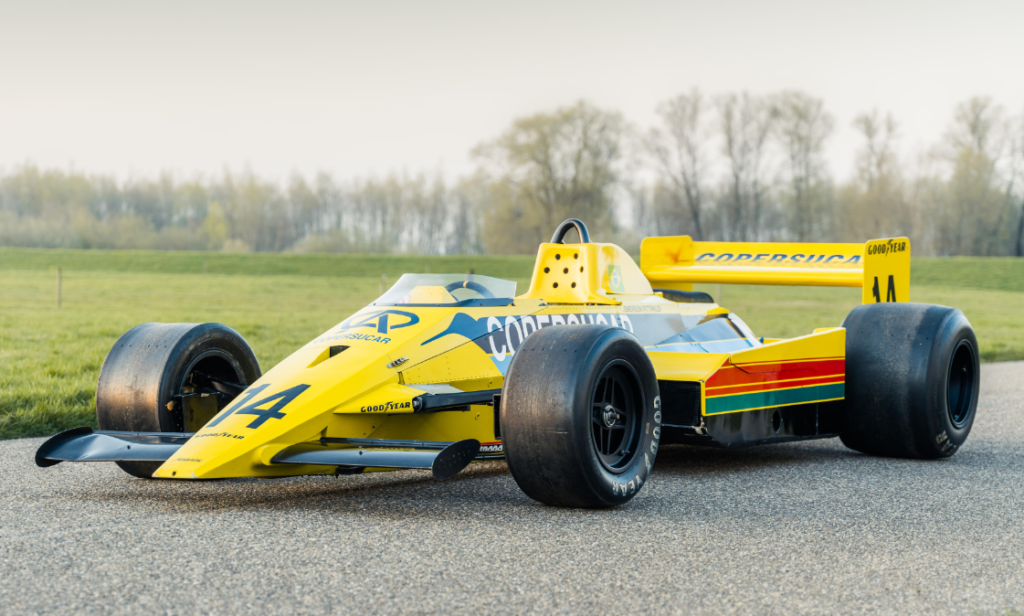
Fittipaldi F6

1979 Fittipaldi F6

Offered by Bonhams | Brussels, Belgium | May 13, 2023

Photo – Bonhams

Imagine Max Verstappen, or Sebastian Vettel, or Michael Schumacher, three years out from an F1 world championship arriving on the grid with a team of their own. It would be insane. But it’s exactly what Emerson (and brother Wilson) Fittipaldi did in 1975.

Emerson Fittipaldi won the F1 driver’s championship for Lotus in 1972, and Wilson drove for Brabham for ’72 and ’73. They started working on Fittipaldi Automotive in 1974. The team appeared on the grid in 1975 with Wilson driving the only car (and Arturo Merzario running in one race). Emerson would be the team’s main driver from 1976-1980, and the team’s final season was 1982.

The F6 was used for the latter part of the 1979 season (and, strangely, one race toward the beginning of the year). Two chassis were built, with Emerson driving one of them in seven races and Alex Ribeiro failing to qualify for three races in the other. The engine at the time was a Ford-Cosworth DFV 3.0-liter V8.

This chassis is lacking all running gear and is set up as a static show car. Apparently it doesn’t even really roll, and the suspension is listed as “not correct.” Still, it’s an interesting part of F1’s small history of “owner/drivers.” It has an estimate of $55,000-$75,000. Click here for more info.

Update: Sold $25,602.

Nissan R90CK

1990 Nissan R90CK

Offered by RM Sotheby’s | Le Mans, France | June 9, 2023

Photo Courtesy of RM Sotheby’s

This is a pretty big deal car. Nissan’s Group C program got off the ground in 1983. In 1990, they launched a new series of cars starting with the R90C, which was based off of the previous R89C. The R90CK variant featured aerodynamic tweaks and revised styling. It was used during the 1990 World Sportscar Championship season and at the 24 Hours of Daytona in ’91 and ’92.

Six R90CK chassis were built, and this one carries number R90C/1. It’s powered by a twin-turbocharged 3.5-liter all-aluminum DOHC V8. In qualifying trim, output could hit 1,000 horsepower. Race trim usually dialed it back to under 800. But still. This car took pole at Le Mans in 1990, and its competition history includes:

  • 1990 24 Hours of Le Mans – 41st, DNF (with Mark Blundell, Julian Bailey, and Gianfranco Brancatelli)

It was retained by Nissan until 2000, spending some time on display at the Le Mans museum before private ownership came calling. The car is usable and has been present at various historic events over the last decade or so. Le Mans pole-winning cars don’t come around everday, nor do Group C legends. Click here to read more about this one.

Update: Sold $1,175,058.

Alain de Cadenet’s Duckhams LM

1972 Duckhams-Ford-Cosworth LM72

Offered by Aguttes | Neuilly, France | April 27, 2023

Photo – Aguttes

This is a car with a great story. Alain de Cadenet was an English racing driver (and later pretty awesome TV presenter if you like old cars). He raced at Le Mans 15 times, including with cars of his own design. In 1971, he ran Le Mans in a Ferrari 512M. The next year he tried to buy a Ferrari 312 PB, which the company refused to sell to a privateer, as it was based on their F1 car and thus too extreme for an “amateur.”

So he thought of something else. De Cadenet owned a Brabham BT33 F1 car himself, a car which he entered in two 1971 F1 races for his friend and endurance racing co-driver, Chris Craft. So he asked Brabham if they could turn it into a full-bodied sports racing prototype. Bernie Ecclestone, who had just bought Brabham, pointed de Cadenet to a young designer named Gordon Murray.

Over the course of six weeks, Murray designed this. But it needed a new engine – so de Cadenet went to McLaren and bought Bruce McLaren‘s 1968 Belgian Grand Prix-winning Cosworth DFV (as one does). Then he convinced lubricant manufacturer Duckhams to sponsor the whole ordeal. And by June, they were on the grid at Le Sarthe. The competition history includes:

  • 1972 24 Hours of Le Mans – 12th (with Alain de Cadenet and Chris Craft)
  • 1973 24 Hours of Le Mans – 45th, DNF (with de Cadenet and Craft)
  • 1974 24 Hours of Le Mans – 26th, DNF (with Craft and John Nicholson)

For the ’73 race the car received longtail bodywork by Murray, and in 1974, with de Cadenet sidelined with an injury and the Duckhams sponsorship deal over, the car raced as a de Cadenet LM72. Which is pretty awesome, even if he didn’t get to drive it.

The car was restored in 2002 to how it competed in 1972, including with a 3.0-liter Cosworth V8. In period, it also competed in Interserie and Can-Am events. More recently, it’s been active at the Le Mans Classic. The estimate now is $1,600,000-$2,750,000. Click here for more info.

Update: Not sold.

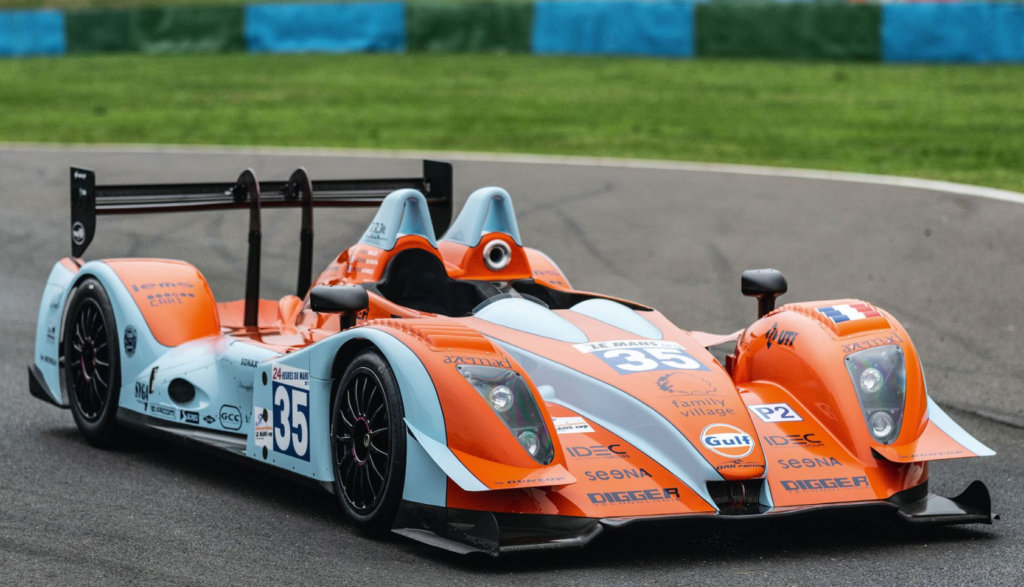
Pescarolo 01

2011 Pescarolo-Judd 01

Offered by Aguttes | Neuilly, France | April 27, 2023

Photo – Aguttes

Henri Pescarolo ran 57 Formula One races and won the 24 Hours of Le Mans as a driver four times for Matra-Simca and Porsche. He founded Pescarolo Sport in 2000 to race (and later build) Le Mans prototype racers. And for a while, their Courage chassis were the second-best LMP1 cars on the grid after the all-too-dominant Audis.

For 2007, the team decided to try their hand with a machine of their own design. The Pescarolo 01 was built for use in both LMP1 and LMP2 categories. This particular chassis, 013, features a 3.6-liter Judd V8 that made about 510 horsepower. Outfitted in LMP2 spec, this car was used by the OAK Racing team and carries Gulf colors. It’s competition history includes:

  • 2011 24 Hours of Le Mans – 25th (with Frederic Da Rocha, Patrice Lafargue, and Andrea Barlesi)

The car has since been overhauled and now carries an estimate of $440,000-$660,000. Click here for more info.

Update: Not sold.

Spyker/Force India

2007 Spyker F8-V11/Force India VJM01

Offered by Bonhams | Goodwood, U.K. | April 16, 2023

Photo – Bonhams

Spyker F1 bought out the Midland F1 team late in the 2006 Formula One season. This was a big leap for what was already a struggling boutique road car manufacturer. 2007 would be the team’s only full year running under the Spyker name.

Late in the 2007 season, Vijay Mallya stepped in to buy the financially doomed team, and it would be renamed Force India for 2008. Spyker raced their Ferrari-powered F8-VII (and VIIB) for the season with drivers Adrian Sutil (who scored Spyker’s only championship point) and Christijan Albers. Albers was let go halfway through the year and was replaced by Markus Winkelhock (for one race) and Sakon Yamamoto for the rest.

Force India’s first F1 entry was the VJM01, which was just an updated version of the previous year’s Spyker chassis. So they literally just updated the existing cars and reused them for the season. This particular chassis, VJM01-04, was a Spyker in 2007 and a Force India in 2008. It’s competition history includes:

  • 2007 French Grand Prix – 17th (with Adrian Sutil)
  • 2007 British Grand Prix – 15th (with Christijan Albers)
  • 2007 European Grand Prix – 17th, DNF (with Markus Winkelhock)
  • 2007 Hungarian Grand Prix – 22nd, DNF (with Sakon Yamamoto)
  • 2007 Italian Grand Prix – 20th (with Yamamoto)
  • 2007 Belgian Grand Prix – 17th (with Yamamoto)
  • 2007 Japanese Grand Prix – 12th (with Yamamoto)
  • 2007 Chinese Grand Prix – 17th (with Yamamoto)
  • 2007 Brazilian Grand Prix – 21st, DNF (with Yamamoto)
  • 2008 Monaco Grand Prix – 18th, DNF (with Giancarlo Fisichella)
  • 2008 Canadian Grand Prix – 14th, DNF (with Fisichella)

The highlight there is the 2007 European Grand Prix, one that featured a monsoon that saw a large number of the field end up in the gravel right after the start. Winkelhock pitted for wet tires at the end of the formation lap, a move that led to him leading the race when all hell broke loose. Then it was red-flagged and he lost his advantage, eventually retiring with electrical issues, probably because of the rain. It was Winkelhock’s only F1 start.

In period, this car would’ve had a 2.4-liter Ferrari V8 making about 750 horsepower (for both seasons). Now it’s just a roller with a $100,000-$125,000 estimate. Click here for more info.

Update: Sold $70,379.