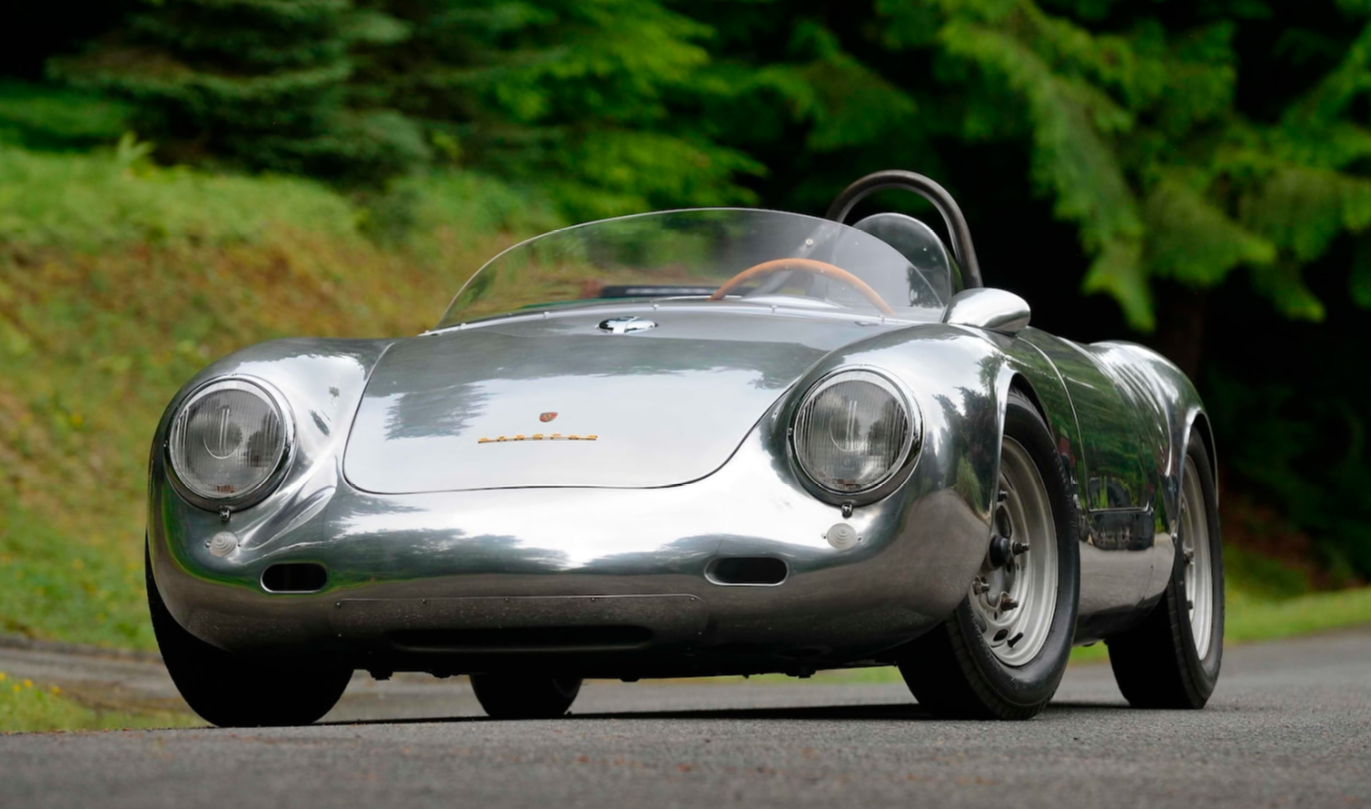
Elva Mk I/B

1956 Elva Mk I/B

Offered by Bonhams | Knokke-Heist, Belgium | October 5, 2018

Photo – Bonhams

Elva Engineering Co. Ltd. was founded by Frank Nichols in 1955. The first series of cars, the Mk I, were based on a previous Nichols creation, the CSM, and were sold as bare rigid tubular chassis with a live rear axle. Some assembly required.

In 1956 the Mk I/B was introduced and it came with an engine – a 1.1-liter Coventry  Climax straight-four. The streamlined fiberglass body was actually built by Falcon Shells and it’s estimated that only 14 were built. This example was road raced around the Midwest its first owner, seeing track time at the likes of Road America and more.

This car was expertly restored in the early 2000s and still shows very well. It is thought to be the final Mk I/B built and is expected to bring between $160,000-$260,000 at auction. Click here for more info and here for more from this sale.

Update: Sold $165,398.

Jaguar XJR-11

1990 Jaguar XJR-11 Group C

Offered by Bonhams | Chichester, U.K. | September 8, 2018

Photo – Bonhams

Jaguar was pretty heavily invested in Group C Prototype Sports Car racing in the late 1980s. They dominated in 1988 and had successes prior to that as well. But by the end of the decade, turbocharged cars were beginning to rule, so Jaguar worked with TWR (Tom Walkinshaw Racing, the team running their factory effort) to get in on the turbo action.

The XJR-11 was introduced in July 1989 and would be replaced by the XJR-14 for the 1991 season. The engine that they came up with was a turbocharged 3.5-liter V6 (for the Group C car, IMSA cars had a 3.0-liter version) capable of 750 horsepower. A slightly more reliable and de-tuned version of this engine would also power the XJ220 road car.

This particular chassis (490) competed in the 1990 World Sportscar Championship (WSC) with drivers Martin Brundle, Jan Lammers, and Alain Ferté. Turbochargers were outlawed in WSC for 1991, so this car went to Japan and competed in the 1991 All-Japan Sports Prototype Championship. Following that, it returned to TWR where it was restored and sold to a private owner.

The car competed in historic racing until 2010 when it was restored again to its WSC Silk Cut livery. This represents a pretty awesome opportunity to acquire a really good-looking, late Group C car in one of the best liveries of the era. It should bring between $1,500,000-$1,900,000. Click here for more info and here for more from Bonhams.

Update: Sold $1,542,582.

1992 Maserati Barchetta

1992 Maserati Barchetta

Offered by RM Sotheby’s | London, U.K. | September 5, 2018

Photo Courtesy of RM Sotheby’s

The Maserati Barchetta was a purpose-built race car from Maserati intended to compete in a one-make racing series, the Grantrofeo Monomarca Barchetta Maserati. They only built 17 of these and they went to well-heeled semi-professional drivers who competed against each other at tracks around Europe, but mostly in Italy. The series ran in 1992 and 1993 only.

All Barchettas are powered by a twin-turbo 2.0-liter V6 good for 315 horsepower. They’re very light, with fiberglass and carbon fiber bodies. The whole thing really wasn’t much of a success and Maserati wasn’t exactly flying high in 1992 to begin with.

They tried to make a road car variant, but only one prototype was built, although some of these are currently road-registered in Europe. The project sort of lived on briefly as the similar-looking De Tomaso Guara, but they had a slightly different body and engine. This particular chassis finished 4th in the first year of the Championship and you can read more here and see more from RM Sotheby’s in London here.

Update: Not sold.

The Winner of the 100th Indy 500

2012 Dallara-Honda DW12

Offered by Mecum | Monterey, California | August 25, 2018

Photo – Mecum

The DW12 was IndyCar’s new chassis beginning in the 2012 season. Named for the late Dan Wheldon, the DW12 is expected to be the series’ base chassis through the 2020 season. Built by Dallara, this chassis, #037, won the 2016 Indy 500 with rookie Alexander Rossi behind the wheel.

The engine in this car is a twin-turbo 2.2-liter Honda V-6 tuned to make about 625-ish horsepower. It still wears the distinctive blue and yellow NAPA livery that Rossi took to victory lane as well as the 2016 Honda Speedway aero kit. You’re probably wondering why this “2012” Dallara won the 2016 Indy 500. Well, here’s the Indy 500 competition history for this chassis:

  • 2012 Indianapolis 500 – 12th (with Alex Tagliani)
  • 2013 Indianapolis 500 – 24th (with Tagliani)
  • 2014 Indianapolis 500 – 20th (with Jack Hawksworth)
  • 2015 Indianapolis 500 – 16th (with Gabby Chaves)
  • 2016 Indianapolis 500 – 1st (with Alexander Rossi)

That’s right, it’s run five Indy 500s, winning the last time out (and what a race it was). The official entrant was Andretti Herta Autosport with Curb-Agajanian… which is a mouthful. Indy 500-winning cars rarely change hands and many of them are owned by the Speedway Museum itself. So it’s rare that one is out in the wild – especially one that could technically still compete. Here’s your chance to grab a piece of history. Click here for more info and here for more from this sale.

Update: Sold $1,127,500.

Patriarca 750 Berlina

1949 Fiat-Patriarca 750 Berlina Sport by Faina

Offered by RM Sotheby’s | Monterey, California | August 24-25, 2018

Photo Courtesy of RM Sotheby’s

With its almost-Porsche-like looks, this Patriarca 750 Berlina is one of many specials built on the backs of small Fiat road cars. Post War Italy didn’t have an economy to support a lot of fancy car sales, so companies like Fiat focused on small, affordable cars for the masses.

But that doesn’t mean Italians still didn’t love motorsport. So people like Rodolfo Patriarca and Carlo Abarth took to modifying these cars for sport. This car was based on a Fiat 500C and has an 81 horsepower, 750cc straight-four tuned for racing by Giannini.

Built by Patriarca for gentleman driver Sesto Leonardi, the competition history for this car includes:

  • 1950 Targa Florio – 3rd in class
  • 1950 Mille Miglia – 1st in class

It continued to race through 1953, with at least one more appearance at the Mille Miglia. It’s wonderfully restored and eligible for many historic events. You can read more here and see more from RM here.

Update: Not sold.

Ferrari 250 GTO

1962 Ferrari 250 GTO by Scaglietti

Offered by RM Sotheby’s | Monterey, California | August 24-25, 2018

Photo Courtesy of RM Sotheby’s

This, of course, is an example of the legendary Ferrari 250 GTO – the most sought-after car in the world, or at least according to its price. Bonhams set a record during the Pebble Beach weekend in 2014 selling another ’62 GTO for just over $38 million. So why feature another one of these grand touring cars? Well, because this one wears a different body.

The 250 GTO – or Gran Turismo Omologata – were homologated race cars built by Ferrari between 1962 and 1964. Only 36 were made and they’re powered by a 3.0-liter Colombo V-12 rated at 296 horsepower. This one has blue seats, which look pretty cool.

Most of the GTOs looked like this, including this car when new. For 1964, the final run of three cars were bodied with “Series II” coachwork. Four earlier, Series I cars, including this one, were rebodied in the more streamlined design. In fact, this was just the third 250 GTO constructed so it lived a solid two years with its first body before heading back to Scaglietti to match the 1964 cars. It is one of two with an extended roof like the 250 LM.

The competition history for this chassis includes:

  • 1962 Targa Florio – test car for Phil Hill and Mauro Forghieri
  • 1963 Italian 3-Litre GT Championship – 1st (with Edoardo Lualdi-Gabardi)
  • 1963 Targa Florio – 4th, 1st in class (with Gianni Bulgari and Maurizio Grana)
  • 1964 Targa Florio – 5th, 1st in class (with Corrado Ferlaino and Luigi Taramazzo)

Acquired by Greg Whitten (of Microsoft fame) in 2000, this 250 GTO is being offered for public sale. Obviously, no estimate is given, and RM Sotheby’s is requiring you to be vetted to even bid on this car. I guess you can’t have some schmo bidding $40 million on something when their net worth tops out in the seven-digit range. Anyway, it’ll sure be interesting to see what it brings – if it sells. Click here for more info and here for more from this sale.

Update: Sold $48,405,000.

Gulf-Mirage GR8

1975 Gulf-Mirage GR8

Offered by Gooding & Company | Pebble Beach, California | August 24, 2018

Photo – Gooding & Company

John Wyer is a name closely associated with Gulf Oil racing. He made a name for himself winning the 1959 24 Hours of Le Mans as a team owner with an Aston Martin. Ford hired him to run their GT40 program (it didn’t go well and he was replaced by Carroll Shelby). So he went out and created his own company, J.W. Automotive Engineering. And the race cars they built were called Mirages.

1967 was the first season for Mirage race cars and in 1975 their new car was called the GR8. It featured an aluminium monocoque chassis and a fiberglass body. Power came from a 482 horsepower, 3.0-liter Ford Cosworth V-8. It definitely has the look of one of those weird-in-retrospect 1970s prototype race cars. But it was pretty stout on track. The competition history for this chassis includes:

  • 1975 24 Hours of Le Mans – 3rd (with Vern Schuppan and Jean-Pierre Jaussaud)
  • 1976 24 Hours of Le Mans – 2nd (with Jean-Louis Lafosse and Francois Migault)
  • 1977 24 Hours of Le Mans – 2nd (with Schuppan and Jean-Pierre Jarier)
  • 1978 24 Hours of Le Mans – 10th (with Schuppan, Jacques Laffite, and Sam Posey), as Renault-Mirage M9
  • 1979 24 Hours of Le Mans – 24th, DNF (with Schuppan, Jaussaud, and David Hobbs), as Ford M10

A different GR8 won the race in ’75 and this car underwent some development along the way, becoming a Renault-Mirage M9 in 1978 when a smaller Renault engine was installed and in 1979 it got the Ford Cosworth engine it sports now, thus it was then called a Ford M10. But still, five years for the same chassis at Le Mans – with three podiums at that – is pretty impressive.

In 1987, the car was retrofitted with its 1978 GR8 bodywork and passed between several collectors. It’s well-sorted and wears the best livery in racing. It can be yours for between $2,500,000-$3,500,000. Click here for more info and here for more from this sale.

Update: Not sold.

Ferrari 250 MM

1953 Ferrari 250 MM Berlinetta by Pinin Farina

Offered by RM Sotheby’s | Monterey, California | August 24-25, 2018

Photo Courtesy of RM Sotheby’s

There are a lot of different “250” models from Ferrari. It started with the 250 S, then came this, the 250 MM. It would evolve into cars like the 250 Testa Rossa, 250 GTO, 250 P and 250 LM. And those are just the racing variants.

The 250 MM was a stout little thing produced in 1952 and 1953. The Colombo V-12 was enlarged to 2.5-liters and produced 237 horsepower when it was dropped into the slightly longer (than the 225) wheelbase of the 250 MM. Named for the famous Mille Miglia road race in Italy, and to commemorate Ferrari’s recent victory there, the 250 MM was one of the premier racing cars for independent drivers of the early 1950s.

This particular car saw action on the privateer sports car circuit in Sweden when new. Down the line, this car was owned by racing driver Jo Bonnier and was eventually registered in Switzerland. Later owners had the car in Italy, England, France, Germany, and finally the United States. In beautiful condition after a recent cosmetic freshening, this will be another of RM’s mega-dollar cars in Monterey. It is one of just 31 250 MMs built and one of only 18 such cars that wear a Pinin Farina Berlinetta body. Click here for more info and here for more from this sale.

Update: Not sold.

Aston Martin DP215

1963 Aston Martin DP215 Grand Touring Competition Prototype

Offered by RM Sotheby’s | Monterey, California | August 24-25, 2018

Photo Courtesy of RM Sotheby’s

How do you make an Aston Martin DB4GT look downright pedestrian? Well the DB4GT is one of the most sought-after competition Astons… so you’ll have to show up with something pretty intense. Well how about this DP215? It’s the only one the factory made and they built it exclusively for Le Mans.

Aston returned to works sports car racing in 1962 with the DP212, or Design Project 212. It had some aerodynamic issues (like you know, wanting to take off at high speed) and they evolved the car from there. A pair of DP214s raced the 1963 sports car season and the DP215 was the ultimate evolution. It’s a one-off car built to show what Aston’s engineers were capable of. Aerodynamic and with a Kamm tail, this car was extremely fast, hitting just a tick over 198 mph on the Mulsanne Straight.

It’s powered by a 4.0-liter straight-six with aluminium heads that’s good for 323 horsepower. Driven by Phil Hill and Lucien Bianchi at the 1963 24 Hours of Le Mans, this car was 12 seconds a lap faster than a 250 GTO. It ultimately retired due to gearbox failure.

Aston held on to the car until the 1970s, even after selling all of the other DP cars. The engine was separated and wasn’t reunited with the car until about 15 years ago. It’s been expertly restored and it’s been used. As a one-of-one Aston works racer, it’ll bring big money. The proof is that you need to be pre-approved by RM Sotheby’s to even bid on this car. Click here for more info and here for more from this sale.

Update: Sold $21,455,000.

Porsche 550A Spyder

1958 Porsche 550A Spyder

Offered by Mecum | Monterey, California | August 23-25, 2018

Photo – Mecum

Have you ever seen one of these in person? Or, I guess, have you ever heard one? They’re loud. And it is intoxicating.

The 550 Spyder was a race car (that you could drive to the track) from Porsche that was available from 1953 through 1956. The 550A was an evolution of the original car and was only available in 1956.

The differences included a tubular space frame (as opposed to the normal 550 Spyder’s ladder frame). This increased rigidity and decreased weight. The transmission got an extra gear (up to five) and the wheels lost an inch in diameter. The improvements were designed to increase the car’s competitiveness on track. The 1.5-liter flat-four was a carryover, but made 135 horsepower in this trim.

This car is thought to have originally been owned by the Piech family (they who own 10% of Porsche today) before being sold to its first owner: a famed Austrian concert pianist and composer. And he raced the pants off this car, winning circuit races and hillclimbs in the late 1950s in Austria and Yugoslavia.

After that it went to the U.S. and spent a lot of time in SCCA races. The current owner found the car over 30 years ago and spent most of the time since restoring it. It shows fewer than 600 miles since restoration. Only 39 examples of the lightweight 550A were built, making this a big money car at Mecum in Monterey. Click here for more info and here for more from this sale.

Update: Not sold, high bid of $2,000,000.