300B by Boano

1956 Chrysler 300B Coupe Speciale by Boano

Offered by RM Sotheby’s | Monterey, California | August 18-19, 2023
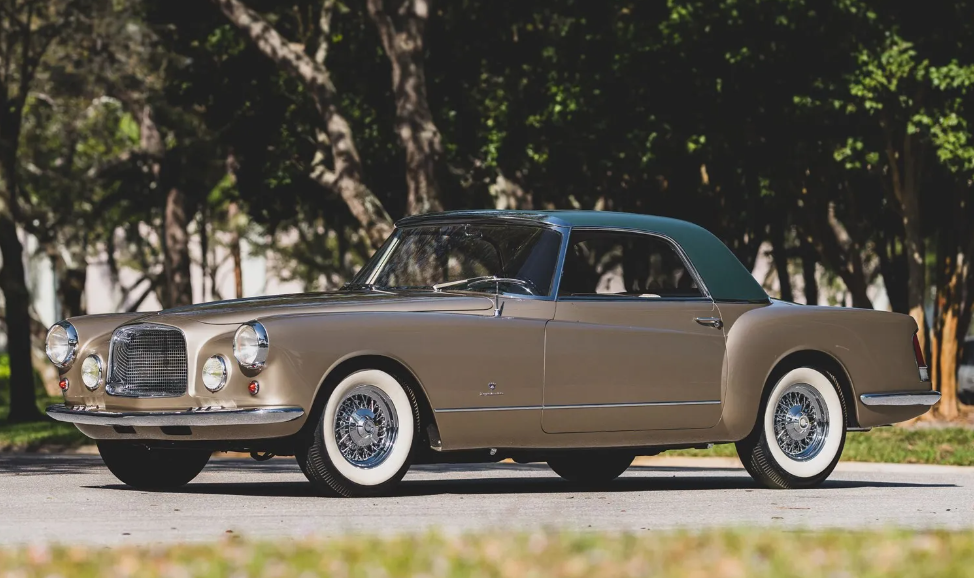
Photo Courtesy of RM Sotheby’s

Chrysler had quite the Italian coachbuilding hookup in the 1950s. But this car really wasn’t their creation. It was built at the behest of Gianni Agnelli, of the family that owned Fiat. Why he chose a Chrysler 300B is beyond anyone, but he did. And this is the result.

It’s different but pretty similar to the other Chrysler Ghia specials of the era (Felice Boano had worked at Ghia before starting out on his own). Just 1,102 Chrysler 300Bs were built in 1955, and they were powered by a 5.8-liter FirePower V8 that made 355 horsepower.

This is one of two Boano-bodied cars on an American chassis with an American engine (this is the other). Agnelli did not take delivery of the car, as Fiat/Chrysler was still decades and decades away. It came to the U.S. in 1989 and was restored after its current owner bought it in 2018. Awards at Pebble and Villa d’Este followed. Now it’s for sale, and you can read more here.

Update: Sold $1,105,000.

Alain de Cadenet’s Duckhams LM

1972 Duckhams-Ford-Cosworth LM72

Offered by Aguttes | Neuilly, France | April 27, 2023

Photo – Aguttes

This is a car with a great story. Alain de Cadenet was an English racing driver (and later pretty awesome TV presenter if you like old cars). He raced at Le Mans 15 times, including with cars of his own design. In 1971, he ran Le Mans in a Ferrari 512M. The next year he tried to buy a Ferrari 312 PB, which the company refused to sell to a privateer, as it was based on their F1 car and thus too extreme for an “amateur.”

So he thought of something else. De Cadenet owned a Brabham BT33 F1 car himself, a car which he entered in two 1971 F1 races for his friend and endurance racing co-driver, Chris Craft. So he asked Brabham if they could turn it into a full-bodied sports racing prototype. Bernie Ecclestone, who had just bought Brabham, pointed de Cadenet to a young designer named Gordon Murray.

Over the course of six weeks, Murray designed this. But it needed a new engine – so de Cadenet went to McLaren and bought Bruce McLaren‘s 1968 Belgian Grand Prix-winning Cosworth DFV (as one does). Then he convinced lubricant manufacturer Duckhams to sponsor the whole ordeal. And by June, they were on the grid at Le Sarthe. The competition history includes:

  • 1972 24 Hours of Le Mans – 12th (with Alain de Cadenet and Chris Craft)
  • 1973 24 Hours of Le Mans – 45th, DNF (with de Cadenet and Craft)
  • 1974 24 Hours of Le Mans – 26th, DNF (with Craft and John Nicholson)

For the ’73 race the car received longtail bodywork by Murray, and in 1974, with de Cadenet sidelined with an injury and the Duckhams sponsorship deal over, the car raced as a de Cadenet LM72. Which is pretty awesome, even if he didn’t get to drive it.

The car was restored in 2002 to how it competed in 1972, including with a 3.0-liter Cosworth V8. In period, it also competed in Interserie and Can-Am events. More recently, it’s been active at the Le Mans Classic. The estimate now is $1,600,000-$2,750,000. Click here for more info.

Update: Not sold.

Ferrari Monza SP1

2019 Ferrari Monza SP1

Offered by RM Sotheby’s | Cernobbio, Italy | May 20, 2023

Photo Courtesy of RM Sotheby’s

Here is a very limited-edition special late-model Ferrari. The Monza SP1 and SP2 were roofless sports cars – errr, collector’s items, produced by Ferrari starting in 2019. The difference between the cars are the number of seats. The SP1 is a single seater, while the SP2 has a passenger seat.

The cars are actually based around the Ferrari 812 Superfast and share that car’s 6.5-liter V12, which is rated at 798 horsepower in Monza form. 60 mph arrives in under three seconds.

This car was delivered new in Spain and has been with its current collection since 2022. Most of these presumably just sit in collections. Ferrari planned a run of 499 examples. This one is selling at no reserve. Click here for more info.

Update: Sold $2,569,538.

Pescarolo 01

2011 Pescarolo-Judd 01

Offered by Aguttes | Neuilly, France | April 27, 2023

Photo – Aguttes

Henri Pescarolo ran 57 Formula One races and won the 24 Hours of Le Mans as a driver four times for Matra-Simca and Porsche. He founded Pescarolo Sport in 2000 to race (and later build) Le Mans prototype racers. And for a while, their Courage chassis were the second-best LMP1 cars on the grid after the all-too-dominant Audis.

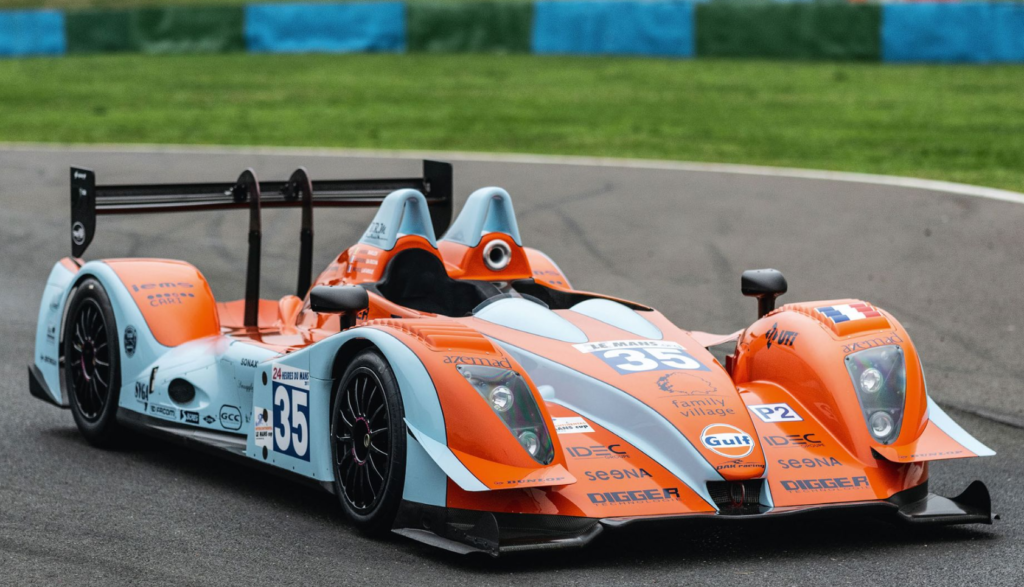
For 2007, the team decided to try their hand with a machine of their own design. The Pescarolo 01 was built for use in both LMP1 and LMP2 categories. This particular chassis, 013, features a 3.6-liter Judd V8 that made about 510 horsepower. Outfitted in LMP2 spec, this car was used by the OAK Racing team and carries Gulf colors. It’s competition history includes:

  • 2011 24 Hours of Le Mans – 25th (with Frederic Da Rocha, Patrice Lafargue, and Andrea Barlesi)

The car has since been overhauled and now carries an estimate of $440,000-$660,000. Click here for more info.

Update: Not sold.

Daimler Dart

1960 Daimler SP250

Offered by H&H Classics | Buxton, U.K. | April 26, 2023

Photo – H&H Classics

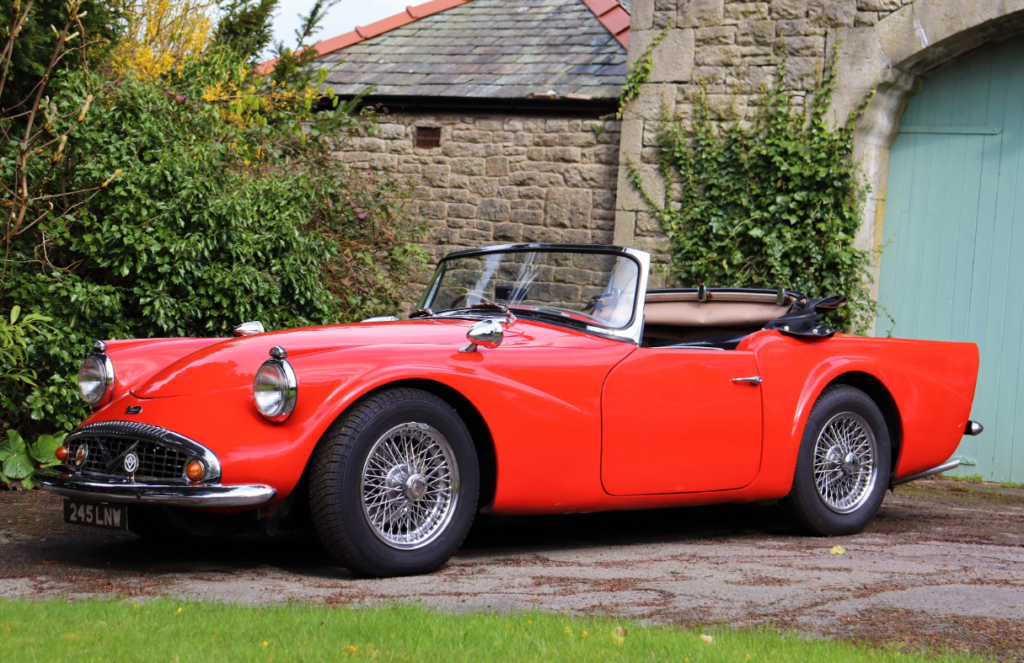
The SP250 was a British sports car from an unlikely source: Daimler, who up to this point had primarily made stodgy saloons and drophead coupes. After this point, they would be reduced to selling badge-engineered Jaguars. So it’s kind of amazing this car ever made it to production.

It debuted at the 1959 New York Motor Show as the “Dart” – which Chrysler obviously did not appreciate. So it was renamed the SP250 when production got under way shortly thereafter. Just 2,654 examples would be produced through 1964. We’ve featured one before – a prototype with a retractable hardtop.

The cars are powered by a very un-British engine: a 2.5-liter V8 designed in-house. Output was rated at 140 horsepower. This U.K.-market example was repainted about 15 years ago. It remains an interesting alternative to the Triumphs and MGs of the era. The estimate is $37,000-$42,000. Click here for more info.

Update: Sold $35,801.

Spyker/Force India

2007 Spyker F8-V11/Force India VJM01

Offered by Bonhams | Goodwood, U.K. | April 16, 2023

Photo – Bonhams

Spyker F1 bought out the Midland F1 team late in the 2006 Formula One season. This was a big leap for what was already a struggling boutique road car manufacturer. 2007 would be the team’s only full year running under the Spyker name.

Late in the 2007 season, Vijay Mallya stepped in to buy the financially doomed team, and it would be renamed Force India for 2008. Spyker raced their Ferrari-powered F8-VII (and VIIB) for the season with drivers Adrian Sutil (who scored Spyker’s only championship point) and Christijan Albers. Albers was let go halfway through the year and was replaced by Markus Winkelhock (for one race) and Sakon Yamamoto for the rest.

Force India’s first F1 entry was the VJM01, which was just an updated version of the previous year’s Spyker chassis. So they literally just updated the existing cars and reused them for the season. This particular chassis, VJM01-04, was a Spyker in 2007 and a Force India in 2008. It’s competition history includes:

  • 2007 French Grand Prix – 17th (with Adrian Sutil)
  • 2007 British Grand Prix – 15th (with Christijan Albers)
  • 2007 European Grand Prix – 17th, DNF (with Markus Winkelhock)
  • 2007 Hungarian Grand Prix – 22nd, DNF (with Sakon Yamamoto)
  • 2007 Italian Grand Prix – 20th (with Yamamoto)
  • 2007 Belgian Grand Prix – 17th (with Yamamoto)
  • 2007 Japanese Grand Prix – 12th (with Yamamoto)
  • 2007 Chinese Grand Prix – 17th (with Yamamoto)
  • 2007 Brazilian Grand Prix – 21st, DNF (with Yamamoto)
  • 2008 Monaco Grand Prix – 18th, DNF (with Giancarlo Fisichella)
  • 2008 Canadian Grand Prix – 14th, DNF (with Fisichella)

The highlight there is the 2007 European Grand Prix, one that featured a monsoon that saw a large number of the field end up in the gravel right after the start. Winkelhock pitted for wet tires at the end of the formation lap, a move that led to him leading the race when all hell broke loose. Then it was red-flagged and he lost his advantage, eventually retiring with electrical issues, probably because of the rain. It was Winkelhock’s only F1 start.

In period, this car would’ve had a 2.4-liter Ferrari V8 making about 750 horsepower (for both seasons). Now it’s just a roller with a $100,000-$125,000 estimate. Click here for more info.

Update: Sold $70,379.

’56 Lincoln Premiere

1956 Lincoln Premiere Coupe

Offered by Mecum | Indianapolis, Indiana | May 12-20, 2023

Photo – Mecum

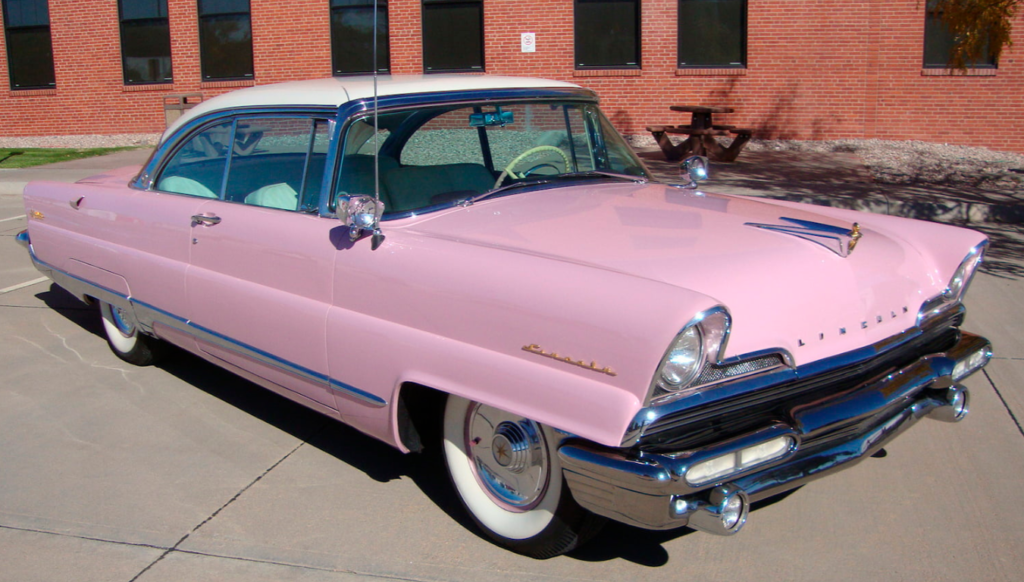
This is the best Lincoln of the 1950s. I mean, the Continental Mark II is pretty great, but it’s not technically a Lincoln. The ’56 Premiere, specifically a coupe in pink, is one of the ideal ’50s American cruisers.

The Premiere nameplate debuted for 1956, and a second generation would launch in 1958 before disappearing after 1960. Three body styles were offered this year, and this example is one of 19,619 coupes made.

Power is provided by 6.0-liter V8 rated at 285 horsepower. The want is strong, and it’s unclear if this one has been restored, but the interior doesn’t appear so (it’s two-tone white and pink just like the exterior). Click here for more info.

Update: Sold $40,700.

JBM Sports

1947 JBM 3.9-Litre Sports

Offered by Bonhams | Goodwood, U.K. | April 16, 2023

Photo – Bonhams

This may look like a kit car from the 1980s that was trying to approximate a post-war sports special. But it actually is a post-war sports special. Jim Boothby was an RAF pilot during the war and established Jim Boothby Motors (JBM) in 1946.

The JBM Sports used surplus Ford V8 engines and refurbished pre-war Ford V8 chassis. Body work was done in the cycle-fendered style of the day. This car has a 3.9-liter Ford V8 that was built in Canada in 1949. It’s estimated to make 110 horsepower.

Only about eight examples of the JBM sports car were built through 1950. The company even had plans of entering Formula One, but they never came to fruition. This is the only survivor. It has an estimate of $25,000-$35,000. Click here for more info.

Update: Sold $23,929.

McLaren M81

1980 McLaren M81 Mustang

Offered by Mecum | Indianapolis, Indiana | May 12-20, 2023

Photo – Mecum

Is this a McLaren or a Ford? Well, kind of both. The Fox-Body Mustang debuted for 1979 to replace the much-unloved Mustang II. It was a return to the Mustang’s true self, and Ford wanted to prove they were serious, so they teamed up with McLaren Performance to build a special Mustang.

These started as a regular Mustang until they were sent to McLaren, where their turbocharged, 2.3-liter inline-fours were torn apart and rebuilt to a higher spec by McLaren. This bumped output from 132 horsepower to 175. They also received steel fender flares, a pretty crazy hood, functional brake ducts, and BBS wheels. This particular one is the only one with a four-speed manual gearbox (the rest had five-speeds).

The plan was to build about 250 of these with a price tag of $25,000. But Ford formed their Special Vehicle Operations team, and the SVO Mustang was soon on its way. Only 10 M81s ended up being built, and this was the original prototype that was also used as a dealer demonstrator. It is one of seven finished in Bittersweet Orange.

This is a pretty special car, and the most special Fox-Body Mustang there is. It’s also the missing link between the McLaren sports cars of the 1960s and the outrageous supercars of the 1990s and 2010s. Click here for more info.

Update: Sold $82,500.

Palmer-Singer

1911 Palmer-Singer Model 4-50 Seven-Passenger Touring

Offered by Bonhams | Middletown, Rhode Island | April 29, 2023

Photo – Bonhams

Yes, that Singer. Charles Singer was part of the Singer sewing machine family, and he joined with barrel maker Henry Palmer to start a Simplex, Matheson, and Isotta Fraschini dealership in Manhattan. The next year, 1908, they started building their own cars in Long Island City.

The company’s 1911 model range constituted four cars, with the 4-50 positioned as the second most powerful. It’s powered by a 50-horsepower, 8.2-liter inline-four. It has a four-speed manual transmission and rear drum brakes. Six body styles were offered, and the seven-passenger touring retailed for a hefty $3,900.

This car has had three owners since new and has been in the same family since 1956. It was restored from ’56 through 1960 and is the only four-cylinder Palmer-Singer left (and the only 4-50). The estimate is $400,000-$500,000. Click here for more info.

Update: Sold $555,000.