Roadmaster Sport Phaeton

1939 Buick Roadmaster Model 80C Sport Phaeton

Offered by RM Sotheby’s | Ft. Lauderdale, Florida | April 7, 2018

Photo Courtesy of RM Sotheby’s

The Roadmaster is one of the most storied models in Buick’s history. First introduced in 1936 as their second-most luxurious offering, the Roadmaster would be produced uninterrupted (except for the war) through 1958. It made a brief reappearance from 1991 through 1996. The second generation of the model was sold in 1938 and 1939 only.

This model of Roadmaster was powered by a 141 horsepower, 5.2-liter Fireball straight-eight. Five body styles were offered and the 80C was the four-door, six-passenger Sport Phaeton. When new, it cost $1,938 – the most expensive Roadmaster. Unfortunately, Buick only found three customers for this car. That’s right, only three were built, making this far and away the rarest 1939 Buick. One of those three was used as the pace car for the 1939 Indianapolis 500.

It’s unclear if this was that car, likely not, as it was restored in the 1990s to look like the car that did lead the field to the green flag in May of 1939. It’s a large and striking automobile that has been shown here and there. This is your chance to acquire one of the rarest Buicks ever built. It should cost between $65,000-$75,000. Click here for more info and here for more from RM in Florida.

Update: Sold $56,100.

1911 De Dion-Bouton

1911 De Dion-Bouton DE1 Two-Seat Tourer

Offered by Brightwells | Bicester, U.K. | April 11, 2017

Photo – Brightwells

De Dion-Bouton was the first automotive giant. By 1900 they were producing 400 cars a year and over 3,000 engines that were used by car makers all over the world. Single-cylinder De Dion engines were ubiquitous in the early days of the automobile.

In 1911, the DE1 was the entry-level De Dion-Bouton offering and it’s powered by one of those legendary single-cylinder engines. In this case, a 720cc unit capable of six horsepower. It was among the final cars to carry their famous single-cylinder as the company moved toward larger cars. Ultimately the company ceased car production in 1932.

The history of this model is known back only a few decades. Within the last ten years the car has been repainted and the engine rebuilt. It’s well-optioned for a car of its age, carrying many period accessories. Brightwells took this car to auction a few months ago and we regrettably failed to feature it. Lucky for us it didn’t meet its reserve and it’s back for us to oogle. It should bring $35,000-$40,000. Click here for more info.

Update: Not sold.

Bristol 401

1950 Bristol 401

Offered by Artcurial | Paris, France | April 8, 2018

Photo – Artcurial

When WWII ended, it left some companies wondering what they were going to do – especially those who were focused 100% on wartime production like the Bristol Aeroplane Company was. But if you’ve mastered production of vehicles (be it airplanes or trucks), cars are a logical next road to go down. And that’s just the path Bristol took.

Their first car was the 400 and this 401 two-door sedan was their second automobile. The first Bristols were sort of based on BMW models, which is probably why this thing looks a lot like a BMW 327. The 401 was available from 1948 through 1953 and a convertible variant, the 402, was built in 1949 and 1950 only. Only 611 examples of the 401 were built.

The aluminium body is by Touring and the engine is from the BMW 328. It’s a 2.0-liter straight-six making 85 horsepower. Bristol is still out there, barely, as one of the most exclusive car companies on the planet. To get your hands on this one will run you between $50,000-$75,000. Click here for more info and here for the rest of Artcurial’s lineup.

Update: Sold $38,167.

The Original NSX

1991 Acura NSX

Offered by RM Sotheby’s | Ft. Lauderdale, Florida | April 7, 2018

Photo Courtesy of RM Sotheby’s

The fact that this 1991 Acura NSX is technically a “historic vehicle” kind of makes me sad. And feel old. This was the most exotic Japanese car of its era. It had supercar looks and supercar construction coupled with Japanese build quality and efficiency. That’s a great combo.

It’s a mid-engined car with a transversely-mounted, naturally-aspirated 3.0-liter V-6 making 270 horsepower. It redlined at 8,300 rpm. It’s an amazingly even-keeled car, handling wise – which probably has something to do with Aryton Senna’s input during development.

The NSX was sold as an Acura in North America and as a Honda everywhere else. Introduced near the tail end of 1990, the first generation of the NSX was built through 2005 which included a hefty styling update in 2002. This example shows 14,700 miles and retains it’s 1991 car phone! It’s still a head turner and the values on nice examples will continue to climb as people look for the pure driving experience offered by the NSX. This one should bring between $70,000-$90,000 – proof that prices are on the way up. Click here for more info and here for more from RM in Ft. Lauderdale.

Update: Sold $71,500.

Palladium

1923 Palladium Victory Super Sports

Offered by Brightwells | Bicester, U.K. | April 11, 2018

Photo – Brightwells

Palladium was a British car company that got their start in 1910 importing and selling French commercial vehicles as their own. Cars followed in 1912 and they were still largely French though they sported English coachwork.

After WWI, Palladium got back into the commercial vehicle business but this time they were building trucks of their own design. When they needed something more profitable, they reintroduced cars to their range in 1922. This model, likely a Victory tourer, features a Dorman 1.5-liter straight-four rated at 12 horsepower. In Victory form it was capable of 60mph – which, while scary, wasn’t so bad as these cars were fitted with front brakes.

This car is listed as “largely complete” and it has been partially restored but it’s not quite done. As you can probably see, the interior is mostly absent. Palladium cars are rare, even in this condition (only 280 were built between 1922 and 1925 when the company closed). This project is expected to bring between $10,000-$13,000. Click here for more info.

Update: Sold $18,342.

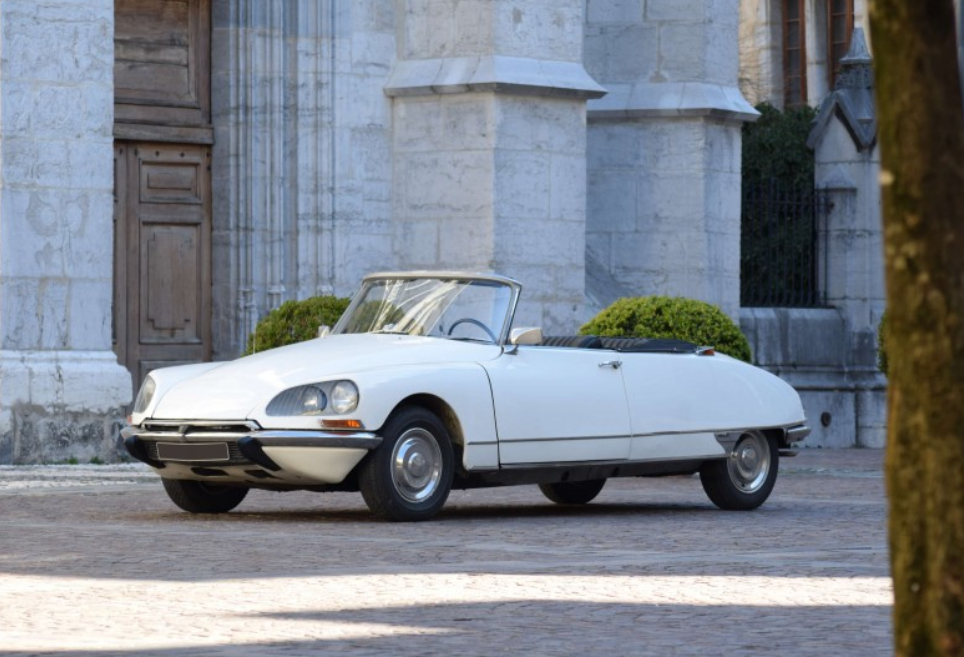
DS 21 Cabriolet d’Usine

1968 Citroen DS 21 Cabriolet d’Usine

Offered by Artcurial | Paris, France | April 8, 2018

Photo – Artcurial

The Citroen DS is one of the classic French cars. In production for 20 years (from 1955 through 1975) it was offered in a variety of submodels and body styles. The DS 21 was introduced for the 1965 model year and featured a few improvements over the original DS 19 models, namely it offered electronic fuel injection – one of the first mass market cars to do so.

The DS 21 also had a larger engine: a 2.2-liter straight-four making 109 horsepower. It would later be one-upped in 1973 by the 141 horsepower DS 23. The DS is also famous for its hydropneumatic suspension: there aren’t springs at each wheel but rather, a hydraulic accumulator. The effect was akin to floating down the road. For extra weirdness, the DS came with a single spoke steering wheel. Why not?

Most DS models were sedans, but Citroen did offer a factory convertible (or “Cabriolet d’Usine”) which was actually bodied by Henri Chapron. It was only sold between 1958 through 1973 and in very limited numbers – just 1,365 factory convertibles were built. and this is one of only 95 built in 1968. Chapron bodied some other DS convertibles outside of these “factory” cars and they are even more expensive.

The consignor has owned this car since 2000 and it was restored since that acquisition. DS Cabriolets are some of the most common-looking big money French cars out there. This one is estimated to bring between $160,000-$250,000. Click here for more info and here for more from this sale.

Update: Sold $156,745.

Continental Mark II

1956 Continental Mark II

Offered by Mecum | Houston, Texas | April 5-7, 2018

Photo – Mecum

Here is one of the loveliest American cars of all time. When it was released in 1956, it was the most expensive car sold in America. In 1956 the base price was $10,400 – the same as a Rolls-Royce and double the price of a Cadillac. And this was no Lincoln. Ford knew they were making a special car and created the Continental Division to produce this car under a separate marque.

It was so opulent that it only lasted two years, through 1957. It’s powered by a 285 horsepower, 6.0-liter V-8 (the ’57s got 300 horsepower). While Mark IIs look best in white (opinion) I really love this 1950s pastel blue with wide whitewalls. The interior is the same shade of blue, mixed with white.

In beautiful condition, this Mark II was once owned by socialite Lolita Armour. It’s one of just 2,550 examples built in 1956 and one of only 2,996 built in total. They’re rare, but they’re around. Click here for more info on this one and here for more from Mecum in Houston.

Update: Not sold, high bid of $42,000.

Update: Not sold, Mecum Indy 2018, high bid of $35,000.

Update: Not sold, Mecum Harrisburg 2018, high bid of $40,000.

March 2018 Auction Highlights, Pt. II

We’re back with more from Amelia Island, this time with RM Sotheby’s. One of the Duesenberg’s we featured failed to sell, but the other one, a Hibbard & Darin-bodied example brought $995,000. Speaking of Hibbard & Darin, this previously-featured Hispano-Suiza failed to find a new home at Amelia Island this year. The top sale was $2,205,000 paid for this 1966 Ferrari 275 GTB.

Photo Courtesy of RM Sotheby’s

We featured a trio of Porsches from this sale, all 1993 911s. The RS 3.8 brought the biggest money: $1,655,00 followed by the RSR racing version of the same car for $1,270,000. And the RS America sold for a comparatively paltry $190,400.

On the British side, the Arnolt-Bristol sold for $401,000 and the Healey Westland $218,400. You can see all of the results from this sale here.

Motostalgia was the fourth sale at Amelia Island this year. The overall top sale was this 2005 Mercedes-Benz SLR McLaren that brought $260,000.

Photo – Motostalgia

A Chevy Beauville Wagon we featured a few weeks ago sold again here for $19,800. Click here for more results.

We move next to Mecum in Kansas City where it finally happened: a Demon was the top sale. In this case it was this poorly-photographed 2018 Dodge Challenger SRT Demon (with crate!) for $130,900.

Photo – Mecum

The Tesla Roadster we featured sold for $55,000 and you can see the rest of the results here.

The first of Bonhams’ Goodwood sales was held in March. The top seller was this 1967 Aston Martin DB6 for $259,671.

Photo – Bonhams

The Attila race car we featured failed to meet its reserve, but the Amilcar sold for $95,756 and the Cannon GT brought $31,256. Click here for complete results.

And finally, a sale from Brightwells, which consisted of a bunch of cars from that giant collection Jaguar Land Rover bought a few years ago and didn’t want (because they were too ordinary or just didn’t have space for 450 cars). We featured three unusual British cars: a Rover Estoura ($13,578), Vauxhaull Velox Friary ($12,729), and a Princess 2200 ($3,111). The top sale was this 2002 Mercedes-Benz CL63 AMG that brought $29,136. Click here for more results.

Photo – Brightwells

Aston Martin Cygnet

2011 Aston Martin Cygnet

Offered by Leclere MDV | Avignon, France | March 25, 2018

Photo – Leclere MDV

As a fan of obscure cars from big manufacturers (even those from Aston Martin), this 2011 Aston Martin Cygnet really hits the spot. The car is essentially a fancy version of the Toyota/Scion iQ city car sold all over the world. It got the Aston grille and a nicer interior. If they haven’t already, people will completely cease to remember this car ever existed in another five years.

Probably because it was still a Toyota underneath. No silky-smooth V-12 power plant here. The engine is a puny 97 horsepower 1.3-liter straight-four. So with that in mind, the question you’re probably asking is “Why?” Well Aston Martin decided they needed to meet the 2012 European Union fleet emissions regulations and by offering a car that got 60 mpg they could continue to build other insanely powerful road cars.

It’s easy to question their strategy of re-branding a Toyota now (well, it was then too) but, as you might expect, it failed spectacularly. They planned to sell about 4,000 of these a year at a price of about $45,000. Initially they were only sold in the U.K. and at one point Aston dealers in the U.K. were giving them away if you bought a DBS, DB9, or V8 Vantage (according to the auction catalog). Over two years of production, they managed to sell just 143 of these in the U.K. (there may have been another 150-ish sold elsewhere but I can’t verify that). Having covered 34,000km, this car is still expected to bring $48,000-$62,5000, proving even un-sellable cars appreciate if they have the right badge. Click here for more info and here for the rest of this auction’s lineup.

Update: Not sold.

Venturi 260 APC

1991 Venturi Coupe 260 APC

Offered by Osenat | Fontainebleau, France | March 24, 2018

Photo – Osenat

We’ve said it before and we’ll say it again: we love Venturis! Founded in the 1980s, the first Venturi road cars went on sale in 1987. The first series of models, the Coupes, were built into 1996 (the 260 LM was the final iteration).

This is a Coupe 260 APC. It was built from 1990 through 1996 and is powered by a turbocharged 2.8-liter V-6 making 260 horsepower. The APC model was thus named because it is equipped with a catalytic converter. Sixty mph arrives in 5.2 seconds.

Only 70 examples of the 260 APC were built and this carries chassis #21. This car is in good shape with exterior yellow paint and a blue interior. Venturis are always cool and this car is no exception. It should bring between $43,000-$55,000. Click here for more info and here for more from this sale.

Update: Sold $52,101.