Maserati 8C 3000

1933 Maserati 8C 3000 Biposto

Offered by Bonhams | Amelia Island, Florida | March 10, 2016
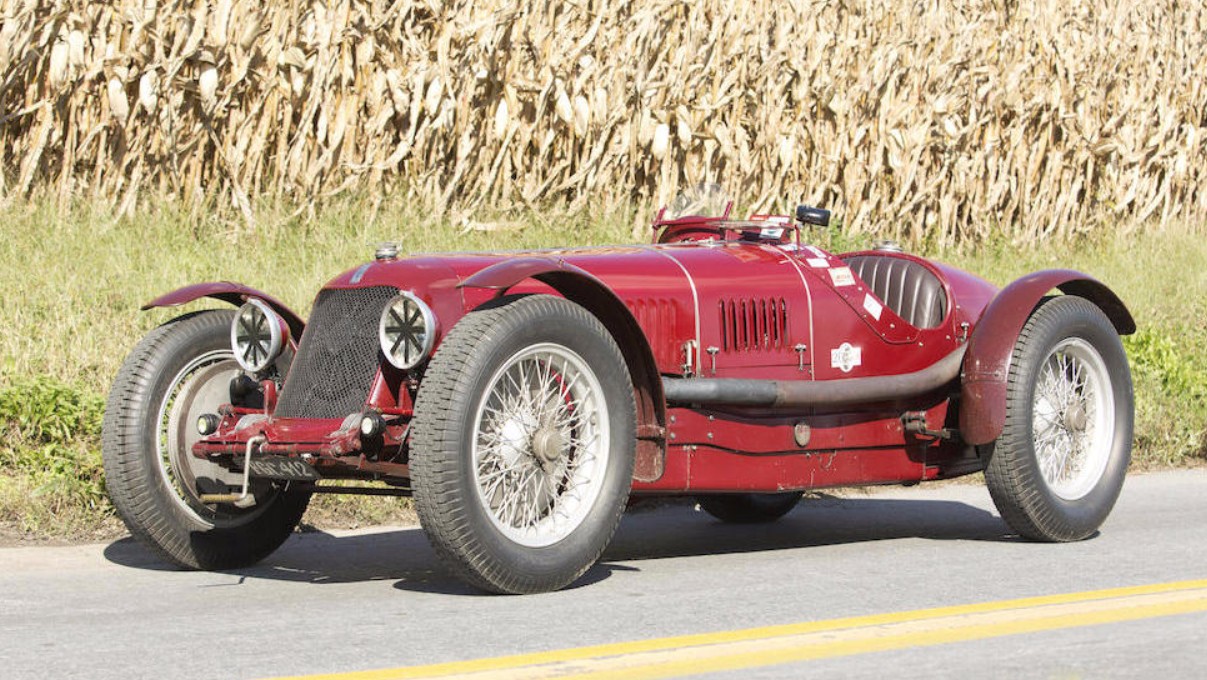
Photo - Bonhams

Photo – Bonhams

Well here is a serious race car. Pre-war Maserati racers were some of the best in their day, competing head-to-head against the likes of Alfa Romeo and Bugatti. The Maserati Tipo 26M gave way to the 8C 2800. When their eight-cylinder engine was upped in capacity, the 8C 3000 was born in 1931. This is the fourth 8C 3000 built and it was built in 1932 for the 1933 season. The 8C 3000 was the final two-seater Grand Prix car Maserati built.

It’s powered by a 2.8-liter straight-eight engine, supercharged to make 220 horsepower. The crankcase for this car was discovered in the 1960s and later an axle was found (along with some other parts). The car is reconstructed of parts but is faithful to the original. There are two existing 8C 3000s that are more complete, but this is still a special car.

It’s one you can use in historic racing – or even on the road. It’s fast, powerful, light and it probably sounds glorious. No pre-sale estimate is being provided so it should be expensive. Click here for more info and here for more from this sale.

Update: Sold $1,001,000.

Jaguar E-Type Competition

1961 Jaguar E-Type 3.8 Competition Roadster

Offered by H&H Classics | Duxford, U.K. | April 20, 2016

Photo - H&H Classics

Photo – H&H Classics

Jaguar offered two special race car versions of the E-Type: the Low Drag Coupe and the Lightweight. This is neither of those things, even if it is a factory race car. By the time the E-Type arrived in 1961, Jaguar had ceased their factory racing program and, because they still understood the marketing value of one, they offered seven of the first eight (not the very first car, but the next seven) E-Types as race cars.

What that meant was that select people would be sold these cars to take racing as privateers. This car is one of two that went to John Coombs. It was on the track by March of 1961. The engine is the Series I 3.8-liter straight-six which made 265 horsepower in road car form, but these seven racers had a higher compression ratio and competition gearbox, among other special items.

This car has a couple of huge things going for it: first, it’s a fantastically early example of the E-Type (it carries chassis #850007). It’s one of the first eight E-Types built. Additionally it has period race history as a factory-built (but not campaigned) racer – a thing not many E-Types can say. And: it’s one of only seven such E-Types built – and some of those (including the sister John Coombs car) were later reworked into Lightweights. And some of these first seven cars are now just road cars. It’s amazing! And it should be no lightweight at auction, with a pre-sale estimate between $1,000,000-$1,300,000. Click here for more info and here for more from this sale.

Update: Sold $1,227,250.

EB110 Race Car

1995 Bugatti EB110 SS Competizione

Offered by Artcurial | Paris, France | February 5, 2016

Photo - Artcurial

Photo – Artcurial

The Bugatti EB110 was the Italian Bugatti – built during the 1990s supercar craze by Romano Artioli in Modena. It was a serious supercar, too: with a 3.5-liter quad-turbocharged V-12 making 611 horsepower and capable of 216 mph, it backed up its looks with performance.

But what Bugatti didn’t do in these years, was go racing. In fact, most of the supercar manufacturers of the 1990s didn’t take these wild things racing. It was left mostly in the hands of privateers. Enter Gildo Pallanca Pastor, a wealthy Monegasque businessman who loved to race. His Monaco Racing Team got permission from Bugatti to take the EB110 sports car racing.

They got the car approved and entered it in the IMSA Championship in the U.S. The driver lineup was Gildo Pastor and Patrick Tambay. They entered five races and then set their sights on Le Mans. However, by the time Le Mans rolled around in ’95, Bugatti was bankrupt – luckily Pastor had the money to keep going. Tambay had a wreck in qualifying and, being a privateer with one car and limited spares, they weren’t able to get the car repaired in time for the race. “Did not start” is what the record book reads.

This car is road-registered in Monaco and is in fabulous condition. There was one other EB110 that ran at Le Mans in ’94, but that’s it as far as EB110 race cars are concerned. This one should bring between $875,000-$1,300,000. Click here for more info and here for more from this sale.

Update: Sold $1,055,133.

Ferrari 335 S

1957 Ferrari 335 S by Scaglietti

Offered by Artcurial | Paris, France | February 5, 2016

Photo - Artcurial

Photo – Artcurial

What you’re looking at could be the second-most expensive car ever sold at auction. This rare Ferrari racer is just one of four made and carries a pre-sale estimate between $30,315,000-$34,650,000. That is some serious dough. But we’re getting ahead of ourselves…

The Ferrari 335 Sport was an evolution of the earlier 315 S that was built in 1957. The 1957-1958 335 S was powered by a 4.0-liter V-12 making a handy 390 horsepower. It was a car built to dominate the Mille Miglia – and it ended up ending the race.

This car began life as a 315 S and in that form competed in two races:

  • 1957 12 Hours of Sebring – 6th (with Peter Collins and Maurice Trintignant
  • 1957 Mille Miglia – 2nd (with Wolfgang von Trips)

After the 1957 Mille Miglia (which was marred by the accident of Alfonso de Portago in a different Ferrari 335 S that killed nine people, including de Portago), this car was upgraded to the 4-liter engine it currently has, bringing it to 335 S specification. It’s factory competition history continued:

  • 1957 24 Hours of Le Mans – 44th, DNF (with Mike Hawthorn and Luigi Musso)
  • 1957 6 Hours of Kristianstad (Sweden) – 2nd (with Hawthorn and Musso)

After this, back to the factory it went for damage repair. Slight modifications were made to add a more “pontoon-fendered” look to it (like the 250 Testa Rossa). Then it was back to the circuit:

  • 1957 Venezuelan Grand Prix – 2nd (with Hawthorn and Musso)
  • 1958 Cuban Grand Prix – 1st (with Masten Gregory and Stirling Moss)
  • 1958 Road America 500 – 1st (with Gaston Andrey and Lance Reventlow)

Those last two races were in privateer hands, once the car had been sold by Ferrari to Luigi Chinetti. It was restored in 1981 and the original nose configuration was put back on the car (although the pontoon-nose was kept as well). This car has been with the same owner since 1970 and a 335 S is not a car you will likely see at auction for years to come. Click here for more info and here for more from this sale.

Update: Sold $35,075,200.

MG Metro 6R4

1985 MG Metro 6R4

Offered by Coys | Birmingham, U.K. | January 16, 2016

Photo - Coys

Photo – Coys

The MG Metro was not an exciting car. In fact, the Metro (which was produced under the Austin, MG, Rover and Morris brands) was originally built as a 1.0-liter front-wheel-drive supermini in England from 1980 through 1990. It could be had as a three or five-door hatchback and three-door van. This is obviously not one of those.

This is what happens when a giant motoring governing body lets people go wild. That’s what Group B Rally represented in the 1980s. The cars that came out of that short-lived era are some of the most collectible rally cars ever built. The 6R4 version of the Metro was built between 1984 and 1987.

In this trim, the engine is mounted behind the driver. It’s a 3.0-liter V-6 – naturally aspirated. Power output was 410 horsepower. Four-wheel drive was permanent. There was even a (slightly neutered) road-going version. Twenty rally versions were built.

This particular car was a Rothmans team rally car. It was never used in anger – mostly at shows and in demonstrations. It has 3,100 miles on it. The pre-sale estimate is between $125,000-$140,000. Click here for more info and here for more from this sale.

Update: Not sold.

Sunbeam Tiger Race Car

1964 Sunbeam Tiger Le Mans Coupe

Offered by Bonhams | London, U.K. | December 6, 2015

Photo - Bonhams

Photo – Bonhams

We’ve featured a Sunbeam Tiger before. That car was a road car – a true cousin to the Shelby Cobra. It’s a simple formula: take a nimble British Roadster and shove a big American V-8 under the hood. But this Tiger is a little different.

For starters, it isn’t a roadster. It’s a fastback and it’s one of only three such Tigers built by the Rootes Group. All three were competition specials – prototypes whose sole purpose was the 1964 24 Hours of Le Mans. The body was the work of Brian Lister – no slouch at building competition cars. The engine is a 4.2-liter V-8 from Shelby making 275 horsepower.

This car was the prototype. Once it was deemed competitive in testing, two further cars were built that were sent to Le Mans. This car only saw competition once it was sold and used in privateer hands. It’s passed through a number of hands and has recently competed in the Le Mans Classic and other historic events. It’s the rarest Sunbeam Tiger you’re likely to find and it should bring between $460,000 and $610,000. Click here for more info and here for more from this sale.

Update: Not sold.

Fangio’s Mille Miglia Ferrari

1956 Ferrari 290 MM by Scaglietti

Offered by RM Sotheby’s | New York, New York | December 10, 2015

Photo - RM Sotheby's

Photo – RM Sotheby’s

Not sure how they do it, but RM Sotheby’s manages to bring some really rare Ferraris to market, including this ultra-rare Ferrari sports racing prototype. The 290 MM was built in 1956 only and competed in the World Sportscar Championship. It was driven by some of the biggest names in racing and in some of the biggest races. The competition history for this car includes:

  • 1956 Mille Miglia – 4th (with Juan Manuel Fangio)
  • 1956 1000km Nurburgring – 3rd (with Phil Hill, Ken Wharton, Olivier Gendebien & Alfonso de Portago)
  • 1957 1000km Buenos Aires – 1st (with Masten Gregory, Luigi Musso & Eugenio Castellotti)

Those are three impressive results with some of the ’50s top drivers. The 290 MM is powered by a 320 horsepower 3.5-liter V-12 that was based on the engine from Ferrari’s Formula One cars.

This was a Scuderia Ferrari race car that finished 4th in the Mille Miglia with Juan Manuel Fangio – that alone is remarkable. That the car has never been crashed and is mostly unrestored (except for the repaint) is incredible. The team used the car in both the 1956 and 1957 World Sportscar Championship and in early 1957 the car was sold to someone in the U.S. It’s had a few owners worldwide since.

This car can be used and hopefully whatever well-heeled buyer walks away with it next month will use it at historic races. Only four 290 MMs were built. This one will bring millions. Click here for more info and here for more from this sale.

Update: Sold $28,050,000.

Porsche 908 Turbo

1970 Porsche 908/03 Spyder Turbo

Offered by Bonhams | Goodwood, U.K. | September 12, 2015

Photo - Bonhams

Photo – Bonhams

We’ve featured a 1970 Porsche 908/03 Spyder before. While this car sports the same Martini racing livery, it looks markedly different from that car. The difference is this: the 908/03 was built between 1970 and 1971. The first cars were short-tail wedges without wings or any real aerodynamic bits. 1971 cars had vertical winglets out back. The original cars were powered by a 3.0-liter flat-8.

In 1972, the racing rules changes and Porsche brought most of the 908/03s back to the factory and retrofitted with upgraded body work and a smaller, 2.1-liter flat-6 that was twin-turbocharged to make 660 horsepower. This was one of those cars. You can see the aerodynamics are much more pronounced here with the big rear wing and giant air inlet above the driver. The competition history for this car includes:

  • 1970 Targa Florio – 5th (with Richard Attwood and Bjorn Waldegaard)
  • 1970 1000km Nurburgring – 46th, DNF (with Pedro Rodriguez and Leo Kinnunen)
  • 1975 1000km Monza – DNF (with Kinnunen and Herbert Muller)
  • 1975 1000km Nurburgring – 3rd (with Kinnunen and Muller)

It was eventually sold into private hands and spent much of its life on the historic circuit. Thirteen 908/03s were built – this is the only turbocharged 908 that still exists. It is race-ready and should sell for between $3,400,000-$3,900,000. Click here for more info and here for more from this sale.

Update: Not sold.

Scarab F1

1960 Scarab-Offenhauser Formula One

Offered by Bonhams | Goodwood, U.K. | September 12, 2015

Photo - Bonhams

Photo – Bonhams

Lance Reventlow. He was an American born in London. He was also an heir to the Woolworth fortune. His step dad won the Targa Florio. These things were the perfect storm for an American forming his own Formula One team.

Scarab was the name of the cars that were built between the late 1950s and early 1960s. They were designed by Tom Barnes and Dick Troutman and financed and raced by Reventlow (other guys raced the cars, too). The front-engined open-wheel cars were built for the 1960 Formula One season and it didn’t go well because the rear-engined revolution was already under way. Scarab only had one start in Formula One: 10th place at the 1960 U.S. Grand Prix with driver Chuck Daigh (although the tried to compete in two other races, one a twin DNQ and one a twin DNS).

After that, they campaigned the car in International Formula racing at races at places like Goodwood. But sports cars were their mainstay. Originally, this car was powered by a Scarab-designed, Offenhauser-style straight-four but it now has a 3.6-liter Offenhauser straight-four – one of only 55 such engines built.

This car is historic event eligible and has definitely been used, even though the restoration is great. The car is coming from a collection of Scarab cars, with one more assembled F1 car among them (of three built). American-built F1 cars are very rare and while this car wasn’t dominant, it is a piece if history. It should bring between $1,100,000-$1,500,000. Click here for more info and here for more from this sale.

Update: Sold $1,053,808.

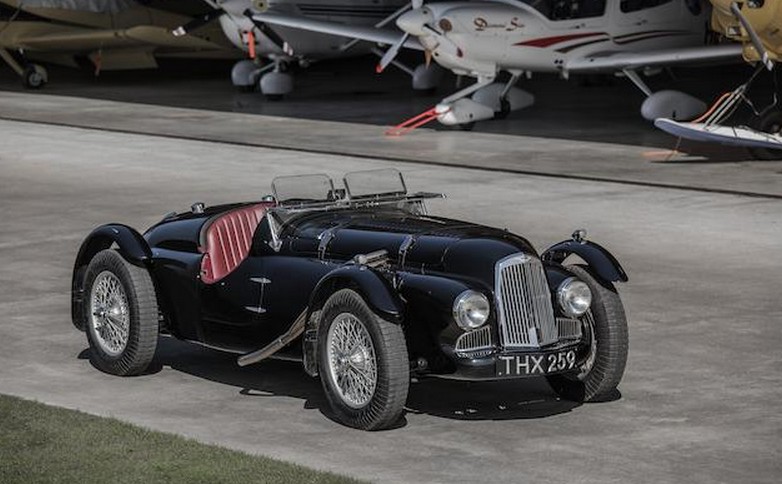
The First Post-War Aston Martin

1948 Aston Martin 2-Litre Sports

Offered by Bonhams | Carmel, California | August 14, 2015

Photo - Bonhams

Photo – Bonhams

A few weeks ago we featured the last Aston Martin sold prior to the outbreak of WWII. Well here is the bookend to that car: the first Aston Martin built after the war ended. It is the first car built in the David Brown era – and in fact, the 2-Litre Sports (as it was originally called) would become the DB1. Only 15 examples of the DB1 were built (the 2-Litre Sports included).

Designed by Claude Hill, the 2-Litre Sports features a – you guessed it – 2.0-liter straight-four engine making 90 horsepower. Because they wanted to race this car to get Aston’s name back on the minds of the motoring public, the body was a rush job. It is cycle-fendered while the successive DB1s were all fully-fendered roadsters.

That race they were in such a hurry to enter was the 1948 24 Hours of Spa. And they won it with drivers St. John “Jock” Horsfall and Leslie Johnson. Then David Brown wanted to show the car at the ’48 London Motor Show so they re-bodied it slightly (to what you see here). They didn’t sell it (so David Brown gave it to his son) but they ended up taking orders for more cars (the 14 DB1s). This car put Aston Martin on a path to success that is still going strong.

This car, one of one, is one of the most important Aston Martins in existence. It should sell for between $600,000-$900,000. Click here for more info and here for more from this sale.

Update: Sold $781,000.