Offered by Bonhams | Scottsdale, Arizona | January 16, 2020
Photo – Bonhams
Boyer was a French automobile manufacturer based near Paris, and their name is thought to first have appeared on a car in 1899. Sales to the general public were underway by 1901, with one- and two-cylinder cars available.
Boyer was related to Clement/Gladiator, as the head of the company was a director of one of their branches. The Boyer was also sold in the U.K. for a hot minute under the name York. The last Boyers were from 1906.
This car is powered by a 1.3-liter twin good for 10 horsepower. It’s been in the U.S. for many years, having been restored under current ownership. It’s also a multi-time participant in the London-to-Brighton run. It is said that this is the only remaining two-cylinder Boyer, and it should bring between $175,000-$250,000. Click here for more info and here for more from this sale.
1932 Hispano-Suiza J12 Dual Cowl Phaeton by Binder
Offered by Gooding & Company | Scottsdale, Arizona | January 18, 2020
Photo – Gooding & Company
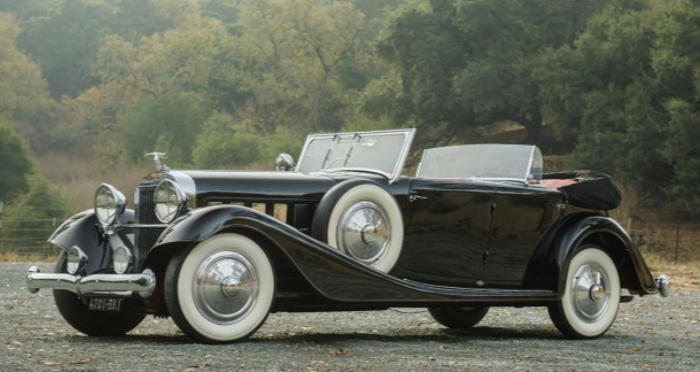
The J12 was the pinnacle of Hispano-Suiza motorcars. It was introduced in 1931 and replaced the H6 line of cars that dated back to 1919. The model was produced by the French arm of the company and lasted through the end of Hispano-Suiza production in 1938.
It’s powered by a 9.4-liter V12 equipped with two carburetors and good for 220 horsepower and 465 lb-ft of torque. It was no slouch in its day. This car carries beautiful dual cowl phaeton coachwork from Binder. Of the 114 examples of the J12 built, only 10 survivors are open cars.
Provenance is where this car really shines. It was purchased by Briggs Cunningham in 1954. It later made its way to the Collier Collection in Florida, where it remained until it went back to the West Coast in 1988, entering the Blackhawk Collection. That’s where the current owner bought it in the 1990s. That’s quite the lineage. The expected price tag is $1,500,000-$2,000,000. Click here for more info and here for more from this sale.
Offered by Mecum | Kissimmee, Florida | January 10, 2020
Photo – Mecum
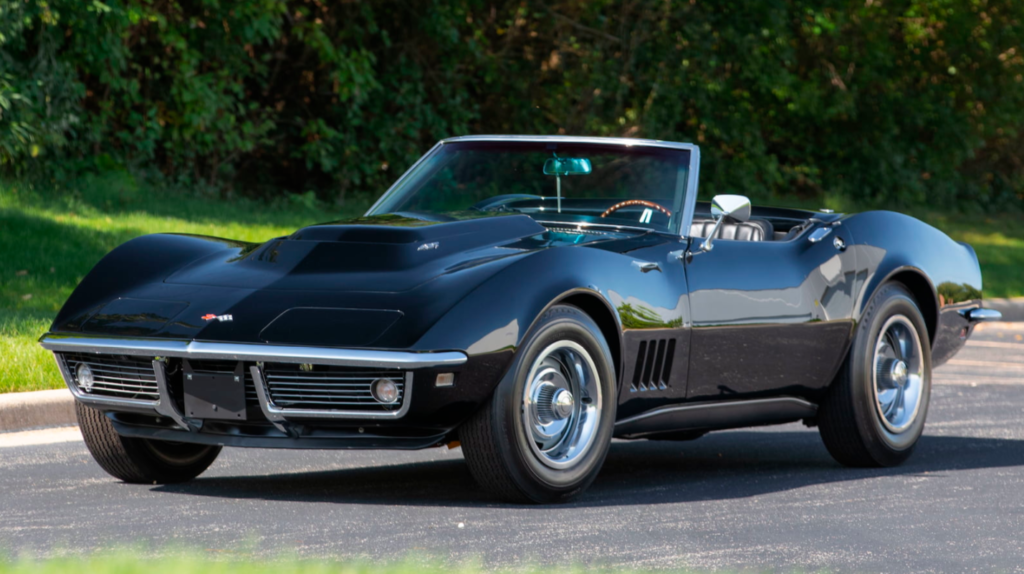
L88-powered third-generation Corvettes are among the most collectible of the era. The C3 Corvette was produced for an eternity: 1968 through 1982. But all of the good ones were in the first four or five years of production. The L88 engine was only available for three years: 1967 through 1969.
The 7.0-liter V8 was rated at 430 horsepower, though it is thought to have actually produced more than 550. It was based on Chevy’s NASCAR engine, and it was a hardcore beast. Only 80 cars were equipped with this engine in 1968, the first of two model years it could be had in a C3. This drop-top version should bring between $450,000-$550,000. Click here for more info and here for more from Mecum.
Update: Not sold, high bid of $350,000.
1969 Chevrolet Corvette L88 Coupe
Offered by Barrett-Jackson | Scottsdale, Arizona | January 11-19, 2020
Photo – Barrett-Jackson
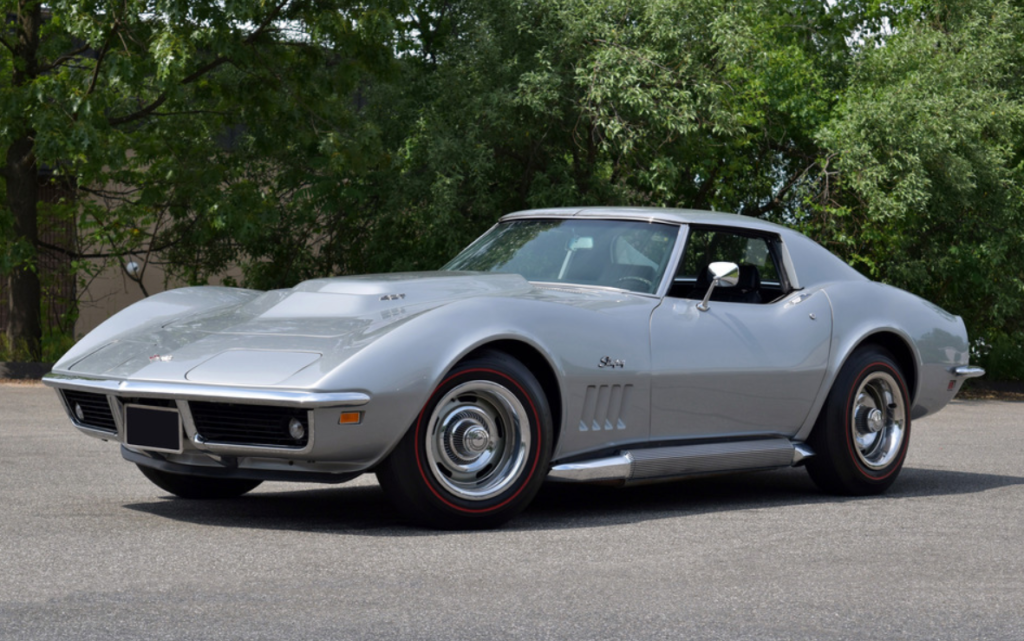
Here is the closed coupe version of Chevrolet’s monster 427 L88 Corvette. This example comes from the final year of L88 production, a year in which 116 examples were produced. Why so few? Well, part of the reason is that these engines have extremely high compression ratios that necessitate 103 octane fuel. Good luck finding that.
This wonderful 7.0-liter V8 also added as much as 35% to the purchase price of a new Corvette back in the day, which didn’t help. That’s a lot of money for a “430 horsepower” car. While the ’67s are the most expensive, the ’69s are still desirable. This will be another big-money car in Scottsdale. Click here for more info and here for more from this sale.
Offered by Mecum | Kissimmee, Florida | January 10, 2020
Photo – Mecum
L88-powered third-generation Corvettes are among the most collectible of the era. The C3 Corvette was produced for an eternity: 1968 through 1982. But all of the good ones were in the first four or five years of production. The L88 engine was only available for three years: 1967 through 1969.
The 7.0-liter V8 was rated at 430 horsepower, though it is thought to have actually produced more than 550. It was based on Chevy’s NASCAR engine, and it was a hardcore beast. Only 80 cars were equipped with this engine in 1968, the first of two model years it could be had in a C3. This drop-top version should bring between $450,000-$550,000. Click here for more info and here for more from Mecum.
Offered by Barrett-Jackson | Scottsdale, Arizona | January 11-19, 2020
Photo – Barrett-Jackson
Here is the closed coupe version of Chevrolet’s monster 427 L88 Corvette. This example comes from the final year of L88 production, a year in which 116 examples were produced. Why so few? Well, part of the reason is that these engines have extremely high compression ratios that necessitate 103 octane fuel. Good luck finding that.
This wonderful 7.0-liter V8 also added as much as 35% to the purchase price of a new Corvette back in the day, which didn’t help. That’s a lot of money for a “430 horsepower” car. While the ’67s are the most expensive, the ’69s are still desirable. This will be another big-money car in Scottsdale. Click here for more info and here for more from this sale.
Offered by RM Sotheby’s | Phoenix, Arizona | January 16-17, 2020
Photo Courtesy of RM Sotheby’s
I think Chalmers has one of the most interesting histories of any defunct auto manufacturer. Its roots trace back to the Buffalo Automobile Company, which became Thomas, then Thomas-Detroit, then Chalmers-Detroit, then Chalmers. Chalmers would later merge into Maxwell, which is now Chrysler. A more detailed history can be viewed here.
The 1914 Chalmers model line consisted of the Model 19 and Model 24. This is an example of the larger model, which is powered by a 60 horsepower inline-six. Six different bodies were offered on this chassis, which was produced as the Model 24 only in 1914. This tourer would’ve cost its first owner $2,175.
This example has been active on the historic circuit since the 1950s, which says a lot about its usability. It is being offered without reserve. Click here for more info and here for more from this sale.
Offered by BH Auction | Tokyo, Japan | January 12, 2020
Photo – BH Auction
Back when you were allowed to be innovative when designing racing cars, Formula One went through an era where ground effects were all the rage. It started in the late 1960s and peaked in the late 1970s and early 1980s. Things were getting pretty wild, and eventually, F1 cracked down, banning moveable aerodynamic devices.
Colin Chapman’s Lotus first started the wave, and they sort of ended it with this car, which was designed for the 1981 season. It features a twin-chassis layout that allows the standard chassis to hunker down at speed, while the second chassis works on mechanical grip. The other F1 teams were not amused and protested this car at every event. It practiced at the first two events, and later at the British Grand Prix (in 88B form), but it never raced.
Finished in John Player livery, the cars were used by drivers Nigel Mansell and Elio de Angelis in practice. Only two examples were built, and they’re powered by Ford-Cosworth 3.0-liter V8s. It is eligible for pretty much any historic F1 event and is being offered from a private Japanese collection. Click here for more info and here for more from this sale.
Offered by Barrett-Jackson | Scottsdale, Arizona | January 11-19, 2020
Photo – Barrett-Jackson
Lawil S.p.A. was founded by Henri Willame and Carlo Lavezzari in Pavia, Italy, in 1967. The company actually stuck around through 1988, building a range of microcars over the years. Their early cars were based on Lambrettas.
The S3, also known by its nickname Varzina, was introduced in 1968 and remained in production through 1980. It is powered by a 246cc twin from a Lambretta that makes 12 horsepower. Top speed was about 40 mph.
The S3 wasn’t very popular in Italy but sold okay in other markets (or okay enough to keep it around for a dozen years). They’re a rare sight today, and this one is selling at no reserve. Click here for more info and here for more from this sale.
We’re starting in November with Silverstone Auctions’ NEC Classic Show sale. This multi-day sale saw this 1965 Aston Martin DB5 bring the biggest bids. It sold for $799,889.
Photo – Silverstone Auctions
The Range Rover limo we featured sold for $42,903. Full results can be found here.
At Historics’ November sale, an AC Buckland we featured a few years back found a new home for $55,555. The overall top sale was $309,959 for this 1971 Mercedes-Benz 600 Pullman. More results are available here.
Photo – Historics at Brooklands
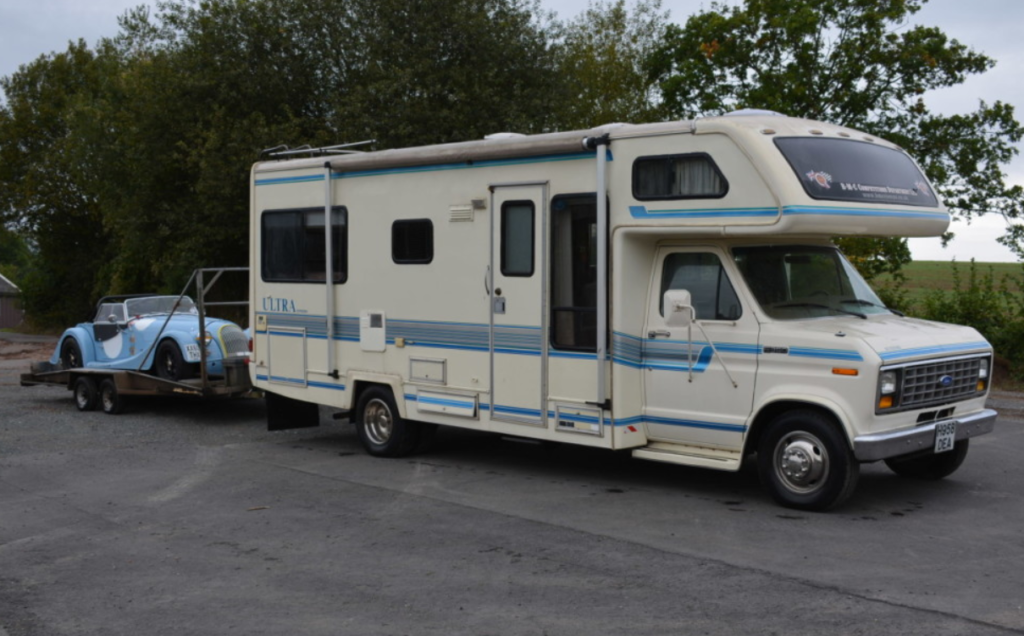
Next up is Brightwells’ Leominster Classic & Vintage sale. The top sale here was an interesting one. It’s a 2011 Morgan Plus Four SuperSports factory race car and the factory transporter, which is a late-80s/early-90s Ford-based RV. Oh, and the trailer. The whole package cost someone $69,861.
Finally, RM Sotheby’s held a sale in Abu Dhabi at the end of November. If you’re imagining a sale chock full of supercars, well, you’re right. In fact, the Pagani Zonda we featured ended up as the top sale at $6,812,500. Not far behind it was Michael Schumacher’s Ferrari F2002 at $6,643,750. The other feature cars that crossed the million-dollar mark were the Zagato Raptor at $1,086,250, the Koenigsegg Agera at $1,356,250, the Ferrari 126 C2 at $2,143,750, and the Ferrari FXX-K at $4,281,250.
Other Lambo highlights include the “brand new” Diablo VT 6.0 SE that went for $525,000, as well as the Concept S, which failed to sell. Click here for complete results.
Offered by Barrett-Jackson | Scottsdale, Arizona | January 11-19, 2020
Photo – Barrett-Jackson
Eddie Kuzma built Indy roadsters in the 1950s and early 1960s. Kuzma won the 500 in 1952 with driver Troy Ruttman, the youngest person to ever win the race. Ruttman actually ran this very car at Indy in 1963, where he finished 12th.
This is a “lay-down” Indy roadster, meaning the 4.2-liter Offenhauser engine is laid on its side, protruding from the bodywork. This both reduced drag and increased the left-side weight bias, making it faster around ovals. The car was not used in USAC after 1963 (the rear-engined cars had arrived). Instead, it went east, where it was used as a super modified.
Unfortunately, Ruttman’s son, Troy Jr., was killed driving this car in an accident at Pocono in 1969. The car was purchased by Bob McConnell in 1980 and was restored by a later owner in 2004. The catalog lists this as a 1963 but also states it was built in 1961. Not really sure which is correct. Anyway, it is selling at no reserve. Click here for more info and here for more from this sale.